Showing posts with label retention. Show all posts

Wednesday, September 24, 2025

National Guard Exceeds 2025 Recruiting Goals

Amid a historic surge in military recruiting, the National Guard exceeded its fiscal year 2025 goals, reflecting a broader trend of robust enlistment across the U.S. military. 
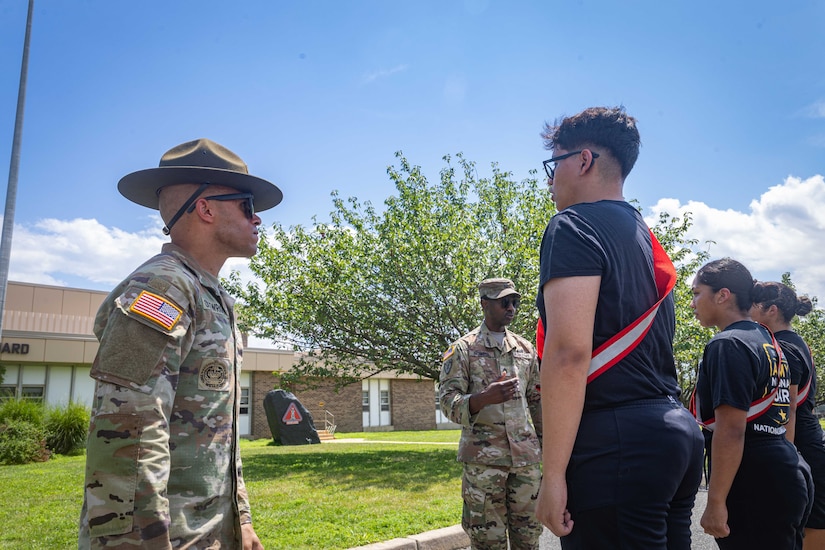
A man wearing a camouflage military uniform and sunglasses stares at a man dressed in civilian attire while standing in formation. In the background, another man, wearing a camouflage military uniform, gestures to two women in civilian attire who are also standing in formation.

Since November 2024, the War Department has achieved its strongest recruiting performance in 30 years, with fiscal year-to-date accessions as of the end of August reaching 106% of active-duty targets.  

The Army National Guard and the Air National Guard have combined to enlist almost 50,000 new members this fiscal year as of this month, bringing total National Guard end strength to over 433,000, surpassing each component's goals and marking one of the most successful recruiting years in over a decade. 

"Young Americans are eager to serve," said Air Force Gen. Steve Nordhaus, National Guard Bureau chief. "Today's recruits are seeking long-term value, and the National Guard delivers through career training and hands-on, practical experience in more than 200 career specialties. 
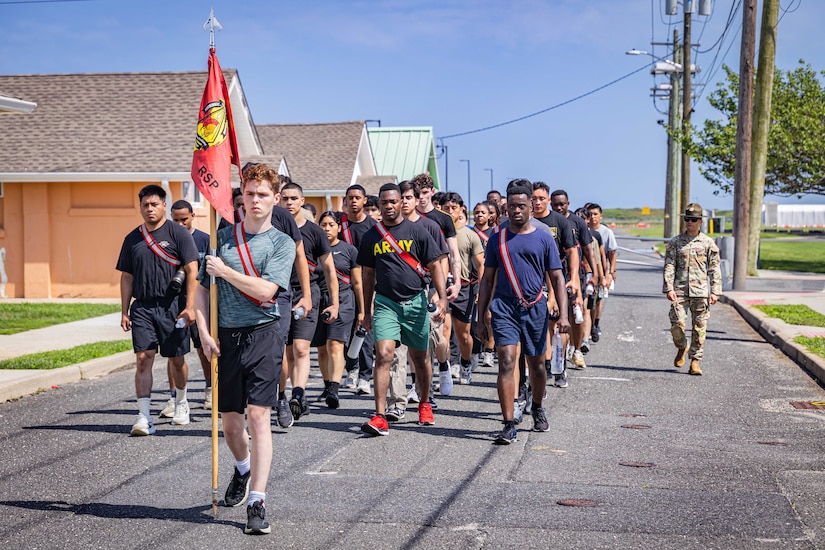
A group of men and women, all dressed in civilian attire, march in formation as a man in civilian attire leads the group, carrying a flag attached to a pole. A man wearing a camouflage military uniform marches to the right of the formation.

"The guard provides a path to service that offers balance with civilian careers and allows our soldiers and airmen to live locally and serve globally," he said. "We're not just preparing new recruits to serve; we're preparing them to lead and succeed." 

Nordhaus emphasized the guard's value, providing 20% of the joint force at 4% of the DOW budget, and its core missions — defending the homeland, supporting the fight, building partnerships and supporting warfighters and their families — which demand wide-ranging skill sets. He noted that the National Guard aligns with the Interim National Defense Strategy Guidance, which prioritizes homeland defense, deterrence in the Indo-Pacific region and burden sharing with allies and partners. 

"The guard is central to President [Donald J.] Trump's vision of peace through strength and Secretary [Pete] Hegseth's focus on restoring the warrior ethos, rebuilding the military and reestablishing deterrence," Nordhaus said. "Recruits are proving they're energized to contribute to that." 

In March, the Army National Guard launched a new marketing campaign to attract young people to part-time service. The campaign, "Uncommon is Calling," highlights the dual lives of guardsmen, who balance civilian careers with essential roles during emergencies and national crises. It emphasizes the unique opportunities for personal and professional growth available within the guard. 

Striking the civilian-military balance is exactly what attracted Army Spc. Bruno DaSilva, who is assigned to the 1060th Transportation Company of the Massachusetts National Guard. 

"Outside of the National Guard, I have my own company … I'm in the insurance business," DaSilva said. "In the National Guard, I can serve my country and run my business at the same time." 

The Army National Guard has focused most of these marketing ads online and on digital streaming services, with some spots airing on traditional television. 

Army Col. Timothy Smith, chief of the Army National Guard's Strength Maintenance Division, said the campaign has helped deliver new awareness of the opportunities of serving in the Army National Guard. 

"The branding refresh of 'Uncommon is Calling' brings a fresh perspective to the unique dual mission of the Army National Guard," he said. "The campaign highlights the most uncommon, exciting and meaningful part-time job out there: serving in the Army National Guard." 

Army Pvt. Ethan Walling enlisted in the Virginia National Guard this summer to serve as a motor transport operator. He said serving in the guard fulfills a lifelong dream. 

"It has always been my dream to be in the military," Walling said. "Since I was 7 years old, I would play with my miniature Army men, and I would always tell my mom that I was going to join one day. After talking with a National Guard recruiter and hearing that I could receive federal and state benefits, I knew that the guard was my calling." 

Walling said the guard has given him "purpose, pride and opportunity," and he is excited to see how the journey shapes his future. 
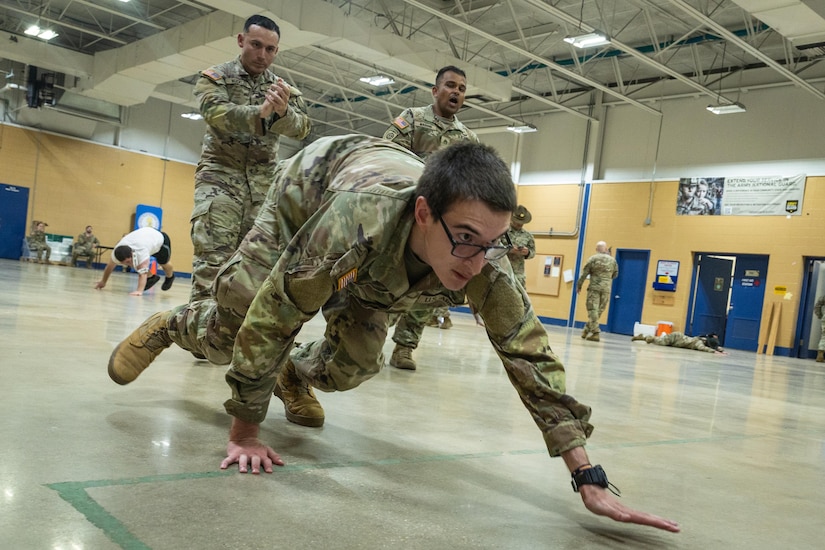
A man wearing glasses and a camouflage military uniform crawls across a gym floor as two other men, also dressed in camouflage military uniforms, yell at him.

"The National Guard has been nothing short of a family since the beginning, and I believe I have finally found the perfect balance between serving my country, supporting my community and pursuing my personal goals," he said. 

In addition to the marketing campaign, Smith also credits the recruiters in every state, three territories and Washington — collectively known as "the 54." 

"Our recruiters' dedication across the 54 drives this success," he said. "Their hard work is the bedrock of our readiness. The organization has made recruiting and end strength priorities because if you can't fill your end strength, you can't be ready; they're tied together. Our readiness starts with our recruiters." 

The Army National Guard has surpassed 328,000 soldiers in end strength — the total number of authorized service members needed to meet mission requirements. Smith highlighted the Army's Future Soldier Preparatory Course as another initiative that has also helped the Army National Guard attract potential soldiers. 

Through the course, the Army provides focused academic and fitness instruction for those who have the desire to work hard to achieve Army standards. The program is a bridge to basic training and, ultimately, assignment to a unit. To date, nearly 7,000 Army National Guard recruits have successfully entered basic training through the future soldier course. 

In March, Nordhaus and Senior Enlisted Advisor John Raines visited the future soldier course at Fort Jackson, South Carolina, to meet with National Guard cadres and trainees. 

"We're a team of teams," Raines told a group of trainees who had completed the program. "And we need every committed American who wants to serve, even if they aren't meeting the standards when they make that decision. This program helps them reach their potential and ensures we have high-quality soldiers in our formations, because the standards won't change." 

Raines also praised the Army National Guard's Recruit Sustainment Program, established in the mid-2000s to reduce attrition and prepare recruits for basic combat training and follow-on advanced individual training. Army National Guard recruiting and retention battalions operate sustainment program sites in every state, territory and Washington. 

"Everybody has a place in the National Guard," he said. "We will find you a place where you can serve your community, your state, your territory or district and our nation." 

The Air National Guard also beat its fiscal year recruiting goals and is on track to surpass 105,000 airmen by the end of the fiscal year. Air Force Col. Daniel Curtin, Air National Guard Recruiting and Retention director, said recent Air National Guard recruiting success is driven by numerous indicators. 

"It's a lot of things," Curtin said. "We've had 19 consecutive months of year-over-year increases in new accessions. The recruiting environment is strong … and we have worked diligently to establish a culture of excellence and opportunity that appeals to potential recruits. The results are evident." 
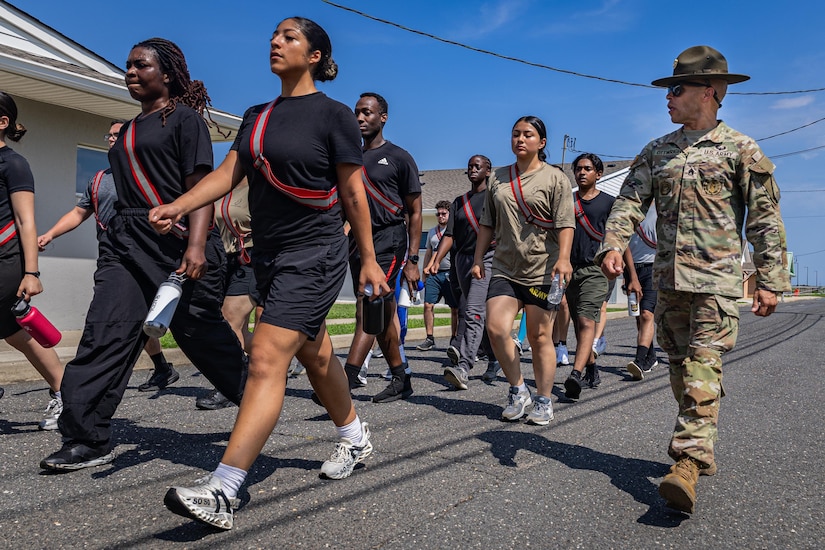
A group of men and women dressed in civilian attire marches in formation, with a man wearing a camouflage military uniform and sunglasses marching alongside the formation.

Curtin explained that the Air National Guard is working to centralize recruiting efforts within each state, territory and Washington. Previously, Air National Guard recruiting operational alignment varied. Some operated under a wing, or a force support squadron, while others worked under a state's joint forces headquarters. Now, Air National Guard recruiting headquarters will operate as separate flights or squadrons, dedicated solely to recruiting and retention. 

"The biggest thing we are trying to do is create a structure where you have a single officer that is responsible for the recruiting force in that state or territory," Curtin said. "It is a formally appointed commander responsible for recruiting. That's probably the most important thing that we're driving out of this, because that allows us to do a lot of other things." 

Curtin added that he believes that the most important initiative in FY25 was the strategic investment in personnel and infrastructure, specifically the funding of 150 temporary recruiting support positions and 210 temporary unit manning document positions.  

"These roles have been critical in enhancing recruiting operations, including production activities, marketing, medical support, training, and administrative efficiency. By bolstering the recruiting command structure and providing targeted resources, the [Air National Guard] has created a robust framework that directly supports its historic accession achievements." 

Nordhaus said he is excited about this year's recruiting numbers and emphasized that the National Guard needs to maintain this momentum. 

"The source of our strength is the fearsome deterrence of our warfighter talent — the men and women of the National Guard," he said. "While we exceeded our goals with historic levels of recruiting this year, we cannot take our foot off the accelerator. We must continue recruiting the next generation of elite warfighters while retaining our most skilled and talented soldiers and airmen." 

Monday, April 23, 2012

DOD Announces Recruiting and Retention Numbers for Fiscal 2012, Through March


The Department of Defense announced today recruiting and retention statistics for the active and reserve components for fiscal 2012, through March.

Active Component.

Recruiting.  All four active services met or exceeded their numerical accession goals for fiscal 2012, through March.

Army - 27,701 accessions, with a goal of 27,550; 101 percent
Navy - 15,151 accessions, with a goal of 15,151; 100 percent
Marine Corps - 10,625 accessions, with a goal of 10,591; 100 percent
Air Force - 14,353 accessions, with a goal of 14,353; 100 percent 

Retention.  The Army, Navy, Marine Corps, and Air Force all exhibited strong retention through the sixth month of fiscal 2012.

Reserve Component.

Recruiting.  Five of the six reserve components met or exceeded their numerical accession goals for fiscal 2012, through March.

Army National Guard - 24,706 accessions, with a goal of 25,991; 95 percent
Army Reserve - 14,095 accessions, with a goal of 12,852; 110 percent
Navy Reserve - 3,756 accessions, with a goal of 3,756; 100 percent
Marine Corps Reserve - 4,485 accessions, with a goal of 4,216; 106 percent
Air National Guard - 4206 accessions, with a goal of 4,192; 100 percent
Air Force Reserve - 4,255 accessions, with a goal of 4,255; 100 percent 

Attrition - All reserve components are on target to achieve their fiscal year attrition goals.

Detailed information on specific recruiting data can be obtained by contacting the individual military recruiting commands at 502-626-0164 for Army, 210-565-4678 for Air Force, 703-784-9454 for Marine Corps, and 901-874-9048 for Navy.  The reserve components can be reached at the following numbers:  National Guard Bureau 703-607-2586; Army Reserve 910-570-8330; Air Force Reserve 703-697-1761; Navy Reserve 757-322-5652; and Marine Corps Reserve 504-678-6535.

Monday, April 16, 2012

Rating Change May Strengthen Career


By Mass Communication Specialist 3rd Class Andrea Perez, Navy Personnel Command Public Affairs

MILLINGTON, Tenn. (NNS) -- Rating conversion allows career-minded Sailors in overmanned ratings to stay Navy and helps shape the force to meet future manning requirements, officials said, April 16.

"If a Sailor is in a rating where promotion is stifled at the present time, converting to a different rating can open up significant advancement opportunities," said Master Chief Navy Counselor David Duncan, enlisted community manager, Bureau of Naval Personnel and rating conversion veteran. Duncan first enlisted as a Radioman before converting to his current rate.

Today, Sailors can apply for rating conversion during their Perform to Serve (PTS) negotiation window. When Sailors with less than 14 years of service are within 12 months of their end of active obligated service (as extended) date, they must compete for a PTS quota to continue their career.

The Fleet Rating Identification Engine-PTS (FR-PTS) provides Sailors with billet availability information in their current rating and other ratings one might qualify for, based on their year group (YG) and Armed Services Vocational Aptitude Battery score.

According to Duncan, when an individual enters the Navy, they may not be assigned the rating they initially wanted and conversion gives them an opportunity to try something different. It also gives Sailors the chance to discover new skill sets and talents.

One Sailor shared his rating conversion experience.

"I put in a package to convert to Cryptologic Technician Technical (CTT), Cryptologic Technician Collection and Cryptologic Technician Networks, and I was accepted for CTT," said Aviation Support Equipment Technician (AS) 1st Class Odel Schroeder. "I think converting is going to benefit me because in the CT (Cryptologic Technician) rating I have a better chance of getting promoted and after the Navy I can get a higher paying job than if I get out as an AS."

To date, thousands of Sailors have converted to different ratings, allowing the Navy to keep Sailors who are committed to a career in the Navy.

"For the past few months, I've felt like I needed to do something different and I'm looking forward to learning my new rate," said Schroeder. "I don't know anything about it, so I'm trying to go TAD (temporary assigned duty), that way I'll have an idea of what to expect before I actually go to school."

Sailors considering conversion can ask their career counselor to review the YG manning for the rating which they would like to convert to.

"They have to do their homework. Understanding what your year group manning is in your current rating and knowing what the year group manning is for the rating that you're looking to convert into is a good start," said Duncan. "You really have to look and if there's something that leaves you scratching your head, talk with your career counselor."

Per MILPERSMAN 1440-010, requests for conversion to ratings that are properly manned, will only be considered on a case-by-case basis and requests for conversion to overmanned ratings will not be considered.

On PTS applications where "willing to convert" is selected, a member will be considered for in-rate reenlistment prior to being reviewed for conversion. On applications where "conversion only" is selected, the member will be reviewed only for conversion.

A Sailor's command career counselor can assist them in understanding the benefits of reviewing their YG information and provide Sailors with guidance throughout the FR-PTS process.

"Many years back, we didn't always see a conversion as a positive thing," said Duncan. "Now days we have got to look at conversion and know that it's the way things have to be for us to stay up to speed and keep the same good people in uniform."

Thursday, March 08, 2012

New Career Paths Open to Sailors Impacted by ERB


By Chief Mass Communication Specialist (SCW/SW) Terrina Weatherspoon, Office of the Master Chief Petty Officer of the Navy

WASHINGTON (NNS) -- An instructor at the U. S. Naval Academy, Annapolis, Md., is preparing himself for a successful transition to civilian life as one of the approximately 3,000 Sailors who have been affected by the Enlisted Retention Board (ERB) and will be separated from the Navy before the end of June.

Machinist's Mate 2nd Class Eric Sandlin was notified by his chain of command in October that he was not being retained.

"I was very angry with the Navy at first," said Sandlin. "I did not think the ERB would affect me. I had given my best to the Navy for eight years and I was a dual-warfare qualified Sailor. I thought only Sailors who were performing badly would be separated."

The ERB became necessary when unprecedented retention and low attrition rates across the Navy resulted in a requirement to rebalance the force. The purpose of the board was to reduce over-manning in ratings projected to be more than 103 percent manned in FY-12. In all, Sailors from 31 overmanned ratings were affected.

"Having to tell one of my best Sailors that he was not being retained was one of the hardest things I have ever done as a chief," said Chief Machinist's Mate Robert Inigo, the Engineering and Weapons Division leading chief petty officer for the Academy. "I felt powerless."

However, Inigo quickly realized that he wasn't powerless.

"The first thing we did was immediately set up a Career Development Board," said Inigo. "In this board, we sat down and discussed all of the resources available to Sandlin. A great tool on the Navy Personnel Command (NPC) website is the Navy Transition Assistance Handbook, which covers all of the benefits and employment opportunities, and has a great pre-separation checklist."

After the Career Development Board, Sandlin said he felt prepared and immediately signed up for the Transition Assistance Program (TAP), which he said is a must for anyone transitioning out.

"Military One Source was another great resource," said Sandlin. "There were also job fairs set up. I finally decided that [I would apply] with the Military Sealift Command (MSC) because of the information I obtained from an MSC representative at a Fleet and Family Support Center job seminar."

Sandlin also said he logged on to the website of Challenger, Gray and Christmas and was able to get extensive help with his resumé.

"Sandlin has built up several great resumes specifically prepared for different possible employers," said Inigo. "He has applied for several jobs and is waiting to hear back from these employers. Overall, career-wise, he has several options, and we will support and encourage him in whichever career he chooses."

"I feel like my chain-of-command has really helped me prepare for my separation by feeding me information on what to expect, providing many of the resources I've talked about, and allowing me the time to pursue my goals toward a career transition," said Sandlin. "I really couldn't have done it without the resources offered by the Navy, and a command willing to take the time to help me explore them."

Sandlin's advice to other Sailors that are facing separation is simple. He advises them to look at all the resources available. However, he knows this can be overwhelming on your own.

"The last thing anyone getting separated wants to hear is, 'the resources are there, and it is up to you to seek them out,'" said Sandlin. "What they really need is a person in their chain of command to spend some one-on-one time helping them through the process; someone to lift their spirits and help them through by providing support, not just a web address."

Sandlin said he believes that with the help of a good chain of command every transitioning Sailor can be successful.

"I am a good Sailor," said Sandlin. "That will never change. What has changed is my career path, and I can't wait to follow it."

Wednesday, February 15, 2012

NAVSUP GLS Supports Shipmates to Workmates Program

By Sam Samuelson, NAVSUP GLS Corporate Communications Director

SAN DIEGO (NNS) -- Naval Supply Systems Command (NAVSUP) Global Logistics Support (GLS) supported more than 300 Sailors exploring government employment during the "Shipmates to Workmates" job fair at Naval Base Coronado Feb. 9.

The job program links Sailors, most of whom are anticipating leaving the Navy due to Enlisted Retention Board (ERB) results, with Department of Navy (DON) agencies seeking the kinds of skills and experiences the Sailors represent.

Record-high retention and low attrition among active duty Sailors for 31 specific ratings, manned at more than 103 percent, prompted the creation of the ERB. The purpose of ERB is to balance the force in terms of seniority, experience and skills, and to improve overall advancement opportunity.

"Shipmates to Workmates" maximizes the skills Sailors have with opportunities and needs that exist throughout the DoN. It's one way the Navy is communicating to Sailors that, force balancing notwithstanding, their skills are still valuable and marketable, according to Joe Bernardo, director, NAVSUP GLS workforce management division.

"There is a lot of skill, talent and enthusiasm in these Sailors and we want them to know that we're interested in exploring a future with them, if we can," Bernardo said.

Sailors attracted by the NAVSUP GLS booth said they were eager to look into alternatives in employment that capitalized on the skills they learned and developed in the Navy.

"I'm just here to see what the Navy is offering in terms of future employment," said Aviation Warfare Systems Operator (Mechanical) 1st Class Josh Glennon. "No one likes to be told it's time to go home, but at least they're offering these opportunities. There has been a lot of assistance to ensure there is a safety net."

Lt. Jasmine Gough sought the NAVSUP GLS booth.

"I just love logistics," Gough said. "I don't know, I think I'm a geek for numbers, supply chain management."

The former supply corps school student said she has always gravitated toward logistics.

"If you know what you like, if you know your calling, then that's what you look for," Gough said.

That's the shared hope of coordinators of "Shipmates to Workmates" and the Sailors seeking employment opportunities.

"It's just another way of looking for opportunities no matter what happens in life," said Personnel Specialist 1st Class Manuel Delgado. "I received word from the ERB around Thanksgiving. About the same time, our extended family experienced a tragedy and that's when I told myself, 'I'm young, healthy and have healthy kids. I have a lot to be thankful for.' I already have a job opportunity, so this is great."

As of Jan. 10, 2012, 2,942 Sailors were in a "not selected for retention" status. These Sailors must separate from the Navy no later than Sept. 1, 2012 unless operational waiver approved for later separation date (up to 90 days later).

Representatives from NAVSUP Global Logistics Support included Joe Bernardo, Chachi Gorman and Anthony Goodwin. From NAVSUP FLC San Diego were Linda Willis, Jeffrey Allen and Margie Hontucan.

Comprised of more than 5,700 military and civilian logistics professionals, contractors and foreign nationals, NAVSUP GLS operates as a single cohesive team providing global logistics services from 110 locations worldwide.

A component of the Naval Supply Systems Command, headquartered in Mechanicsburg, Pa., NAVSUP GLS is part of a worldwide network of more than 22,500 military and civilian personnel providing combat capability through logistics.

For more information about transition benefits visit the Transition Assistance Web Page available under the Hot Links section of the Navy Personnel Command at www.npc.navy.mil or contact the NPC customer service center at CSCmailbox@navy.mil or 1-866-U-ASK-NPC.

Friday, January 06, 2012

NPC Leaders to Discuss Post-ERB, Transition Matters in Western Pacific

From Navy Personnel Command Public Affairs

MILLINGTON, Tenn. (NNS) -- Representatives from Navy Personnel Command's fleet engagement team will meet with Sailors, families and leadership in Japan and Hawaii this month to discuss personnel policies and force management measures impacting the fleet, officials said Jan. 6.

"We'll be discussing post-Enlisted Retention Board (ERB) matters, with an emphasis on transition benefits," said Capt. Steven Holmes, director, community management branch, Bureau of Naval Personnel. "These visits are also an excellent opportunity to get feedback directly from the fleet and share personnel policy information directly from the source."

Representatives from the enlisted distribution division, enlisted community managers and the Navy's ERB transition assistance coordinator will conduct all-hands briefs geared for transitioning Sailors, including specific information for Sailors not retained by the ERB, as well as guidance specific to Sailors transitioning from overseas.

ERB affected Sailors and their spouses are encouraged to attend the all-hands sessions.

The team will be in Japan at Yokosuka Naval Base Jan. 17, Naval Air Facility Atsugi Jan. 18, and in Hawaii Jan. 20 at Joint Base Pearl Harbor-Hickam and Marine Corps Air Station Kaneohe Bay.

The fleet engagement team will also conduct a leadership roundtable for commanding officers and their command teams at each site for commands that have ERB affected Sailors.

"It is imperative that every leader in the chain of command take an active role in the transition process to ensure each Sailor is optimally prepared whether they leave the Navy after four years of service or 30," said Holmes.

Sailors should contact their command career counselor for local briefing times and locations.

Navy will conduct additional fleet engagement visits to San Diego, Pacific Northwest, Norfolk, and Mayport/Jacksonville in the coming months. Dates will be released as they become available.

For more information about transition benefits visit Transition Assistance Web Page available under the Hot Links section of the Navy Personnel Command at www.npc.navy.mil.

For more information about ERB transition support, check out the NPC ERB transition support page at www.npc.navy.mil/boards/ERB/, contact the NPC customer service center at 1-866-U-ASK-NPC (1-866-827-5672), or email cscmailbox@navy.mil.