Showing posts with label military leadership. Show all posts

Friday, July 31, 2026

Hegseth: Department Success Buoyed by Courage, Spirit, Leadership

The War Department has had a lot of success in the past 19 months, said Secretary of War Pete Hegseth. And that's in no small part due to the dedication and training of the men and women in uniform who form the heart of the U.S. military.

But underwriting that success is presidential leadership from the very top, Hegseth told President Donald J. Trump today during a cabinet meeting at Camp David in Maryland.
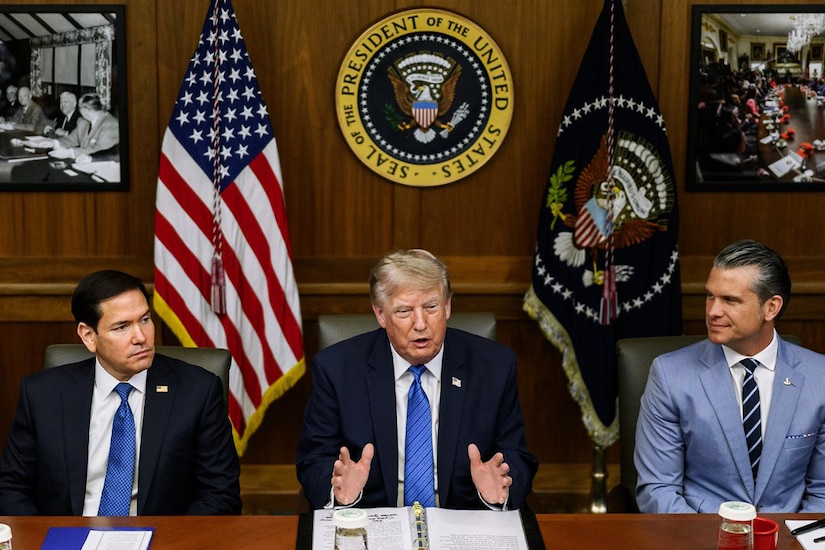
Three men in business attire sit next to each other at a table; behind them are an American flag and another flag.

"It's great Americans here and all around the country, and all around the world, who are the core of what keeps us safe," Hegseth said. "But in order to do that, you have to have a leader that's willing to put them in a position to do it."

The secretary listed three things Trump provides that make success possible for American warfighters: courage, a mandate to restore the warrior spirit and a generational investment in making the U.S. military the best it can be.

"I think people miss ... the courage it takes to seal the border, to say we're going to do it, and we're going to do it every single day, and we're going to do it on behalf of the American people," Hegseth said.
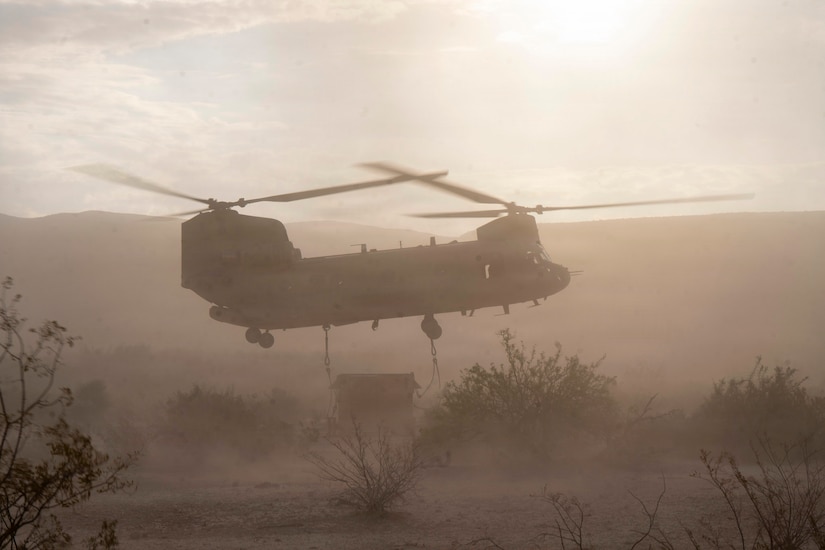
A large helicopter with a sling hanging from it hovers over a square piece of equipment in the dusty desert.

Since January 2025, American troops from all services, and with various skills, have been working first to gain and then maintain 100% operational control of America's southern border and to stop both drug traffickers and the flow of illegal immigration.

"[It takes] courage to bomb the Houthis and say we will maintain freedom of navigation," Hegseth said. "If you wonder why they're not involved in this conflict [in Iran], even though they're a proxy of Iran, it's because they've felt the weight of American power for 45 days, and you had the courage to do that."

In the Red Sea, Iran-backed Houthi forces had been attacking U.S. ships and those of other nations for years, disrupting legal commerce for all. In March 2025, the U.S. took steps to put an end to those attacks during Operation Rough Rider, when U.S. Central Command, at the direction of the president, began a series of attacks at key terrorist Houthi targets in Yemen. Two months later, the president announced that the Houthis agreed to a ceasefire.

Operation Midnight Hammer, the June 2025 mission to obliterate Iran's nuclear capability, also resulted in a ceasefire of the 12-day war, Hegseth noted, calling it a bold move no other president had dared to do.

"Other presidents had the option on their table to do [that], but they never pulled the trigger because of the complications, because of the challenges, because of the risk," he said. "Courage."

The secretary also cited presidential leadership and a willingness to take risks as key enablers for stopping the flow of illegal drugs in the Caribbean, the capture of Venezuelan leader Nicolás Maduro as part of Operation Absolute Resolve and the willingness to undertake the significant Operation Epic Fury, to ensure the Iranian regime will never have a nuclear weapon.

Embolden Spirit
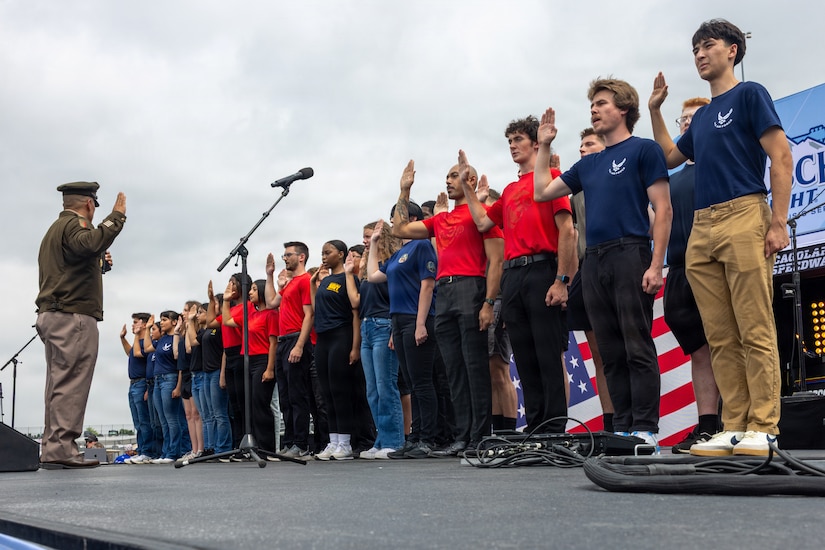
More than a dozen young people stand together on a stage and raise their right hands as a man in a formal military uniform stands in front of them with his own hand raised.

The secretary also credited the president with reinvigorating the spirit of the U.S. armed forces by providing a mandate to eliminate distractions in the force and refocus the warfighter on lethality, meritocracy, accountability, readiness and standards.

"You talk about spirit all the time, and you're right to do so," Hegseth told Trump. "When you rip out [diversity, equity and inclusion], when you rip out social engineering and social justice, and you put in merit; and then you untie the hands of commanders to be commanders, to enforce discipline and accountability, to get back to basics, then you get historic reenlistment inside our ranks."

The secretary said that reinvigorated spirit has caught on across the nation and ignited an interest in serving, adding that the U.S. military is reaping the benefits through increased enlistments and retention.

"Our best people ... are staying, because they want to be in that kind of department," he said. "And then [there is] the historic recruitment record amongst young Americans. Every month our department breaks records."

Investing in Now, Future
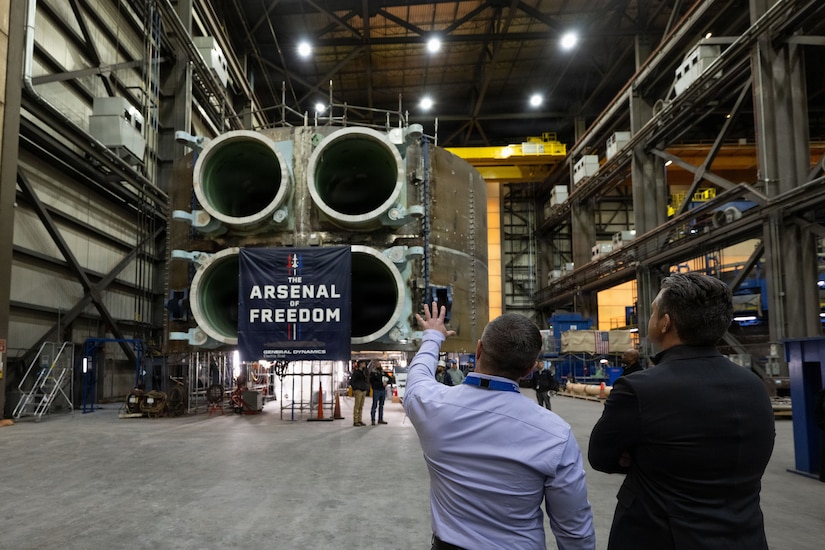
Two men stand near each other and look at a large piece of military hardware inside a large building. A sign hangs off the equipment that says, "The Arsenal of Freedom."

This year, the president has asked for $1.5 trillion to fund the U.S. military. However, Hegseth said it's not going to be business as usual for how that money will be spent, noting that Deputy Secretary of War Steve Feinberg will be responsible for ensuring the money is spent in a way that truly strengthens the department.

"This is a businessman in charge; this is the deputy secretary of our department, who's a turnaround guy, just like the president is — saying we will not fund ... the department the way we have in the past," Hegseth said.

In addition to funding, the secretary highlighted recent efforts to strengthen the defense industrial base, including being a better customer, which has resulted in America's industry partners reinvesting in themselves, ultimately driving down costs to the department.

"[There is] $75 billion in private investment from defense companies that are now investing in new plants, new equipment and new assembly lines, to build the munitions of the future faster than ever possible," the secretary told the president. "That's saving taxpayer dollars because the companies themselves are investing — the arsenal of freedom would never happen without you."

Wednesday, October 24, 2012

Panetta: U.S., South Korea Strengthen Alliance


By Cheryl Pellerin
American Forces Press Service

WASHINGTON, Oct. 24, 2012 – U.S. and South Korean militaries will continue their close cooperation against wide-ranging global security challenges and strengthen their cooperation in space and cyberspace, Defense Secretary Leon E. Panetta said today.


Click photo for screen-resolution image
U.S. Defense Secretary Leon E. Panetta, right, welcomes South Korean Defense Minister Kim Kwan-jin, left, to the Pentagon, Oct. 24, 2012. The two counterparts were to discuss defense-related topics. DOD photo by Erin A. Kirk-Cuomo
  

(Click photo for screen-resolution image);high-resolution image available.
In a joint news conference after the 44th U.S.-Republic of Korea Security Consultative meeting here, Panetta and South Korean National Defense Minister Kim Kwan-jin affirmed that the nearly 59-year-old alliance will remain a cornerstone of stability in Northeast Asia into the future.
 
At the meeting between the civilian and military leadership of the two defense establishments, the defense leaders led delegations that included senior defense and foreign affairs officials. This is the fourth time the two defense leaders have met, and the second time they’ve led the annual security meeting.

The United States and South Korea “will continue to enhance close alliance cooperation to address wide-ranging global security challenges, including through stabilization and reconstruction efforts, humanitarian assistance, disaster relief and counterproliferation,” Panetta told reporters.

“Minister Kim and I agreed on the need to strengthen cooperation with respect to protection of space and cyberspace domains,” he added. “We must ensure that this alliance stays ahead of the cyber threat.”
The secretary also announced the signing of terms of reference for bilateral military space cooperation. The document, he said, formally establishes a U.S.-South Korea defense working group that will address space policy, architecture, training and personnel exchange.

“The new defense strategy of the United States makes clear that, as the military emerges from a decade of war, we will rebalance towards the Asia-Pacific region,” Panetta said. “Because of its importance for global security [and] its importance to global prosperity in the 21st century, a stronger U.S.-Republic of Korea alliance is a critical part of this rebalancing effort.”

The secretary said he assured Kim that the United States stands fully committed to South Korea’s security.
“Make no mistake, we will provide the forces and the military capabilities needed to help maintain security on the Korean peninsula,” he said. “And we are committed to deepening and adapting our defense cooperation to meet evolving security challenges in the region.”

Discussions today focused on North Korea, he added.

“North Korea remains a serious threat to both of our nations and a serious threat to regional and global stability,” Panetta said. “Over the past year, North Korea has continued its pattern of defiance and provocative actions, including the unsuccessful test of a ballistic missile capability.”

“Minister Kim and I reaffirmed that North Korean aggression or military provocation will not be tolerated,” he continued, “and that we will continue working shoulder to shoulder to demonstrate our combined resolve.”

The United States and South Korea are committed to maintaining their close consultation, Panetta added, to develop comprehensive alliance capabilities to counter North Korean threats.

It has been nearly 60 years since the Korean War ended and the U.S.-South Korea alliance was born, the secretary said.

“For 60 years, our two countries have stood side by side and forged security and prosperity for our nations,” Panetta added. “We have been tested time and time again, and we have met every challenge.”

The reality, he said, “is that over the last 60 years, we have preserved peace in the peninsula and in that region, [and] as a result, today this alliance is stronger than ever.”

Monday, June 11, 2012

Dempsey Urges Alma Mater Grads to ‘Push the Envelope’


By Donna Miles
American Forces Press Service

WASHINGTON – Army Gen. Martin E. Dempsey, the chairman of the Joint Chiefs of Staff, returned to his high school alma mater today to encourage the John S. Burke Catholic High School graduating class to embrace new opportunities in a demanding, fast-changing world.

The chairman addressed the graduates of the school, based in Goshen, N.Y., in an auditorium at the U.S. Military Academy at West Point, N.Y., from which he graduated in 1974.

“Push yourself to explore space you haven’t considered before, to lead where leadership is required and to keep options open -- because life will deal you changes and challenges you’ll have to figure out,” Dempsey told the 2012 class.

“The future will find you,” he said. “Be ready.”

Dempsey and his wife Deanie both are Burke High graduates, and he was inducted into the school’s hall of fame in 2003. He told the new graduates today he’s never forgotten his roots, and how his own high school experiences prepared him for what was ahead.

Recognizing the many high achievers in this year’s class, the chairman cautioned them not to rest on past accomplishments. “No matter how successful you’ve been up to this point, you need to keep working to be better than you think you can be,” he said.

It’s a lesson he said he learned quickly after arriving at West Point with his solid Burke record. “I realized that I had to keep getting better,” he said. “I realized that never settling for mediocre is one of our enduring national traits. As a nation, we dare to be great.”

Dempsey urged the students to be willing to take the risks as they “push the envelope” and embrace new opportunities.

“Many of you will exceed your wildest imaginations,” he said. But in doing so, he encouraged them to stay true to their moral compasses and never lose sight of their values. “Prioritize what’s most important to you,” and keep those priorities in order, he said.

As they apply the lessons they’ve learned to overcome obstacles they confront, Dempsey urged the class to serve, whether in the military or other endeavors. He congratulated those headed to military academies or ROTC units, and said other graduates may find their calling to serve in other vocations.

Dempsey said he looks forward to seeing the new graduates make a difference and impact society as they help influence the future.

“Your life takes on meaning only as the causes to which you attach yourself have meaning,” the chairman said. “The greatest value of a life is to spend it for something that lives after it. “

“In the end, you become what you are through some cause you have made your own,” he concluded.

Monday, May 28, 2012

'Lead Your Country,' Biden Tells West Point Grads


By Jim Garamone
American Forces Press Service

WASHINGTON  – West Point is even more important to the country today than when Gen. George Washington called it “the key to the continent,” Vice President Joe Biden said during graduation exercises at the U.S. Military Academy today.

In 1777, West Point was a fortified area along the Hudson River that stopped the British from splitting the colonies. Today, the home of the military academy produces leaders who shape America and answer every call to duty the country makes, the vice president said.

Biden spoke to the 1,032 cadets who received their diplomas and were commissioned into service. He also spoke to their families and friends gathered under a hot sun at Michie Stadium.

The class represents the best of the 9/11 generation, the vice president said, adding that the cadets “are more than worthy of the proud legacy you inherit today.”

The cadets, like all men and women who joined the military after 9/11, knew they would be deployed to Iraq and Afghanistan, Biden said. “Hundreds of thousands of you have laced up those combat boots and walked across those barren deserts or snow-capped mountains, where 24 members of this graduating class have already served,” he said.

The graduates will be commissioned officers, but they will also be much more, the vice president said. They will learn the intricacies of tribal politics, they will learn how to run a school system, put in irrigation, train indigenous forces and much more.

These young officers must learn counterinsurgency doctrine and apply it, but they must be ready for changes in the world, too, Biden said. The United States is working to strengthen NATO so it can continue being the most successful alliance in history, he said. And as the war in Iraq has ended and the war in Afghanistan ends, the military can spend time on other priorities including the Asia-Pacific region.

“The United States has long been and will remain a Pacific power, and a critical provider of peace, prosperity and security in this vital region,” Biden told the cadets. “The most critical relationship to get right is that between the United States and China. Every day the affairs of our nations and the livelihoods of our citizens grow more connected. How we manage this relationship between the world’s two largest economies … will help shape the 21st century.”

The United States also is working with other emerging powers like India, Brazil, Turkey and South Africa. “All these efforts are helping advance America’s interests at home and around the world,” he said.

The new strategic defense strategy will affect these new officers. The strategy provides “a more agile, flexible force prepared for future challenges, better able to confront the aggressors and project power with strong partners to share the burden and smart investments in cutting edge capabilities,” he said.

America’s unique position in the world requires the finest fighting force, Biden said. “And that’s exactly what this strategy does,” he said.

The U.S. Military Academy has prepared the new officers to face new challenges and lead. They have “the minds to adapt to tomorrow’s horizons, from cyberspace to outer space,” he said.

“West Point is in the business of producing great leaders,” Biden said. “Class of 2012, this is your destiny – to lead your country.”

Sunday, May 13, 2012

Chairman Urges Norwich Grads to Live ‘Uncommon Lives’


By Jim Garamone
American Forces Press Service

WASHINGTON, May 13, 2012 – Army Gen. Martin E. Dempsey, the chairman of the Joint Chiefs of Staff, today urged Norwich University graduates to live “uncommon lives” of leadership based on time-honored virtues.

Norwich, located in the town of Northfield, Vt., is the oldest of six senior military colleges and is considered the birthplace of the Reserve Officers’ Training Corps.

“Norwich has started you on an uncommon road of selflessness and courage, to go out and contribute and serve our nation,” Dempsey said in prepared remarks. “Realize it or not, you have internalized the Norwich virtues of courage, honesty, temperance and wisdom -- guideposts that will serve you as you lead our nation’s future.”

Norwich is a private university whose student body features a Corps of Cadets as well as traditional civilian students. Some of this year’s graduates are joining the U.S. military as commissioned officers. Others will go on to eventually take leadership roles in business, industry, politics, government, and other fields of endeavor.

The experiences the university provides will serve all of the graduates in good stead, because leadership is important in all aspects of life, Dempsey said.

Norwich University dates from 1819 and it boasts a long list of famous leaders as graduates, from Admiral of the Navy George Dewey of Spanish-American War fame to retired Gen. Gordon R. Sullivan, who had served as the Army chief of staff in the early 1990s and now serves as president and chief operating officer of the Association of the United States Army headquartered in Arlington, Va.

Dempsey said the university “would be little more than a beautiful monument to the past glory of American leaders if not for you, its next generation of leaders.”

Now it is up to the graduates to make the most of their experiences at Norwich -- and the ones they will have in the future -- to make a difference and have an impact, he said.

Living an uncommon life means achieving “the outcome that is necessary in whatever particular line of work you choose.” Dempsey said.

Dempsey also spoke about trust. “It doesn’t get any more fundamental than trust,” he said. “It’s one of the pillars of the strength of our nation. At every level, trust wins, and it starts with trust in yourself.”

There’s also “a broader trust between the citizen and the nation, and nation-to-nation with our allies and partners, as well,” Dempsey said, noting that the pursuit of U.S. security interests today involves more than just military power.

“Our security commitments cut across the lines of diplomacy, intelligence, economics, and social progress,” he said. “It demands the support of an array of professions and skills as well as alliances, international systems and volunteer organizations. And it requires the best from each of us and all of us.”

In today’s changing world, the challenge for Americans involves “doing what’s right for ourselves, our family, our nation, and the global community,” Dempsey said.

“We can only make it work,” he added, “if we consistently and persistently leverage every opportunity to build confidence in each other, building trust.”

Monday, March 05, 2012

Military Must Examine Barriers to Service, Admiral Says

By Jim Garamone
American Forces Press Service

NATIONAL HARBOR, Md., March 5, 2012 – The military needs to examine the barriers that can prevent the best people from serving, the director of the Joint Staff said here today.

Navy Vice Adm. William E. Gortney spoke to 1,700 participants in the Joint Women’s Leadership Symposium here in place of Army Gen. Martin E. Dempsey, the chairman of the Joint Chiefs of Staff, who was scheduled to speak but was called to meetings at the Pentagon and White House.

The admiral, who is President Barack Obama’s nominee to be the next commander of U.S. Fleet Forces Command, said the military today is far better than when he joined.

“It is a direct result of the leadership and talent pool women bring,” he said. “I would never want to go back in time.”

Gortney noted that debates are going on in Congress and around the military about the correct percentage of women in the military. “My answer is as many we can get and retain, and it is a lot more than we have today,” he said.

But the real issue, he added, is more about leadership than it is about how many women serve.

“Our job in the military is to fight and win our nation’s wars,” he said. “It is the sole purpose of our existence. We also need to provide a credible deterrent so perhaps we won’t have to fight those wars.”

The military, Gortney told the audience, is an experience-based force, with career paths built to prepare service members to lead and succeed in combat. “Ill-prepared leaders not only put our successes in combat at risk. It gets soldiers, sailors, airmen, Marines and [Coast Guardsmen] killed and injured in both peacetime and combat,” he said.

The command structures in all military services are pyramids, the admiral explained. “In order to move up the pyramid, you must succeed in every one of your tours,” he said, “for our past tours prepare us for our future tours, and this increases in importance the higher you go up the pyramid.”

Accession and retention are keys to creating the force America needs for the future, Gortney said.

“We must recruit into the base of the pyramid larger numbers of the demographics we are seeking, and then we must retain the best qualified as they move up the pyramid in their career paths,” he said. “This is true no matter what your gender, race or religion happens to be.” Growing the force, he added, requires identifying and removing barriers to accession and retention.

And leaders must recognize this will take time, Gortney said. It takes 17 years to train an Army battalion commander or a Navy or Air Force squadron commander, he noted, 24 to 25 years to “build” a brigade or regimental commander or a ship or wing commander, and 27 to 28 years for a leader to be ready for the general and officer ranks.

“Every service and every tribe within a service has similar stages,” he said. “We must recognize this is generational and will take time to correct. Leadership and experience must be grown. There is no quick fix.”

But people can help, Gortney said. In the accessions field, the military needs to identify practices that prevent or discourage “the youth of our nation from wearing the cloth of our nation,” he told the audience.

In retention, he said, leaders need to mentor, teach and lead.

“I mentor officers in every stage,” Gortney said, “and here is what I tell them: It’s not about the flying or the sailing, it’s about the people with whom you serve and the sense of purpose and mission that you share.”

Navy Chaplain (Rear Adm.) Margaret Grun Kibben, chief of chaplains for the Marine Corps and the deputy chief of chaplains for the Navy, delivered the blessing for the awards luncheon. She spoke of the achievements being celebrated and the “underside” that women have had to overcome throughout their careers.

“We stand in the shadows of heroes who have served their country in spite of those who said they couldn’t, and who blazed the trail we so contentedly walk today,” she said. The admiral spoke of the problem of sexual assault and sexual harassment, and the way women still serve.

“Bless all those who serve at sea, in the air, with boots on ground or at home who consistently demonstrate the enduring strength, commitment and faithfulness to preserving our nation’s peace,” she said. “As we celebrate these women -- both named and unnamed -- grant that we who surround them are inspired to live our lives with the same perseverance and enthusiasm wherever you call us.”

Thursday, February 24, 2011

ONR Reflects on African-American Contributions

From Office of Naval Research Public Affairs

ARLINGTON, Va. (NNS) -- The Office of Naval Research celebrated African-American History Month with a speaking event at its Arlington, Va., headquarters, Feb. 22.

Rear Adm. Julius Caesar, Joint Concept Development and Experimentation vice director, U.S. Joint Forces Command, gave the keynote address, using the theme of "African-Americans and the Civil War" as the context for the lecture.

Caesar said that African-Americans are an influential American history and people as a whole have a pride for who they are, bringing them together as a group but also allowing them to be individuals.

"People have a natural sense of pride for where they come from," he said. "That sense of identity affirms the groups we are from and affirms you as an individual."

The audience learned the history of African-Americans' involvement in the Civil War, and how influential figures, such as Frederick Douglass, Civil War spy John Scobell and ship's pilot Robert Smalls, were important in defining American culture throughout history.

While stressing the inequalities that African-American troops encountered during the Civil War, Caesar also described how they played a decisive role in its outcome. More than 186,000 African-Americans served in 'negro' regiments and comprised nearly 10 percent of the Union Army. However, the casualty rate of the entire African-American troop contingent throughout the Civil War was more than 30 percent, which was 35 percent higher than their white counterparts.

"African-Americans were also paid 35 percent less than the white troops," he added. "And there were only 16 blacks who received the Medal of Honor during the Civil War."

This reality was portrayed in "The Negro's Civil War: How American Blacks Felt and Acted During the War for the Union," a book Caesar cited during his speech, drawing anecdotal examples of both the oppression of African-American troops and their loyalty to the country.

"What it comes down to is that people want their freedom. African-Americans helped fight for, and build, this country. With that said, their contributions should never be overlooked," he said.

Caesar followed his discussion with a question and answer session where he addressed diversity in the Navy as well as his own personal motivations for pursuing a naval career.

There are currently more than 89,000 African-Americans serving in the Navy, comprising 18 percent of Navy enlisted personnel and 8 percent of naval officers. African-American History Month was founded by the writer, editor and historian Carter G. Woodson in 1926, to address and memorialize the significant achievements of African-Americans throughout history.

The Department of the Navy's Office of Naval Research (ONR) provides the science and technology necessary to maintain the Navy and Marine Corps' technological advantage. Through its affiliates, ONR is a leader in science and technology with engagement in 50 states, 70 countries, 1,035 institutions of higher learning and 914 industry partners. ONR employs approximately 1,400 people, comprising uniformed, civilian and contract personnel, with additional employees at the Naval Research Lab in Washington, D.C.

For more news from Office of Naval Research, visit www.navy.mil/local/onr/.

This article was sponsored by Military Leadership.