Showing posts with label mentorship. Show all posts

Friday, December 05, 2025

Air Force Celebrates 75 Years of Honor Guard Drill Team Excellence

For 75 years, the U.S. Air Force Honor Guard Drill Team has represented the discipline, precision and professionalism of the service to audiences around the world. 
 
Founded in 1950 to perform ceremonial honors in the National Capital Region, today the drill team operates from Joint Base Anacostia-Bolling, Washington, and performs more than 100 exhibitions each year across the globe. 
 
The team's legacy of precision has been built by seven and a half decades of airmen who refined every crisp movement to reflect the Air Force's commitment to excellence.
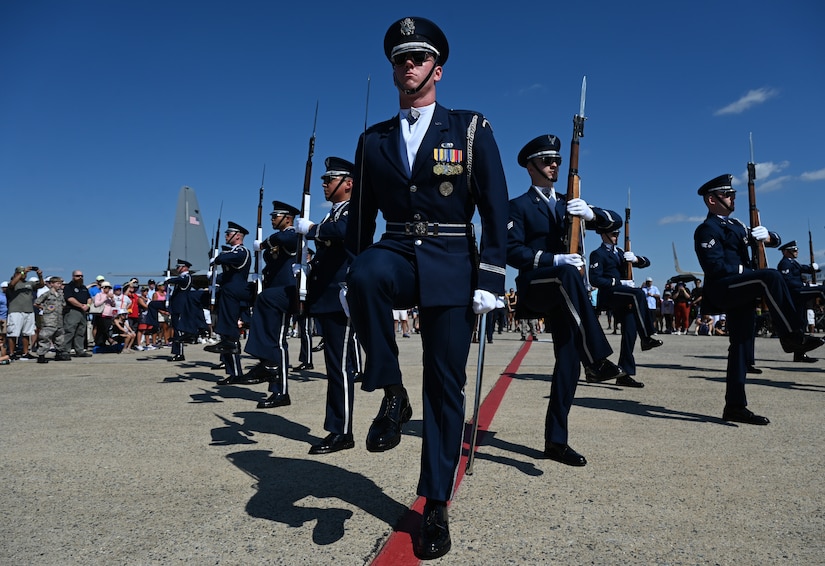
Airmen dressed in honor guard uniforms perform in a letter V formation. Several of the service members are holding rifles. There are people in casual attire observing in the background.

 
"We have been the living embodiment of that commitment," said Air Force Capt. Andrew Paquin, honor guard flight commander of ceremonial operations. "The core theme has been the same since the beginning. It's the relentless pursuit of perfection." 
 
Each member trains full time to master the team's seven-minute routine. Behind every public performance are thousands of hours of repetition and technical correction. 
 
"We break down every movement into its smallest components until the sequence becomes muscle memory," Paquin said. 
 
That dedication to excellence was evident during the 2025 Royal Edinburgh Military Tattoo in Scotland, where the team performed alongside international partners during driving rain and heavy winds. 
 
"Seeing the team perform in those conditions was a reminder of their resilience and ability to adapt and push through discomfort," Paquin said. "Being there on the ground with them created a bond built on mutual trust." 
 
That standard of excellence extends to mentorship and development within the team.  
 
"The main mission [of the honor guard] is to honor the individuals being buried at Arlington [National Cemetery]," said Air Force Senior Airman Richard Miles, honor guard drill team trainer. "Drill is the traveling component of that mission, the part that connects the public to who we are and what we represent." 
 
Miles wanted to join the unit after seeing a drill team performance during his time in Air Force technical training. After he was accepted, he spent more than a year working to become a trainer. 
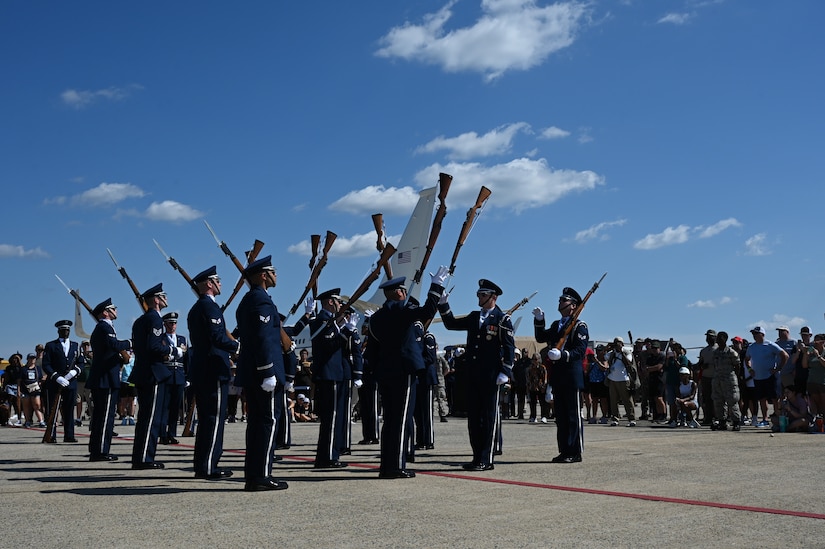
Airmen dressed in honor guard uniforms pass their rifles to each other during a performance on a tarmac. There are people in casual attire observing in the background.

 
"I failed my first evaluation," he said. "I passed my second and from then on spent a lot of extra hours practicing by myself after group training ended." 
 
The extra hours he spent training paid off when he earned the position of drill team trainer and that perseverance now guides how he trains others. 
 
"We have a big-brother, big-sister program, where experienced drillers mentor new members," Miles said. "As a trainer, the best part is seeing people accomplish what they once thought they couldn't. It's about being a hands-on leader who sets the tone for excellence." 
 
The perfection that audiences see during drill team performances directly reflects the accountability and trust built in training. 
 
"We train to perform under fatigue, stress and pressure, because that's where excellence becomes habit," Paquin said. 
 
That high standard is recognized by symbols on each member's white ascot; the most advanced level of competency is represented by two stars. 
 
"The stars represent the best of the best," Miles said. "You can't earn them through just drills. You have to be the airman that leadership knows they can rely on, no matter what." 
 
While the uniforms, movements and routines have undergone changes during the 75-year history, the mission to represent the Air Force with honor remains steadfast. 
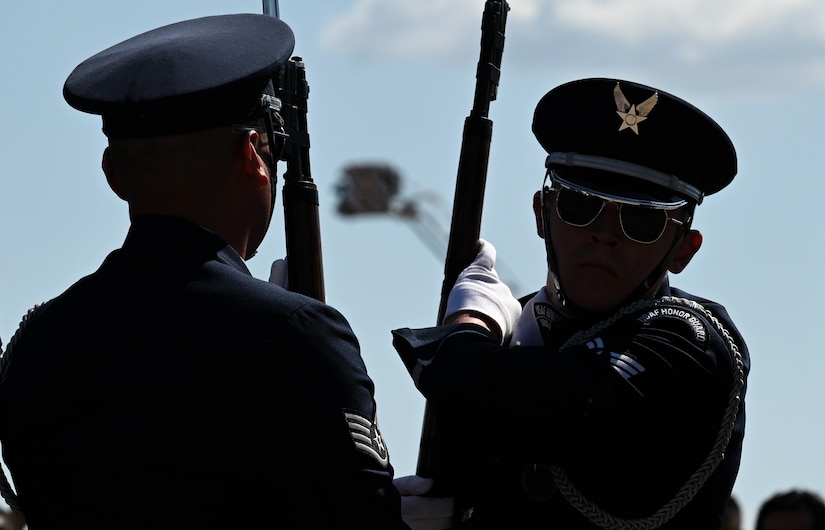
Two Airmen dressed in honor guard uniforms hold rifles while performing.

 
"When the team arrives at a performance, they're impressive, but the real magic happens afterward with the crowd interaction," Paquin said. "People see that the airmen behind the uniforms are young men and women from towns just like theirs. That's what builds trust with the American public." 
 
In an age of rapidly evolving technology, the human element is what continues to keep the drill team relevant. As the team looks ahead to its next major milestone, a centennial in 2050, Paquin said the focus will stay the same. 
 
"The Air Force Honor Guard Drill Team is needed now more than ever," he said. "It humanizes the Air Force mission, builds trust with the American public, and inspires future generations." 

Thursday, October 01, 2015

Strengthening Our Path: A Call to the Future

by 2nd Lt Veronica Perez
90th Missile Wing Public Affairs


9/29/2015 - F.E. WARREN AIR FORCE BASE, Wyo. -- Sitting in a room filled with over 70 female Airmen is invigorating, inspiring and empowering. The inaugural 20th Air Force Women's Leadership Symposium wrapped up Wednesday, Sept. 16, 2015, at F.E. Warren Air Force Base, Wyoming. The symposium brought female Airmen (ranks E4 through E5 and O1through O3) within 20th Air Force together for professional development through networking and mentorship.

I was surrounded by single mothers who work 12-hour shifts and wives married to military members stationed across the country. I exchanged conversations with daughters of adoption, divorcees, cancer survivors, life-long civil servants, world-record breakers and entrepreneurs. I listened to a doctor's life of service, a pilot's view on leadership and an author dedicated to telling the story of heroes unheard. I learned of their passion to lead, their motivation to help others and their unwavering will to serve in spite of struggle.

During her opening remarks Tuesday, Sept. 15, 2015, the Director of Washington Headquarters Services, Patricia Young, challenged us to spread the ideas discussed here among our peers, our leadership and our Air Force.

"Coming back to the field and meeting truly the future leaders of the Air Force, is incredibly insightful and invigorating. There is so much energy here, and it's exciting for me," Young said. "For this event to be successful, participants have to take what they've learned and share it with others. I really want the participants to challenge themselves and I'm excited for them to have this opportunity."

Throughout the day, speakers discussed their experiences, painting pictures of success, failure and personal growth while we listened in awe of their transparency and genuine honesty.

"I think this event is very enlightening because I learned a lot of perspectives I never really considered," said 2nd Lt. Eunice Park, 90th Missile Wing intelligence officer. "There are people in the Air Force who really care and are really considerate of what we're doing, and I just never realized how we have so many role models, especially for women."

Almost all of the Airmen I spoke with mentioned similar leadership themes discussed by the speakers, such as seizing opportunities, being authentic, gaining trust and continuously trying to be better in everything we do.

"We got to hear a lot of different leadership perspectives, enlisted and officer, so we got to see what they have done in their careers and then take what works for us and build from that," said Staff Sgt. Amanda Buck 341st MW command post team member.

Some topics included balancing family and career, female standards and policies, commander and chief perspectives, the power of vulnerability and the desire to serve.

Chief Master Sgt. Felica Noil, 91st MW command chief master sergeant, entertained us as she shared her journey as a security forces Airmen and the lessons she learned during her 29 and a half years of service.

"Hopefully, at the very end of this journey, I will have helped someone not have to endure what I went through, to help them get through it, and to encourage them to stand up for the right to be an advocate, to be a voice and to make a difference," Noil said. "What I want to challenge you all to know is that everything you endure is not just for you."

There was an undeniable feeling of excitement in the room as we interacted with each other and the seeds of mentorship grew roots.

"It's good having a bunch of different women from different backgrounds coming and sharing their perspective on leadership and women in the Air Force," said Capt Melissa Crenshaw, 341st MW code controller. "It's been good for me having mentors, most are all male, but now that I have other female mentors [and] I'm hoping to share [what I've learned] here."

Col. Kristin Goodwin, 2nd Bomb Wing commander, Barksdale Air Force Base, Louisiana, spoke about leading with a purpose and expressed how we can create change in the future.

"We are Airmen," she said. "And we need to go out there and lead with courage, we need to inspire, we need to set the standard and we need to be proud of our units and our Air Force. This symposium is not just about women, it's about men and women, Airmen being better as a force and collectively moving forward and rising to a higher standard of excellence in everything we do."

Throughout the three days we were encouraged, motivated and challenged to create our own path as leaders in the United States Air Force in order to spread diversity of thought and character.

Major General Jack Weinstein, 20th Air Force and Task Force 214 commander, and Chief Master Sgt. Matthew Wells, 20th Air Force and Task Force 214 command chief master sergeant, addressed these ideas head on.

"What we're hoping for this leadership symposium is that you all remember why you came in, maybe find some other reasons for staying in, grow, broaden, learn and take that back to your units because we need people like you, and we need people who aren't like you to be leaders in our Air Force," said Wells.

Weinstein added, "At any level in the United States Air Force, you can be a leader. Leadership is not dictated by the amount of stripes you have on your sleeve or the metal on your shoulders.. Who you are and what you do for your Airmen is leadership."

Monday, September 21, 2015

General Reflects on Hispanic Heritage, Credits Mentors with Success


By Shannon Collins DoD News Features, Defense Media Activity

WASHINGTON, September 21, 2015 — Education and mentorship helped a young Hispanic girl who dreamed of going to the U.S. Air Force Academy not only achieve her dreams, but earn the rank of major general and the position of deputy A2, Intelligence, Surveillance and Reconnaissance for Air Force Headquarters at the Pentagon.

In honor of National Hispanic Heritage Month, which runs from Sept. 15 to Oct. 15, Air Force Maj. Gen. Linda Urrutia-Varhall shares her lessons learned at the U.S. Air Force Academy, at luncheons and at other events, hoping to pay it forward to junior enlisted and officers, especially those in the Hispanic community.

Role Models

Growing up in Pueblo, Colorado, Urrutia-Varhall said her biggest role models were her parents.

“My mom was a stay-at-home mom, and my father worked at the Pepsi Cola plant,” she said. “My dad, I’m proud to say, came in as a janitor and by the time he retired in 39 years, he was running the plant in Pueblo.”

She said she got her work ethic from her hard-working parents, adding that her mother is the smartest person she knows. Her relatives didn’t really leave Pueblo but she wanted more. When she was 13 in 1974, she and her uncle went to visit the academy.

“I told my uncle, even though there were no women there, I would graduate from there,” she said. “He said, ‘Oh hija [little one], I know you say that, but they don’t let women in here.’ Little did I know I would graduate from there in 1984.”

She said her parents told her she could be anything she wanted to be. Her other role model was Lt. Gen. Norma Brown, the first woman to command an Air Force wing in 1974.

Culture and Education

Urrutia-Varhall said her ancestors came up from Mexico after arriving from the Basque region of Spain, settling in Colorado for a generation as pickers at a farm and then working long hours at the steel mill in Pueblo. She said the Air Force was an easy transition for her because the Spanish culture is all about family, and she gets that feeling with the military. The biggest challenge in the military is obtaining the balance of family and career, she said.

“I’ve been blessed to have met a great man who said he would follow me wherever I went and support me and my career,” Urrutia-Varhall said.

The general encourages all Hispanics, as well as all children of all ethnicities, to stay in school and get their education.

“You’ve got to stay in school to at least have a chance at becoming an enlisted or an officer in the military and doing great things,” she said. “Get your secondary education. Some way, you’ll make it. Whether you work a job, your mom and dad work, whether you get scholarships or grants, somehow, if you want to go to school bad enough, you can get there, and then all you need is somebody to open the door just once. And for each of us that is in some way successful or helpful, help that one person, just get one person’s foot in the door and pay it forward.”

Advice, Mentorship

The general said she wouldn’t be in the position she’s in today if it hadn’t been for mentors such as her parents, third grade teacher, air officer commander or husband.

To junior service members and civilians working their way toward leadership positions, she offered this advice: “You never know who you’ll meet, where you’ll get to go or what you’ll get to do or see,” Urrutia-Varhall said. “It really helped expand my horizons. Also, if you’re an officer or senior enlisted, always look people in the eye and ask them how they’re doing. Have empathy and don’t become a non-person.”

Finally, she said, “You belong in every room; learn to be comfortable in any room you walk in. You belong because of your hard work and everything you do. You belong there just as much as anybody else. And you can be whatever you want to be. The only one holding you back is you.”