July 30, 2026 |
At the White House today, President Donald J. Trump announced the kickoff of the Freedom Haulers campaign, a new effort to help military veterans find good-paying jobs as commercial drivers following their military service by establishing a military-to-commercial driver's license pipeline.
"Under our brand-new ... Freedom Haulers initiative, any American who has driven a heavy truck for our military will automatically be eligible for a commercial driver's license — and it's good-paying jobs too," Trump said. "Any veteran with heavy vehicle experience from the military will now be eligible to skip redundant road tests to obtain a commercial driver's license."
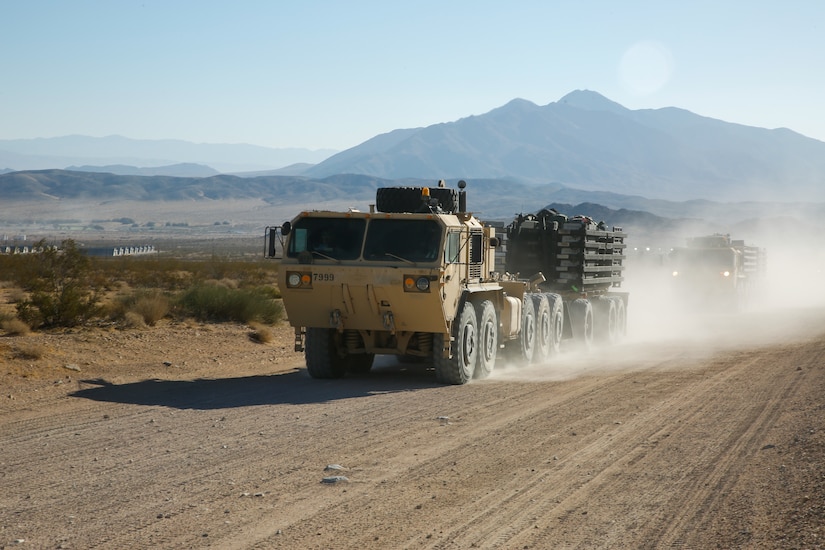
The president said the initiative also helps military personnel with no truck driving experience get trained and licensed to drive commercial vehicles.
One element of Freedom Haulers is that drivers with two years of experience safely operating heavy military vehicles can obtain a commercial driver's license without taking the driving test. Previously, that option was available for only 12 months after leaving a qualifying military job. But now the window to take advantage of the waiver has been extended to 24 months. All states participate in this program, and more than 40,000 veterans have used this waiver.
Also, part of the Freedom Haulers campaign is the "Even Exchange" program, which exempts qualified military drivers from the knowledge test required to obtain a commercial driver's license. This program applies to Army motor transport operators, fuelers and Patriot launching station operators; Marine Corps motor vehicle operators; Navy equipment operators; and Air Force vehicle operators, fuelers, and pavement and construction equipment operators. Right now, 34 states participate in the initiative, but Trump said he thinks more states will soon follow.
"This is a big deal; we believe that all 50 states and Washington, D.C., should join us in supporting these great veterans. ... I think they're all going to be signing up," Trump said.
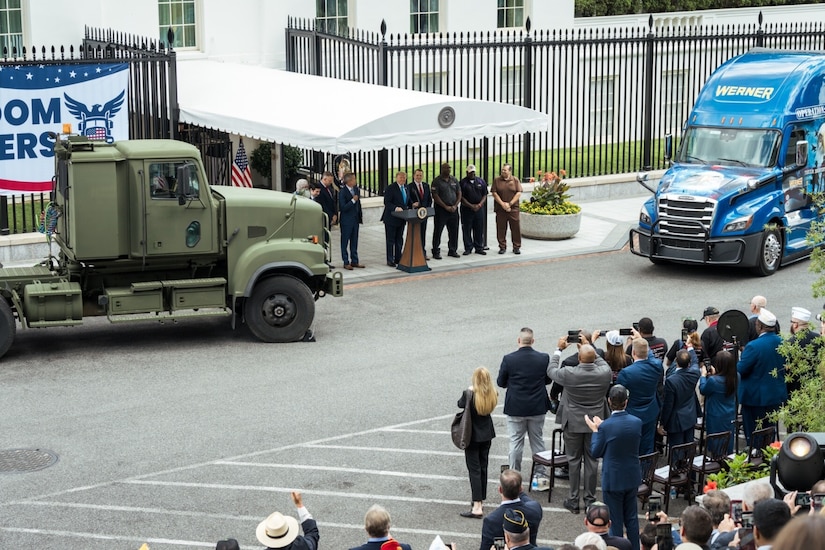
The White House, along with the departments of War, Labor, Transportation and Veterans Affairs, are involved in the effort.
Transportation Secretary Sean Duffy explained how, under Freedom Haulers, military veterans will be exposed to great opportunities to find good-paying jobs following their military service.
"These are great-paying jobs; they're anywhere from $80 to $100,000-plus a year," Duffy said.
Without a program like Freedom Haulers, Duffy said, military veterans with the skills to do the work would have to retrain for a job they already performed for years in service to the nation.
"If Secretary [of War] Pete Hegseth thinks that you can drive a vehicle like this," Duffy said, pointing to a military combat vehicle on display at the White House, "[President] Donald Trump and Sean Duffy think that you can drive a vehicle like that," he said, pointing at a commercial big rig.
The aim of Freedom Haulers is to get veterans into good jobs and increase the number of veteran commercial drivers, Veterans Affairs Secretary Doug Collins said.
"I can't think of anything else that says freedom more in our country than an open road truck and a veteran," Collins said. "Veterans [have] said one thing: when they raised their right hand, they pledged what others would not do. They said, 'I will go and do what others will not do.'"
Now, Collins said, the VA is putting veterans first by helping them get into the driver's seat with great after-service jobs.
"Let's put veterans in the seats, making jobs safer and better for all Americans as we go along," he said. "Veterans ... you proved once you can do it. I know for a fact you can do it every single day."
Collins said the GI Bill will cover up to 100% of commercial driver's license tuition at state- and agency-approved schools. And for veterans with service-connected disabilities, the Veterans Readiness and Employment program also fully funds training and assists with job placement.
"One in 10 of our truck drivers across the country are veterans already — one in 10," Collins said. "Why don't we make it two in 10? Why don't we get three in 10?"


 Posts
Posts

