Showing posts with label combat medic. Show all posts

Monday, March 16, 2026

Medal of Honor Monday: Navy Petty Officer 1st Class Francis Pierce

As the chaos of World War II's Battle of Iwo Jima unfolded, Navy Petty Officer 1st Class Francis Junior Pierce refused to leave any wounded men behind. The hospital corpsman showed fearlessness throughout the turmoil. That valor led him to receive the Medal of Honor. 
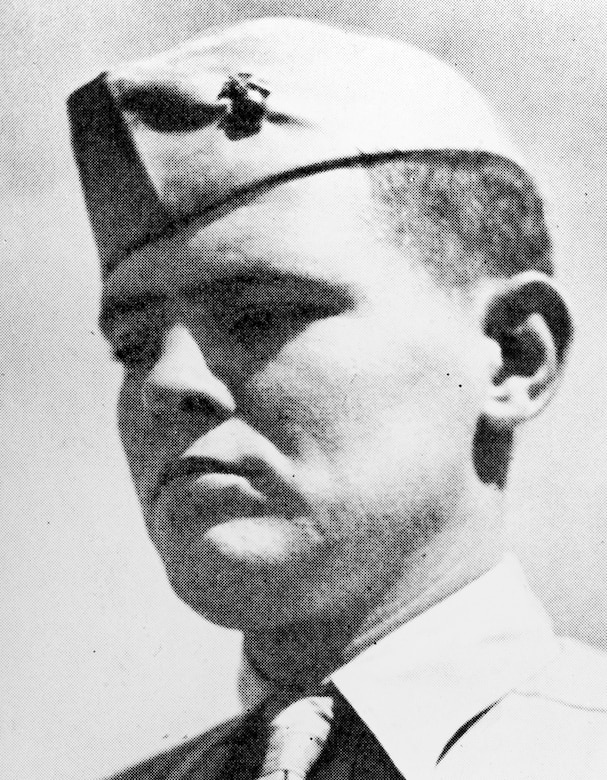
A man in a military cap looks stoic while looking toward the ground.

Pierce was born Dec. 7, 1924, in Earlville, Iowa, to Frank and Rose Pierce. He grew up on a farm and had a younger brother named Donald.

Pierce turned 17 the day Pearl Harbor was attacked by Japan, which thrust the U.S. into World War II. Shortly thereafter, he enlisted in the Navy to do his part for the war effort.

After completing training to be a hospital corpsman, Pierce served the early part of the war at various duty stations in the Carolinas. He rose to the rank of pharmacist's mate before being transferred in January 1944 to the newly activated 4th Marine Division in Camp Pendleton, California. Soon after, the unit was deployed to the Pacific.

Pierce's first time in combat was in February 1944 during the Marshall Islands campaign, when the division landed on Roi-Namur, a small island in the Kwajalein Atoll. During that battle, Pierce saw fighting that made him reject the corpsman's code to remain unarmed. Going forward, he was never without a submachine gun. According to naval historians, he "used it so effectively that the Marines nicknamed him 'the Angel with a Tommy Gun.'"
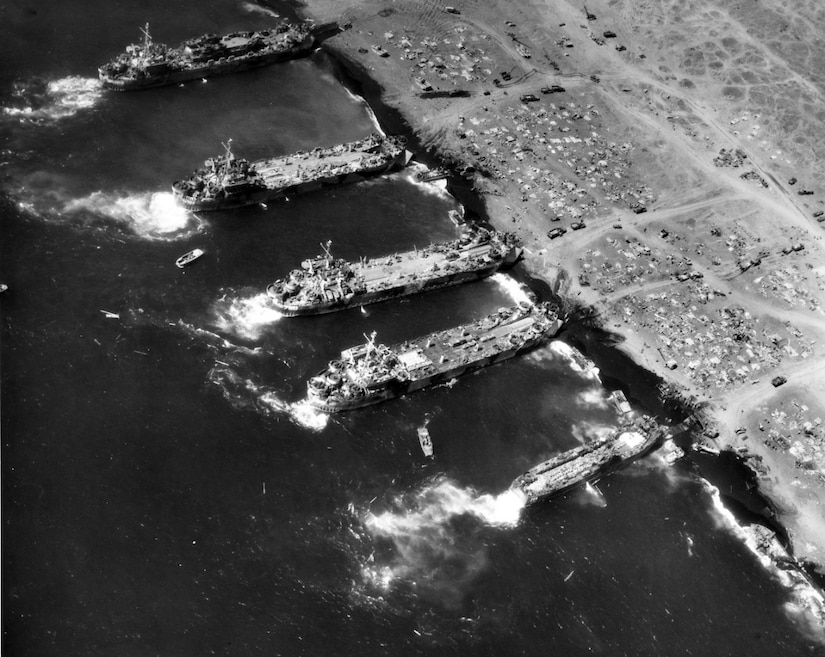
An aerial view of four large ships beached along a shoreline to deliver supplies.

For the rest of the year, Pierce's unit, the 2nd Battalion, 24th Marines, remained almost continuously in combat, fighting on the islands of Saipan and Tinian in the Mariana Islands chain.

Their next stop — Iwo Jima, a tiny volcanic island that, if taken from the enemy, would put Allied aircraft in striking distance of the Japanese mainland. It became the bloodiest campaign of the war for the Marine Corps, a monthlong battle in which 27 men later received Medals of Honor for their heroics, including Pierce.

Throughout the battle, Pierce carried out dangerous volunteer missions that put him under near-continuous enemy fire. He became an expert on the terrain, going back and forth about 25 miles of the landscape to memorize details and draw a map marking enemy forces he'd encountered.
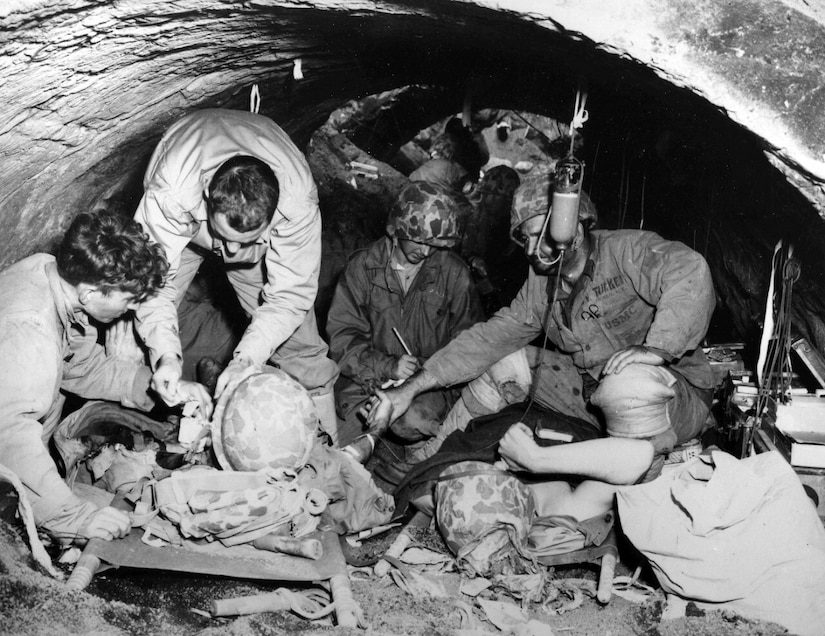
Four men stand or kneel above two men on stretchers, giving them aid. All are in a small concrete shelter not high enough to stand up in.

On March 15, 1945, Pierce was in a group of medics who were carrying two wounded Marines to an aid station when they got caught in heavy enemy fire that injured a corpsman and two stretcher bearers. Pierce quickly took charge and carried the newly wounded men to a shelter, where he gave them first aid and directed them toward an evacuation route.

Pierce then stood out in the open and blasted his weapon toward the enemy to draw their fire, giving six other stretcher bearers a chance to reach cover. From there, he focused on the Marines who'd been injured before the latest chaos erupted.

As Pierce was attending to the profuse bleeding of one of the Marines, the victim was struck again by a bullet from an enemy hiding in a cave about 20 yards away. With no concern for his own safety, Pierce put himself in harm's way to draw out the attacker and kill him using the last of his ammunition.

Now unarmed, Pierce lifted the wounded Marine onto his back before moving across 200 feet of open, bullet-strewn terrain to get him to safety. It was a harrowing trip, but Pierce pushed through his exhaustion — as well as warnings from his peers — to go back across the same fire-swept path to rescue the second Marine. That effort paid off, and they both reached safety.
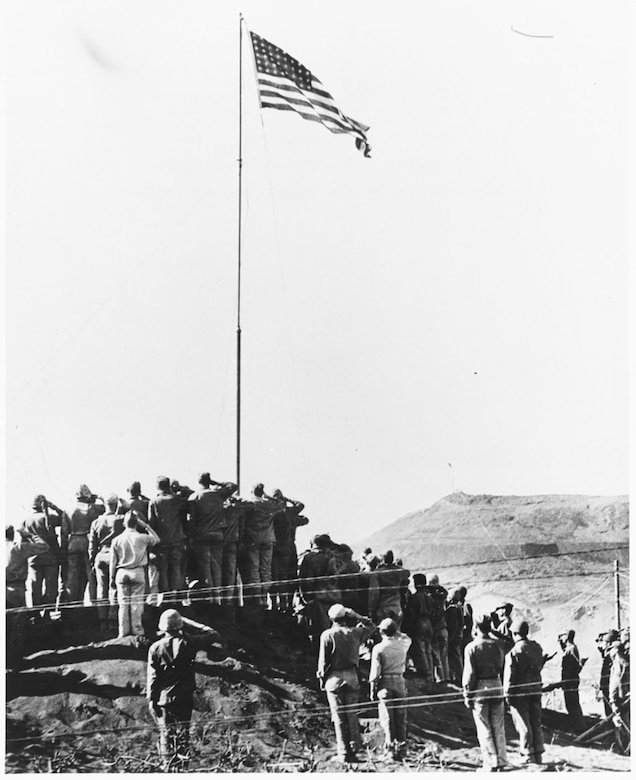
Dozens of men stand on a small, desolate hill to salute an American flag that’s been raised on a tall flagpole.

The next day, Pierce led a combat patrol to a sniper's nest. As he was attending to a stricken Marine, he was shot in the shoulder and suffered shrapnel injuries. Pierce refused aid for himself, though, instead directing others to continue attending to the wounded Marine's treatment while he laid down cover fire for their protection.

Pierce's fearless actions inspired his entire battalion. He was initially awarded a Silver Star and the Navy Cross, but they were later combined and replaced by the Medal of Honor.

Pierce received the nation's highest honor for valor on June 25, 1948, from President Harry S. Truman during a White House ceremony. The medal was also bestowed upon Army Staff Sgt. John R. Crews and Navy Lt. Cmdr. Jackson Charles Pharris that day.

Aside from Pierce, three other pharmacist's mates were awarded the Medal of Honor for their actions on Iwo Jima: Navy Petty Officer 3rd Class Jack Williams, Navy Petty Officer 2nd Class George Wahlen and Navy Petty Officer 1st Class John Willis. 
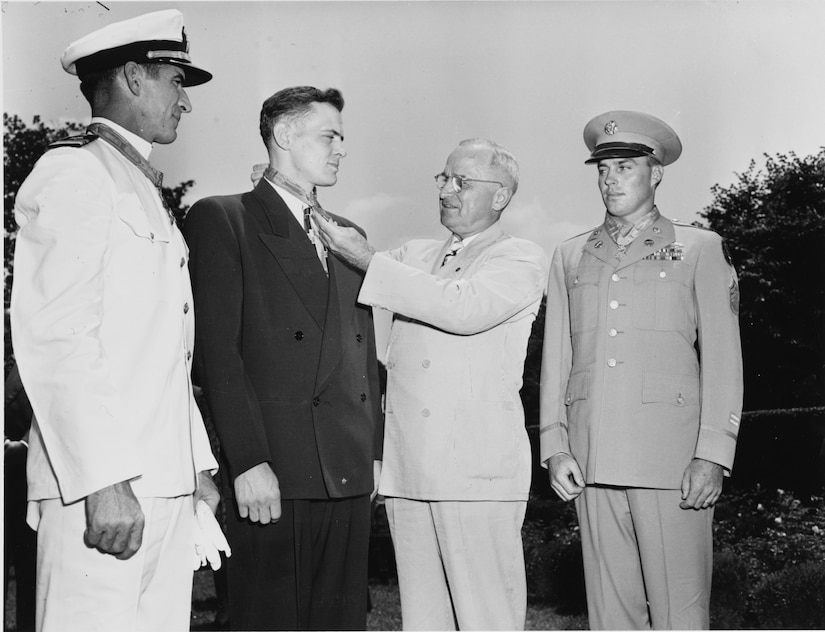
Three men in formal military uniforms stand together, with a man in business attire standing in the center, who places a medal around the neck of the man in the middle.

Pierce was discharged from the Navy in 1945 and worked for a short time as a logger back in his home state. Later that year, however, he moved to Grand Rapids, Michigan, to finally meet Lorraine Decker, with whom he'd been corresponding throughout the war, according to the Grand Rapids Press newspaper. The pair married in August 1946 and had two sons.

Pierce went to work as an officer for the Grand Rapids Police Department, working his way up the ranks from beat patrolman to deputy chief by the time he retired in 1982. The Grand Rapids Press said among his many duties, he was the city's bomb disposal expert.

After Lorraine Pierce died in the 1970s, Pierce spent his remaining years with his second wife, Madelyn, before succumbing to lung cancer on Dec. 21, 1986, at age 62.

Pierce is buried in Holy Cross Cemetery in Grand Rapids.

In 2003, toy maker Hasbro released a commemorative G.I. Joe figurine of Pierce. To date, he's the only hospital corpsman to be honored with his own action figure.

Tuesday, September 09, 2025

JTF-DC Medic Doubles as Third-Year Medical Student so Others May Live

 Sept. 9, 2025 | By Army Master Sgt. Whitney Hughes, National Guard Bureau

Not many people can say their interest in one of the body's most complicated organs began with a water pump. 
 
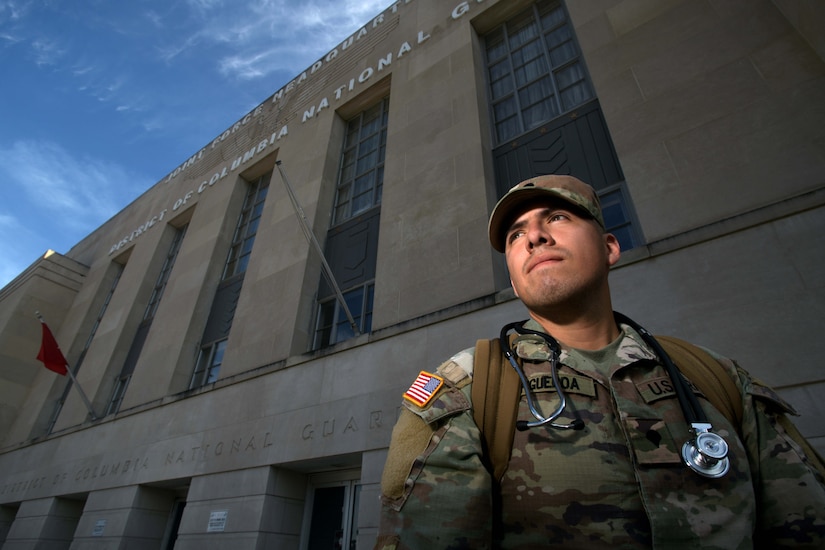
However, for Army Spc. Elias Figueroa, a combat medic assigned to the D.C. Army National Guard and third-year medical student, his interest in medicine began with helping his father install a water pump. His inherent understanding of the pump system and the similarities he drew to the human cardiovascular system are what drew him to the field. 

A person wearing a camouflage military uniform stands outside in front of a building and gazes up into the distance.

 
"Just understanding the pump systems, the math made sense and the picture made sense in my head," said Figueroa, adding that it converted so well in his first two years of medical studies that he was tutoring other students. 
 
This same curiosity and hands-on approach drove him to join the Army National Guard as a combat medic and led to his current assignment with the D.C. Safe and Beautiful Task Force, Joint Task Force District of Columbia. He initially joined the National Guard in 2020 and qualified as a combat medic upon graduating from an intense 16-week course focused on emergency medical technician, emergency medical services and tactical combat casualty care training. 
 
Since being on duty with the task force, his duties have included treating fellow soldiers and responding to several incidents involving civilians. 
 
His squad leader, Army Sgt. Jay Whited, said Figueroa's experience and skill set have been invaluable in many of the situations they have encountered. 
 
"He's treated at least half a dozen civilians at Union Station since the mission started," Whited said. "We are very lucky to have such a well-trained medic. He's right there, and he's pretty close to being a doctor, so that makes us feel good. It's good for him. It's an actual medical emergency in public that he can get his hands on and do something about." 
 
While assigned to the task force, Figueroa has provided hands-on treatment or assessments for everything from a heat casualty to a narcotic overdose. He said experience like that gives him an advantage going into his third year of medical school, where studies move from the classroom to practical application with patients. 
 
"A lot of us [medical students] kind of fumble to the point to where some people repeat a semester because they just can't do the clinical part," Figueroa said. "So, I've been able to kind of hone my abilities a little bit. I'm a little more confident. I was like, 'Oh, I can do that. I can take vitals without even hesitating. I can go through an assessment.'" 
 
Despite the added confidence, he doesn't take the gravity of his position lightly. 
 
"It's a responsibility," Figueroa said. "You can't freak out. You have to keep a level head and relax. For all those events, when someone yells 'Medic!' I'm calm as heck, I don't overreact." 
 
He said he often reminds himself to begin with the basics to stay calm as he assesses and reassures the patient. 
 
"And that's kind of the first thing that comes to mind is just relax and do the job," Figueroa said. 
 
For the 28-year-old, medicine goes beyond a job to a spiritual and moral code. When he "found Christianity and God" during college, Figueroa asked himself what his strengths were and how he could use them to serve others. That also tied in with a duty he felt as a naturalized citizen to serve his country. 
 
His family emigrated from Peru, and he and his parents became American citizens in 2011. 
 
"My dad got citizenship that January, and I got it through him, because I was still a minor," Figueroa said. "I always felt I didn't really earn it. My dad took the test. My dad did all this work. So, part of me was like, I want to actually earn this." 
 
His family started off in an apartment, and now they own three properties — one of which is the house where he helped install the water pump that inspired his interest in cardiology, he noted. 
 
"This country gave us a lot, it's kind of like the American dream showed itself," Figueroa said, who will conclude his time with the D.C. task force in two weeks to return to his role as a full-time medical student. 

Wednesday, June 13, 2012

Guard, active duty medical providers get back to basics with Ugandan counterparts


By Army Staff Sgt. Malcolm McClendon
Task Force Raptor

SINGO, Uganda  – An exchange of best practices in advanced combat medicine proved to be a welcomed, back-to-the-basics refresher for two experienced U.S. military medical providers.

Army Capt. Alexander Alba, a physician's assistant with Task Force Raptor, 3rd Squadron, 124th Cavalry Regiment, Texas Army National Guard, and Navy Lt. Cmdr. Guillermo Navarro, an emergency physician with Expeditionary Medical Facility, Camp Lemonnier, Djibouti, were invited by the Ugandan People's Defense Forces to participate in an Advanced Combat Medicine Seminar here, May 14–18.

"It was good to meet other medical providers and talk about medicine," said Alba. "The fact that they were service members from Uganda made the discussion even more interesting."

The medical providers from both countries shared their experiences and best practices for the advancements and breakthroughs in combat medicine.

"U.S. combat medicine has come a long way in the past 10 years. We've learned a lot from Operations Enduring and Iraqi Freedom," Alba said. "Ugandan combat medical professionals have also learned and evolved from the conflicts they've been involved in."

As Alba, Navarro and the Ugandan medical providers discussed complex medical practices such as applying chest tubes and surgical cricothyrotomy, or an incision to create a life-saving airway, they decided to take things back a notch.

"Medical technology has advanced so much and allowed us to save more lives than ever before," Alba said. "While discussing this, we brought up scenarios where maybe access to our modern day equipment wouldn't be available, so we decided to incorporate a session to discuss basic combat medicine."

The medical professionals traded their complex, high-tech training aids for simpler items.

"We practiced applying improvised tourniquets using sticks," Alba said. "We even discussed the basics of casualty evacuations using buddy carries."

After the week-long seminar discussing advanced medicine practices, Alba appreciated reviewing the basics.

"As advanced medical professionals we are always learning and keeping up with the ever-evolving medical practices," Alba said. "So to be able to share and revisit basic primary medical care with our Ugandan counterparts was a welcomed refresher and a reminder that these are just as important in saving someone's life."

Friday, May 25, 2012

Navy Corpsman Saves Drowning Victim at Corpus Christi Beach


By Bill W. Love, Naval Health Clinic Corpus Christi Public Affairs

CORPUS CHRISTI, Texas (NNS) -- A Sailor assigned to Naval Health Clinic Corpus Christi (NHCCC) was awarded a medal for saving a child's life during a family outing May 6.

Hospital Corpsman 1st Class (FMF) Jesus A. Cordova, who thought two surfers were playing with their children coming out of the surf, realized that each of the two youngsters were lifeless.

"Once I noticed the children's situation and the anxiety on the surfers' faces, I rushed out and carried on as I've been trained without any thoughts but to resuscitate the child successfully," Cordova said.

Cordova continued cardiopulmonary resuscitation while simultaneously monitoring another adult's lifesaving efforts on the second child.

"It's a state of mind for EMTs, a course I am well-versed in as I have taught it throughout my career," he said.

Capt. Gina M. Jaeger, commanding officer at NHCCC, praised the El Paso, Texas Navy corpsman for his heroic achievement by presenting him the Navy and Marine Corps Achievement Medal.

"HM1 Cordova you had a lot of self-trust that day," Jaeger said, refering to Ralph Waldo Emerson's quote about the essence of heroism. "It is a wonderful thing that you did, saving someone's life, and we really appreciate it. And you are just a fine example of the Sailors we have here at Naval Health Clinic Corpus Christi, so again, thank you."

Friday, March 23, 2012

Corpsmen Detailers Visit US Naval Hospital Guantanamo Bay


By Stacey Byington, U.S. Naval Hospital Guantanamo Bay Public Affairs

GUANTANAMO BAY, Cuba (NNS) -- Detailers from the hospital corpsmen community and a member of the placement team visited U.S. Naval Hospital Guantanamo Bay (USNH GTMO), March 20-21.

The visit offered detailers a better sense of the requirements of the command, and provided Sailors an opportunity to talk to their detailers face-to-face.

Leading the team was Master Chief Hospital Corspman (SW/AW/FMF) Lucas Van Emelen, lead detailer for Navy corpsmen. He was accompanied by Chief Hospital Corpsman (SW/FMF) Vincent Soto, the HM "A" and "C" schools detailer, and Hospital Corpsman 1st Class (FMF/SW) John Kitchen, a member of the enlisted placement team.

"Our detailer visit was a huge success," said Master Chief Hospital Corpsman Betty Watson, USNH GTMO command master shief. "To have them come here and actually experience GTMO helps them understand issues and requirements here as they attempt to fill our billets."

Watson said that the hospital's corpsmen learned about different billets available to them and the process for selecting people for those billets.

"Our Sailors know they matter, and most of those who needed orders received them," added Watson.

Hospital Corpsman 2nd Class Latoya Hooper works in the hospital's pharmacy and said her interaction with the detailers was very beneficial.

"My visit with the detailer was great," said Hooper. "I was very impressed by Chief Soto, and the level of knowledge he possessed with regards to the submission
of my IDC School (Independent Duty Corpsman) request package. I was pointed in the right direction very quickly, and by the time my session was over, I knew exactly what I needed to do."

The visitors from Milington said they were impressed with the quality of GTMO corpsmen and the professionalism everyone displayed.

"We are working diligently to understand the needs here," said Van Emelen. "It has been an eye-opening experience. It's a beautiful place."

One of the issues currently challenging the command is the fact that Fed/Fire does not currently operate ambulance services for the community. Corpsmen who work in the hospital's emergency room need to be certified emergency medical technicians (EMT), and must qualify to drive the hospital's ambulances.

"We do it all," said Capt. Barth Merrill, USNH GTMO executive officer. "GMTO is one of those places where junior corpsmen can get training in areas that they might not get in other assignments."

A good percentage of the command's enlisted Sailors are junior corpsmen on their first assignment out of "A" school. In addition, many corpsmen who come to Guantanamo Bay are single or arrive unaccompanied without their families, which means shorter tour lengths thus, staff turnover is a challenge.

In a brief to hospital leadership, the detailers said that public perception of GTMO tends to influence Sailors who might otherwise consider orders to the hospital.

"One of the things we need to do is change the mindset of how Guantanamo Bay is perceived," said Soto. "When I mention GTMO to corpsmen, they tend to react negatively. We need to change that image."

What many corpsmen and other enlisted personnel who could get orders to GTMO do not realize is that there is much more to the base.

The base has almost 6,000 residents, and hospital personnel interact with almost all of them. The detention center is several miles away from where most people live and work on the base. During off-duty hours most people fish, kayak, scuba dive, and snorkel. There is also a DoDDS school system for kindergarten through 12th grades.

"GTMO is a great place to come for those with families," said Merrill. "If corpsmen want leadership and education opportunities, then they should consider orders to GTMO."

Corpsmen play an essential role in the fleet's health and wellness. That readiness is an area of the 21st Century Sailor and Marine initiative which consolidates a set of objectives and policies, new and existing, to maximize Sailor and Marine personal readiness, build resiliency and hone the most combat-effective force in the history of the Department.

For more news from U.S. Naval Hospital Guantanamo Bay, visit www.navy.mil/local/nhgb/.

Monday, March 19, 2012

Momsen Expeditionary Medical Team Prepared to Support VBSS Team


By Mass Communication Specialist 3rd Class Carlos M. Vazquez II, USS Momsen Public Affairs

USS MOMSEN, At sea (NNS) -- A team of medical officers and hospital corpsmen assigned to the 8th Expeditionary Resuscitative Surgical System (ERSS), embarked aboard guided-missile destroyer USS Momsen (DDG 92), are prepared, should the need to arise, to render medical assistance to members of visit, board, search and seizure (VBSS) team.

ERSS teams are deployed aboard surface naval ships conducting counter-piracy missions which normally do not have a fully staffed emergency medical team. The team's primary purpose is to provide any necessary life-saving surgery and quickly transport the patient to a higher level of care.

"We are here to treat any severe injuries that might result during VBSS operations," said Cmdr. Todd Parker, the emergency medicine physician. "We treat anything that compromises the patient's ability to breathe or circulate blood throughout their body."

The ERSS is comprised of nine Sailors and split into three teams: expeditionary trauma team, expeditionary surgical team and expeditionary transport team. Even though the physician, surgeon, nurses and hospital corpsmen are divided into separate teams, they would act as one team during a real emergency situation.

"The unit is modeled after similar types of mobile trauma bays that are deployed with the Marines," said Parker. "Ultimately, we operate as one team and back each other up."

In the event of an emergency, the team has built a temporary operating room aboard Momsen. After surgery has been completed by the expeditionary surgical team, the expeditionary transport team would then take charge to medically evacuate the patient to the nearest hospital or to a larger ship, such as an aircraft carrier equipped with more resources to treat the patient.

"My primary mission is to be a transport nurse if we had to medically evacuate a patient," said Lt. j.g. Thomas Gaffney, critical care nurse for the expeditionary transport team. "I keep the patient stable."

The team trains daily in various scenarios to maintain their medical qualifications and operational readiness.

"As a Navy medical professional, you give Sailors fighting at the tip of the spear the peace of mind that if something happens to them, there's going to be someone there to take care of them," said Parker.

Momsen is deployed with Carrier Strike Group (CSG) 9, which also includes aircraft carrier USS Abraham Lincoln (CVN 72), guided-missile cruiser USS Cape St. George (CG 71), Carrier Air Wing (CVW) 2 and Destroyer Squadron (DESRON) 9, with guided-missile destroyer USS Sterett (DDG 104).

CSG 9 is operating in the U.S. 5th Fleet area of responsibility (AOR) conducting maritime security operations, theater security cooperation efforts and support missions as part of Operation Enduring Freedom.

Monday, March 12, 2012

Face of Defense: Petty Officer Reaches for Stars


By Marine Corps Cpl. Bruno J. Bego
2nd Marine Logistics Group

CAMP LEJEUNE, N.C., March 12, 2012 – Many people grow up with the dream of joining the military to improve themselves. For Navy Petty Officer 2nd Class Jason F. Figgeroa, a hospital corpsman with Medical Battalion, Combat Logistics Regiment 25, 2nd Marine Logistics Group, the military was his ticket to a better life.

“I wanted to get out of Hawaii,” the Waipahu native said. “Times got rough, and I was going through some family issues, so it was time for me to go.”

When Figgeroa joined the Navy in 2007, his main focus was to take advantage of the tuition assistance program to get his bachelor’s degree in political science.

“My driving force was education,” he said. “I was focused on getting my bachelor’s degree in order to improve my lifestyle.”

As his desire for education and his passion for serving his country increased rapidly over time, he said, he decided to make the military a life-long profession and to pursue a commission in the Navy.

“Initially, I didn’t join to become an officer,” he said. “After growing and maturing, I started to think becoming an officer is the best route for me.” His wish to expand his prospects and enrich his life required him to take seven or eight classes per semester for two-and-a-half years.

“It was brutal,” he said. “I was definitely stressed out, because besides the college classes, I still had to maintain my military commitments.”

He also had to pay for whatever tuition assistance didn’t cover as he pursued his dream. “It was well worth it,” he said, “because I really want to become an officer.”

And he wasn’t alone in his struggles, Figgeroa said. Navy Master Chief Petty Officer Florian C. Rio, the medical battalion’s command master chief, shared his wisdom with Figgeroa from the beginning.

“I do not discriminate,” Rio said. “I mentor everybody equally and provide them with the chances to improve themselves. Now, if there is somebody who is really interested in becoming an officer, like Figgeroa, I talk to that person, and I explain the process. I show them which direction they need to go to accomplish their dream.”

Rio said Figgeroa’s initiative and persistence impressed him from the beginning.

“That’s one of the things I saw about him. He is a go-getter,” Rio added. “He saw the opportunity there, and he went for it. He achieved his goal of getting his bachelor’s degree.”

Figgeroa is preparing to attend his Officer Candidate School class, which begins April 15. And he already has new goals in sight.

“I want a star. I want to be an admiral one day,” he said. “I also want to work at the Pentagon. I just want to have the privilege to step foot into the Pentagon as a staff member.”

Figgeroa’s said his quest not only has helped himself, but also has inspired his fellow sailors and Marines.

“I love the fact I can help and encourage other people to improve,” he said. “I love the Navy. I think joining the military is the best decision I’ve made, and I will continue to do my best to help others.”