Showing posts with label uganda. Show all posts

Wednesday, June 13, 2012

Guard, active duty medical providers get back to basics with Ugandan counterparts


By Army Staff Sgt. Malcolm McClendon
Task Force Raptor

SINGO, Uganda  – An exchange of best practices in advanced combat medicine proved to be a welcomed, back-to-the-basics refresher for two experienced U.S. military medical providers.

Army Capt. Alexander Alba, a physician's assistant with Task Force Raptor, 3rd Squadron, 124th Cavalry Regiment, Texas Army National Guard, and Navy Lt. Cmdr. Guillermo Navarro, an emergency physician with Expeditionary Medical Facility, Camp Lemonnier, Djibouti, were invited by the Ugandan People's Defense Forces to participate in an Advanced Combat Medicine Seminar here, May 14–18.

"It was good to meet other medical providers and talk about medicine," said Alba. "The fact that they were service members from Uganda made the discussion even more interesting."

The medical providers from both countries shared their experiences and best practices for the advancements and breakthroughs in combat medicine.

"U.S. combat medicine has come a long way in the past 10 years. We've learned a lot from Operations Enduring and Iraqi Freedom," Alba said. "Ugandan combat medical professionals have also learned and evolved from the conflicts they've been involved in."

As Alba, Navarro and the Ugandan medical providers discussed complex medical practices such as applying chest tubes and surgical cricothyrotomy, or an incision to create a life-saving airway, they decided to take things back a notch.

"Medical technology has advanced so much and allowed us to save more lives than ever before," Alba said. "While discussing this, we brought up scenarios where maybe access to our modern day equipment wouldn't be available, so we decided to incorporate a session to discuss basic combat medicine."

The medical professionals traded their complex, high-tech training aids for simpler items.

"We practiced applying improvised tourniquets using sticks," Alba said. "We even discussed the basics of casualty evacuations using buddy carries."

After the week-long seminar discussing advanced medicine practices, Alba appreciated reviewing the basics.

"As advanced medical professionals we are always learning and keeping up with the ever-evolving medical practices," Alba said. "So to be able to share and revisit basic primary medical care with our Ugandan counterparts was a welcomed refresher and a reminder that these are just as important in saving someone's life."

Monday, April 23, 2012

Texas Guard members connect with Uganda airmen, children


By Army National Guard Staff Sgt. Malcolm McClendon
Task Force Raptor

SINGO, Uganda (4/23/12) – The road four Texas Army National Guard Soldiers took to the Singo Training Center each day of their deployment here opened up an opportunity for them that they won’t soon forget.

“Every morning, I remember passing a school at the entrance of the Singo Center,” said Army 1st Lt. Victor Lauersdorf, a security officer with Task Force Raptor, 3rd Squadron, 124th Cavalry Regiment, and a member of the Texas Army National Guard. “It was unique, because the same field the children used for their recess, the Ugandan People's Defense Forces used for their military training.”

Lauersdorf, along with Army Staff Sgt. Jason Smith, Sgt. Enrique Icedo and Spc. James Andrew, exchanged best practices with Uganda Air Force airmen during an RQ-11 Raven unmanned aircraft system operational skills course held here March 19 through April 7.

“The Raven is a small, unmanned reconnaissance and surveillance aircraft,” Smith said, a squad leader with Task Force Raptor. “It is flown in support of ground troops, giving commanders an eye in the sky on what may lie ahead.”

The Raven is a new addition to the UPDF, and Smith said the Ugandan airmen new to the unit took the training very seriously.

“It’s a lot of information for a technology that most of these guys have never seen, but these guys were up to the challenge,” said Smith. “We’d give them tasks and homework and the next day they had everything memorized and completed. These men are well prepared for what challenges may lay ahead.”

Like their U.S. counterparts, the Ugandan airmen constantly train for possible deployment and to defend their country. They also share the likelihood of being away from family and friends back home.

“The children of the airmen we trained with attended the school we passed every day,” Lauersdorf said. “As a father of two children, I empathized with the Ugandan servicemen who could at any time leave their families behind.”

Remembering how they felt when they themselves left home for deployments, the Guard members decided to take the opportunity and pay the Ugandan children a visit.

“We all pitched in a few dollars of our own money and bought some school supplies and soccer balls for the children to use,” Smith said. “When we showed up with the supplies, the smiles on the children were priceless. We spent a couple of hours with them playing, shaking hands and taking pictures with them. It was a special experience.”

The Ugandan servicemen were also touched by the act of kindness, Lauersdorf said.

“When we asked the leadership if it was OK to visit the school, they said yes and let us know that they were very appreciative of the gesture,” Lauersdorf said.

“They said they couldn’t believe that not only did we come to train with them, but now we are helping out their children as well,” he said.

Friday, July 08, 2011

Kansas National Guard Soldiers pose with Ugandan soldiers

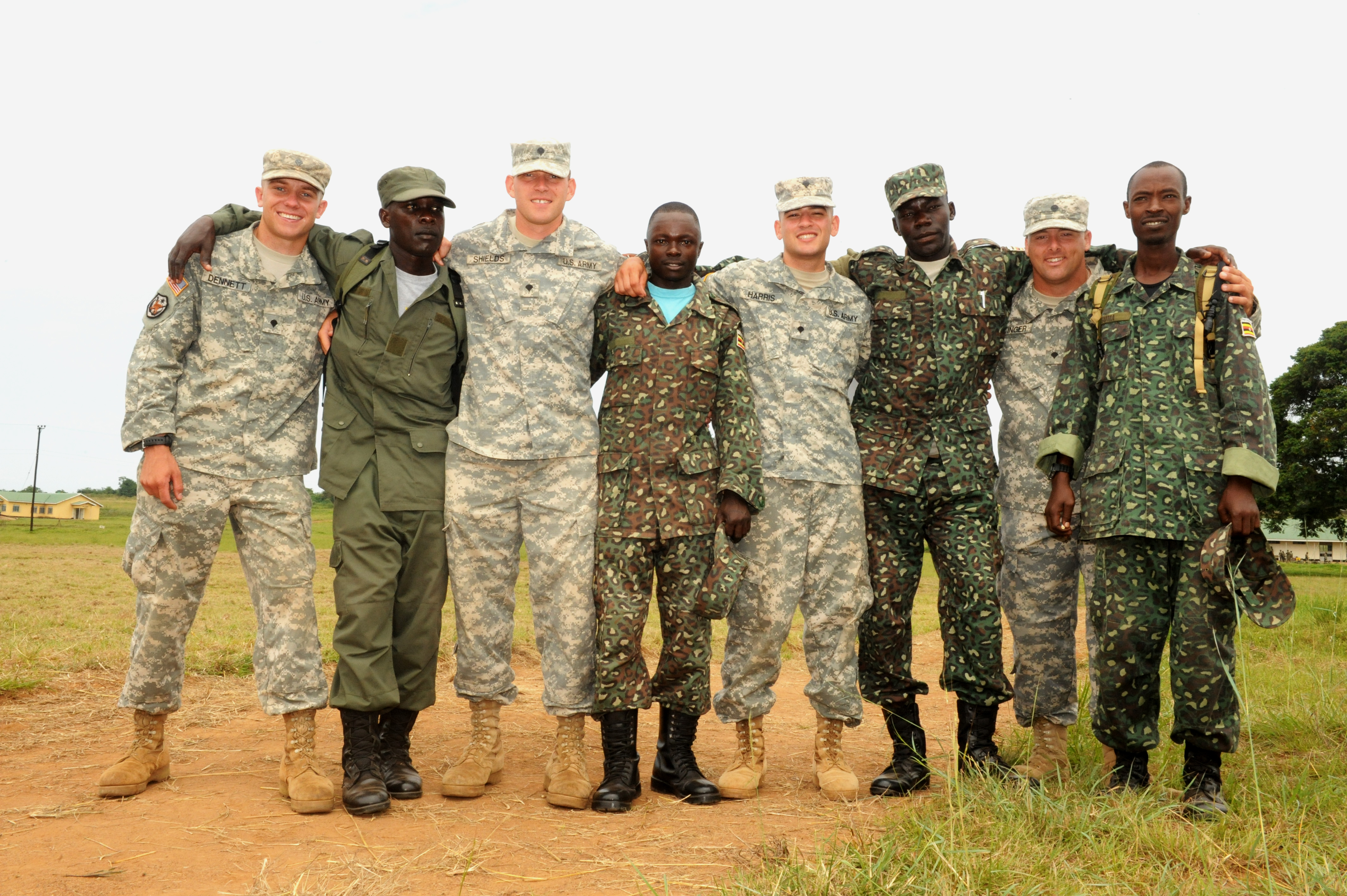
Ugandan People's Defense Force soldiers pose with U.S Soldiers assigned to the 1st Battalion 161st Field Artillery, Kansas National Guard, at Camp Kasenyi, Uganda, after graduating the 16-week Kasenyi Special Forces Group Advanced Infantry Training Course, June 22, 2011. The U.S. Soldiers partnered with UPDF instructors to teach the course. From left to right: Army Spc. Daniel Dennett, UPDF Lance Cpl. David Esoru, U.S. Army Spc. Chris Shields, UPDF Pvt. Moses Irumba, U.S. Army Spc. Leymon Harris, UPDF Lance Cpl. Bosco Guma, U.S. Army Spc. Michael Stinger and UPDF Cpl. Stephen Baguma. (U.S. Air Force photo by Master Sgt. Ray Bowden)

Monday, February 14, 2011

Atlas Drop

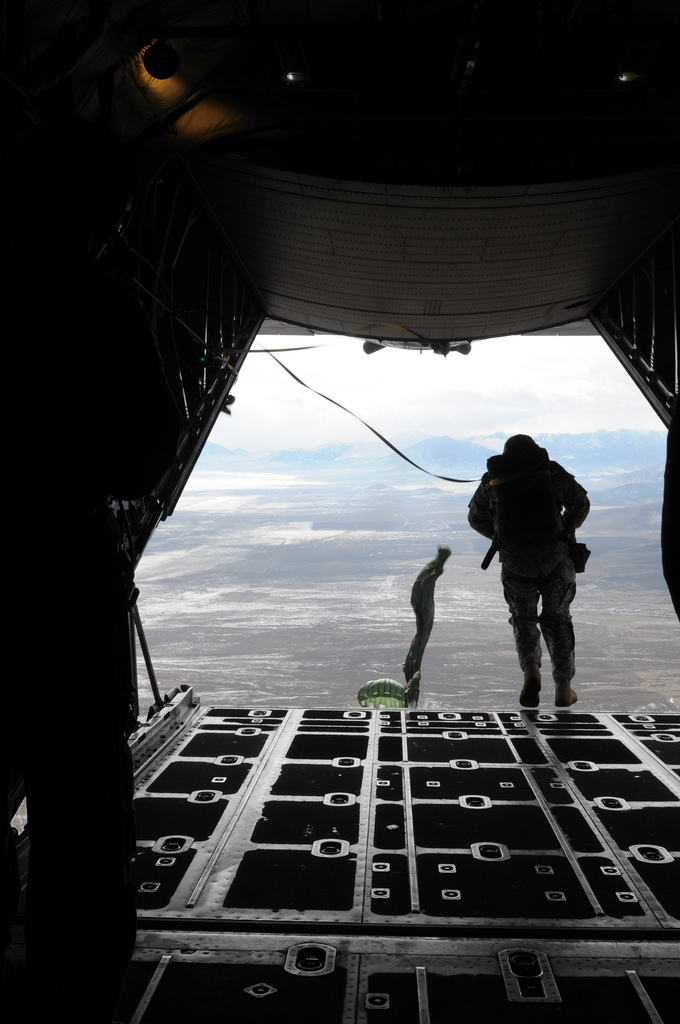
A Utah Guardmember from the 197th Special Troops Company (A) jumps from a C-130 aircraft as part of Operation Atlas Drop. Atlas Drop is an annual joint aerial-delivery exercise that brings together U.S. Army personnel with counterparts from the Uganda People's Defense Force.

Thursday, February 03, 2011

Face of Defense: Uganda-born Army Officer Pursues Dreams

By Vince Little
The Bayonet

FORT BENNING, Ga., Feb. 3, 2011 – As a boy growing up in Uganda, Joseph D'costa became inspired by America's role in World War II and told his teacher he wanted to go to the U.S. Military Academy someday.

"She laughed at me for my dream of going to West Point, telling me it would be impossible because I wasn't an American and Uganda had no ties to the U.S.," he recalled. "I still remember that to this day."

The 13th of 14 children raised by an Indian father and an African mother, D'costa was exiled to Austria at age 7 following Idi Amin's 1971 rise to power in Uganda. Two years later, he came to the United States and ultimately got into West Point on a third and final attempt, earning his commission in 1989.

Now a lieutenant colonel in the Army Reserve, D’costa just completed a 10-month mobilization here as commander of 1st Battalion, 378th Infantry Regiment, a Lafayette, La.-based unit activated to augment basic combat training for the 192nd Infantry Brigade on Sand Hill.

"When we talk about the diversity of soldiers across our Army, Lieutenant Colonel D'costa's life story is one that tells a great story and serves as a motivational and inspiring example for our soldiers, [Defense Department] civilians and the nation's civilian population," said Army Lt. Col. Roger O'Steen, the brigade's executive officer.

Shortly after Amin seized the Ugandan presidency in a military coup, D'costa's mother fell ill with pneumonia-like symptoms. Because of her religious faith, however, she didn't get proper treatment as Amin decreed that anyone who was not a Muslim would get sent to the back of the line for health care. She died at age 42.

"For me, it was very devastating, to realize the person I depended on so much was no longer there," said D'costa, who was 6 years old at the time. He said Amin then declared that anybody who wasn't 100 percent black had a choice: leave Uganda or face execution.

D'costa's father fled to India. A brother and sister got sent to Italy, and D’costa took exile in Austria with five other siblings. Three stayed behind.

"I was half, so I was considered impure and had to leave," he said. "Here's a black man saying, 'You are not the perfect race.' When you experience racism from your own race, … I was not expecting that.

"Idi Amin was killing so many innocent people when they weren't leaving the country fast enough,” he continued. “Books were burned. Even educated blacks got killed, because they were considered threats to Amin."

The "Butcher of Uganda," as Amin became known, ruled over the nation for eight years. The number of opponents killed, tortured or imprisoned varies from 100,000 to a half million, according to biographical accounts. The dictator was ousted in 1979 by Ugandan nationalists, and he fled into exile.

In Austria, a Catholic priest looked after D'costa, who spoke Swahili in Uganda and never learned English. In time, he learned German.

D'costa said he told the priest about his desire to attend West Point. The priest was a friend of then-U.N. Secretary General Kurt Waldheim, who arranged for 9-year-old D'costa and several siblings to go to the United States. He went to live with an older brother in Englewood, N.J.

After graduating high school in 1983, D'costa applied to West Point, but he was turned down.

"They said I'm not American and don't speak English well enough -- the very thing that teacher was telling me would happen," he said.

So he joined the Army ROTC cadet corps at Providence College in Rhode Island. Following his freshman year, the department head offered him a full scholarship, but he'd have to abandon his West Point dream and remain at Providence.

"It would've been the easy way out," he said, "but I needed to know how far I was willing to commit. I had given up on that, but [the ROTC department head] said, 'If West Point is in your heart, you need to apply again.'"

D'costa submitted a second application, but West Point was already at its 1,500-cadet limit, so he had to go to the U.S. Military Academy Preparatory School at Fort Monmouth, N.J., for a year and then apply again. If turned down, he would have been too old for another shot, but he finally was accepted and became a 21-year-old "plebe."

D’costa served in the Gulf War as a field artillery officer. He left the Army in 1994, but joined the Army Reserve two years later. Since then, he's deployed twice to Iraq and once to Afghanistan, and he has supported military relief missions following Hurricane Katrina and the Pakistan earthquake.

At a ceremony in Lafayette on March 12, he’ll turn over the battalion command that he’s held since 2008. He's set to leave Fort Benning on Feb. 11.

"I credit every success I've had to my faith in Jesus Christ, because I shouldn't be alive today,” he said. “My life should've ended in Uganda. All these people I encountered along the way were put into my life to help me reach my goals. … I never looked at my skin color as a reason I did not get to West Point at first. They were looking for certain qualities and tools I needed to learn."

D'costa will return to work in the private sector, but he's expected to graduate from the U.S. Army War College by July. From there, he'll learn if the Army has any further plans for him.

The lieutenant colonel praised the U.S. military for preserving freedom around the globe and said he stays in the Army Reserve to serve his country.

"The United States could've said 'no' to me," he said. "Putting my life on the line for a country that took me in is a small price to pay. … Freedom is so priceless, and all I have to do is serve in the reserves to continue saying 'thank you.' Until the Army tells me to get out, I'll stay.

"This is the greatest country in the world,” he continued. “When I say that, I'm not just saying it because I heard it from somebody else. … The majority of Americans don't know what it's like when you have no freedom."

D'costa said he hopes ultimately to work for NASA. In the late 1990s, he spent two years with the agency in a liaison role for a civilian company.

"West Point seemed like an impossible goal, … but I kept pursuing that goal till I made it happen," he said. "You can achieve anything you want -- you just have to put a little effort into it."

Tuesday, January 25, 2011

Naval War College Faculty Lectures in Uganda

From Naval War College Public Affairs

JINJA, Uganda (NNS) -- U.S. Naval War College (NWC) faculty members visited Jinja, Uganda, Jan. 17-20, to kick-off the Uganda People's Defense Force (UPDF) Senior Command & Staff College 2011 academic year.

The visit was at the request of U.S. Africa Command (USAFRICOM) and the U.S. Embassy at Kampala, Uganda.

Professors from NWC's National Security Decision Making and Strategy and Policy departments, Larry McCabe, Al Shimkus and Dex Wilson, delivered presentations to students about the history and theory of armed conflict, strategic considerations for armed conflict, military technology, and strategic leadership.

The lecture series is designed to provide the students a strategic foundation to support a nine-month course on strategy, war, and leadership, as well as military operations and tactics.

In addition to the lectures, McCabe, Shimkus, and Wilson met with the student syndicates to facilitate an in-depth discussion on strategic leadership, and they met with the college faculty to discuss curriculum development.

This is the third year NWC has provided support to the Uganda Command & Staff College.

The College Director, General Gutti, said "the lectures by the Naval War College faculty have become critical to our success as they introduce my students to the key concepts they will study throughout the year. We always look forward to (NWC's) visit. We make a good team."

This year's class included students from Uganda, Kenya, Tanzania, Southern Sudan, Rwanda, and Burundi. The students from the Sudan People's Liberation Army were particularly interested in discussions on national strategy development and strategic leadership.

The senior student from Southern Sudan, an autonomous region seeking independence, said "these are the issues our new country must understand if we are to be secure and successful."

NWC support to Uganda is one of several Newport programs providing primary military education support to operational commanders' theater security engagement programs.

"Working directly with our international partners is a clear win-win for the NWC and theater commanders," McCabe said. "We strengthen important relationships and deliver useful content to our regional allies while gaining extraordinary insight and experience to support our Newport curriculum."

USAFRICOM's representative to the U.S. Embassy in Kampala, Lt. Col. Vince Golembeski, chief, Office of Security Cooperation, considers NWC support to the UPDF to be a key component of his engagement program.

"NWC support to the college has been great," Golembeski said. "We look forward to strengthening the program over the next several years."

For more news from Naval War College, visit www.navy.mil/local/nwc/.

This article was sponsored by Military Writers.