Showing posts with label f-35. Show all posts

Tuesday, June 30, 2026

Exercise Venom Forge Strengthens Partnerships, Boosts Combat Readiness

 June 30, 2026 | By Air Force Staff Sgt. Jake Jacobsen, 432nd Wing

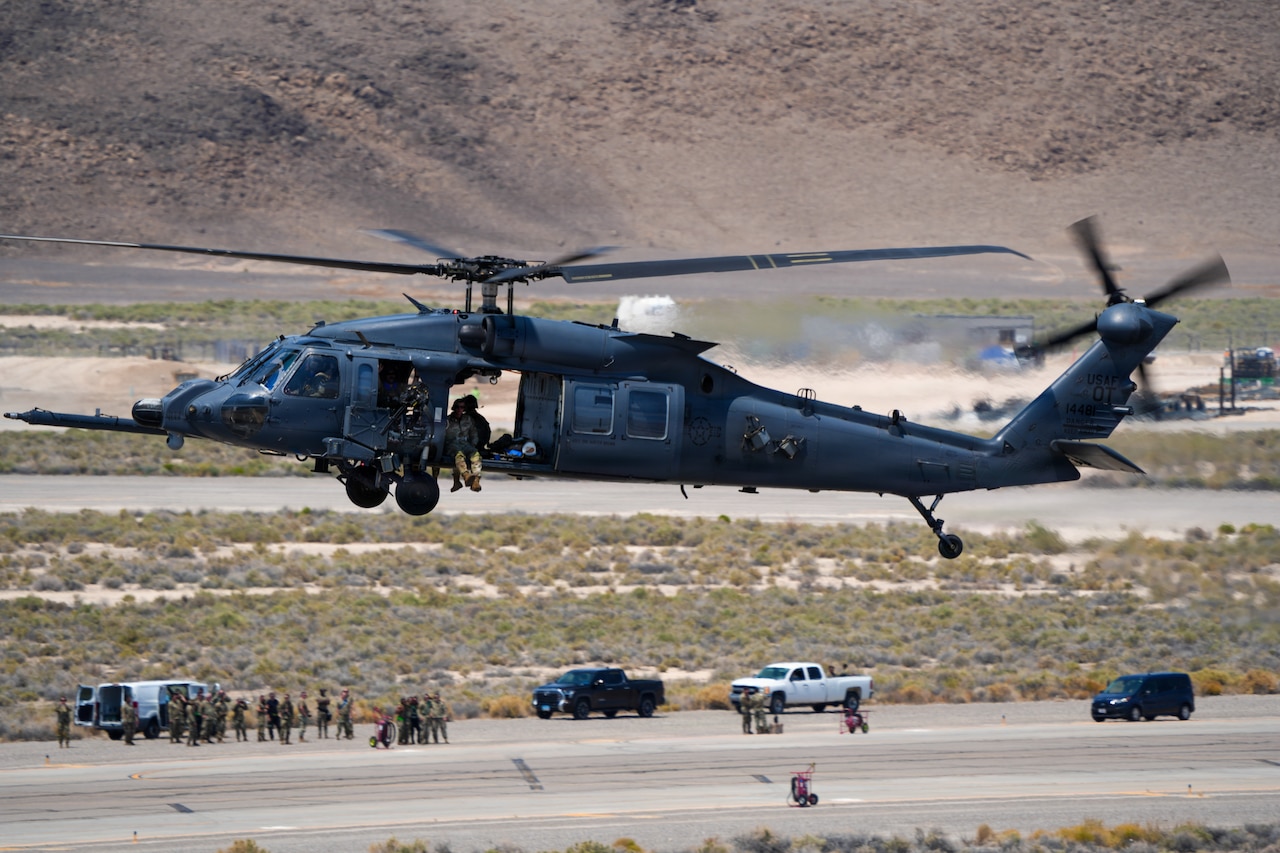
A military helicopter hovers above a flight line as people in military camouflage uniforms stand around on the ground.

An integration exercise designed to develop new tactics, techniques and procedures, combined support from five wings, seven groups and 17 squadrons across a multitude of operations and support at Creech Air Force Base, Nevada, June 17.

Dubbed Venom Forge, this exercise implemented lessons derived from the 57th Maintenance Group's inaugural Agile Maintenance Leadership Course to develop tactical-level maintenance leaders who can build mission-type orders, manage risk, communicate under friction, generate aircraft and create the conditions for combat airpower to happen.

In preparation for the event, mission partners completed a multiplatform hot-pit refueling site certification on base, helping enable contingency hot-pit and integrated combat turn training for multiple fighter platforms. The effort created a foundation for future agile combat employment training iterations.

"Creech [Air Force Base's] support was critical because it gave the capstone an unfamiliar environment and helped turn the course concept into executable training," said Air Force Maj. Yoarmerby Gomez, 57th Maintenance Group maintenance tactics officer. "This exercise required more than ramp space. It required access, support equipment, airfield operations, fuels support, fire emergency services, safety, security, medical response planning, host-base coordination and leadership buy-in."
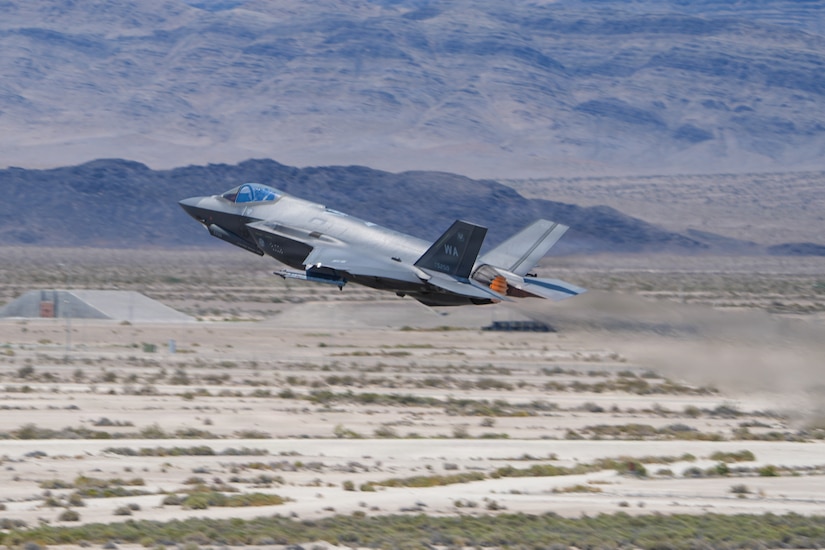
A military jet flies over desert terrain.

To execute the exercise, organizations from the 57th Wing, 99th Air Base Wing, 53rd Wing, 355th Wing and 432nd Wing came together to give students a realistic stage to experience how maintenance decisions affect logistics. The students learned how movement timelines affect aircraft generation, how medical and emergency-response planning affects mission risk, and how base constraints shape execution.

The base provided further support with equipment required for execution, facilitation of access across the installation and aided aircraft integration and operations not part of normal day-to-day mission operations.

"[The base] provided the right balance of proximity, realism and operational value," Gomez said. "It is close enough to Nellis [Air Force Base] to support a controlled hub-to-spoke training model but separate enough to force students to coordinate with a real host base instead of relying on home-station assumptions."

To further test units involved, an inject involving members suffering from simulated heat stroke was enacted, allowing medical teams on HH-60W Jolly Green II helicopters to integrate critical care air transport while aggressor units conducted hot-pit integrated combat turns on F-35A Lightning IIs and F-16C Fighting Falcons.
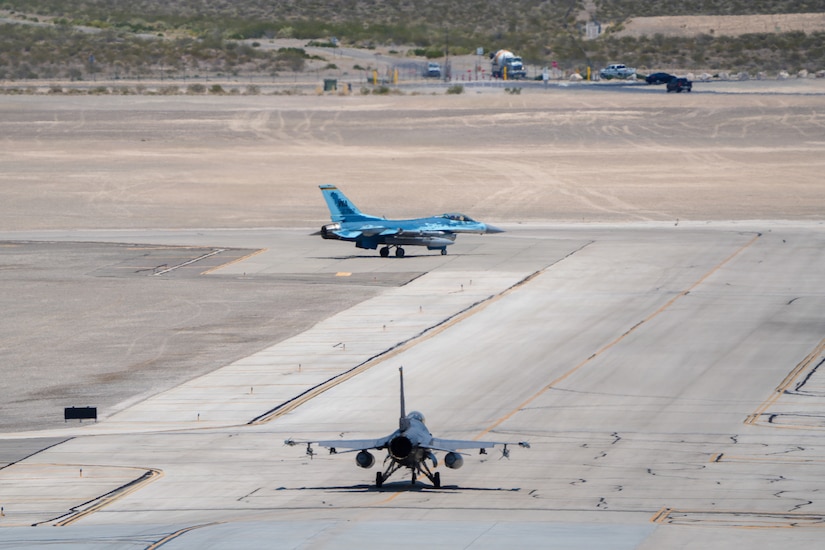
Two military jets taxi on a flight line.

"What made Venom Forge unique was that every organization had its own reason to be there," Gomez said. "One of the clearest examples of the training value was the level of deconfliction required on the airfield. At one point, F-35s and F-16s were being refueled and rearmed while two HH-60s were entering the airspace. These elements of controlled chaos were exactly what we wanted the students to experience. It forced multiple agencies to communicate, deconflict and execute safely in a dynamic environment."

The certification and partnership conducted during the exercise enabled a repeatable foundation for future iterations. These next events could include more students, additional mission partners, different aircraft and more deliberate deconfliction across multiple simultaneous operations.

"For the students, Venom Forge showed that aircraft generation is not just a maintenance action," Gomez said. "Thanks to this exercise, we now have a scalable course model, a stronger relationship with [the base], a multiagency training framework and a better understanding of what it takes to generate combat airpower from a spoke location."

Tuesday, September 15, 2015

F-35 ITF, Italian air force KC-767 'fuel' the way for milestone

by Jet Fabara
412th Test Wing Public Affairs


9/10/2015 - EDWARDS AIR FORCE BASE, Calif. -- Italy's F-35 program achieved two recent milestones with the completion of the first aerial refueling certification between an Italian air force KC-767A tanker with an F-35A and the inaugural flight of an Italian-built F-35A.

"Italy is one of the partner nations on the F-35 program and since we are getting ready to receive our first two F-35s from our Cameri [Italy] Final Assembly and Check Out Facility, we needed to certify the Italian tanker. This is a full certification with all the F-35s, so it doesn't matter if the F-35s are Italian, USAF or Australian assets," said Italian Air Force Maj. Fabio De Michele, 311th Flight Test Squadron experimental test pilot.

The Italian test team arrived here in early July and the first test sortie was flown July 22.

"We require only three more test sorties to complete the program. If the remaining flights are successfully completed as scheduled, the program will complete this week," said Vince Caterina, 461st Flight Test Squadron, F-35 experimental test pilot.

"Overall, we are pretty satisfied with the campaign since we are nearing the end of full certification. We are really happy to be the first international tanker to be certified with the F-35. This is truly a historic milestone for the Italian air force," said De Michele.

With these specific tests, De Michele highlighted the Italian tanker's incorporation of a new concept of refueling, called a remote vision system, which involves boom operators looking through a helmet-mounted display.

"The HMD displays three-dimensional imagery through the use of two stereoscopic cameras on the bottom of the KC-767A," De Michele said.

Throughout the duration of testing, De Michele noted the multiple organizations that were involved in order to ensure the success of each of the refueling certification trials.

"There were test boom operators [from the 418th Flight Test Squadron] that were responsible for checking the compatibility between the two aircraft involved. There were also flight test engineers who were tracking data and making sure that nothing was going to go beyond the limit of the receiver and the tanker," said De Michele. "Since we had the aircraft fully instrumented, we could see all the data real-time and capture what we needed to certify the aircraft."

The testing included additional organizations and teams of personnel.

"There were four primary organizations directly involved with the test program: the Italian air force, the 461 FLTS/JSF ITF, the 418 FLTS, and the Lockheed Martin Corp. The integrated test team developed and executed the test plan to ensure aerial refueling certification requirements would be met in a safe and effective manner," said Christina Ryskey, 418 FLTS Aerial Refueling flight test engineer.

In addition to this, Ryskey said there were teams of flight test boom operators, human systems integration engineers, fuel systems engineers, flying qualities engineers, Boeing personnel, F-35 maintenance teams, the F-35 Joint Program Office, the Air Force Life Cycle Management Center at Wright-Patterson Air Force Base, Ohio, the 412th Test Wing Range Squadron and the Navy Sea Test Range, that were all part of the testing process.

Of those organizations, the 418 FLTS was the designated lead test organization, which prepared the test package to include the test plan and safety plan, according to Sawn Sandland, 418 FLTS program manager.

"This is the first time we've done this sort of thing. This is No. 1 in a long line of foreign tankers that will be tested at Edwards AFB to support AR certification with multiple USAF receivers," said Sandland. "Right after this Italian tanker test, we'll be testing the Australian tanker. We have a whole other coalition tanker effort that's going to certify additional receivers with the Italian, Australian and United Arab Emirates tanker, which we plan to start within the next year."

Italy's first F-35A Lightning II, known as AL-1 and assembled at the Cameri Final Assembly and Check Out (FACO) facility, flew for the first time on Sept. 7 and marked the program's first ever F-35 flight outside the United States.

When the first Italian-built F-35As are ready to be ferried to Luke AFB, Arizona, next year for their student pilots to begin fight training, their KC-767s are anticipated to refuel them on the cross Atlantic voyage.

Tuesday, July 21, 2015

First F-35 fighter squadron activated at Hill

by Mitch Shaw
Hilltop Times Correspondent


7/21/2015 - HILL AIR FORCE BASE, Utah -- The jets won't arrive for another few months, but the first F-35 fighter squadron has officially started work at Hill Air Force Base.

The 34th Fighter Squadron -- affectionately known as the Rude Rams -- was reactivated at Hill Friday afternoon, marking the beginning of the F-35's combat era for both the 388th and 419th Fighter Wings. The fighter squadron is a historic one, with a past that can be traced back to Word War II and includes participation in conflicts from Vietnam and the first Gulf War to Iraq and Afghanistan, post Sept. 11, 2001.

The squadron was mothballed as an F-16 unit in 2010 as part of an Air Force restructuring plan to retire planes and save money, but it returns to accommodate the F-16's replacement, becoming the first operational Air Force unit to fly combat-coded F-35s.

Col. David B. Lyons, current 388th commander and former commander of the 34th, said the reactivation is one of the highlights of his career. He led the squadron when it was deactivated in 2010.

"This has got to be one of the finest days of my military career," he said. "To see this squadron shut down in 2010 was heartbreaking, but somebody, somewhere had the good sense to bring it back to duty."

Lt. Col. George Watkins, new commander of the squadron, said that while the first operational F-35 is not slated to arrive at the base until September, the new squadron shouldn't have trouble keeping busy until then.

The first group of F-35 maintainers, which will make up the 34th Aircraft Maintenance Unit, have been at Hill for two months, completing mostly administrative work critical to the upcoming aircraft transition.

Watkins said the airmen have been writing programs on how the unit will maintain the F-35 in peace and wartime scenarios and have created a flying-hours program that includes directives for training, off-station sorties, contingency scenarios, local flying, and any major modifications to the aircraft.

"There a lot of work to be done before we get that first jet," Watkins said.

The initial group of F-35 maintainers from the 419th are in training, and the first 419th pilot to fly the F-35 will beginning training this fall.

When the F-35s begin to arrive at Hill, they'll be divided among three fighter squadrons and flown and maintained by members of both the 388th and its reserve component 419th Fighter Wing.

After the first jets arrive at Hill, the rest of the fleet will be coming in on a staggered basis, spread through 2019. There will eventually be a total of 72 F-35s at Hill, with approximately 35 to 40 pilots in each of the three fighter squadrons.

The jets will be delivered at a rate of just more than one per month until August 2016. By then, Hill officials hope to have 15 jets and reach a status known as "Initial Operational Capability," which means the fighter wings meet the minimum operational capabilities to use the jet for normal operations.

The 34th is scheduled to have five qualified pilots during the first month of flying, taking turns in what will be two F-35s on base. The 388th FW is sending pilots through training at Eglin AFB, Florida and Luke AFB, Arizona. By January 2016, the wing will have 10 pilots qualified to fly the F-35, including Watkins and Lyons, who both finished their training earlier this year.

The colonels answered to those who have criticized the F-35 program for its expense and apparent lack of performance. The most recent cost estimate for operating and supporting the F-35 fleet exceeds $1 trillion and a leaked internal brief written by a test pilot who was flying the F-35 during a January test run revealed the jet was losing dogfights to the F-16.

"Things aren't perfect, but things are still in development and you can see the potential," Lyons said, adding that the F-35 flies similarly to the F-16, but by fusing many different sensors together, makes the pilot's job easier in the cockpit.

Fighter Wing Spokesman Nathan Simmons said that by the time the F-35 is in full operation at Hill in 2019, the 388th will have added more than 260 active-duty positions.