Showing posts with label security forces. Show all posts

Tuesday, September 01, 2026

Meet Mmoab: A Military Working Dog Serving in England

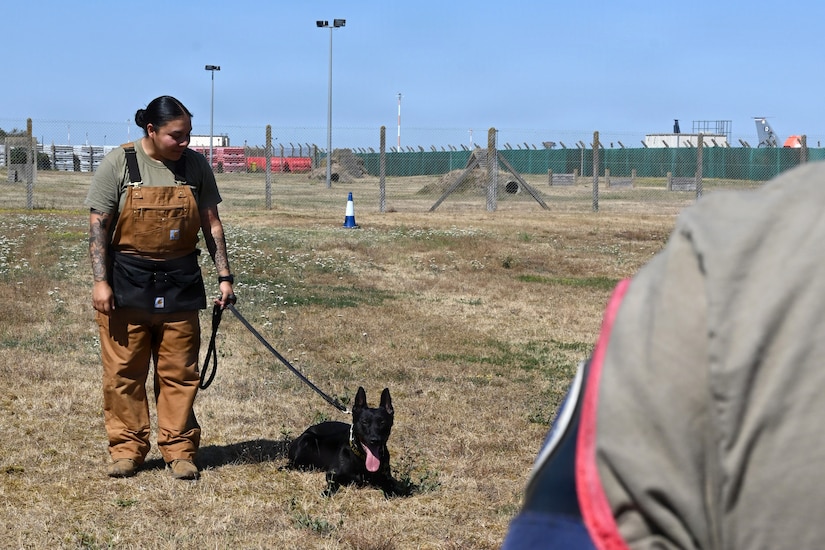
A woman wearing brown overalls holds a black dog on a leash.

The latest addition to the 100th Security Forces Squadron's military working dog pack is 3-year-old Mmoab, a black Belgian Malinois who joined the U.S. Air Force canine team at Royal Air Force Mildenhall, England.

The double letter at the beginning of Mmoab's name is intentional. It signifies that he came from the Military Working Dog Breeding and Foster Program at Joint Base San Antonio, Texas. He is currently the only 100th Security Forces Squadron dog born, bred and initially trained at the Military Working Dog Center in Texas — and just the fourth specially bred canine at RAF Mildenhall — his predecessors being military working dogs Vvonya, Ootto and Oorion.

Operated by the 341st Training Squadron, the puppy program, as it is commonly called, was established at Joint Base San Antonio in 1998 to allow the military to breed its own dogs, cut costs and produce highly trained military working dogs. The program provides hands-on training from the day the puppy is born, and the Air Force can track the dog's social progression. Their training includes several months of detection and patrol work.
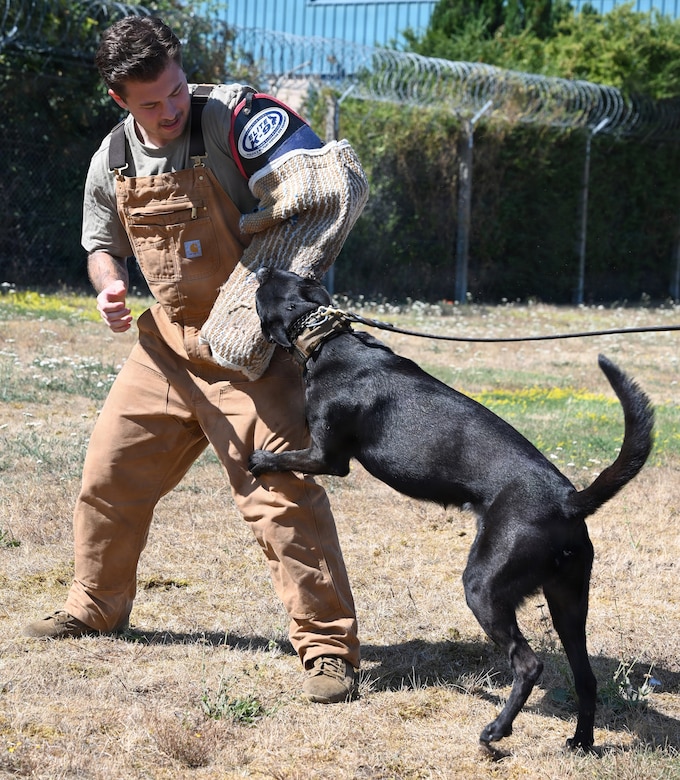
A black dog bites a safety pad on a man’s arm outside in a field.

Once a litter is whelped and weaned, the puppies are placed in foster homes in and around San Antonio. The volunteer families must meet specific requirements before being accepted into the program. They provide care until the puppies return to the training program. Foster families receive everything needed to care for the puppies, including dog food, veterinary care equipment, toys and training.

Once a dog is trained and ready to head to its new duty station, a handler travels to Joint Base San Antonio to personally escort the dog to its new home.

Mmoab's handlers said he showed from the start that he was perfect for the job.

"He's insanely fast, very driven and loves to give hugs to his handlers," said Air Force Staff Sgt. Cameron Gilbert, a trainer assigned to the 100th Security Forces Squadron, who was also the first handler paired with Mmoab. The pair recently returned from a five-month deployment to Royal Air Force Fairford in England, where they performed patrol and detection duties.

"I've done his field evaluation from the ground up," Gilbert said. "Everything he's done and where he is now is a result of how I've worked with him, so I'm proud of where he's at right now and when I handed him over to his new handler."
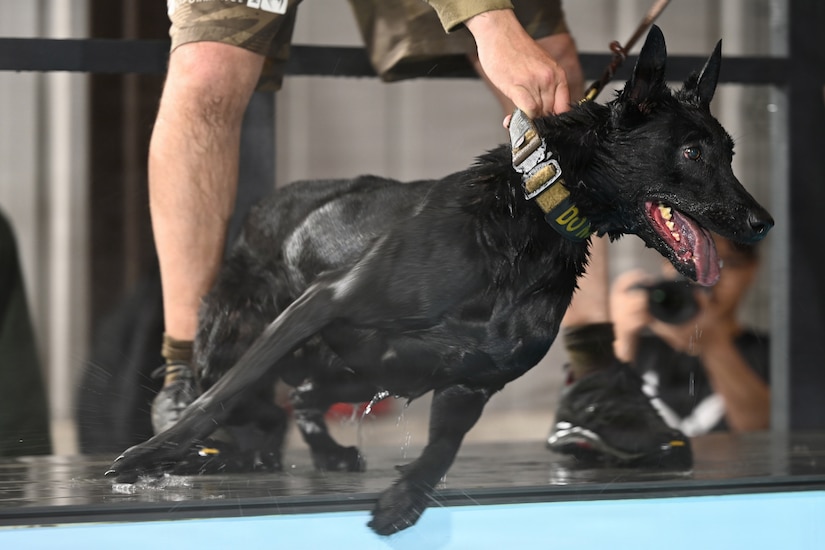
A person stands on the edge of a swimming pool and holds a black dog by the collar.

The young Belgian Malinois is now teamed with Air Force Senior Airman Karina Flores, a handler assigned to the 100th Security Forces Squadron. Mmoab is the third K-9 she's worked with during her Air Force career, and she said they are currently in the rapport phase of their partnership.

"He's my first puppy program dog and is focused 24/7; other dogs can often be like, 'Okay, I'm here, so I'll do it,' but he's completely dedicated," she said. "Mmoab is definitely the most energetic dog I've worked with, and I've been spending a lot of time bonding with him and getting him used to me.

Flores said she gives Mmoab simple tasks, and he receives his favorite toy as a reward so he knows he can trust her and sees her as his "mom."

"It's going good so far," Flores said. "Because he's so driven, I know he's going to make me a better handler because of how much he wants to work."
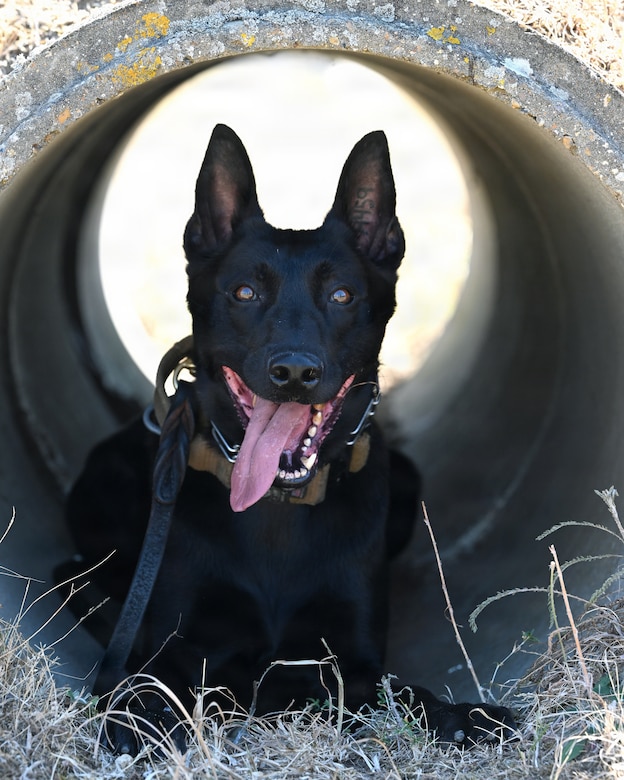
A black dog sits under a large concrete pipe.

After military working dogs arrive at the base, which will be their home for the duration of their career, the next stage for them is to pass their field evaluation qualification.

"We made sure Mmoab can meet what's asked of us operationally here," Gilbert said. "Once he arrived and settled in, we took him out to the different training areas to make sure he can do the tasks no matter what."

While military working dogs may draw attention when they are out, don't let their appearance fool you. With a top running speed of more than 30 mph, a bite force of more than 200 pounds and a nose 40 times more powerful than a human, they are highly trained psychological deterrents and a vital asset to the Air Force and the War Department.

Tuesday, August 04, 2026

Air National Guard Squadron Sharpens Readiness in Jungle Terrain

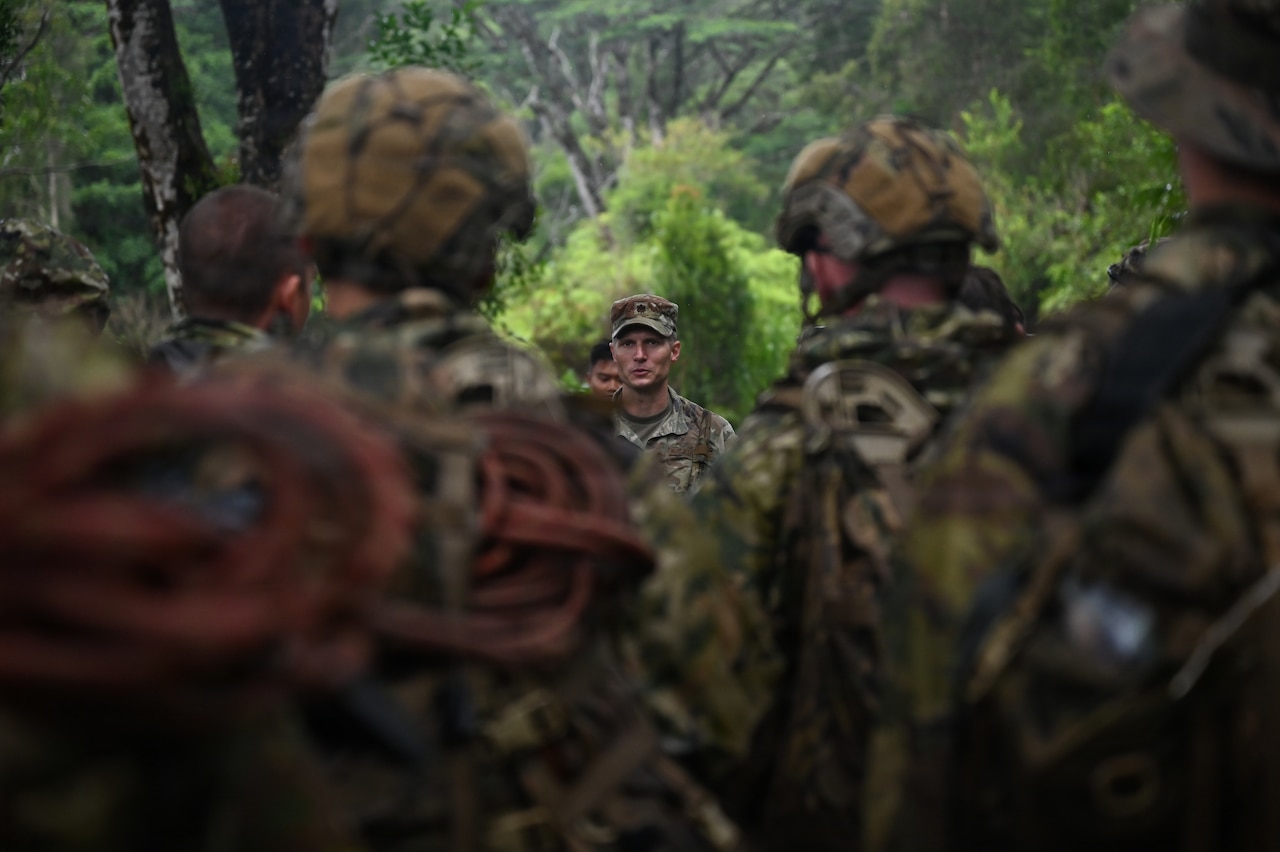
A man in a camouflage military uniform speaks to a group of other people in similar attire while standing in the jungle.

Wind moves through the trees at Schofield Barracks' East Range as leaves crunch underfoot and boots sink into mud. Humidity clings to uniforms as security forces airmen navigate steep terrain, flowing water and unfamiliar surroundings, trading the familiar landscape of the Midwest for the jungle terrain of Oahu, Hawaii.

For two weeks, July 13-27, airmen assigned to the Ohio Air National Guard's 178th Security Forces Squadron challenged themselves through annual training designed to strengthen small-unit tactics, decision-making and expeditionary readiness.

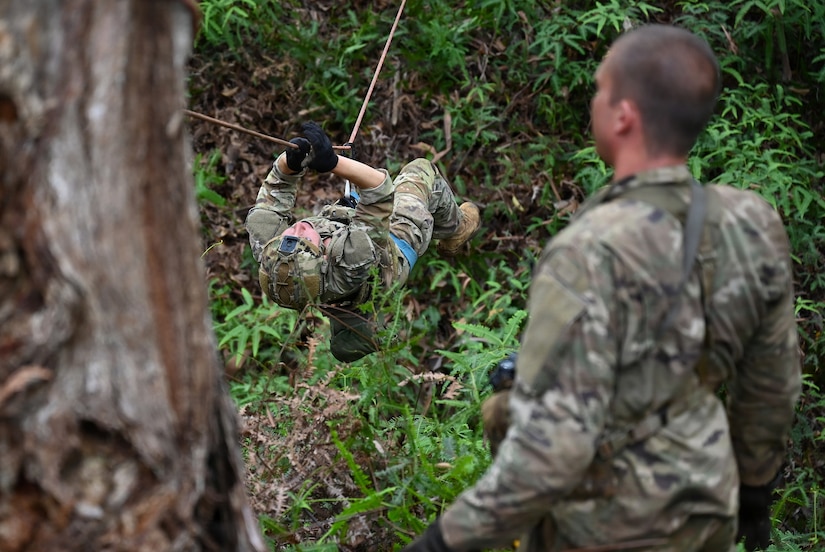
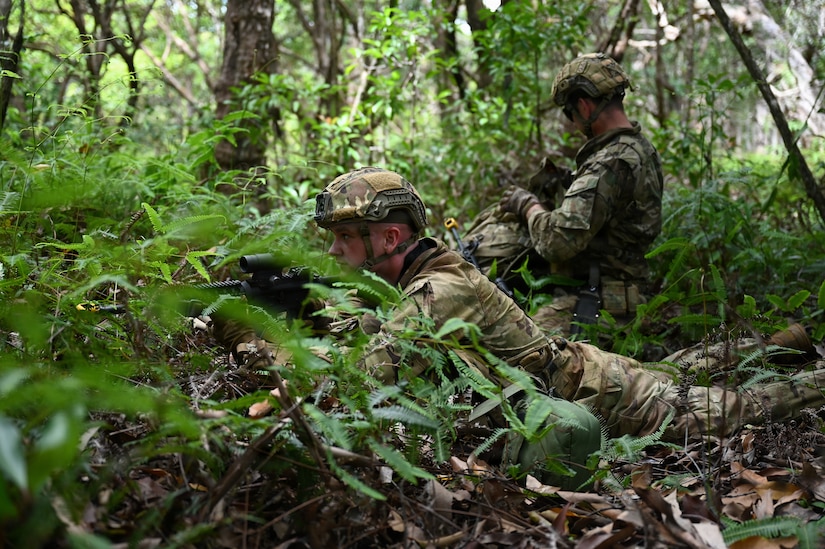
The training combined classroom instruction with hands-on field exercises, including jungle familiarization, dismounted patrolling, ambush training, land navigation and rope systems. The realistic environment challenged airmen to apply what they learned while operating in unfamiliar terrain.

This was part of an 18-month effort by the squadron to increase its focus on small-team operations and prepare airmen to make tactical-level decisions in increasingly decentralized environments that will be needed in the future, said Air Force Maj. Eric Minshaw, 178th Security Forces Squadron commander.

The jungle environment quickly became one of the most valuable instructors.

"The terrain and the environment have been perfect," Minshaw said. "It certainly has been the greatest challenge that we've faced out here, just navigating through the water and elevation changes."

A person in a camouflage military uniform uses a rope to cross an area in the jungle as another person in similar attire observes.
A man in a camouflage military uniform and helmet lies on the ground in the jungle aiming a rifle; there is another man in similar attire checking his equipment in the background.
For Air Force 1st Lt. Kyle Mackerig, a guest jungle instructor assigned to the 820th Base Defense Group at Moody Air Force Base, Georgia, the training provided an opportunity to share knowledge gained through his experience operating in jungle environments.

Mackerig graduated from the Army Jungle Operations Training Course in May 2025 and joined the 178th SFS to help airmen develop the skills necessary to operate in jungle terrain.

The goal extended beyond simply learning how to navigate. The training challenged airmen to remain effective when conditions were unfamiliar, and the path forward was uncertain.

"The jungle is the classroom, not the objective," said Air Force Master Sgt. Bradley Akers. "Our purpose is to push our airmen beyond their comfort zones in one of the world's most demanding environments, reinforcing disciplined leadership, teamwork and adaptability. Those are the qualities that make them more capable defenders, regardless of where the mission takes them."

That challenge took many forms throughout the two weeks. Airmen hiked through steep terrain and mud, navigated waterways and practiced moving through the jungle while carrying their equipment.

During one exercise, they made their way to a river and moved chest-deep through the water, testing whether their packs could float and learning how to operate in and around a water obstacle. They emerged from the river covered in mud, carrying another lesson from an environment far removed from what they typically encounter in Ohio.

For Air Force Staff Sgt. Macy Flannery, squadron member, the experience also provided an opportunity to strengthen the bonds within her team. Flannery, who is in her fifth year of service, said the training challenged them to work together while learning basic survival skills and small-unit tactics.

"It's been a good bonding experience for our team," she said. "We're going through it all together and having to do a lot of teamwork for our different training experiences."

Mackerig said the teamwork he witnessed throughout the training gave him a new appreciation for the squadron.

"The biggest thing that surprised me about working with the [National] Guard, and in particular the 178th, is how tight-knit they are, how much of a family they are," he said. "Everyone feels welcome here, even from being an outsider."

That sense of teamwork became evident throughout the training, as airmen and noncommissioned officers looked after one another and shared skills developed through previous training and experience.

"We've got a great team," Minshaw said. "The NCOs that we have and the instructor cadre that have come in [are] absolutely top shelf."

From checking water supplies and applying sunscreen to sharing specialized skills and helping teammates navigate difficult terrain, the small actions demonstrated the team's commitment to one another, he said.

"It's really awesome to see the team come together" and use some of the special skills they have in the training environment and then teach their teammates, Minshaw said, adding that the ultimate value of the training lies in what airmen take with them when they leave. Training environments like this allow airmen to discover their limits in a controlled setting, giving them the confidence to face future challenges.

"It's better to find ... your breaking points and move past those in a training environment like this, rather than to be caught flat-footed in our operational environment," Minshaw said.

As the airmen leave the mud, water and steep terrain of Schofield Barracks, the lessons learned in the jungle will follow them. The physical challenges, tactical problems and moments of uncertainty provided more than a test of endurance. It allowed them to build confidence, strengthen teamwork and develop the ability to make decisions in unfamiliar environments.

Friday, September 26, 2025

Security Forces in Alaska Take Part in Specialized Training

Eight airmen assigned to the 673rd Security Forces Squadron participated in a Fly Away Security Team training course at Joint Base Elmendorf-Richardson, Alaska, Sept. 15-19.

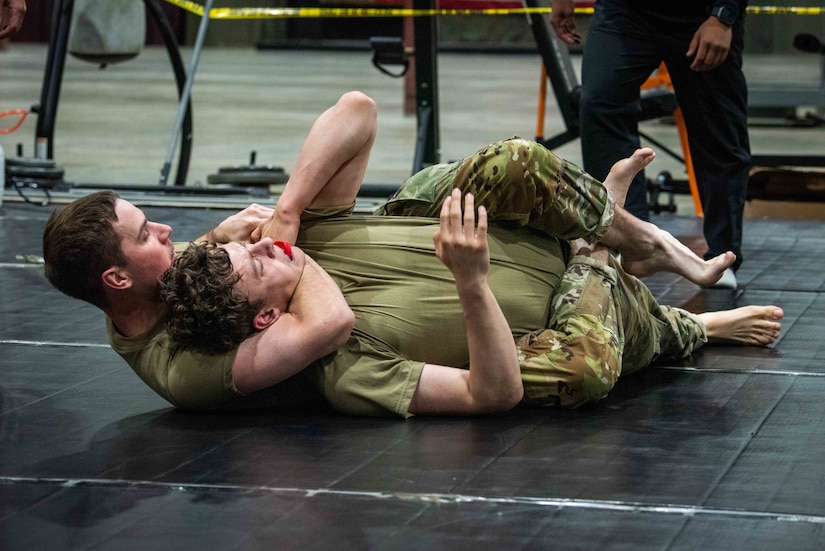
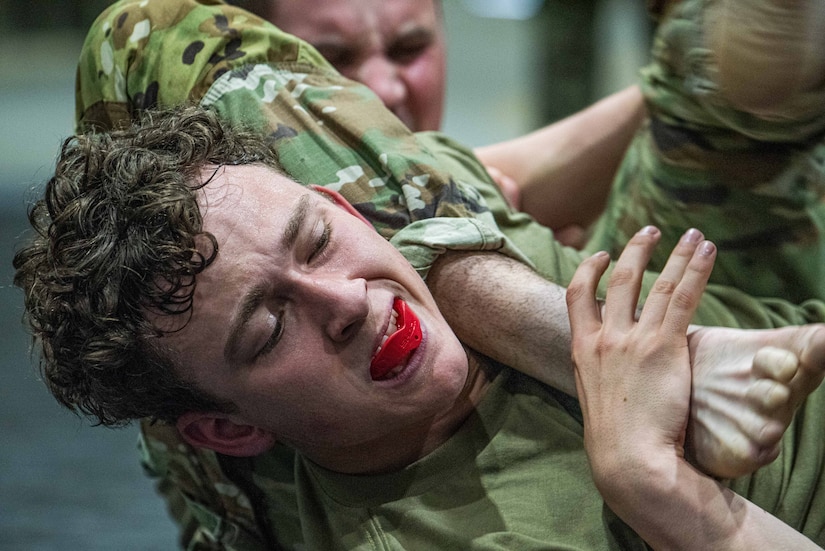
Two men dressed in camouflage military uniforms wrestle during combatives training. One man has a red bite guard in his mouth.

 
Fly Away Security Team training is a five-day, 40-hour course that challenges airmen physically and mentally to enhance their lethality while protecting aircraft, aircrew, cargo and distinguished visitors during operations on austere airfields. 
 
They aid in humanitarian missions and War Department operations; their missions typically involve providing a security perimeter around aircraft at unsecured, foreign airfields.

Two men wearing camouflage military uniforms wrestle during combatives training. One man has a red bite guard in his mouth.

 
"Fly Away Security is a certification that should carry a lot of weight — it is not for your average security forces member," said Air Force Staff Sgt. Taylor Davis, 673rd Security Forces Squadron noncommissioned officer in charge of small unmanned aircraft systems. "Here at [Joint Base Elmendorf-Richardson], we hold the FAST to a higher standard, and we train them at a higher standard; we train them to win." 
 
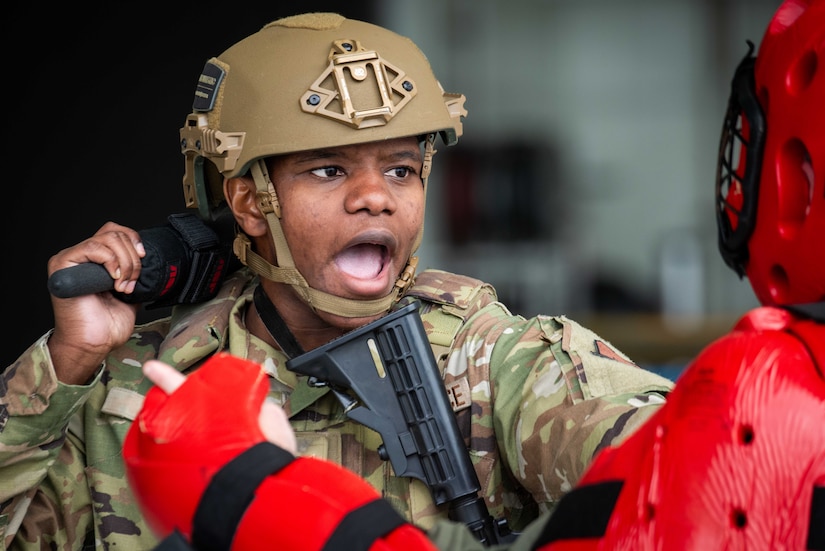
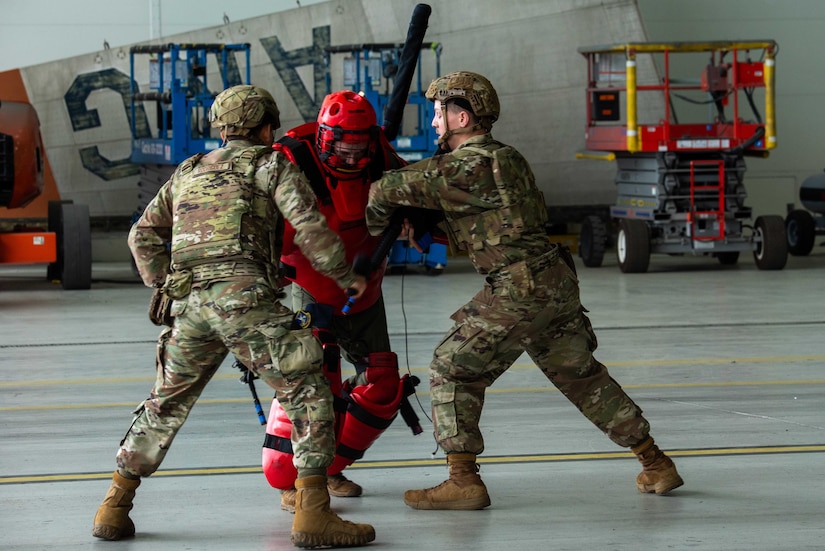
During the course, students undergo combat and hands-on training. They work through real-world simulations, demonstrating skills they have learned throughout the week. Some of the training included peer-on-peer wrestling, baton evaluation and flightline training with a C-17 Globemaster III assigned to the 517th Airlift Squadron.

A man wearing an advanced combat helmet and camouflage military uniform swings a baton at a person wearing a red padded suit during baton combatives training.
Two men wearing advanced combat helmets and camouflage military uniforms push a person dressed in a red padded suit and helmet during combatives training.
"We train our members to go out to these austere locations or airfields that do not have adequate security," said Air Force Tech. Sgt. Adam Stanley, 673rd Security Forces Squadron base defense noncommissioned officer in charge. "They have been trusted in protecting personnel and assets to provide a safer environment within their area of responsibility." 
 
The 673rd Security Forces Squadron conducts FAST training courses multiple times a year, not only for its own members but also for other Air Force units. They plan to expand the program to enhance security for airfields and aircraft.

Wednesday, September 09, 2015

Face of Defense: Seeing Double


By Air Force Airman 1st Class Alexa Ann Henderson 36th Wing

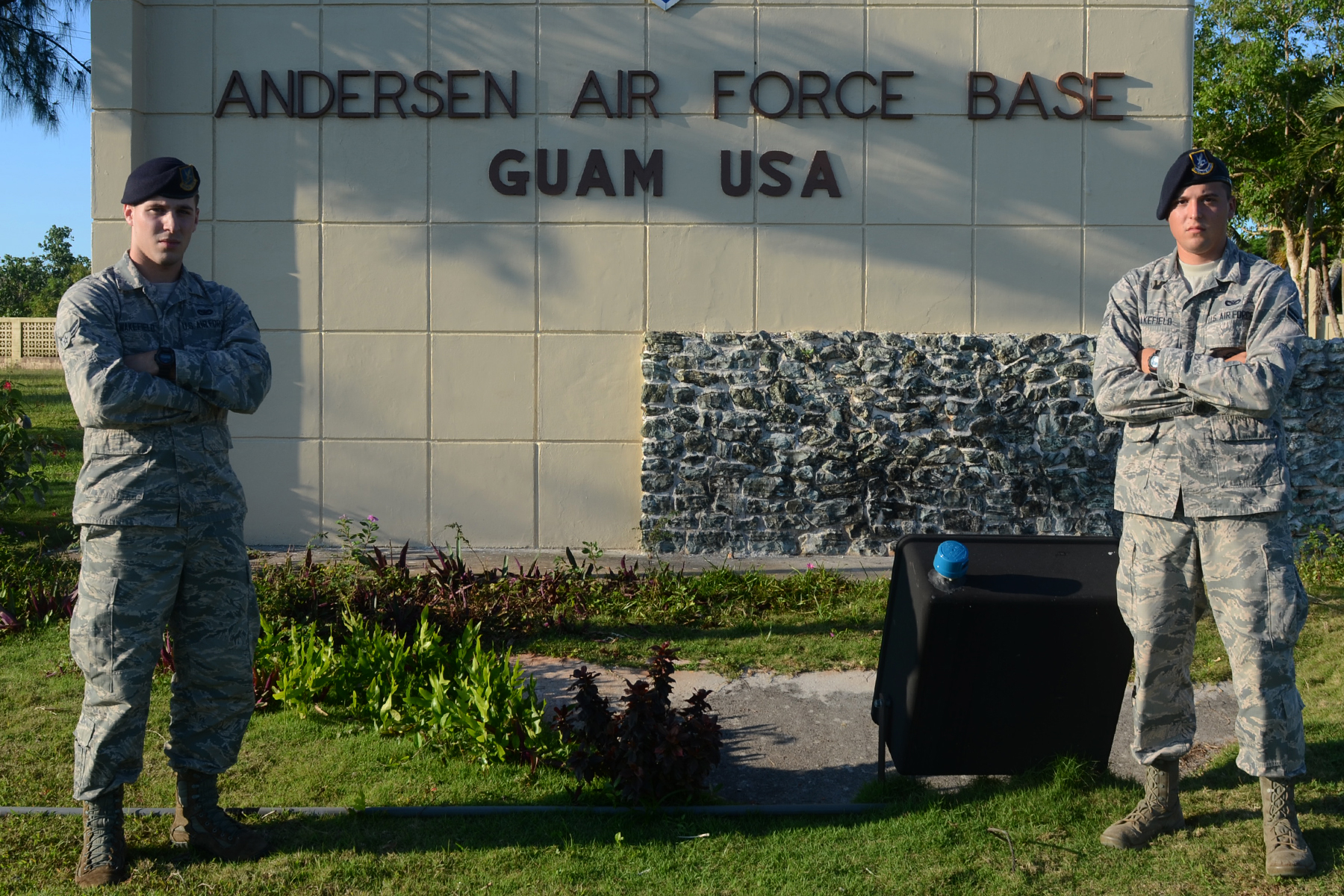
ANDERSEN AIR FORCE BASE, Guam, September 9, 2015 — Driving through the gates at Andersen Air Force Base, someone could easily mistake the two airmen that stand guard there, and it’s easy to see why.

Though not identical, they could almost be the same person, but one has longer hair. They have the same Washington state accent, stand at about the same height with little difference in their features and they bear the same name on their vests.

U.S. Air Force Airmen 1st Class Colby and Travis Wakefield are fraternal twins who also are 36th Security Forces Squadron entry controllers.

Although Andersen is their first duty station, this is not the first time the Wakefields have served together since beginning their military careers.

Travis and Colby both signed up for security forces and left for basic training on the same day after asking if they could go together. After arriving at Joint Base San Antonio-Lackland, Texas, for basic military training, they found out they were in the same flight. Together, they graduated and became airmen.

Once they reached technical training, they found a way to become roommates. However, this is not where their camaraderie was destined to end.

"After we had been at tech school for a week or so, we decided to look and see where we were going to be stationed," Colby said. "I looked first, and it said Andersen Air Force Base. My brother decided to look next, and it also said Andersen. We don't know how, but we got stationed together."

The brothers graduated technical training and went home before reporting to their first duty station.

"It was easier to come here, because I had my brother with me," Colby said. "We were going through the same thing."

After spending the first 18 years of their lives with each other, the brothers arrived here in April 2014 to perform the same job within the same squadron.

The brothers currently share the same work schedule, so their days off often coincide.

"We spend a lot of our off time doing the same things," Travis said. "We play golf and other sports with our squadron. We grew up playing a lot of the same sports. We pretty much do everything together."

Having two airmen who look very similar and share a last name can be confusing, so they were given nicknames.

"We call Colby 'Regular Wakefield' and Travis 'Baby Wakefield,' because they were born one minute apart," said Tech. Sgt. Alicia Goetschel, the 36th SFS flight chief.

The twins are soon due to find out where they’ll be assigned when they return from overseas, but they hope it won't be the end of them working together.

"We were told there's a possibility we could be kept together until we reach [higher ranks]," Colby said.

They both agreed that joining the Air Force was one of the best decisions of their life, and they hope to continue their careers together wherever the Air Force may take them.

The Wakefields also have an older sister, a mother and father who live in Washington.

"Every time I call them on the phone to see how they’re doing, they always tell me the same thing," said the twin's mother. "They tell me how happy they are with joining the Air Force and how they are so proud to see just how far they have come."

The twins aren't the only ones who have pride in what they are doing, though.

"It's been a blessing to have them stay together," the mother said. "It's also comforting to us, too; I always find out what's going on from one of the boys. We are so proud of them and all that they have accomplished."