Showing posts with label Military Housing. Show all posts

Friday, October 02, 2026

Navy High-Speed Wi-Fi Reaches Milestone for Global Unaccompanied Housing

The Navy's initiative to provide free, high-speed Wi-Fi to all Navy-owned and -operated unaccompanied housing is 90% complete, with the service now available in 865 of 962 buildings since the rollout began in November 2025. 

The program, a partnership between Commander, Navy Installations Command and the Navy Exchange Service Command, continued its worldwide expansion with service going live across bases throughout the continental United States, Europe, Asia and the Pacific region. 

Driven by a dedicated focus on improving the quality of service, well-being and operational readiness of sailors, the effort ensures warfighters remain connected to family, support networks and educational resources while stationed abroad and in the United States.

A man wearing a camouflage military uniform uses a laptop while sitting in a building as two other people in similar attire, one standing and one sitting, watch him. A sign next to them reads "Just Connect. Free Wi-Fi Here."

"Reliable connectivity is an important part of sustaining the force and ensuring sailors have the support they need to remain ready and resilient," said Navy Vice Adm. Scott Gray, deputy chief of naval operations for sustainment. "This milestone demonstrates the Navy's continued investment in the infrastructure and services that enable our people to focus on the mission, wherever they serve." 

Navy Vice Adm. Brad Collins, Navy Installations Command commander, said the command will sustain the initiative's momentum through completion and continue pursuing improvements across the shore enterprise. 

"Across 71 installations, our responsibility is clear: deliver the safe, resilient and reliable shore infrastructure and services sailors need to succeed," he said. "Completing this Wi-Fi initiative remains a priority, and we will build on this progress to raise the standard of service, strengthen quality of life, and ensure our shore enterprise keeps pace with the needs of a ready naval force." 

The remaining 10% of unaccompanied housing facilities located in isolated regions, such as Camp Lemonnier in Djibouti and the Naval Support Facility Diego Garcia in the central Indian Ocean, are scheduled for completion in fiscal year 2027. 

The program continues to offer filtered free Wi-Fi and subsidized high-speed upgrades without long-term contracts or termination fees in full compliance with the Military Honor and Decency Act of 1996. 

Program managers report network operations continue to run smoothly, and sailors experiencing connection issues are encouraged to contact the service provider help desk for immediate support. For more information on the program and availability, sailors can visit www.navymwrsinglesailor.com.

Monday, September 21, 2026

Military Spouse Commission Holds First Meeting, Identifies Top Issues

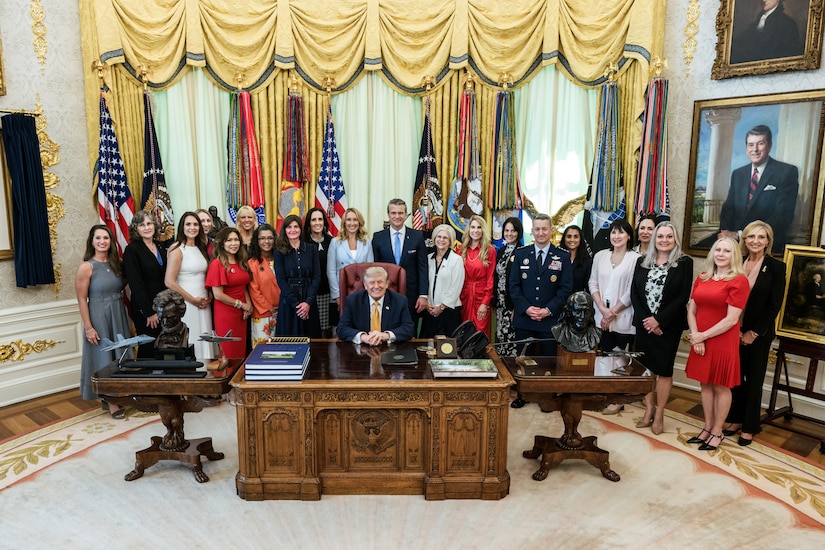
The Military Spouse Commission held its first meeting today at the White House. 

The commission, which President Donald J. Trump established via executive order Aug. 3, is tasked with advising and assisting the president on policies that affect military spouses and families.

A man in business attire sits at a large wooden desk inside an office, surrounded by roughly two dozen men and women.
 

Secretary of War Pete Hegseth, who attended the meeting as a guest, spoke briefly to the roughly 20 attendees. 

“A lot of things that need to happen in our department happen with the stroke of a pen from either your husbands, at [their] level, and if not, up at the office of secretary of war level; and we are prepared to wield that pen,” Hegseth told the commission, which comprises the spouses of the War Department’s most senior military leaders.   

His wife, Jennifer Hegseth, chairs the commission and spoke about its establishment. 

“We're here to help President Trump improve the lives of America's nearly 1 million military spouses, which you all are a part of. And as you know firsthand, military spouses make a sacrifice for our nation together with the sacrifice of your warrior,” she said. 

She went on to explain that the commission will work to tackle big issues like employment, housing, education and healthcare, as well as micro issues that also need addressing. 

“Many of those solutions will be new, but some already exist and have gotten stuck in the bureaucracy — and we'll find those too,” she said. 

Jennifer Hegseth noted that some of those issues will need to be revived from past efforts to fix them, and that some solutions will require Congressional legislation.  

“We will work to find solutions to all of them, so thank you all again for being willing to serve,” she said. 

Each commission member then introduced themself and spoke about the issues that they prioritize the most. As the meeting continued, it became clear that the three most referenced issues were: healthcare, employment and housing. 

Donna Caudle, the wife of the chief of naval operations, said that as a licensed healthcare professional, she has seen firsthand and heard from countless Navy families about the challenges they face when accessing healthcare. 

“I look forward to working with the commission to help President Trump improve continuity of care and capacity, reduce appointment wait times, and close the gaps in specialty care and mental health services for our military families,” she added. 

Debbie Schiess, the wife of the chief of space operations for the Space Force, said she would love to see legislation that allows spouses who are licensed in any state to practice on federal installations.  

“This would tackle two issues at once: aiding in spouse employment and increasing our mental health providers,” she said. 

Regarding employment, Angie Perryman — who’s married to Master Chief Petty Officer of the Navy John Perryman — explained that spousal employment is near and dear to her. 

“I've been a full-time federal employee with the Department of War for almost 20 years as a licensed clinical social worker, and I know firsthand that military spouse employment is not simply about finding a job; it's about preserving a career,” Angie Perryman said. 

She noted the importance of allowing spouses to maintain their jobs despite frequent changes of location. 

“My goal is to help make military-directed moves as close to career-neutral as possible through portable work, remote work, meaningful license, portability, and employment policies that allow spouses to build careers that move with their families,” she further explained. 

Katrina Isom, the wife of the senior enlisted advisor to the chairman of the Joint Chiefs of Staff, explained that experiencing numerous moves over her husband’s nearly 40-year career has led her to focus on the quality of military housing. 

“During our time in the military, I've seen and experienced firsthand the struggles of increasing costs of housing, and the challenges of ensuring [the basic allowance for housing] meets the needs of our service members. As a member of this commission, I look forward to helping ensure that we are doing everything possible to ensure the housing needs of our military members is adequately met,” Isom said.

A silhouette of two adults and two children standing with their backs to the camera, holding hands while watching the sun set over a beach.

Following all the introductions, the secretary of war had high praise for the quality of talent among the commission members, as well as the 544 years combined of active-duty spouse experience the members share. 

“What an incredible background of human beings — Americans who gave the entirety of your lives to the whims of where the government sent your family,” he said. “And the least we can do is try to look back on that [time] and give.” 

The commission is scheduled to meet monthly at the White House.

Friday, December 05, 2025

Hegseth Directs Task Force to Oversee Department-Wide Barracks Improvement

Secretary of War Pete Hegseth directed in an Oct. 6 memorandum that a barracks task force be stood up to develop a departmentwide investment plan for barracks improvements and report its progress to him within 30 days. 

A four-story two-tone barrack is shown with snow on the ground.

"For far too long, this department has failed too many of our warfighters. Every member of our joint force deserves housing that is clean, comfortable and safe," he said in a Nov. 25 video posted to department social media sites. 

Too often, barracks are shabby and without basic modern amenities, Hegseth said. 

Troops in camouflage uniforms are seated at a table eating outside in front of a building.

"But this isn't just about creature comforts. This impacts morale, readiness and our ability to recruit and retain the best warriors. Quality of life for our warriors is a critical component of reviving the warrior ethos and rebuilding our military," he added.

Barracks are where warriors live, rest and recover, Hegseth said. 

"How can we expect them to be ready for anything on the battlefield when their own living space is a constant source of stress and frustration? That all ends now," the secretary said. 

The barracks task force includes representatives from across the War Department, including experts in contracting, leaders from military installations, and experts in personnel, readiness and finance. 

Hegseth expects the task force to deliver results and cut through the bureaucracy to bring immediate solutions, as well as a long-term plan to keep barracks at the standard warriors deserve. 

Five troops in camouflage uniforms and white hardhats smile as they hold shovels of dirt.

"No delays, no excuses, and no more business as usual. The standards will be enforced, and accountability will be nonnegotiable. This is not just another study over the course of years," he said. Items the task force will expedite include, he said.

  • Leverage the expertise of private industry to deliver innovative technologies and contracting strategies that accelerate construction and renovation.  
  • Consolidating, when possible, contracts for maintenance, services and equipment.  
  • Empowering unit commanders and senior enlisted leaders to fix issues at their level without having to wait on Pentagon bureaucracy. 
  • Working across the federal government to gather even more tools that will help ensure this happens quickly.  
  • Working with the Office of Management and Budget on new solutions to renovate and maintain barracks to the standards that warriors deserve. 
  • Where possible, using the kinds of rapid processes found in the private industry. 

The Office of Acquisition and Sustainment; Office of Energy, Installations and Environment; Office of Personnel and Readiness and others are involved in planning and execution of the secretary's directive.