Showing posts with label vietnam veteran. Show all posts

Wednesday, November 04, 2026

From Vietnam to Afghanistan: A Vermont Guard Member's Lifetime of Service

A man in casual attire smiles and poses for a photo as he pretends to board a military helicopter on a flight line.

"At midnight, it was time to move," said retired Army Sgt. 1st Class Pete Ferrell, recalling a night in Afghanistan.

He gripped the handle of one of the four corners of a field stretcher carrying a wounded soldier. A tray of medical equipment on the soldier's chest chirped as it monitored vital signs and sustained him. The team of four soldiers locked step, carrying the patient onto a plane bound for a higher level of care.

As the plane transporting the wounded soldier took off, Ferrell found himself on the same runway at Bagram Airfield where the deployment began months earlier. There, at the feet of the towering Hindu Kush mountain range, four decades and nearly 3,000 miles stood between him and the jungles he hovered over in a UH-1 Huey helicopter in Vietnam during his first combat tour.

In 2010, at age 62, Ferrell secured an age waiver and volunteered for the deployment to Afghanistan with the Vermont Army National Guard's 86th Infantry Brigade Combat Team.

A man in a camouflage military uniform carries a weapon strapped across his body and smiles for a photo.

"He always seeks something bigger than himself to be part of; that's just who Pete is," said Army Maj. Beth Carrier, a physician assistant assigned to the New Hampshire Army National Guard, who deployed to Bosnia with Ferrell in 2002, when she was a flight medic. "I can only hope that somewhere in my life that I am a fraction as good of a human as he is."

For many, it's hard to imagine that the Vietnam veteran, who flew over 250 combat hours as a Huey crew chief and survived being shot down in Laos, felt he owed more.

"I never got wounded or had PTSD; I was still capable, and I felt I still had to do more," Ferrell said.

When he arrived in Da Nang, Vietnam, in 1970 as a helicopter mechanic, he was assigned to the night maintenance shift in a hangar. It was far from the excitement of flying he had imagined as a child growing up in Braintree, Massachusetts, watching planes take off and land at the airport and flying his own model aircraft. So, he went to his platoon sergeant and asked for a flight platoon assignment.

A few days later, the platoon sergeant told him to shadow another soldier who showed him how to do daily maintenance on a Huey.

"Then he says, 'OK, that one's yours,'" Ferrell recalled. From then on, the 22-year-old specialist was now in charge of his own helicopter.  

"We learned a lot about maintenance in training, but overseeing a whole aircraft was a lot of responsibility," he said.

But along with the added responsibility, he also got his childhood wish.

"When the aircraft flew, you went with it," he said. 

Ferrell said he mostly flew "ash and trash missions" — lift missions that could include transporting anything from troops to supplies to mail.

However, about three months before his tour ended, his unit was selected for Operation Lam 719, a highly contested two-month offensive where they flew South Vietnamese troops into southeastern Laos. The objective was to disrupt North Vietnam's military supply network on the Ho Chi Minh Trail.

Ferrell said he knew this mission was not routine; the danger felt so imminent that he prayed.

"I started out saying [Psalm 23] when we took off on the first three sorties, and by the fourth one, I must have gotten too comfortable," he said. "One pilot said to the other, 'Stay tight to this hill,' and he no sooner said that, and the windshield for the aircraft was blown out."

The aircraft crashed, but Ferrell and the rest of the crew survived.

"Somebody started yelling, 'Come on, come on!'" he said, adding that another aircraft had landed nearby, and they all started running to it. "I grabbed my M16 and started tromping through the jungle, and we all got on the other aircraft and flew out."

An older photo depicting a young man in a flight suit leaning on a military helicopter

It wasn't until Ferrell was on the plane flying home from Vietnam with a ream of military records that he realized he had received 10 Air Medals for his combat flight hours; he received an Air Medal with Valor for the mission on which he was shot down.

Ferrell finished his active-duty service in 1973 and settled into civilian life. He married Deb, the woman he exchanged letters with throughout the war, and they moved to Vermont, where they had their first son.

Then, in 1981, he heard a familiar sound and looked up in the Vermont sky, where he saw Hueys overhead. Ferrell said he knew he had to track them down. He found them at a Vermont Army Guard aviation unit hangar in Burlington.

"I walked in, and there were 12 Hueys there, and it was like a homecoming. I was home again," he said.

Ferrell met with a flight platoon sergeant who eased his fears that joining the National Guard might mean sweeping floors instead of maintaining and flying aircraft.

With that, Ferrell reenlisted and was back to working on Hueys.

In 1998, his unit transitioned to the UH-60 Black Hawk helicopter and assumed a medevac mission. Ferrell was hesitant about learning a new aircraft and mission until he teamed up with Carrier, a 20-year-old specialist so passionate about her role as a flight medic that she inspired him.

"She taught me that it was all about saving lives, and there's no better mission than that," he said.

Ferrell didn't come around right away, though, Carrier said, adding that he refused to do medical training, insisting his job as the crew chief didn't require it. However, he changed his tune after they transported a soldier with severe appendicitis — their first real-world patient in Bosnia.

After the mission, Ferrell told Carrier that her ability to help the soldier had captivated him, but he admitted he felt helpless to assist.

"He completely did a 180 on the entire idea of not touching a patient. It was a 100% adjustment of his thought process," she said. "From then on, he wanted to do all he could, asking, 'What can I do? What can I learn? What can you teach me so I can help you?'"

In turn, Ferrell used his aircraft knowledge to help Carrier better set up her medical gear to deliver care more expediently. She took these lessons with her when their careers parted ways. Carrier deployed to Iraq, was commissioned as an officer and went on to study medicine.

The two remained close. Ferrell was the "man of honor" at her wedding, which required him to wear a raspberry-pink shirt for the occasion.

"I always knew, with him, I was well protected. On the hoist, he could drop me on a dime. I always knew that the aircraft that we were on was the safest that it could possibly be. That was because of Pete's work ethic," Carrier said.

When Ferrell returned from the Bosnia deployment, changes in the aviation unit led him to move on from aviation. Eventually, he was assigned to the Vermont Army National Guard's 86th Infantry Brigade Combat Team headquarters, which led to his 2010 Afghanistan deployment.

When Ferrell told his wife and sons about volunteering for the deployment, he said they were the only people in his family who didn't think he was crazy.

"It's just a part of who he is, and it's how they [his sons] always knew their father," his wife said. "So, it was just, he's going to be gone for a while, but he'll be back, and we will, as we say, improvise, adapt, and overcome."

When Ferrell arrived in Afghanistan, his daily duties at the headquarters company kept him mostly at Bagram, but as he had throughout his career, he felt he still had more to give.

A man in casual attire smiles for a portrait outside; a military helicopter is in the distance.

One night he stumbled upon it while sitting in the base's operations center. A major from another section told him he had a mission at the airfield. Ferrell's interest was piqued. It turned out that the officer had inadvertently found Ferrell another medevac mission: transferring wounded patients from the field hospital to facilities with higher levels of care.

"You know, like Beth [Carrier] had taught me, saving lives is the greatest mission there is, and that is what it was," he said. 

He began stopping at the hospital every day after his shift to ask if volunteers were needed that night, but he never mentioned his side quests to anyone in his unit until years later. Ferrell continued the late-night missions until he returned home from Afghanistan just before Christmas 2010.

By then, he was 63 years old, three years past the standard mandatory retirement age.

Ferrell finally retired from the military in 2011, with 33 years of service.

"You get home from Vietnam, you realize how many men were lost and how many were wounded, and you think, 'Why me? Why did I survive?'" he said. "You figure out that there is a plan here, so you have to go with it. You take it as the blessing that you were saved for a reason. I can look back now and say that this is where God was pointing me."

Monday, October 19, 2026

Medal of Honor Monday: Army Col. Lloyd L. 'Scooter' Burke

Army Col. Lloyd L. "Scooter" Burke served on active duty for 30 years and saw three wars. He received the Medal of Honor in 1952 for the courage and leadership he displayed as a young officer during the Korean War. 

Burke was born Sept. 29, 1924, in Tichnor, Arkansas, to Arthur Dewey Burke, a lumber mill foreman, and Betty. He was the second oldest and had four siblings: Claude, Dorothy, Donna and Betty. His family nicknamed him Scooter because, as a child, he was always scooting around the house and yard. 

A man in a formal military uniform is wearing a star-shaped medal attached to a ribbon around his neck.

In 1930, his family moved to Clarendon, Arkansas, and a few years later, they moved down the road to Stuttgart, Arkansas. After graduating from Stuttgart High School in 1942, Burke enrolled at Henderson State Teachers College in Arkadelphia, Arkansas. However, he dropped out in 1943 to enlist in the Army. 

He served two years in Italy as a combat engineer during World War II, rising to the rank of sergeant.  

After being honorably discharged on Jan. 28, 1946, he returned to Henderson State, majored in chemistry and joined the ROTC program.  

In 1946, he married Virginia Fletcher, and they had three children. They divorced in February 1975, and three years later, Burke married Maxine Hardin. 

Following graduation in June 1950, Burke was commissioned as an Army second lieutenant, just as the Korean War was starting. After infantry officer training at Fort Benning, Georgia, he was assigned to Company G, 2nd Battalion, 5th Cavalry Regiment, 1st Cavalry Division, and boarded a troop transport ship to South Korea. 

On Nov. 26, 1950, near Samso-ri, North Korea, his unit encountered an enemy roadblock on a ridge, manned by Chinese soldiers who had recently come to the aid of their communist ally. 

A stainless steel statue of a man in a military-style helmet and rain poncho is positioned in a landscaped area near similar statues.

Burke led his company in five attacks that cleared the impasse, earning him the Distinguished Service Cross — the second-highest Army medal for valor. 

From December 1950 to January 1951, the soldiers battled south of the 38th Parallel to establish defensive lines against overwhelming enemy forces.  

On Oct. 28, 1951, Burke's unit was on Hill 200 near Chong-dong, North Korea. His Medal of Honor citation states that intense enemy fire had pinned down leading elements of his company when Burke left his command post to rally and urge the men to follow him toward three bunkers impeding their advance. 

Dashing to an exposed vantage point, he threw several grenades at the bunkers and then returned for an M1 rifle and the grenade projection adapter, which allowed him to fire grenades instead of throwing them. 

He made a lone assault — killing the crew of a bunker. He lobbed grenades through the opening of another bunker and, with his pistol, killed three of its occupants who were attempting to surround him.

Three men stand side by side with their hands folded beneath their waists.

Ordering his men forward, Burke charged the third bunker, catching several enemy grenades in midair and hurling them back at the enemy. Inspired by his display of valor, his men stormed the hostile positions but were again pinned down by increased fire.  

Grabbing an M1919 Browning machine gun and three boxes of ammunition, Burke dashed through the impact area to an open knoll, set up his gun and poured crippling fire into the ranks of the enemy, killing approximately 75.  

Although wounded, he procured more ammunition and destroyed two mortar emplacements and a machine-gun position with his accurate fire. Cradling the weapon in his arms, he then led his men forward, killing about 25 more enemy forces and securing the objective.

After being treated for his wounds, he flew back to the U.S., where President Harry S. Truman awarded him the Medal of Honor during a ceremony at the White House, April 11, 1952. 

Burke chose to remain on active duty and was assigned as an infantry school instructor at Fort Benning from 1952 to 1955. He served as a company commander with the 13th Infantry Regiment at Fort Carson, Colorado, deploying to Smith Barracks in Baumholder, West Germany, until April 1958. 

He was assigned to the 1st Infantry Division at Fort Riley, Kansas, for two years, followed by four years as an Army staff officer at the Pentagon. In July 1964, Burke returned to Fort Riley and became the battalion commander of the 2nd Battalion, 16th Infantry Regiment, 1st Infantry Division. 

Three people in military uniforms and carrying weapons run toward a helicopter as two other helicopters hover in the distance.

In June 1965, his unit deployed to South Vietnam, tasked with protecting Bien Hoa Air Base and the surrounding area. On July 22, 1965, while flying in a UH-1 Huey helicopter, enemy fire from the Viet Cong riddled the bird, causing it to crash. Burke sustained multiple back, foot and leg injuries that required months of recovery and surgeries. 

Following his recovery, he served as the chief Army liaison to the House of Representatives from 1966 until his retirement. He rose to the rank of colonel and retired June 30, 1978.  

A burial marker sits in a grassy field and reads, "Lloyd L. Burke, Medal of Honor, Col. U.S. Army."

After his retirement, Burke moved to Hot Springs, Arkansas, where he and other veterans advocated for the building of the Korean War Veterans Memorial on the National Mall in Washington. He participated in the memorial's dedication in July 1995. 

Burke died of a heart attack June 1, 1999, and is buried in Arlington National Cemetery in Virginia. 

In 2004, the U.S. Post Office in Stuttgart, Arkansas, was named for him, and in 2017, the youth services center at Camp Humphreys, South Korea, was dedicated to Burke. A highway historical marker also stands at his birthplace in Tichnor, Arkansas. Tichnor and Stuttgart claim Burke as their native son. The ROTC program at this alma mater is nicknamed Burke's Raiders in his memory.

Sunday, July 05, 2026

Vietnam Veteran Receives Purple Heart 57 Years Later

Fifty-seven years after Spec. 4 Raymond Williams was wounded in Vietnam, one Army Reserve noncommissioned officer made sure he finally had his moment.

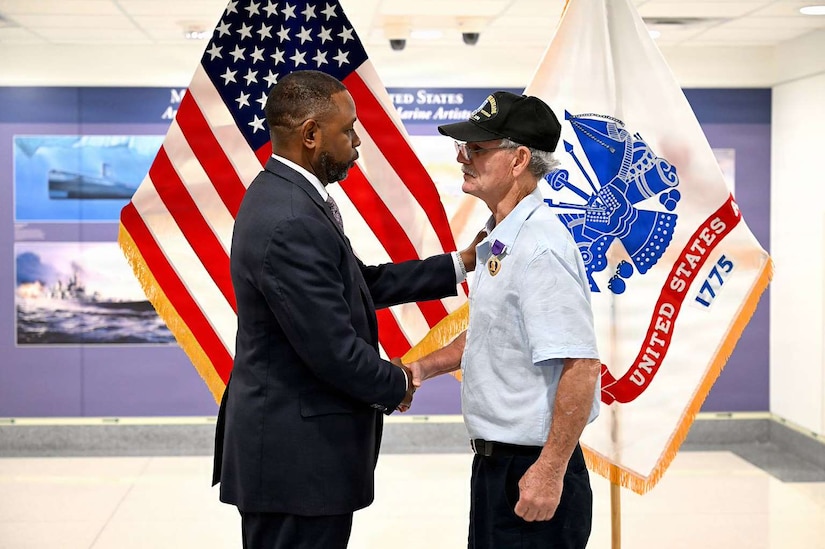
A man in business attire shakes the hand of a man in casual attire in front of an American flag and an Army flag.

For then-19-year-old Williams, 1969 was shaping up to be a year to forget before it even began. On Dec. 31, 1968, the young infantryman was being loaded onto a helicopter and evacuated out of the jungle with wounds that would take more than half a century to heal. 

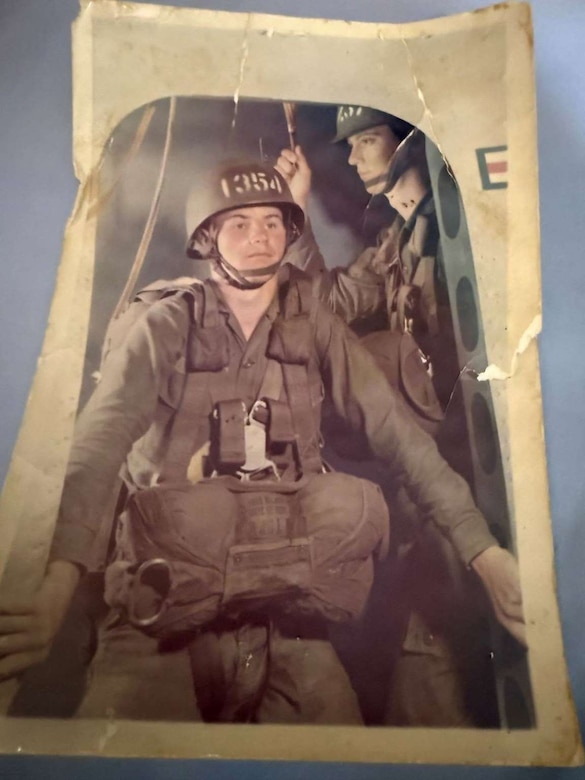
A year earlier, almost to the day, Williams walked into a recruiting station and raised his right hand. He completed basic training, earned his paratrooper wings and soon became the M60 gunner for his unit, Bravo Company, 4th Battalion, 503rd Infantry, 173rd Airborne Brigade. It was the weapon he carried into the Central Highlands of Vietnam, where Williams found himself in what he called "a small firefight." 

"I just remember getting shot in the arm first, then the shoulder. I was trying to carry on, but my right arm was just hanging," Williams said. "I did the best I could." 

Military records confirm what happened; at approximately 10 a.m., local time, near the town of An Khe, Vietnam, an enemy AK-47 round tore through his right arm. The round fractured the bone in two places and lacerated the nerve leading to his forearm and thumb. 

Eight months later and permanently disabled from his combat wounds, Williams medically retired from the Army. 

"I remember getting on the chopper, and I didn't want to leave," he said. "I did not want to leave." 

A man, wearing a Vietnam-era Army uniform, a helmet and a packed parachute, prepares to jump from an aircraft.

Back home, Williams built a life. He worked as a pressman at the Easter Seals printing press, married and raised three children. Life was good — but the war never fully lost its grip. 

"The [Department of Veterans Affairs] was never prepared for us," he said. "We stood outside in a line in the ice-cold to get into the hospital because they just weren't ready. But it was just what it was." 

Williams rarely spoke of the war. Like many veterans of that era, he battled with depression and did his best to cope with post-traumatic stress disorder, long before it had a name. 

"It was a tough, unpopular war — coming home was tough," he said. "Nobody wanted to talk. You kind of bury it." 

Years passed; his family learned not to bring it up. Then, in 2025, Williams decided it was time. 

At 77, while in the hospital, Williams told his daughter Kelly he wanted to visit the Vietnam Veterans Memorial — and finally receive the Purple Heart he had earned but never been awarded. 

Kelly Williams filed the paperwork with the National Personnel Records Center. Weeks later, she received confirmation. When the medal arrived in May, she contacted the Army to ask whether her father could receive it during their trip to Washington. She hoped it could be a surprise. 

It was a long shot. The family was deep into their travel plans from New Hampshire, and time was short. 

Army Master Sgt. Virginia Crutchfield was working at the Pentagon when the request came through — and immediately knew she had to make it happen. 

Crutchfield was on a yearlong tour coordinating Medal of Honor ceremonies; Purple Heart presentations were not in her lane. She had just nine days to pull it together, and the team shifted workloads so she could take on the mission. She handled every detail — from securing Pentagon space to arranging homemade brownies and cake. She said she was driven by an understanding of what soldiers of Williams' generation faced when they came home — the silence, the stigma, the lack of welcome — it drove her to make the moment right. 

"When I go out, people see me in uniform and say, 'thank you for your service,' with a smile; sometimes with a hug. In their time, they didn't," Crutchfield said, her voice breaking. "It touched me. They go out and fight for us to remain free. It's the least we could do." 

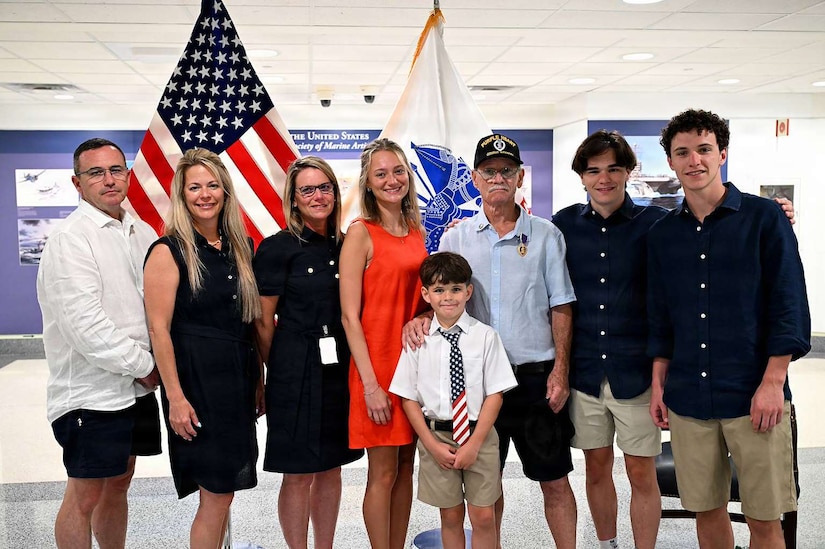
On the morning of the ceremony, Williams arrived expecting a tour. He and his family — daughter Kelly, sons Eric and Mark, and grandson Fynn — were escorted through the Pentagon to a corridor junction where a crowd had gathered: unfamiliar faces, soldiers in uniform and Crutchfield.

Eight people pose for a photo in front of an American flag and an Army flag.

That's when he realized what was happening. Overwhelmed, he took Crutchfield's hand. 

"All he could say was, 'You, you … you got me,'" she recalled, replying, "Sir, you did this. We are honored to do this for you." 

Retired Army Maj. Gen. Phillip Churn Sr., Army Reserve ambassador, presented the award.  

"The Purple Heart is not an award soldiers seek," Churn said. "It is … earned through blood, sacrifice and an unyielding commitment to the defense of this nation. Today, we correct the record. Today, we pin this medal where it has always belonged — on the chest of a paratrooper who gave his blood for our freedom." 

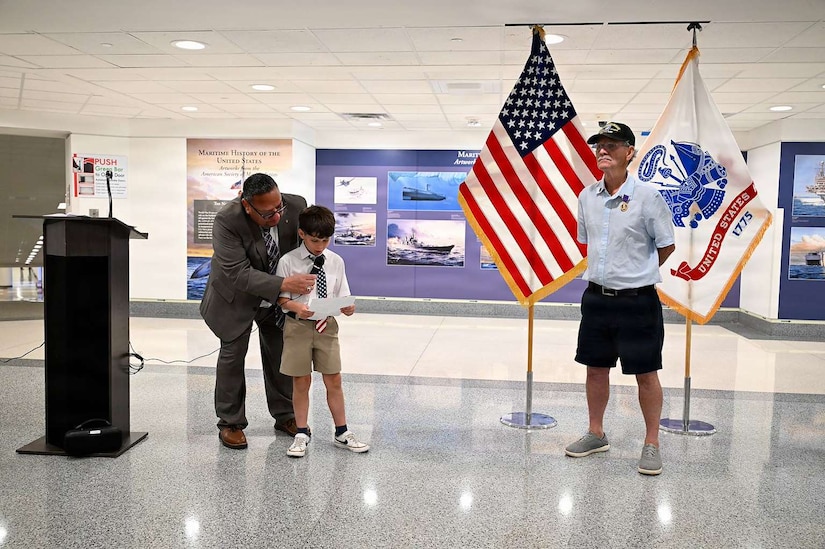
Fynn Williams, 8, had practiced his speech for weeks while keeping the secret from his grandfather. 

"There are some things in life that should never be lost," Fynn said. "Especially honor, sacrifice and courage. Years ago, you earned this through your service and sacrifice for our country. Even though the medal was gone, what it represents never was. We wanted to make sure it found its way back home, to where it belongs."

"We are proud of you. We are grateful for you. We love you, Papa."

A man in business attire crouches to hold a microphone for a boy who is speaking into a microphone while another man stands to the side at parade rest. An American flag and an Army flag are in the background.

For Kelly Williams, the ceremony was about more than just a medal. 

"It is about ensuring that his story, his service and his legacy are remembered," she said. "We have hope that today provides our father with a measure of peace." 

Williams had one word to describe the ceremony: "closure." 

"It never goes away," he said of the memories that still haunt him. "But it's a step in the right direction. This is probably good closure now. I feel like it's all out in the open." 

"I feel good now; I feel good today. This is good," he added.

Wednesday, August 29, 2012

Military Advisors Reflect on Vietnam War Experiences


By John Valceanu
American Forces Press Service

WASHINGTON, Aug. 29, 2012 – Two former military advisors who served with Vietnamese units during the Vietnam War spoke about their experiences in the Pentagon yesterday and shared their thoughts on advisory programs and counterinsurgency operations.

Retired Marine Corps Gen. Anthony Zinni and retired Army Lt. Col. James Willbanks took part in a panel discussion on “Advisors in the Vietnam War,” along with Andrew Birtle, chief of the Military Operations Branch at the Army Center of Military History. The panel was part of the Historical Speakers Series sponsored by the Office of the Secretary of Defense Historical Office.

Birtle opened the program with an overview of the U.S. advisory effort in Vietnam. An expert on counterinsurgency operations doctrine who authored books on the subject, Birtle outlined the development of the military advisor program from the first U.S. advisors in 1950 until end of the war in the early 1970s.

“Perhaps the most common emotion advisors experienced in Vietnam was the frustration of being held responsible for something they could not control,” Birtle said. “Nothing was more frustrating than the feelings that one’s efforts were falling on fallow ground.”

Zinni spoke after Birtle, sharing his experiences as an advisor to a Vietnamese Marine unit in 1967. The general, who eventually rose through the ranks to lead U.S. Central Command, said his primary duties as an advisor in Vietnam were to help coordinate fire support, air capability and operations with U.S. units. Working, living and eating with the Vietnamese – and operating all over South Vietnam -- gave him an insight into the conflict that he said he wouldn’t have gotten otherwise.

“Those who saw that war from inside a U.S. unit – despite the fact that certainly they saw plenty of combat, as we did – they saw a different war than I did,” Zinni said.

“I saw the war through the eyes of the Vietnamese people. I saw the war through the eyes of villagers that I lived with. I saw the war through the eyes of Vietnamese soldiers and Marines there weren’t there on one-year tours, but were there for the duration,” he said. “I saw the war from the Delta to the DMZ. I saw the war from Cambodia to the coastal plains in the east. And it was a totally different perspective than I was hearing from my counterparts.”

Zinni said he saw the most benefits result from Vietnamese units that built relationships with U.S. units over time, in which U.S. and Vietnamese soldiers could get to know and trust each other over time. He said it worked well with relatively small Marine Corps units, as well as with Army airborne and Ranger units.

“One of the strengths of the advisor unit, besides the fact that we didn’t have advisory teams and we sort of immersed ourselves into their organization and culture, is that we connected to the Vietnamese Marines very closely,” Zinni said.

But Zinni said there was a price to pay for being that close to the local forces.

“The advisory effort, when you were totally immersed in the culture, took a toll on you. By the time my advisory tour was coming neat to its end… I had contracted malaria, mononucleosis, dysentery and hepatitis,” Zinni said. “I was down to 123 pounds.”

This was not an uncommon phenomenon for service members in advisory roles.

“Most of the advisors suffered health issues and very few advisors finished a whole tour without a significant health problem or eventually being evacuated because of a health problem,” Zinni said.

Despite the physical hardships,  Zinni said the experience gave him “a sense of what this war was all about” and made him realize that the U.S. was failing to give the South Vietnamese people a good enough reason to put their lives on the line.

“If we didn’t capture the hearts of the people, if we couldn’t give them something to fight for, if we weren’t willing to ensure that the government was responsible to people, and we weren’t willing to cut off a base of supply that was endless, we eventually could not win that conflict, despite all the victories on the battlefield,” he said.

Zinni said he felt military leaders did not pay enough attention to knowledge gained in Vietnam, as attention shifted elsewhere after the war ended.

“Vietnam was rich in the lessons we never learned,” he said.

“The enemy beat us strategically; they didn’t beat us tactically,” Zinni said. “They didn’t beat us in terms of what we were able to develop in military capability with the South Vietnamese, but they beat us psychologically, and they beat us strategically. That lesson was never carried over.”

Willbanks spoke after Zinni. Now the director of the Department of Military History at the U.S. Army Command and General Staff College, Willbanks arrived in Vietnam as an advisor in 1971, when only four U.S. Army infantry battalions and a total of fewer than 125,000 U.S. troops were left in the country. He was assigned to an advisory team supporting an Army of the Republic of Vietnam, or ARVN, division.

“I was a captain with two and a half years in service, on my first combat tour,” Willbanks said. “I was being asked to advise a 40-year-old ARVN battalion commander, a lieutenant colonel who had been fighting most of his adult life. “

Because of his lower rank and relative inexperience, Willbanks said he sometimes had difficulty in getting the battalion commanders to listen to his advice. His duties during the early part of his tour involved assisting and training the Vietnamese in staff operations, acting as liaison to the remaining U.S. units in the area, helping with combat operations planning and accompanying the battalions on combat operations in the field.

Willbanks said everything changed when the North Vietnamese launched the “Easter Offensive” on March 31, 1972. He volunteered to replace a wounded advisor in provincial capital city of An Loc, where a battle raged day and night for the next two and a half months.

“At this point, the focus of my efforts shifted to coordinating U.S. combat support,” Willbanks said. “I spent all my time adjusting artillery – at least in the beginning, and pretty soon we had no artillery to adjust – air strikes, and also coordinating attack helicopters and fixed-wing gunships, calling for dustoff medical evacuation and coordinating aerial resupply.”

Willbanks said being in An Lac at that time was an experience different than anything he had ever conceived.

“It was a desperate battle that seesawed back and forth as the North Vietnamese and the South Vietnamese forces fought each other, sometimes house to house, block to block, room to room,” he said.

The South Vietnamese forces held out, and the battle began to die down as the summer wore on, but Willbanks was wounded for a second time and evacuated from the city. Once he was released from the hospital, he spent the rest of his time helping the ARVN recover from the Easter Offensive. He said he left the country at the end of his tour “feeling pretty good” about what he’d been able to accomplish in helping the South Vietnamese forces.

Speaking generally about advisory efforts, Willbanks said there was less of an emphasis on the advisory effort and a shift away from it once U.S. ground troops started arriving in Vietnam. This eventually meant that not all advisors had the right qualifications, training or ability for the job. The advisory tours were often less than 12 months, which created turbulence hampered the ability to form a bond between Vietnamese troops and their U.S. advisors.

Eventually, the emphasis began to shift back to the advisors, as combat troops left Vietnam, but Willbanks said he thought it was too late by that point.

“From a personal perspective, I found the advisory duty very difficult. The duty required decisiveness and aggressive pursuit of the mission, but it also called for patience and restraint – a conflicted mix, to say the least,” he said. “The reality on the ground often flew in the face of the need to report progress.”

Willbanks said advisors “walked a tightrope” when it came to their duties. They had to be involved and proactive without stifling the initiative of the Vietnamese commanders. They had to be empathetic to their counterparts and understand their culture while being honest about the units and their leaders.

Perhaps most importantly, Willbanks said, advisors had to find a way to build a relationship with their counterparts without making them too dependent on the advisor and on U.S. combat and service support.  This proved to be a problem when the U.S. withdrew and the Vietnamese were left on their own.

“I have to say, even with all the difficulties involved, and even knowing how it all turned out, I’m proud of what I did as an advisor in Vietnam, and I only wish we could have done more,” Willbanks said. “The South Vietnamese were good people, and they deserved better than they got.”

Wednesday, June 20, 2012

Local employers urged to shift plans for hiring veterans into high gear


By 1st Sgt. Vaughn R. Larson
Wisconsin National Guard

With unemployment for Wisconsin National Guard members at twice the state average and about one-third higher than the national average, Wisconsin National Guard and Panther Racing Team officials emphasized the pressing need to turn the corner quickly to a group of local employers at an employment initiative June 16 at The Milwaukee Mile on the Wisconsin State Fairgrounds.

Maj. Gen. Don Dunbar, adjutant general of Wisconsin, explained that a Guard member's employment status has a directi mpact on his or her overall readiness and ability to serve.

"When the young men and women willing to serve this nation in a combat zone multiple times comes home to unemployment and can't provide for their families, we're going to lose that Soldier or Airman because they have to take care of their families," Dunbar said.

"That is why we asked you to join us today, to enlist you in this mission that's so important to us," said John Barnes, Panther Racing Team owner. "No matter what else is said up here, we're here for one reason and one reason only - to get these guys jobs and make sure their lives are up to the standards they deserve."

Spokespersons as varied as JR Hildebrand, National Guard car driver for Panther Racing, Wisconsin National Guard senior enlisted advisors Command Sgt. Maj. George Stopper and Command Chief Master Sgt. Gregory Cullen, and TriWest Healthcare Alliance President and CEO Dave McIntyre extolled the desirable qualities of veterans and National Guard members - practical experience, strong work ethic, leadership, education and professionalism.

"There's a very tangible quality they bring to the table that, frankly, from a self-interested perspective as an employer, makes a great difference," McIntyre told employers. "I've been employing thousands of folks who come out of uniform, and their families - there are no better employees that you can find."

Some of the representatives attending the employment initiative - Time Warner and Prudential among them - currently have their own initiatives to hire veterans whenever possible, and took the opportunity to network with like-minded companies. Others, such as Roland Lauterbach of Oberlin Filter Company, wanted to learn more about involvement with the National Guard.

Drew Dix, a Vietnam veteran who received the Medal of Honor as a staff sergeant and retired as a major, remarked that many Soldiers he served with were forgotten as they came home and melted into their communities.

"I think that's one of the reasons, personally, why I'm here," Dix said. "We can't just let that happen. The members of the National Guard are really performing well, right up there with the active duty military, doing frequent deployments. We've got to make sure the communities welcome them back and give them employment, give them an opportunity to work so when they're called again they can go back and serve us."

Dunbar told employers he was not seeking their charity, but their consideration.

"Some employers may not hire a veteran because of the chance of deployment," Dunbar acknowledged. "But if we have a citizen willing to fight for us overseas, and it's your employee, instead of running from that I would ask employers to embrace that. I believe it's the best thing you can do to hire a veteran."

Barnes noted that he has four National Guard members on his team, and one who copes with post-traumatic stress is an inspiration to the team.

"Today is the start of your race - the CEOs, the entrepreneurs and business owners here," Barnes said. "It's very easy to leave here motivated, to hear these great people and what they've done. It's another thing to go home to your community and make a difference. Each one of you has the opportunity to make a difference. If you hire just one Guard member or spouse, you've made a huge difference."

Wednesday, June 06, 2012

Podcast Series to Help Servicewomen & Veterans Returning Home from Deployment Launched This Week


Series Includes Army Women’s Hall of Fame Inductees—Army Women Who Served in Vietnam

During March, military leaders, government officials, academics, and corporate and non-profit leaders assembled in Washington, D.C. with one question:  how do we use our collective knowledge and resources to help servicewomen successfully transition back into their homes, jobs, and communities?   This question was the focus of the Army Women's Foundation’s 4th Annual Army Women in Transition Symposium & Hall of Fame Luncheon. 

The answers offered by these leaders are found in a podcast series and are based on their experiences, research, knowledge, lessons learned, and best practices.  Starting today, podcasts of the Symposium will be available for free viewing and download from http://podcast.awfdn.org.  The podcasts will provide servicewomen and veterans returning home from deployment with real advice.  A schedule of podcasts is below.  These podcasts are made possible through support by Booz Allen Hamilton and Stars and Stripes.

         Monday, June 4:  Symposium Panel One, “Beyond the Battlefield: Coming Home”        
         Tuesday, June 5:  Symposium Panel Two, “Beyond the Battlefield: Back to Work”
         Wednesday, June 6:  Hall of Fame Luncheon Part I and a Tribute Speech by MG Janet Cobb
         Thursday, June 7:   Hall of Fame Luncheon Part II and Inductee Remarks  

Tuesday, May 29, 2012

Panetta, Dempsey Recall Vietnam Vets’ Valor, Sacrifice


By Jim Garamone
American Forces Press Service

WASHINGTON  – The Defense Department’s most senior leaders today honored Vietnam War veterans, including their own friends and mentors, in a commemoration at the Vietnam Veterans Memorial wall here they said was long overdue.

Defense Secretary Leon E. Panetta, Army Gen. Martin E. Dempsey, the chairman of the Joint Chiefs of Staff, and actor Tom Selleck all mentioned friends and mentors whose names are among the 58,282 etched into the black granite panels. They joined President Barack Obama in a ceremony marking the beginning of the 50th anniversary of the war.

The Vietnam War ended in April 1975 when North Vietnamese troops took the South Vietnamese capital of Saigon. While the end date is a certainty, it is a mirror of the war and the divisions it caused that Americans still disagree on when U.S. involvement in the country began.

American advisors were dying with their South Vietnamese soldiers in the mid-1950s. But historians – and the Defense Department – are commemorating the 50th anniversary of U.S. involvement in Vietnam now.

“At this hour, and at this hallowed memorial, we mark the 50th anniversary of the Vietnam War – a war that occupies a central place in the American story,” Panetta said. “Millions of Americans were sent across the Pacific to a little known place to fight in the service of the country they loved.”

Participating in the service was especially moving to Panetta, he said, because he went through ROTC and served in the Army with some of those killed in Vietnam. “No memorial better reflects the pain of the sacrifices that were made (than this one),” he said.

Millions of American served in Vietnam and, at one point, well over 500,000 U.S. service members were deployed there. They returned, Panetta said, to a country that “failed to fully acknowledge their service, their sacrifice and failed to give them the honor they so justly deserved.”

The Vietnam generation “is graying now,” Panetta said. But it is not too late for the commemoration of Vietnam to right the wrongs of the past, he said.

The secretary spoke of his recent participation in a ceremony presenting the Medal of Honor to the widow of Army Spec. 4 Les Sabo. Sabo, a member of the famed 101st Airborne Division, died saving his platoon in 1970. The award recommendation was lost for years before another Screaming Eagle found it and revived the process.

“The story of Les, in many ways, is the story of the Vietnam War: We forgot and now we finally remember,” Panetta said.

Dempsey noted that some people called the war – and the wall – a scar. “But history’s temperance allows us to see success where some only saw failure, to see hope where some only saw loss, and to see valor where some simply refused to look,” he said.

The war’s 50th anniversary gives Americans the opportunity to look, the chairman said.

Dempsey recalled being a 16-year-old in upstate New York and watching Army Capt. John Graham come back from the war, motivating him to want to be a soldier himself. “I remember the day in 1971 when Captain John Graham was buried at West Point,” Dempsey said. “He died during his second tour advising the South Vietnamese Army. His son is now on West Point’s faculty.”

The chairman also spoke of Army Warrant Officer Roy Thomas, a gunship pilot with the 25th Infantry Division. “He died in battle when his son was four months old,” the chairman said. “His son is an Air Force officer on my staff.”

Those men are just two examples that echo thousands more who share a martial bond with their forbearers, Dempsey said.

“Whether they served in Vietnam or Iraq or Afghanistan, whether they returned home or we still await their homecoming, there is no difference in their courage and sense of duty,” he said. “There is no difference when it comes to fear and suffering, on the front line and on the home front. There is no difference in the love and longing of their families.

“And, there is no difference in the wounds that remain both seen and unseen.”

Their example calls for Americans to resolve to “never again allow our veterans and their families to be left alone, left to feel outside, left to fend for themselves,” Dempsey said. “And let us resolve today to not just say ‘welcome home,’ but to truly welcome our troops home with the respect and care that they and their families have earned.”