Showing posts with label fort leonard wood. Show all posts

Friday, March 13, 2026

Soldiers Assist Air Force Squadron With Drone Warfare Training

More than 200 airmen training with the Air Force's 368th Training Squadron spent Feb. 27 at Fort Leonard Wood, Missouri, learning about unmanned aerial systems during an exercise designed to cultivate Air Force airmindedness and the warrior ethos. 
 
The training squadron, based at Fort Leonard Wood, provides initial skills and advanced level training in the areas of ground transportation, engineering, emergency management and pavements and construction equipment. 
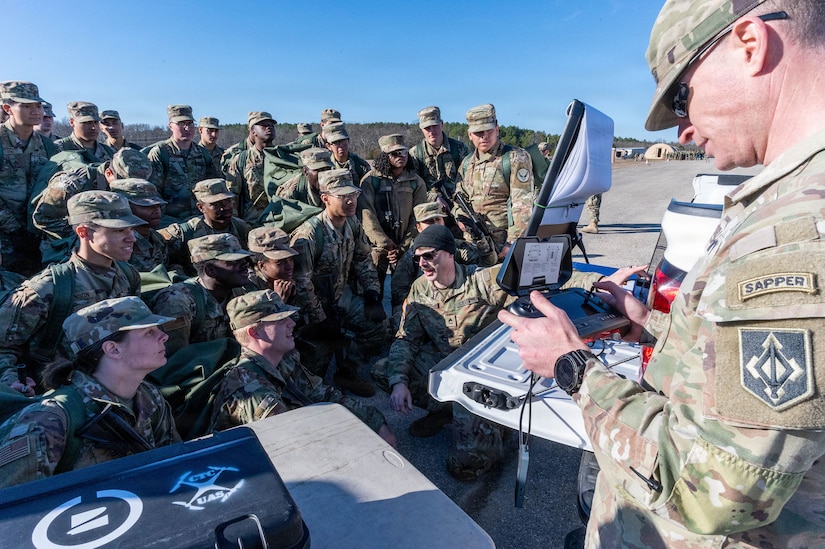
A man in a camouflage military uniform uses a remote control to pilot a drone while another man in similar attire crouches as he speaks to a group of people in camouflage military uniforms gathered outside.

 
According to Air Force Tech. Sgt. Christopher Moss, a specialty code instructor assigned to the training squadron, airmen at various specialty schools on base usually train separately, but this day was unique because it brought them all together. 
 
"It allows them to integrate with our other schoolhouses, bringing them together as one force instead of each person learning just their craft," Moss said. "Producing more well-rounded airmen for the force." 
 
Air Force Capt. Nathan Elking, 368th Training Squadron director of operations, said the unique training event is called Bracer Forge and is an operational readiness exercise. 
 
"It is a continuation of the training airmen receive at basic training," Elking said. "Both exercise initiatives are designed to instill airmindedness and warrior ethos in our airmen." 
 
The squadron's exercise topics vary, but the current unmanned aerial system focus was driven by the unit's specialty codes, which according to Elking play a key role in airfield damage assessment and rapid airfield damage recovery. 
 
"Before each iteration of Bracer Forge, we provide the participating airmen with an operation order for the day and reporting instructions with a training scenario to recover a damaged airfield," he said. 
 
Squadron instructors prepared four stations for the airmen to rotate through. 

A man in a camouflage military uniform speaks to a group of people in similar attire holding rifles while they stand in a tent.

 
At the airfield damage assessment challenge, Elking said teams conducted an assessment on a simulated airfield and relayed the information to their teammates in an emergency operations center. 
 
"The airmen in the EOC were tasked with creating a map of the airfield using the details their counterparts called in over the radio," he said. 
 
While at the UAS reporting challenge, teams established defensive fighting positions and reported UAS activity to their teammates in the EOC by consolidating the information into a report to send up. 

The other two stations were a high intensity physical fitness event and a UAS capabilities overview. Soldiers assigned to the Maneuver Support Center of Excellence Combat Training Company gave the UAS portion of the training. 
 
"We are not subject matter experts on counter-UAS and UAS employment. Being able to leverage our Army partners at [center of excellence] played a significant role in the exercise's success," Elking said. 
 
According to Army Sgt. 1st Class Austin Priebe, Combat Training Company UAS chief, his mission was to introduce small UAS threats, and teach the basics of identifying, reacting to and reporting small UAS threats. 
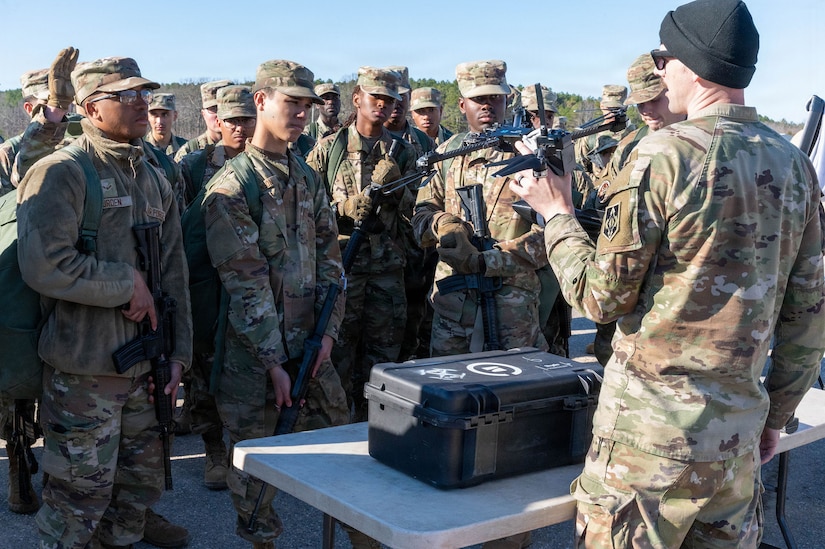
A man in a camouflage military uniform holds a drone while speaking to a group of people in similar attire gathered outside. In front of the man is a black case sitting on a table.

 
Priebe said most trainees he instructs have watched or controlled a simulated UAS in video games, but being able to experience a UAS in person, see and hear a drone up close, is "essential to prepare service members for what they will see in current and future conflicts." 
 
"We conducted practical exercises on scanning for [small] UAS, completing a report and showed the airmen what they look like from an elevated viewpoint," Priebe said. 
 
This was the training company's first time facilitating interservice UAS training. 
 
"I've largely been focused on enabling training and instruction to the Army units here on Fort Leonard Wood since the inception of our UAS program this past fall," Priebe said. 
 
As the battlefield changes rapidly, so does our training requirements. If our organization can provide more realistic and in-depth training to our brothers and sisters in other branches, we only stand to benefit as a military." 

Priebe said his team is looking forward to conducting more interservice training events in the future. 
 
At the end of the day, the exercise was a catalyst for innovation, Elking said. 
 
"By exposing airmen to the dual nature of UASs — both as a threat to counter and a tool to master — we challenge them to rethink their mission sets and pioneer new solutions for the modern battlefield," he said.

Tuesday, February 21, 2012

Face of Defense: Soldier, 51, Completes Basic Combat Training

By Melissa K. Buckley
Fort Leonard Wood

FORT LEONARD WOOD, Mo., Feb. 21, 2012 – Army Sgt. Sandra Coast graduated from Basic Combat Training here Feb. 17, officially beginning her Army career at 51 years old.

The average age for an Army Reserve recruit is about 23, making Coast one of the oldest people to go through basic combat training, U.S. Army Recruiting Command officials said.

"Everybody in the world thinks I am a total nutcase," Coast said. "I just want to support our troops. I love all of them."

From 1982 to 1993, Coast devoted her life to the Navy. She gave up her lifestyle as a sailor to raise her son, Jeff, who ironically led her back to the military she left behind years ago.

"When Jeff graduated high school, he joined the Marine Corps. When I was at the recruiter's office with my son, I walked into the Army recruiting office and said 'I want to join,'" Coast said. Her previous years of military service allowed her to join the Army Reserve well past the age someone without prior service could join, she explained.

For as long as she can remember, Coast said, she has had a special place in her heart for troops and a hunger to serve.

"I have a friend in the Navy that was emailing me from Afghanistan,” she said. “It's his third combat tour in seven years. I don't know, I can't explain it. I just had this overwhelming desire to give back to the military somehow. I was doing the same job day after day after day. I can't live my life that way. There is more to life than this, so I ended up in basic training."

She was stunned to learn that as a paralegal specialist she would have to go back to basic training -- this time, Army style.

"I wasn't quite expecting to be running around with an M16 and all of this gear," Coast said as her training neared its end. "This is nothing even remotely similar to being a sailor. I was blown away by the total difference of it. We carried M16s during Navy boot camp, but we never shot them. Here we are shooting several times a week. Shooting this weapon with all of the gear on takes a toll on me."

Coast started preparing for basic combat training months prior to stepping foot on Fort Leonard Wood.

"Before the recruiters would even talk to me, I had to lose 30 pounds,” she said. “I went from sitting at home every night eating ice cream to exercising and watching what I ate. I also started getting up at 4 o'clock in the morning to exercise and tried to go to bed early at night. I knew I needed every advantage I could have to get through this."

Coast’s 10-week journey from civilian to soldier was spent in Company B, 2nd Battalion, 10th Infantry Regiment, 3rd Chemical Brigade. Army 1st Sgt. John Byars, her first sergeant, said his first reaction when he heard he had a 51-year-old headed his way was "Wow, that's strange." Now, Byars has a new perception.

"I was impressed, because she can do everything the younger soldiers do," he said. "She never expected us to feel sorry for her. She even got one of the highest Army physical fitness test scores in the company. She is a prime example that age is just a number. She ran faster than soldiers young enough to be her kids."

Coast even amazed herself when she came in second place during the test.

"I am still kind of blown away by that,” she said. “I even ran faster than all but one female."

The fitness test may have been a breeze for Coast, but she said one of the hardest things for her to adjust to was the divide in life stages between her and her roommates.

"Everything about basic training is pretty tough, but living with more than 30 teenage females is one of the hardest things," she said. But despite the age gap, she added, she was treated like every other soldier in training.

"We don't treat her any different, and we don't see the privates treat her any different," Byars said.

Coast agreed.

"They treat me as an equal,” she said. “The males, especially, have the utmost respect. They will do little things that they probably aren't supposed to do, like give me their seat on the bus and hold the doors for me. It's the little things that mean so much."

Coast recalled an incident during hand-to-hand combat training that was particularly tough for one of her battle buddies.

"We had to slap each other in the face. The poor guy that was up against me said, 'I cannot do this. I cannot slap her,'” she said. “I told him I would pay for his counseling when we were done. I was slapping him -- he finally slapped me."

As her graduation approached, she said the thing she was looking forward to the most was wrapping her arms around her son.

"I am thrilled to wear the title of sergeant in the U.S. Army, but the title that is also very near and dear to my heart is Marine mom. You can't beat that. I feel totally blessed," Coast said.

Marine Corps Pfc. Jeff Coast didn't think his mother was serious when she expressed interest in joining the Army, but recently he started seeing a side of her that was new to him.

"She is doing what most people her age would consider crazy," he said. "I think she is hardcore. I hope when I get older I am still active and do all kinds of cool stuff."

The Marine’s mother said she made it through basic training because of the support she received from family, friends and even outsiders.

"It blows my mind that I am able to accomplish this," she said. "I couldn't have done it without the support of my Marine mom friends. I get more mail from them than anybody. That support keeps me going. They are constantly cheering me on. Even random people around here will tell me they are cheering for me.

"At the dining facility the workers walk up and tell me they are cheering for me," she continued. "I cry pretty much every day. Not a lot, because it's not an Army thing to do I know, but it's mind-boggling to me how supportive strangers can be."

Coast said she is delighted to have reached the end of her basic training adventure, and that she’s thankful for all of the new experiences it provided.

"This has been very challenging,” she said before her graduation. “It makes me realize that I can do all of this. I got to do some really fun things. After the rappelling tower, I decided to start rock climbing when I get out of basic training."

Coast added that she also is looking forward to her life in the Army Reserve. She said she enlisted hoping to work directly with active-duty troops, but instead was attached to a reserve unit. But on the plus side, she said, she will be able to work near her son's reserve unit.

"I wanted to go active duty, but they are not taking people as old as me for active duty,” Coast said. “So I got attached to a virtual unit. Everything I do will be by the Internet and phone.”

Basic combat training left her with a new respect for combat soldiers and a new respect for herself, Coast said.

"Their gear is heavy, and they are doing this constantly,” she noted. “We have some really awesome troops out there. I am 51 years old, and I can do this."