Showing posts with label UAS training. Show all posts

Friday, June 12, 2026

Michigan Army National Guard Uses UAS to Train for Tomorrow's Battlefield

Nine soldiers assigned to the 3rd Battalion, 126th Infantry Regiment, Michigan Army National Guard, participated in a two-week unmanned aerial system program that began May 31, 2026, as the Michigan National Guard expands its UAS training initiative.
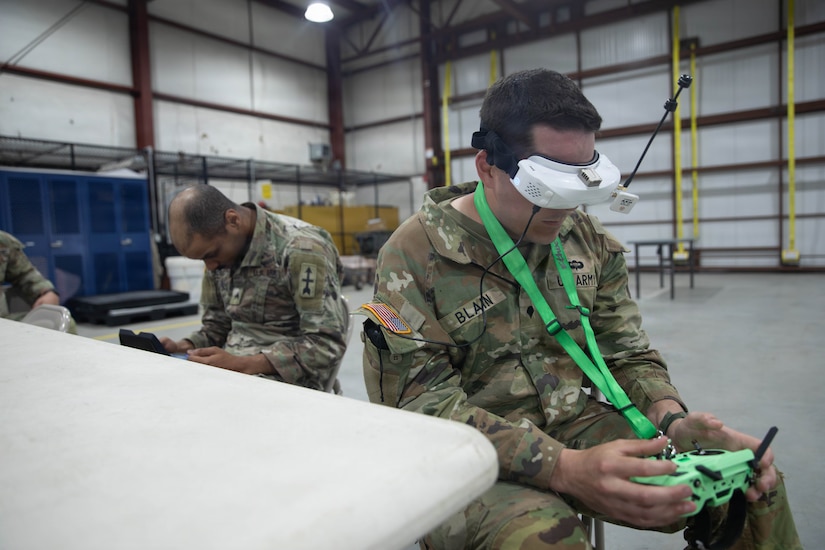
A man in a camouflage military uniform wears a headset and holds a remote control while seated in a warehouse. Another man in similar attire sits near him, holding a remote control.

The Michigan National Guard's UAS program provides service members with no prior experience the training needed to understand regulations, develop flight proficiency and safely operate unmanned aerial systems in support of unit missions. Once certified, operators can utilize and integrate UAS into their units. The training can also tailor instruction to specific unit capabilities, including drone-strike simulations.

"The goal of this training is to expose [service members] to the challenges and opportunities provided by a piece of equipment like that," said Army Maj. Brandon Shortner, the battalion's executive officer. "That's making such an impact on the modern battlefield."

Students began in the classroom for an overview of regulations and systems before moving to flight simulators. Once proficient, they transitioned to field training with a level one UAS, the smallest drone class, maneuvering through an obstacle course that replicates real-world conditions. Instructors adapted the course difficulty based on mission requirements and individual skills.
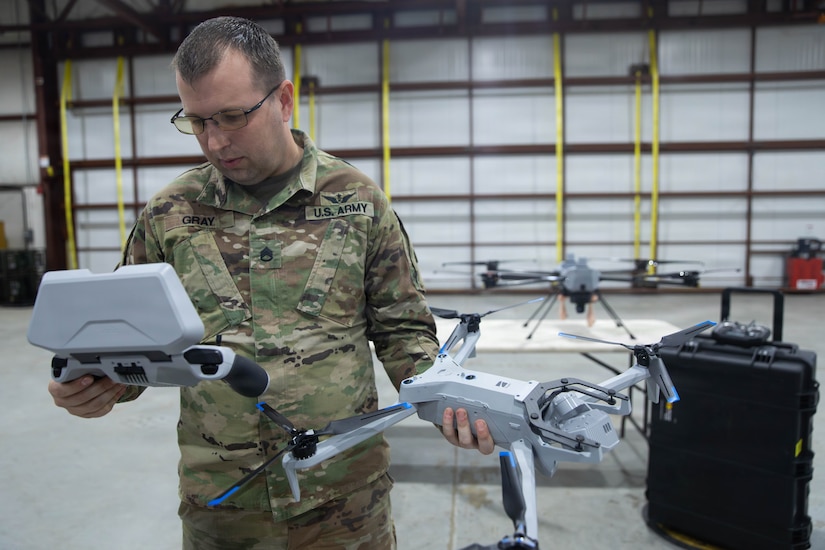
A man in a camouflage military uniform holds a drone in one hand and looks at a controller in the other.

"Every unit has a different mission set, and every mission set will require a different platform," said Army Chief Warrant Officer 2 Aric Petersen, UAS Training Center supervisor for the Michigan National Guard.

After demonstrating competence on the level one drone, the soldiers will progress to live-fire training to learn demolitions and how to arm the platforms.

In February, the War Department designated the Michigan National Guard's Camp Grayling as the nation's first national range for deep uncrewed aerial systems training, resulting in an increased emphasis on UAS training and capability development across the force. Camp Grayling is the largest National Guard training facility in the U.S.
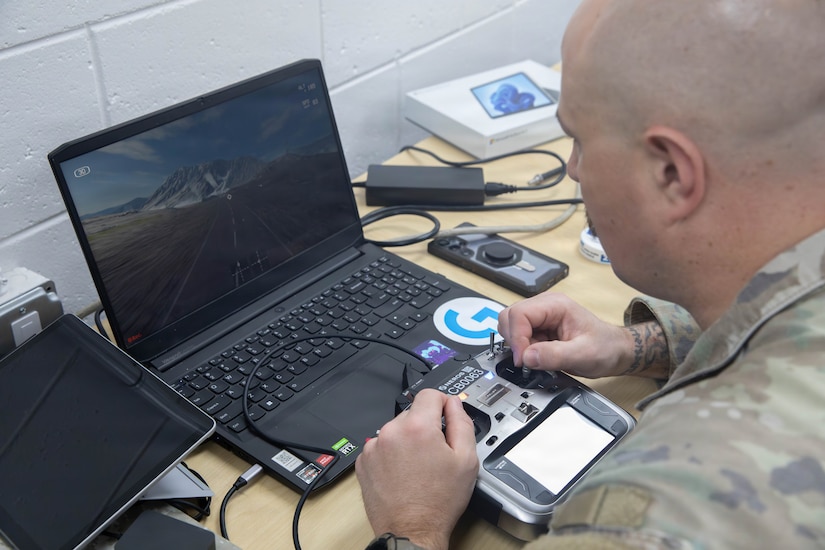
A man in a camouflage military uniform looks at a drone simulator on a laptop.

"It's an incredible honor to be part of a small group of individuals selected to do this," said Army Spc. Aleksandr Blain, an infantry team leader assigned to the 3rd Battalion, 126th Infantry Regiment. "We are looking forward to developing these skills."

Blain was the first of the trained 126th Infantry Regiment drone pilots to execute a drone strike using a first-person view drone June 10. Army Sgt. 1st Class David Burr, an infantry platoon sergeant assigned to the battalion, assisted Blain with the strike as the drone navigator. The navigator role is critical to ensuring UASs reach targets accurately and safely.

The strike was completed using a two-drone hunter-killer team composed of an intelligence, surveillance and reconnaissance platform used to crosstalk with the pilots to confirm targets prior to the strike and a first-person-view system equipped with a fixed-angle camera, giving operators a real-time view from the aircraft's perspective.
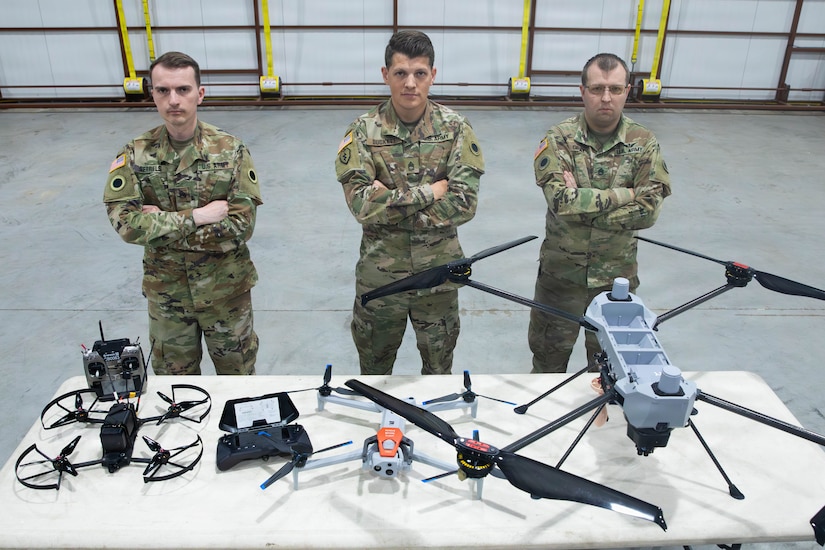
Three men in camouflage military uniforms stand and pose with arms folded behind a table filled with military drones.

The drone is flown entirely by the pilot, enabling precise maneuverability and continued operation in contested environments where GPS may be unavailable or degraded.

The first-person-view drones are piloted completely by manual control, so they find what is called acrobatic mode, which means the pilot has full control over the drone; it doesn't hover.

The two-week training course not only enhanced the unit's tactical performance but also boosted morale among the small group of participants.

"Being on the cusp of innovation is always fun," Blain said. "It's uncharted territory."

Friday, March 13, 2026

Soldiers Assist Air Force Squadron With Drone Warfare Training

More than 200 airmen training with the Air Force's 368th Training Squadron spent Feb. 27 at Fort Leonard Wood, Missouri, learning about unmanned aerial systems during an exercise designed to cultivate Air Force airmindedness and the warrior ethos. 
 
The training squadron, based at Fort Leonard Wood, provides initial skills and advanced level training in the areas of ground transportation, engineering, emergency management and pavements and construction equipment. 

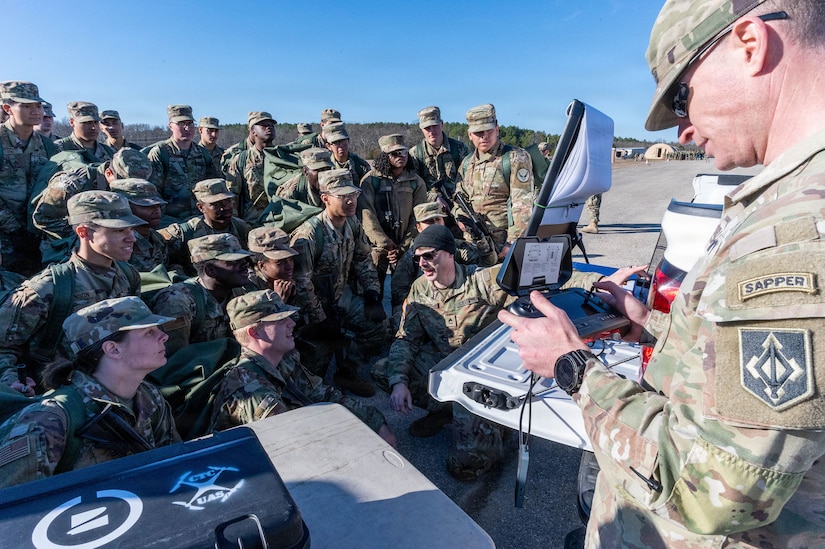
A man in a camouflage military uniform uses a remote control to pilot a drone while another man in similar attire crouches as he speaks to a group of people in camouflage military uniforms gathered outside.

 
According to Air Force Tech. Sgt. Christopher Moss, a specialty code instructor assigned to the training squadron, airmen at various specialty schools on base usually train separately, but this day was unique because it brought them all together. 
 
"It allows them to integrate with our other schoolhouses, bringing them together as one force instead of each person learning just their craft," Moss said. "Producing more well-rounded airmen for the force." 
 
Air Force Capt. Nathan Elking, 368th Training Squadron director of operations, said the unique training event is called Bracer Forge and is an operational readiness exercise. 
 
"It is a continuation of the training airmen receive at basic training," Elking said. "Both exercise initiatives are designed to instill airmindedness and warrior ethos in our airmen." 
 
The squadron's exercise topics vary, but the current unmanned aerial system focus was driven by the unit's specialty codes, which according to Elking play a key role in airfield damage assessment and rapid airfield damage recovery. 
 
"Before each iteration of Bracer Forge, we provide the participating airmen with an operation order for the day and reporting instructions with a training scenario to recover a damaged airfield," he said. 
 
Squadron instructors prepared four stations for the airmen to rotate through. 

A man in a camouflage military uniform speaks to a group of people in similar attire holding rifles while they stand in a tent.

 
At the airfield damage assessment challenge, Elking said teams conducted an assessment on a simulated airfield and relayed the information to their teammates in an emergency operations center. 
 
"The airmen in the EOC were tasked with creating a map of the airfield using the details their counterparts called in over the radio," he said. 
 
While at the UAS reporting challenge, teams established defensive fighting positions and reported UAS activity to their teammates in the EOC by consolidating the information into a report to send up. 

The other two stations were a high intensity physical fitness event and a UAS capabilities overview. Soldiers assigned to the Maneuver Support Center of Excellence Combat Training Company gave the UAS portion of the training. 
 
"We are not subject matter experts on counter-UAS and UAS employment. Being able to leverage our Army partners at [center of excellence] played a significant role in the exercise's success," Elking said. 
 
According to Army Sgt. 1st Class Austin Priebe, Combat Training Company UAS chief, his mission was to introduce small UAS threats, and teach the basics of identifying, reacting to and reporting small UAS threats. 

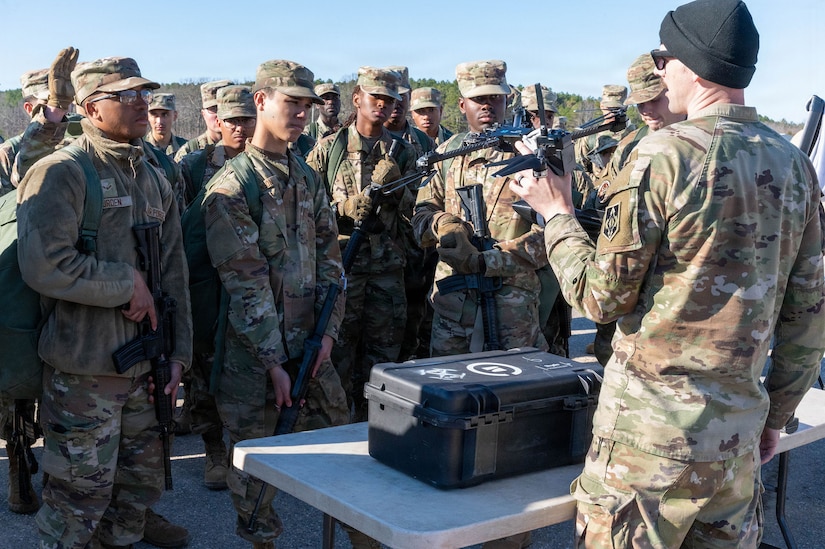
A man in a camouflage military uniform holds a drone while speaking to a group of people in similar attire gathered outside. In front of the man is a black case sitting on a table.

 
Priebe said most trainees he instructs have watched or controlled a simulated UAS in video games, but being able to experience a UAS in person, see and hear a drone up close, is "essential to prepare service members for what they will see in current and future conflicts." 
 
"We conducted practical exercises on scanning for [small] UAS, completing a report and showed the airmen what they look like from an elevated viewpoint," Priebe said. 
 
This was the training company's first time facilitating interservice UAS training. 
 
"I've largely been focused on enabling training and instruction to the Army units here on Fort Leonard Wood since the inception of our UAS program this past fall," Priebe said. 
 
As the battlefield changes rapidly, so does our training requirements. If our organization can provide more realistic and in-depth training to our brothers and sisters in other branches, we only stand to benefit as a military." 

Priebe said his team is looking forward to conducting more interservice training events in the future. 
 
At the end of the day, the exercise was a catalyst for innovation, Elking said. 
 
"By exposing airmen to the dual nature of UASs — both as a threat to counter and a tool to master — we challenge them to rethink their mission sets and pioneer new solutions for the modern battlefield," he said.