Showing posts with label Fort Drum. Show all posts

Monday, August 17, 2026

Competitors Display Resilience, Teamwork at Fort Drum's Mountain Mudder

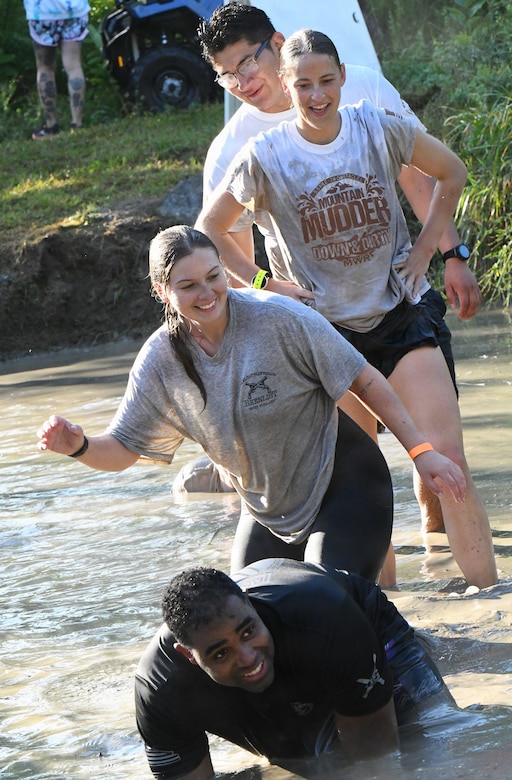
More than 1,000 Fort Drum, New York, community members answered the "call to dirty" Aug. 14, putting their laundry detergent to the test as they dove into the muck during the base's annual Mountain Mudder.

A group of smiling people in athletic gear run in a line into a ditch filled with muddy water.
Hosted by the installation's Directorate of Family and Morale, Welfare and Recreation, the grueling 5.5-mile course was a showcase of resiliency and esprit de corps. Competitors raced through 27 formidable obstacles, ranging from icy water plunges, towering rope climbs and sticky mud pits. 
 
To be sure, running shoes were separated from feet, socks went from white to gray in an instant and it even took a group effort to fish one competitor's eyeglasses out of the mud. 
 
But after completing the final obstacle — the warped wall — and receiving a medal and complimentary power-hose shower, most participants left with a profound sense of accomplishment. 
 
"I feel unbelievable," said Army Sgt. Kristen Kisner. "It was so nice to actually have this experience with some of my battle buddies." 
 
Kisner ran her first Mountain Mudder alongside fellow members of Company C, 548th Division Sustainment Support Battalion, 10th Mountain Division Sustainment Brigade. For her, the most rewarding part was helping each other overcome the course's physical demands to finish as a team. 
 
"Just working together and making sure we were staying together," she said. "Going over the walls was challenging, because some of us are really short, so we had to work as a team to actually accomplish those climbs." 
 
Kisner, who arrived at Fort Drum in the spring, is relatively new to the 10th Mountain Division. She said her job has kept her busy and participating in the event was a welcome break. 
 
"This was absolutely amazing, and I'm glad that our leaders had the time to come out and support us," she said. "Some of them did the challenge with us, so we loved that."

The event was also a first for Army Spc. Tanner Sublett, assigned to the Multipurpose Company, 1st Battalion, 87th Infantry Regiment, 1st Mobile Brigade Combat Team. He ran the course with his platoon and said the final warped wall was the day's toughest test. 
 
"But it was really a lot of fun, and I just like challenging myself," he said. "You know, seeing something that looks tough and then going out and doing it just to prove to myself that I can." 

One of his teammates, Army Pfc. Nathan Simmons, recently returned from supporting cadet training at the U.S. Military Academy at West Point, New York. He said it was the challenge that drew him to the Mountain Mudder. 
 
"Honestly, I heard this was going to be tough — getting through 27 obstacles on a 5-mile course — but this was something I really wanted to do," Simmons said. "The hardest part for me was getting out of the water and running to the next obstacle — that transition when your body is weighed down from all the water. But we got through it."

Wednesday, January 18, 2012

Air Guard's 174th Fighter Wing writing the book on Air Force MQ-9 maintenance

By Air National Guard Capt. Anthony L. Bucci
174th Fighter Wing

HANCOCK FIELD AIR NATIONAL GUARD BASE, Syracuse, NY -- Since Hancock Field Air National Guard Base converted from the F-16 Fighting Falcon to the MQ-9 Reaper, the flight line has become more silent and there has been a noticeable reduction in the level of aircraft maintenance activity on the base.

However, that all began to change recently as the unit commenced MQ-9 flying operations at Wheeler-Sack Army Air Field at Fort Drum, N.Y., and the 174th FW Maintenance Group resumed a more normal maintenance posture on base.

"Our maintenance personnel have contributed to the creating and/or validation of approximately 80 percent of all maintenance technical data for the U. S. Air Force in regards to maintenance for the MQ-9," said Air Force Maj. Tim Martin, 174th Fighter Wing Aircraft maintenance squadron commander.

Currently, the 174th Fighter Wing flies at its training range located at WSAAF with 174th Fighter Wing maintenance personnel positioned there to assist with necessary maintenance requirements. However, when more in-depth maintenance needs to be done those aircraft are boxed up and transported back to Hancock Field where 174th Fighter Wing maintenance troops begin the more arduous maintenance work. As a result of this maintenance activity, the unit has been generating a significant amount of technical data concerning the proper maintenance of the MQ-9.

"We are importing what the U. S. Air Force is using as it relates to the MQ-9 for technical data, maintenance procedures, etc., as well as providing improvements for the overall care and maintenance of the MQ-9," said Martin.

As the unit continues to fly at WSAAF, the maintenance tempo has picked up dramatically to include pre and post-flight maintenance in addition to maintenance issues that have never been seen before. In fact, the unit has submitted more than 100 engineering requests during the past two years for technical data on how to fix certain issues with the MQ-9 - in comparison to the F-16, which the unit only submitted three engineering requests during the unit's some 20 years of flying the aircraft.

"The maintenance personnel here at Hancock Field are becoming the subject matter experts for the MQ-9, while working very closely with the U. S. Air Force and General Atomics. These maintainers have a vested interest in the technical data that is being written for this aircraft and they take that responsibility very seriously, knowing they have the potential in helping to decide the proper and safest procedures for maintaining the MQ-9," Martin said.

The MQ-9 is a medium-to-high altitude, long-endurance remotely piloted aircraft system. The Reaper's primary missions are close air support, air interdiction, and intelligence, surveillance and reconnaissance, or ISR. It acts as a Joint Forces Air Component commander-owned theater asset for reconnaissance, surveillance and target acquisition in support of the Joint Forces commander.

The turboprop-powered, multi-mission Predator B Unmanned Aircraft System was developed with General Atomics Aeronautical Systems, Inc., funding and provides significantly greater capabilities than Predator.

First flown in 2001, Predator B is a highly sophisticated development built on the experience gained with GA-ASI's battle-proven Predator UAS and a major evolutionary leap in overall performance and reliability.

With an operational ceiling of 50,000 feet, and higher cruising speed, the MQ-9 can cover a larger area, under all weather conditions carrying payloads of more than 1.5 tons. The aircraft is powered by a single Honeywell TP331-10 engine, which provides a maximum airspeed of 260 knots and a cruise speed for maximum endurance of 150-170 knots.

This aircraft has been acquired by the Air Force, Navy, Department of Homeland Security, NASA, the Royal Air Force and the Italian Air Force.

Tuesday, December 20, 2011

Face of Defense: Commando Couple Embraces Army Values

By Michelle Kennedy
Fort Drum Public Affairs

FORT DRUM, N.Y., Dec. 20, 2011 – Balancing work and personal responsibilities is a challenge for many families, but dual military families face a different set of challenges when dealing with long duty days, deployments and other separations.

One Army couple here -- Warrant Officer Julia Armstrong and Sgt. 1st Class Everett Armstrong -- has endured almost 35 years of combined military service, all while raising a family, balancing work schedules and keeping open lines of communication.

Julia Armstrong, who serves as an adjutant general technician for 2nd Brigade Combat Team "Commandos," works down the hall from her husband, who is the brigade's dining facility noncommissioned officer in charge. While working in the same building has its benefits, it hasn't always been easy.

Everett Armstrong who has served in the Army for 20 years, never thought the military was the right choice for him. "The military was always something I loved watching on TV, but I never thought it would be for me," he said.

That was until he figured out the military would be his ticket out of his rough Houston neighborhood and for the family life he desired.

"Growing up, I was adamant about being married," he continued. "I didn't want to be a football star; I just wanted to be a father.”

“I was already ready for the mission that was coming,” he said of his decision to enlist. But, “I think it was hard on my family when I went straight into the military. They had no clue until that recruiter showed up on the doorstep. I was ready to write a new chapter for myself, and I say it turned out great."

Armstrong’s high school graduation was June 6, 1991, and five days later, he was at basic training.

"The military has been very good for me -- I've got my kids, my wife and everything," he said.

He and his wife met in 1996 while he was stationed at Fort Sill, Okla.

"We met on a basketball court, of all places," he said.

That wouldn’t seem strange except, "I'm 6'2" and he's 5'4," and everybody assumes that I'm the basketball player," Julia Armstrong said, laughing. "I'm so not athletic."

Armstrong was not in the Army when she met her husband while dropping her friend off at her job on Fort Sill. She noticed a group of soldiers playing basketball and goofing around. That's when she saw Everett.

Armstrong asked her friend about her future husband, but her friend warned her that he was "short."

"From a distance, 5'4" doesn't look that bad, but when I met him -- he was short," she said. "We exchanged phone numbers, and we talked on the phone every day that week. We had our first date that Friday and we've been inseparable from that point on. We got married six months later (in September 1996)."

Even though it's been almost 16 years since they met, Armstrong still remembers exactly what his wife was wearing.

"I thought she was gorgeous -- in tennis shoes, sweat pants that were a little high because she was so tall, and a big Starter overcoat," he said. "Our first words were, 'Wow, you're short!' and, 'Wow, you're tall!' And we joked from there."

The Armstrongs think it's funny when people don't realize they're married.

"It's hilarious, even now," Julia Armstrong said. "We have the same last name, but even until a couple of months ago, there were people who didn't put the two together that we are married."

Laughing, understanding and communication have helped this Army couple stay strong during their careers.

Nine months after they were married, Julia Armstrong decided to join the Army in May 1997.

"I had been going to school, working two jobs and raising our oldest (son), and it was just too much," she said.

Fifteen years later, she still loves the Army, but she said she's a little scared at what the future may hold if her husband decides to retire.

"He's at that point where he's at the end of the road, and that scares me because I'm so used to us being a dual-military couple," Armstrong said.

The Armstrong family has been fortunate to not have to endure too many separations from each other or from their four children -- Devyn, 17; Stephon, 15; and twins Trinity and Everett Jr., 4.

With the exception of training and his deployment to Iraq from 2003 to 2004, the couple has been able to stay close. The Armstrongs served together during all their assignments, including Korea.

"All of our duty stations have been always been about us being together as a family unit," Julia Armstrong said. "We've always considered our family and the Army equal; if it was good for the Army and it was good for the family, it was good for us."

During their careers, balancing work and family hasn't always been easy, she explained.

"There were times where you question if you're putting the military before your family or vice versa," Armstrong said, adding that over the years, they have learned to share the responsibility equally. "There are so many other factors. I think what works for us is that we communicate."

Each has faced jobs that required long hours and late nights, while the other tended to the children, cooked dinner and cleaned the house.

"I think for us, it just works," Julia Armstrong said. "We tackle things head on. We discuss it and talk about it. There's no time for someone to say 'I don't want to do that,' because it's all about the kids and making sure things are good for them."

Although the couple has mastered the ways of Army life on and off duty, it is still a struggle when it comes to ensuring their children are taken care of. When both have to go to the field, they have to know that the people who watch their children are responsible.

"It takes coordination," she said. "You can't just leave your kids with anyone; you have to have that support system. We don't have family here, so it takes a while to get to know people and trust them with your kids. That's a lot of responsibility to pass on to someone else."

Everett Armstrong agreed. Right now, it's his wife's turn to work late some days, so he picks up the slack at home.

"We're in sync," he said. "I already know what needs to be done, and I know when she's working late. There's no reason for me to call to ask what she needs me to do. I'm already starting the washing, cooking, kids are bathed, so when she gets home all she needs to do is rest."

He added that throughout his career, he has been fortunate to have great assignments.

"At Fort Sill, when I first met my wife, it was pretty rough because I was always in the field or always working," Armstrong said. "As the years progressed, I've bounced around and gotten some excellent jobs where I can cover my own hours."

Julia Armstrong added that she believes a lot of their success throughout the years has to do with the command climate. They've been fortunate to have supportive commands that understood their situation.

"They have to understand that (with us), they're getting two for the price of one," Armstrong said. "There will be times where a kid gets sick, and I have to leave work because he can't.

Working in an environment where people understand that and they support you and they see that you're still part of the team, (you're) an asset and they're getting the best end of the deal makes all the difference."
Friday, June 24, 2011

Obama Visits Fort Drum, Thanks First to Deploy

By Steve Ghiringhelli, Fort Drum Public Affairs Office
American Forces Press Service

FORT DRUM, N.Y. , June 23, 2011 – The day after announcing a drawdown of troops from Afghanistan, President Barack Obama visited Fort Drum to thank members of an Army division that was among the first to deploy units following the terrorist attacks of Sept. 11, 2001.

"I don't want to give a long speech, because I want to spend most of my time just shaking hands and thanking all of you," Obama told a small gathering of 10th Mountain Division soldiersJune 23, 2011, during his first official visit to Fort Drum.

The soldiers of 1st Brigade Combat Team, which returned earlier this year from its deployment to northern Afghanistan, sat in complete silence as they awaited the commander in chief's arrival at the 10th Combat Aviation Brigade dining facility. It was soldiers from the brigade's 1st Battalion, 87th Infantry Regiment, who provided a quick reaction force in Afghanistan immediately following 9/11, ultimately helping to overthrow the Taliban-run regime that harbored al-Qaida terrorists.

Once the president was announced, he was introduced to the 150 soldiers by the brigade's commander, Col. Willard "Bill" Burleson.

"Sir, it's a great privilege to share these great soldiers here with you today," Burleson said. "They represent about 4,000 of the first elements of (last year's surge) in Afghanistan."

The president thanked Burleson for his hard work and leadership and then spoke about his decision last year to deploy an additional 30,000 troops into Afghanistan, calling it one of the toughest decisions he has made as president.

"The only reason I was able to make that decision was because I knew that we had the finest fighting force in the world, and that if I gave a command to our troops, they would be able to accomplish that mission," the president said. "The 10th Mountain Division … (were) the first folks to go in after that order was given.

"And that's not surprising," he added, "because you guys were also some of the first folks to go in right after 9/11."

During his televised address to the nation Wednesday night, Obama announced that 10,000 troops will redeploy to the U.S. this year and that a total of 33,000 -- roughly the number of troops sent to Afghanistan last year -- will return by next summer. As Afghan security forces move into the lead, the president said, American troops will continue steadily coming home until 2014, when the U.S. mission completes its transition from combat to support.

He also stated that it was time for America to rethink some of its national security policies, cautioning that the U.S. is in need of some "nation building" of its own.

"Already, this decade of war has caused many to question the nature of America’s engagement around the world," he said during his primetime speech. "Some would have America retreat from our responsibility as an anchor of global security and embrace an isolation that ignores the very real threats that we face. Others would have America over-extended, confronting every evil that can be found abroad.

"We must chart a more centered course," the president noted.

Currently, the 10th Mountain Division's headquarters leads coalition forces in Regional Command - South in Kandahar, Afghanistan. In addition, three of the division's six brigades are deployed in support of Operation Enduring Freedom -- 3rd Brigade Combat Team, 4th Brigade Combat Team and 10th Combat Aviation Brigade.

It brings the total number of 10th Mountain Division soldiers serving in Afghanistan to more than 10,000.

Meanwhile, the 10th Sustainment Brigade is readying to deploy to Afghanistan this fall.

Obama said his respect for the 10th Mountain Division's storied past goes back to his days at the U.S. Senate.

"I've always run into you guys -- and for some reason, it's always in some rough spots," he said. "You guys have always been there in the toughest fights. The fact that you are continuing, even as we speak, and that many of your comrades are there right now under some very tough circumstances, (demonstrates) your dedication and your patriotism."

In order to sustain their accomplishments so far in the war-torn country, the president assured soldiers that his plan to decrease the number of troops in Afghanistan would not be done "precipitously."

"Because of what you have done, areas like Kandahar are more secure than they have been in years," Obama said. "Because of you, we are now taking the fight to the Taliban, instead of the Taliban bringing the fight to us. Because of you, there are signs that the Taliban may be interested in figuring out political settlements.

"It's also because of you that we have a platform to be able to go after bin Laden and al-Qaida, and we have decimated their ranks," he said.

Obama said even with his planned drawdown, tough work lies ahead.

"The American people understand the sacrifices you are making; they understand the sacrifices that your Families are making," he said. "But there's still some fighting to be done. And frankly, the 10th Mountain Division is still going to be represented there until we have fully transferred to the Afghan military and security forces.

"You guys are the tip of the spear," Obama continued. "You guys are the ones that keep us safe each and every day. For all of the sacrifices you have made, I want to say thank you. For all of the sacrifices your Families have made, I want to say thank you.

"I have no greater job -- nothing gives me more honor -- than serving as your commander in chief. To all of you who are potentially going to be (deployed again), just know that your commander in chief has your back."

Before boarding Air Force One at Wheeler-Sack Army Airfield, Obama met privately inside the Rapid Deployment Facility with family members of fallen soldiers.

Tuesday, November 17, 2009

Army suicides to top 2008, but progress reported

By PAULINE JELINEK, Associated Press Writer

WASHINGTON – Soldier suicides this year are almost sure to top last year's grim totals, but a recent decline in the pace of such incidents could mean the Army is starting to make progress in stemming them, officials said Tuesday.

Army Vice Chief of Staff General Peter Chiarelli said that as of Monday, 140 active duty soldiers were believed to have died of self-inflicted wounds so far in 2009. That's the same as were confirmed for all of 2008.

"We are almost certainly going to end the year higher than last year ... this is horrible, and I do not want to downplay the significance of these numbers in any way," he said.

But Chiarelli said there has been a tapering off in recent months from large surges in suspected suicides in January and February.

"Our goal since the beginning has been to reduce the overall incidence of suicide and I do believe we are finally beginning to see progress being made," Chiarelli told a Pentagon press conference.

He attributed those hints of a turning to some unprecedented efforts the Army has made since February to educate soldiers and leaders about the issue.

Officials are still stumped about what is driving the historically high rates across the military force. When asked whether the rates reflect unprecedented high stress from long and repeated deployments to provide manpower for the wars in Iraq and Afghanistan, Chiarelli said he didn't know.

"The reality is there is no simple answer," he said. "Each suicide is as unique as the individuals themselves."

Chiarelli said that on top of the 140 suicides reported from the active duty force, there were another 71 suicides by troops in the National Guard and Reserve.

All of the numbers are preliminary in that investigations into some of the deaths are still ongoing. Of the 140 so far this year among active duty troops, 90 have been confirmed as suicides and 50 are suspected but the probes are not yet finished.

Each year, nearly all suspected suicides are eventually confirmed. For instance in 2008, there were 143 suspected and 140 were eventually confirmed.

Chiarelli said officials will continue to focus on things that are symptoms of high-risk individuals such as undiagnosed brain injuries like concussions; on Post-Traumatic Stress, and on risky behavior such as poor diet and sleep habits as well as more serious behaviors such as drug and alcohol abuse.

The Army widened its suicide prevention in March in an attempt to make rapid improvements. In October, the service introduced its Comprehensive Soldier Fitness program, which Chiarelli called "the biggest step ... taken to enhance wellness in the entire force through prevention rather than treatment."

The program aims to put the same emphasis on mental and emotion strength as the military traditionally has on physical strength. Basic training now includes anti-stress programs as part of a broader effort to help soldiers deal with the aftereffects of combat and prevent suicides.

Also last month, the Army started using a new screening questionnaire to try to determine preexisting or current mental health issues among troops as part of the enlistment process.

Despite those campaigns, another jump in suicide figures for 2009 would make it the fifth straight year that such deaths have set a record within the military. Last year's 140 record erased a high 115 in 2007 and 102 in 2006.

Chiarelli said officials are concerned with increases this year at Fort Campbell, Fort Stewart and Schofield Barracks and are trying to learn why suicides rates are down at Fort Hood, Fort Bragg and Fort Drum.

At Fort Campbell in Kentucky there were 18, while at Fort Bragg, N.C., which has almost double the population, there have been six all year.

Using some bases as examples of the trend downward, Chiarelli said that of the 18 suicides reported this year at Fort Campbell, 11 of those were in the first four months of the year. At Schofield Barracks in Hawaii, there were seven all year so far — five in the first five months of the year and only two since.

The numbers kept by the service branches don't show the whole picture of war-related suicides because they don't include deaths after people have left the military. The Department of Veterans Affairs tracks those numbers and says there were 144 suicides among the nearly 500,000 service members who left the military from 2002-2005 after fighting in at least one of the wars.

The true incidence of suicide among military veterans is not known, according to a report last year by the Congressional Research Service. Based on numbers from the Centers for Disease Control and Prevention, the VA estimates that 18 veterans a day — or 6,500 a year — take their lives, but that number includes vets from all previous wars.

___

On the Net: http://www.army.mil


Reblog this post [with Zemanta]