Showing posts with label military fitness. Show all posts

Monday, September 21, 2026

Mental Grit Propels Champions at 2026 Air Force Marathon

Every mile of a race is a physical negotiation — a stark reminder that while the human body has limits, the mind can be trained to push past them. 

More than 9,000 people across 50 states registered for the 2026 Air Force Marathon, testing their mental and physical endurance across several race categories Sept. 18-19. Races took place at Wright-Patterson Air Force Base, Ohio, and outside of the National Museum of the U.S. Air Force at Wright-Patterson Air Force Base, and Wright State University in Dayton, Ohio. 

A woman smiles as she reaches a marathon finish line. Two people wearing camouflage military uniforms hold a red, white and blue finish line ribbon with “U.S. Air Force Marathon 2026” on it.
A man reaches a marathon finish line. Two people wearing camouflage military uniforms hold a red, white and blue finish line ribbon with “U.S. Air Force Marathon 2026” on it.

Leading the charge were full marathon champions Space Force 1st Lt. Nicholas McKenzie, assigned to Vandenberg Space Force Base, California, with a time of 2:34:31, and Kayla Rice, a Wright-Patterson Air Force Base employee, with a time of 2:56:39. 

"I'm ecstatic — it's a great day with super energy out on the course and beautiful weather," McKenzie said. "This is my second time running the Air Force Marathon, and I'm super grateful for all the volunteers, the support and all the other runners out here getting it done today."

However, for McKenzie, the mental turning point came during the race's most solemn stretch. 

"Around mile 21, it definitely starts to get hard. But running and seeing the tributes to our fallen service members was emotional and heartwarming. It really helped me stay motivated to get to the end," he said. "Seeing that helps you realize the ultimate sacrifice they gave, and it motivated me to dig a little deeper."

For Rice, crossing the finish line as the women's champion marked the culmination of years of dedicated training right on her home base at Wright-Patterson Air Force Base. 

"I feel incredible. This has been a goal I've been working toward for the past few years, and it's great to finally achieve it," Rice said. "This is my fourth time running it, so every year it's been my goal to just get a little bit faster and eventually get where I am today. It was a big personal record for me, and getting to see all my friends, family, coworkers and teammates out on the course was amazing."

Sharing the spotlight were half-marathon champions Simon Heys, a civilian runner at 1:05:45, and Air Force 2nd Lt. Allyson Peterson, assigned to Ramstein Air Base, Germany, with a time of 1:19:10. 

For Heys, pushing through the half-marathon course was a personal way to show gratitude for military service members. 

"It was special," Heys said. "I really wanted to come here and just run as hard as I could. I wanted to put the grind out there, like the men and women who fight for this country do every day."

Peterson, competing in her first half marathon, relied on strategic pacing and late-race momentum to win. 

"I've been looking forward to this race," she said. "I had a great group of guys to chase coming down for the last like 6 miles. So, I was just focusing on closing that gap."

Beyond individual determination on the course, Air Force leaders underscored how physical discipline and community support directly reinforce the strength and readiness of the joint force. 

"If I have one message for you today, thank you for showing up to do hard things," said Matthew L. Lohmeier, Air Force undersecretary. "Thank you for working together as a community, both to support the 30th Air Force Marathon and to make the Department of the Air Force and the entire joint force a better place to work, a more lethal, ready force. And thank you for taking care of yourselves to be a part of our ready force."

As the cheers from the finish line festival filled the air and the champions took their places at the awards ceremony, the legacy of the 2026 race extended beyond the trophy stands. For the thousands who crossed the finish line, the race was more than an athletic showcase. It was a masterclass in mental readiness, proving that when the mission demands endurance, disciplined preparation always carries you through. 

Here's a look at the top three men's and women's finishers in the full marathon and half marathon: 

Unofficial times according to RacePenguin, the Air Force Marathon's race tracker: 

  • Men's Full Marathon — first: Nick McKenzie 2:34:31; second: Hunter Boyer 2:40:01; third: Jack Walker 2:41:24 
  • Women's Full Marathon — first: Kayla Rice 2:56:39; second: Lindsay Babish 3:09:12; third: Kristen Petrosky 3:14:06 
  • Men's Half Marathon — first: Simon Heys 1:05:45; second: Peter Allegre 1:11:01; third: Patrick Konecny 1:11:13 
  • Women's Half Marathon — first: Allyson Peterson 1:19:10; second: Kelsi Harris 1:24:52; third: Corinne Yorkman 1:26:26 

Monday, August 17, 2026

Competitors Display Resilience, Teamwork at Fort Drum's Mountain Mudder

More than 1,000 Fort Drum, New York, community members answered the "call to dirty" Aug. 14, putting their laundry detergent to the test as they dove into the muck during the base's annual Mountain Mudder.

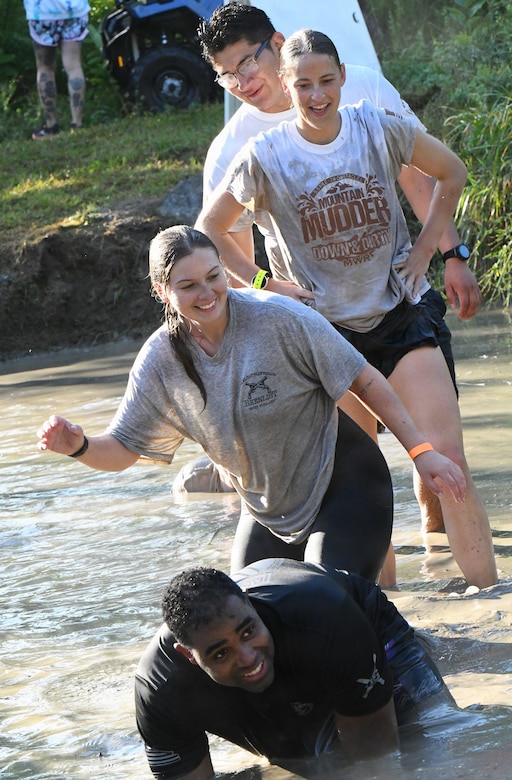
A group of smiling people in athletic gear run in a line into a ditch filled with muddy water.
Hosted by the installation's Directorate of Family and Morale, Welfare and Recreation, the grueling 5.5-mile course was a showcase of resiliency and esprit de corps. Competitors raced through 27 formidable obstacles, ranging from icy water plunges, towering rope climbs and sticky mud pits. 
 
To be sure, running shoes were separated from feet, socks went from white to gray in an instant and it even took a group effort to fish one competitor's eyeglasses out of the mud. 
 
But after completing the final obstacle — the warped wall — and receiving a medal and complimentary power-hose shower, most participants left with a profound sense of accomplishment. 
 
"I feel unbelievable," said Army Sgt. Kristen Kisner. "It was so nice to actually have this experience with some of my battle buddies." 
 
Kisner ran her first Mountain Mudder alongside fellow members of Company C, 548th Division Sustainment Support Battalion, 10th Mountain Division Sustainment Brigade. For her, the most rewarding part was helping each other overcome the course's physical demands to finish as a team. 
 
"Just working together and making sure we were staying together," she said. "Going over the walls was challenging, because some of us are really short, so we had to work as a team to actually accomplish those climbs." 
 
Kisner, who arrived at Fort Drum in the spring, is relatively new to the 10th Mountain Division. She said her job has kept her busy and participating in the event was a welcome break. 
 
"This was absolutely amazing, and I'm glad that our leaders had the time to come out and support us," she said. "Some of them did the challenge with us, so we loved that."

The event was also a first for Army Spc. Tanner Sublett, assigned to the Multipurpose Company, 1st Battalion, 87th Infantry Regiment, 1st Mobile Brigade Combat Team. He ran the course with his platoon and said the final warped wall was the day's toughest test. 
 
"But it was really a lot of fun, and I just like challenging myself," he said. "You know, seeing something that looks tough and then going out and doing it just to prove to myself that I can." 

One of his teammates, Army Pfc. Nathan Simmons, recently returned from supporting cadet training at the U.S. Military Academy at West Point, New York. He said it was the challenge that drew him to the Mountain Mudder. 
 
"Honestly, I heard this was going to be tough — getting through 27 obstacles on a 5-mile course — but this was something I really wanted to do," Simmons said. "The hardest part for me was getting out of the water and running to the next obstacle — that transition when your body is weighed down from all the water. But we got through it."

Monday, February 09, 2026

U.S., Italian Soldiers Earn German Military Qualification

U.S. and Italian soldiers accepted the challenge of earning the German Armed Forces Proficiency Badge during a military qualification assessment at various locations throughout Caserma Del Din, Italy, Feb. 2-6.

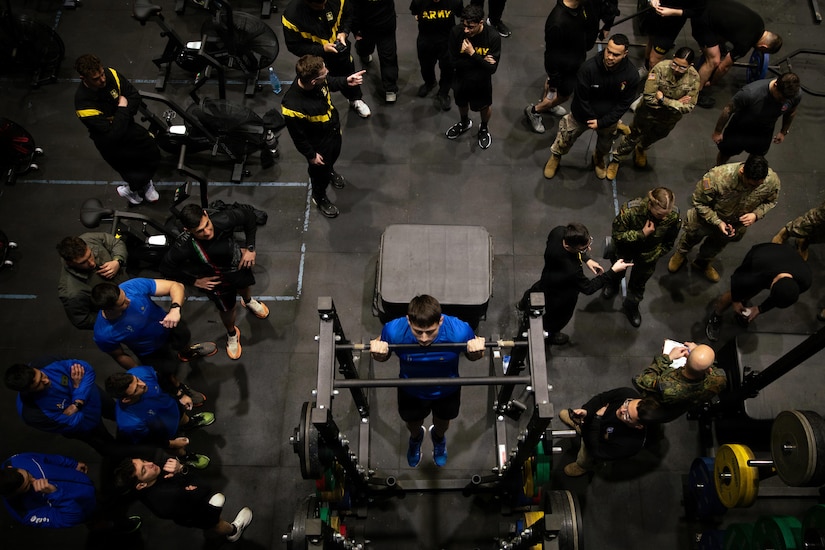
An overhead view of a man in athletic attire holding his chin over a bar on a piece of gym equipment as another man observes him. Two dozen other people in camouflage military uniforms and similar athletic attire are standing around the gym.

The proficiency badge is a German armed forces decoration that is one of the few foreign awards approved for wear on formal U.S. service uniforms. 

Over 110 candidates reported for the challenge. U.S. participants included 99 soldiers representing: 173rd Airborne Brigade, 207th Military Intelligence Brigade, 517th Geospatial Planning Cell, 79th Theater Sustainment Command (FWD), 21st Theater Sustainment Command and U.S. Army Southern European Task Force, Africa. They joined Italian paratroopers in their quest for the badge. 

German soldiers assigned to the Support Battalion 8, 10th Panzer Division, oversaw the assessment that determined whether candidates met the standard to wear one of the badge's three qualification levels: gold, silver or bronze. 

The goals of the challenge included strengthening bonds between U.S. service members, building partner-nation military relations, and promoting esprit de corps while showcasing military and physical preparedness.

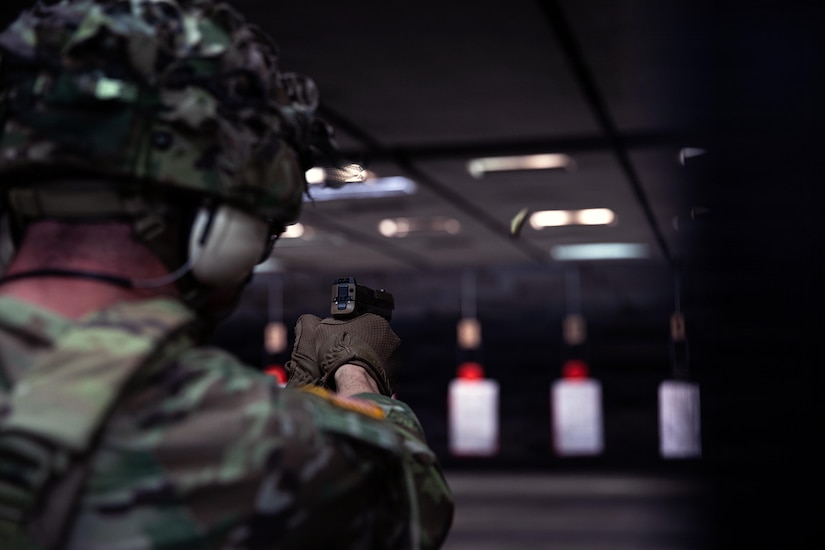
A man in a military camouflage uniform fires a pistol at a target inside a firing range. There is a bullet casing flying away from the gun.

U.S. Army 1st Lt. Mitchell Hansen, executive officer for the U.S. Army Southern European Task Force, Africa's intelligence and sustainment company, said earning the badge would be an important accomplishment at his command, considering the extensive work his team does with allies and partners in Europe. Hansen took on the challenge while serving as an officer in charge during the assessment, primarily acting as a liaison. 

"It builds trust and camaraderie working with our German partners … so we can complete our mission both in Europe and in Africa," Hansen said. "This training has really opened my eyes, working with our Italian and German partners, because they each have different processes for completing the mission." 

Over four days, participants completed the German armed forces' basic fitness test, swimming and pistol marksmanship assessments, as well as a road march ranging from 3-7 miles with a 35-pound pack. Academic testing required participants to demonstrate competency and proficiency in chemical, biological, radioactive and nuclear first-aid training. 

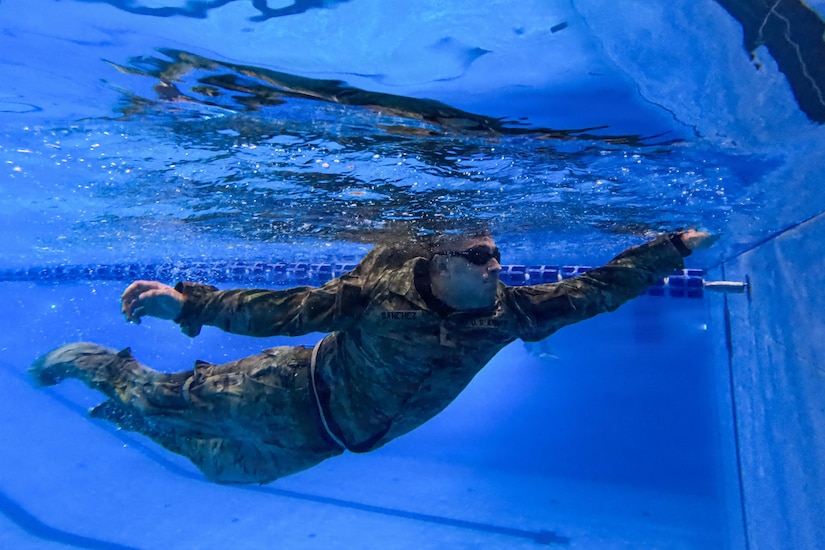
Hansen considered the 100-meter swim to be the most challenging single event, which required candidates to swim the distance in full military uniform, then take off their blouses and trousers and throw them out of the pool.

An underwater view of a man in a camouflage military uniform as he reaches his hand out for the pool wall while swimming.

U.S. Army Staff Sgt. Michelle Alvarado, an all-source intelligence analyst assigned to the 17th Military Intelligence Company, 173rd Mobile Brigade Combat Team, agreed with Hansen on the difficulty of the badge's swim requirement. Having previously earned her U.S. Army Expert Soldier Badge, Alvarado said the swim presented "a different type of challenge," highlighting it as an example of the skill sets candidates needed to improve for the testing. 

"I would usually never be [swimming] for my occupation," Alvarado said. "Training with allied forces teaches us how differently they operate in different environments, what they're proficient in and what we can learn from them." 

German Army Capt. Stefanie Mayer, executive officer for 2nd Company, Support Battalion 8, led the team that administered the testing and noted that both American and Italian candidates were "very fit and very trained." She also pointed out other benefits of allies forming personal bonds while rising to meet the same challenges together. 

"Especially notable was the camaraderie between the candidates," Mayer said. "They were cheering each other on and having fun with these disciplines. We are looking forward to repeating this event again, maybe forming a lasting partnership [with the U.S.], and hopefully having the opportunity to come back or have a team do something with an American proficiency badge for German soldiers." 

The weeklong assessment ended with an awards ceremony Feb. 6, where candidates received recognition for their efforts. After organizers calculated the final scores, U.S. recipients earned 11 gold, 30 silver and 19 bronze badges. The Italian cohort received six gold and six silver badges.