Showing posts with label paratroopers. Show all posts

Wednesday, August 27, 2025

Paratroopers Make History With Army's First Drone-on-Drone Strike

 Aug. 27, 2025 

By Army Capt. Jennifer French, 173rd Airborne Brigade

For Army 1st Lt. Francesco La Torre, the Army's first drone-on-drone strike wasn't exactly a Hollywood moment. 
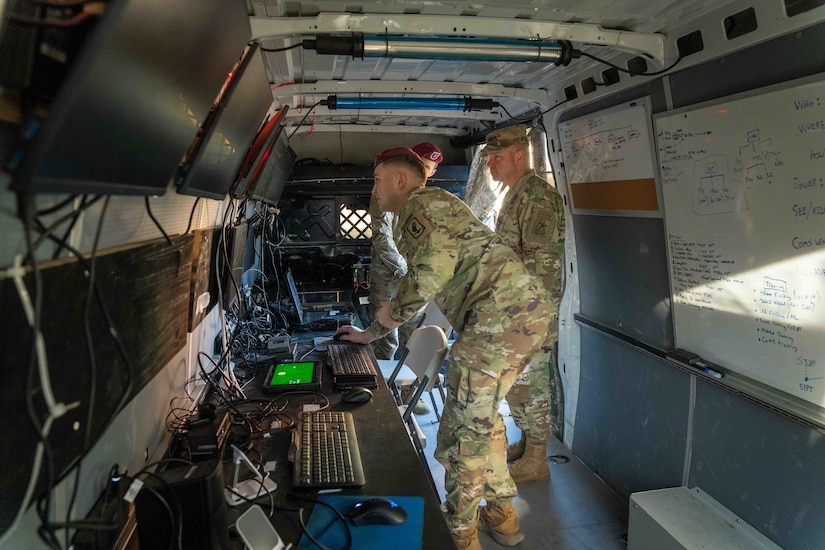
A man in a camouflage military uniform looks at a computer screen while moving a mouse. Another soldier in similar attire looks at the screen. Both men and another soldier in the background are standing in a long vehicle with a line of computers and monitors on the left side.
"In [the Star Wars movie], 'A New Hope,' Luke Skywalker flies an X-Wing through the Death Star trench and blows it up," La Torre said. "This wasn't like that. It was way harder. Honestly, it felt more like Darth Vader shooting down rebel pilots. He might be the villain, but he's also one of the best pilots in the galaxy." 
 
That was the image in La Torre's mind as his team with the 173rd Airborne Brigade achieved a milestone once unimaginable for conventional Army units: destroying an aircraft in flight using a first-person-view drone carrying an explosive charge. 
 
The strike took place earlier this month during the Army's Unmanned Aerial Systems and Launched Effects Summit, held Aug. 11-15 at Fort Rucker, Alabama. The live-fire event was led by the brigade's bayonet innovation team in partnership with the Pennsylvania Army National Guard and engineers from Army Combat Capabilities Development Command. 
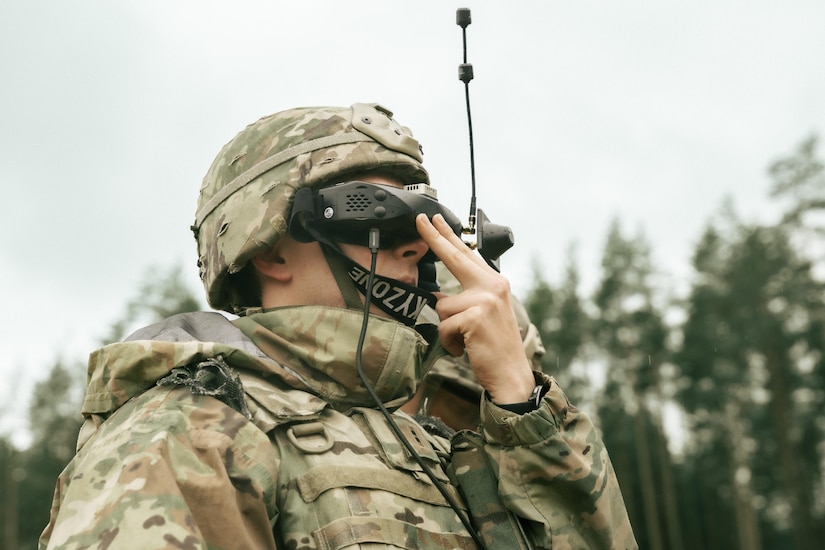
A soldier in a camouflage military uniform and helmet adjusts tactical goggles on his face.

 
"When I heard [Army] Chief [Warrant Officer 2] Nate Shea say, 'Arming,' when he was lined up behind the fixed wing threat UAS, I knew he'd take it down," La Torre said. "A few seconds later he detonated the claymore [mine], and I looked up from my end-user device to see the fixed-wing [aircraft] drop out of the sky." 
 
The success came after weeks of training. Paratroopers flew for hours each day, building muscle memory while rehearsing how to engage a fast-moving aircraft. Army Chief Warrant Officer 2 Andrew Topits familiarized himself with the fixed-wing platform a month in advance, while Shea practiced with inactive claymores. Once on the ground at Fort Rucker, the operators flew daily in changing weather, preparing for a target that could appear anywhere across the range. 
 
Technical skill proved as important as piloting. 
 
"The ability to train and solve problems immediately afterwards was critical to mission success," La Torre said. "The team was soldering, disassembling, reassembling and performing [quality assurance] around the clock while rehearsals were underway. While tactical units and technicians may not share the same language, they do share an intellectual curiosity and desire to succeed." 
 
La Torre emphasized what it means for the average paratrooper. 
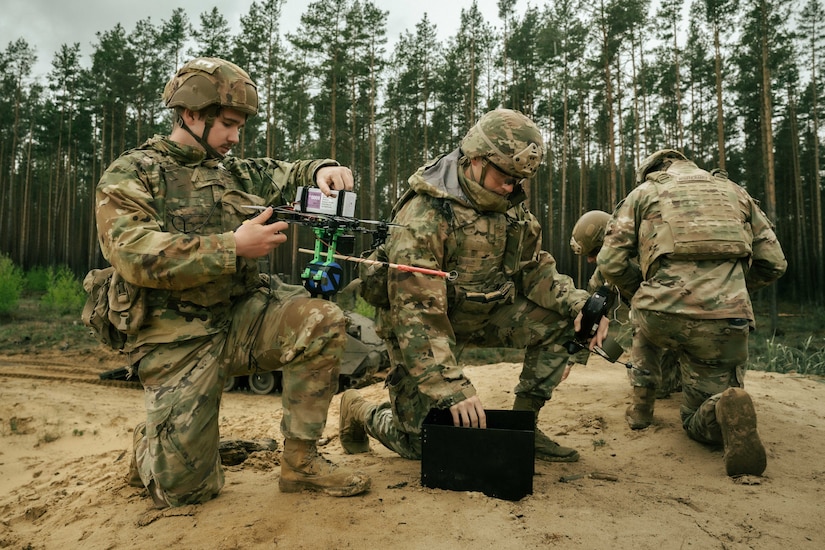
A group of soldiers in camouflage military uniforms kneel in the sand. A soldier on the left is holding a drone, while the soldier to the right is holding a remote. There are trees in the background.

 
"With the right kit, paratroopers will be able to utilize a low-cost system with preexisting munitions to execute a wide variety of mission tasks — and have the power to protect their unit from an endemic threat," he said. 
 
The drone demonstration showed that innovation doesn't have to come from the top. 
 
"It feels extremely satisfying to have this level of impact, but solving these kinds of problems should not be alien to junior officers, or any leader," La Torre said. "Every year the Army produces leaders at all levels who are better educated now than ever before. At the end of the day, rank is immaterial when it comes to problem-solving." 
 
For La Torre, the milestone reflects how far the 173rd Airborne Brigade has come. 
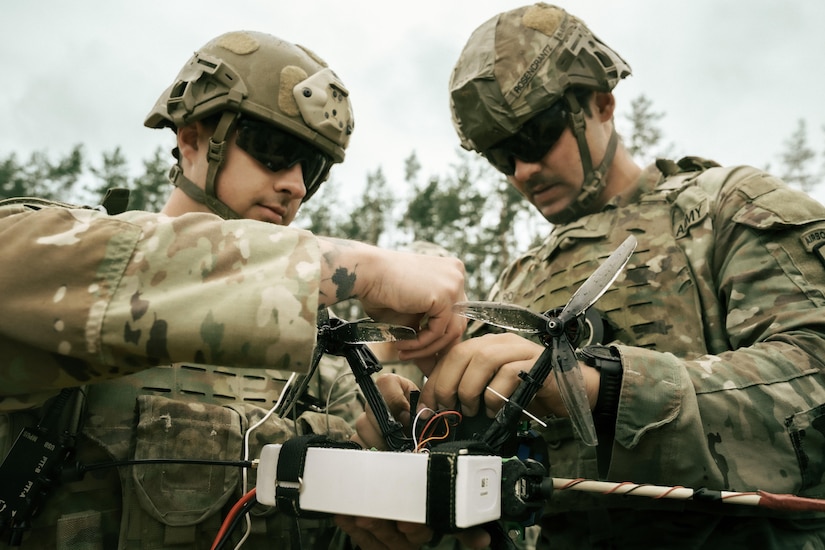
Two soldiers in camouflage military uniforms work on a drone.

 
"At this time last year, this kind of training was a pipe dream for conventional units," he said. "For the engagement itself, Chief Shea did an incredible job and so did Chief Topits. It's such a difficult mission profile for both aircraft." 
 
Lessons from the bayonet innovation team fed directly into Fort Rucker's new lethal UAS course, directed by Army Capt. Rachel Martin and Army Maj. Wolf Amacker. The course consolidates milestones within the Army's UAS community and serves as a hub for education and experimentation. 
 
"The more testing and experimentation we do, the less we must teach theoretically and the more we can back claims with real data," La Torre said. "Safe and effective experimentation allows commanders to understand the true nature of the risks they assume with these systems and helps make this training more commonplace." 
 
For La Torre, the boundaries are clear: safety and scalability. 
 
"We must safely conduct training, testing and experimentation," he said. "We also must make sure everything we do is exportable to other units so they can do the same. I'm confident what we've done is scalable, and the lethal UAS course at Fort Rucker will centralize the growth of lethal UAS engagements while also serving as a hub for subject matter experts to gather and exchange lessons learned."

Wednesday, August 26, 2015

Thai combat controllers, U.S. air support operations make it rain

by Staff Sgt. Wes Wright
JBER Public Affairs


8/26/2015 - JOINT BASE ELMENDORF-RICHARDSON, Alaska -- Fliers and ground crews got used to a lot of foreign accents throughout Red Flag Alaska 15-3.

However, for U.S. and coalition C-130 Hercules pilots, one unique accent that routinely pierced the steady droning noise of their Pratt and Whitney motors came from Royal Thai Air Force combat controllers.

Going by their call signs, RTAF combat controllers "Nok" and "Piglet," Flight Sgt. 1st Class Saknarong Wongin and Flight Lieutenant Phongsakron Namjit, worked with side-by-side with a U.S. Air Force air mobility liaison officer, Capt. Michael Spanogle from the 3rd Air Support Operations Squadron to drop common delivery system bundles and paratroopers from the back of coalition aircraft in simulated combat situations.

"This was a very unique opportunity for both parties," Spanogle said. "Just to see how their special forces and combat controllers operate is helpful. There are a lot of parallels when it comes to passing nine-lines, radio operations and things of that nature."

While there are vast differences and scopes of responsibility between not only AMLOs and CCTs, one constant is the ability to be a one-man air traffic controller in an austere location.

"Whenever there is an air drop, my job is to go out and survey the area, make sure it's safe for operations, and coordinate with the users," Spanogle said. "My job is to go out as a single resource, which is what I normally do, or, in this case, working with the Royal Thai Air Force to help train them."

The U.S.-Thai ground team focused on improving radio platform integration and streamlining communication.

"It was good working with the Americans to learn new communication techniques and procedures," Wongin said. "It was fun. [Spanogle] taught us a lot. We will use the lessons we learned in the future for improved cooperation."

While the U.S. AMLO and Thai CCT personnel were working to improve their craft, 3rd ASOS technicians, took the opportunity to install radio equipment onboard a Humvee. They were then able to test and demonstrate the improved voice and digital radio capabilities to the Thais.

According to Tech. Sgt. Mike Whiteman, 3rd ASOS support superintendent, the capabilities, tactics, techniques and procedures demonstrated to the RTAF CCT members shows how an improved radio platform can increase communication with both ground and air resources.

The combined efforts are representative of the learning processes required from international forces during large operations and continue to prove how crucial these events are to conducting streamlined operations for future exercises and real world operations, Whitman said.

In addition to radio communication, Spanogle, Nok and Piglet worked together to set up point-of-impact markings and landing zone panels to guide aircraft. They also shared techniques on recording data and how to best pass that information to an inbound aircraft.

"It's absolutely critical," Spanogle said. "From a flying standpoint, when integrating with other nations, you see a lot of dynamics and aspects come together. From the ground sense, it's a very unique opportunity. Learning how they think and operate is awesome. It teaches us how to make things more streamlined and safe. That way, if we do go to combat, those lessons will make us more effective when we integrate."

While the Thai CCT personnel and U.S. AMLO had  operational duties to perform together, the same amount of effort was put into solidifying their personal relationships.

A common understanding among participants at Red Flag was if you went near the Thai aircrew area around lunch time, you'd be invited to stay for food, according to several aircrews.

"Personal relationships are huge," Spanogle said. "That first day you get to meet someone really sets the tone for how things are going to go. I have nothing but accolades to sing for them. They were very professional and kind. They were here for more than to just drop things out of the back of an airplane. They were here to build a relationship with our forces."

Friday, July 10, 2015

1/40th CAV redeploys with fanfare

by Staff Sgt. William Banton
Joint Base Elmendorf-Richardson Public Affairs


7/10/2015 - JOINT BASE ELMENDORF-RICHARDSON, Alaska -- Approximately 350 Soldiers from the 4th Infantry Brigade Combat Team (Airborne), 25th Infantry Division were honored in a redeployment ceremony at Buckner Physical Fitness Center July 10, 2015.

Several hundred paratroopers assigned to the 1st Squadron (Airborne), 40th Cavalry Regiment, along with a small contingent of paratroopers assigned to the brigade's Headquarters and Headquarters Company, returned home from a 10-month rotation in support of peacekeeping operations in Kosovo.

"This team ensured a continuous safe and secure environment for the freedom of the people of Kosovo," said Maj. Gen. Bryan Owens, U.S. Army Alaska commanding general, at the redeployment ceremony. "These Arctic Warriors served daily alongside our North Atlantic Treaty Organization allies supporting nations including Hungary, Armenia, Germany, Poland and Turkey."

As part of the NATO-led Kosovo Force, Multinational Battle Group-East, the 1-40th CAV supported Kosovo police, alongside a multinational force which included Soldiers from Romania, Armenia, Moldova and Kazakhstan. This support included conducting steady-state operations involving more than 1,000 presence patrols, 180 unexploded ordnance disposals, 139 synchronized patrols and 18 reconnaissance operations.

"I think the behavior and the conduct of the Soldiers was extremely professional," said. Col. Clint Baker, MNBG-E commander. "We had a flawless record of mission success. All in all, I think the Soldiers did it as about as good as anyone could do it. I'm really proud of them."

Owens echoed the same sentiment in his remarks.

"They epitomize what the chief of staff of the Army refers to as globally deployed, regionally engaged forces," Owens said. "Today it is an absolute pleasure to welcome home this team and say job well done."

KFOR entered Kosovo in June 1999 in support of U.N. Security Council Resolution 1244, tasked with maintaining a safe and secure environment and freedom of movement for all Kosovo's citizens. At that time, the Balkans were in turmoil, facing the biggest military and humanitarian crisis since World War II.

A mounting conflict between the Serb-dominated military of the Federal Yugoslav Republic and the ethnic Albanian Kosovo Liberation Army demanding independence from Belgrade had claimed some 10,000 lives and sparked the exodus of almost 1 million Albanian refugees.

According to the U.S. Department of State, the U.S. forces played a key role in KFOR operations to end the war and established diplomatic relations with Kosovo, following its declaration of independence in 2008.

Additional reporting by Donna Miles, American Forces Press Service, and Army Sergeant Brian Ragin, 4-25 Public Affairs.