Showing posts with label combat controllers. Show all posts

Friday, September 05, 2025

Kentucky Air Guard Special Tactics Airmen Test Maritime Skill in Caribbean

A squadron of special tactics airmen from the Kentucky Air National Guard completed a grueling five-day exercise, Aug. 30, testing their ability to perform a broad spectrum of operations in a maritime environment while responding to an enemy threat. 
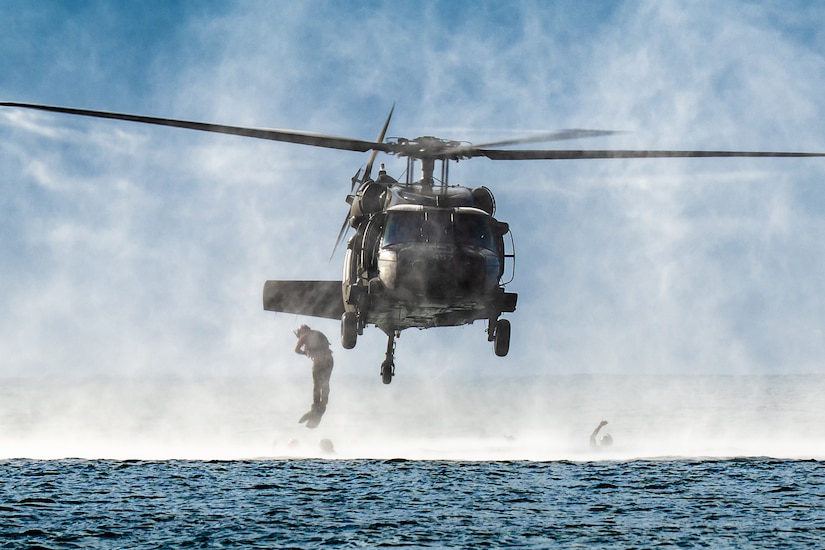
A person jumps from a military helicopter into a body of water. The sky is blue, with clouds and a smoky mist rises above the water.

 
The airmen, including combat controllers, pararescuemen and special reconnaissance troops, operated from the island of St. Croix, U.S. Virgin Islands, to conduct land, sea and air missions with fixed- and rotary-wing aircraft as part of Exercise Emerald Warrior 25.2, according to the special tactics officer who served as lead planner. 
 
"Our airmen exercised their unique skill sets to parachute into contested territory, establish airfield operations, control aircraft, respond to search and rescue scenarios, manage notional medical evacuations and conduct reconnaissance and targeting operations on a very tight timeline," the officer said. 
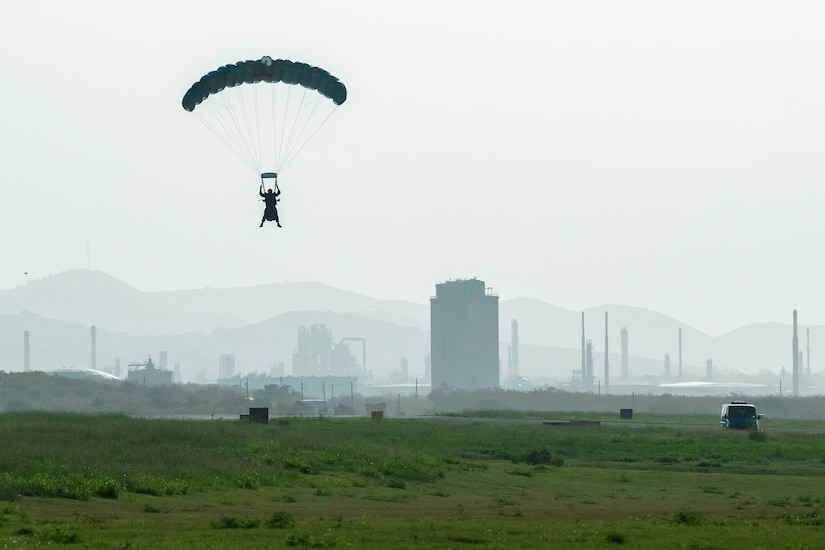
The silhouette of a person hanging from a parachute and landing in a green grassy field with buildings and mountains in the background.

 
St. Croix and its neighboring islands provided an ideal training environment, he added. 
 
"Operations in the Caribbean simulate many of the geographical features our forces may encounter when deployed around the globe," he said. "Having to overcome the kinds of challenges presented here will make us a more lethal and effective force the next time we conduct littoral operations anywhere in the world." 
 
The St. Croix event was just one piece of Emerald Warrior, a large-scale special operations exercise staged in multiple locations by Air Force Special Operations Command to train special operations components, sister services, interagency and partner forces. The exercise simulates missions for a theater campaign to support combatant commanders operating in a volatile environment against strategic competitors. 
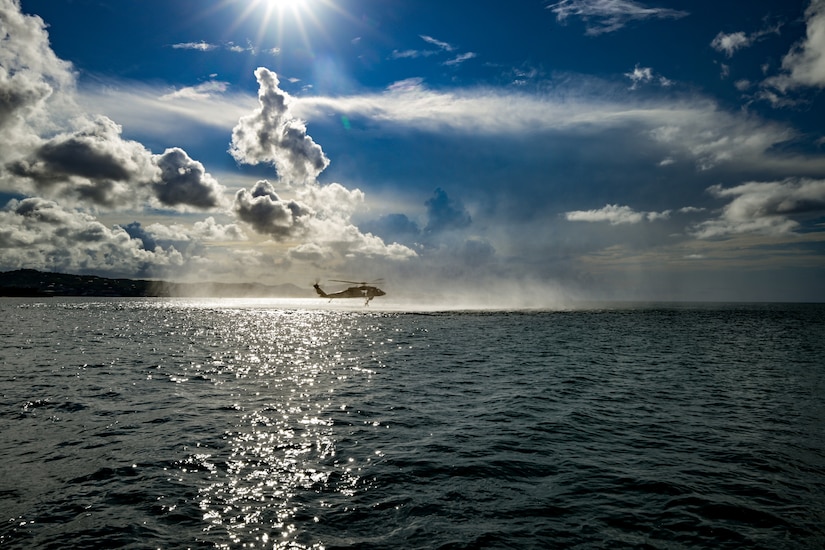
Mist rises from a body of water as a military helicopter hovers over it. The sky is blue with clouds, and the sun shines above the aircraft, creating a glow in the water below.

 
A key focus was an agile combat employment exercise, meant to advance the ability to project air power in complex, unfamiliar or contested environments while working from distributed locations with limited support, the officer said. 
 
The exercise, staged and executed by forces from the Louisville, Kentucky-based 123rd Airlift Wing, kicked off Aug. 26 when six special tactics airmen parachuted into the Caribbean Sea with an inflatable boat, 3 miles off the shore of St. Croix, from a Kentucky Air Guard C-130J Super Hercules. Eleven more combat controllers and pararescuemen then jumped directly into Henry E. Rohlsen Airport from the same aircraft, with both forces combining to take control of the airfield. Within minutes, the airmen had cleared the runways, established perimeter security and implemented air traffic control, allowing the C-130 to land and offload crucial assets. 
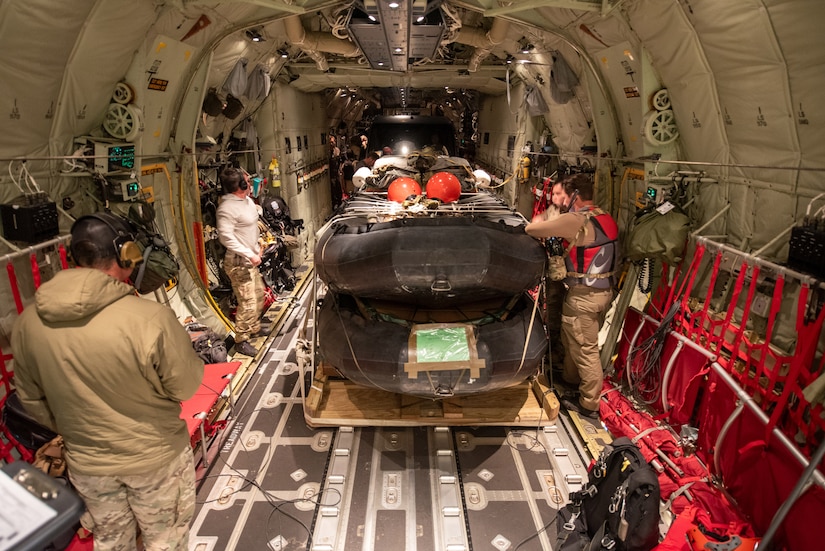
A group of people wearing brown military uniforms prepare to airdrop a boat from the inside of a military aircraft.

 
In another mission, spanning two days, a group of airmen traveled 75 nautical miles by boat to conduct reconnaissance and targeting operations on a nearby island held by simulated enemy forces. 
 
Two other scenarios tested the squadron's ability to conduct search and rescue operations and provide medical care in challenging environments. 
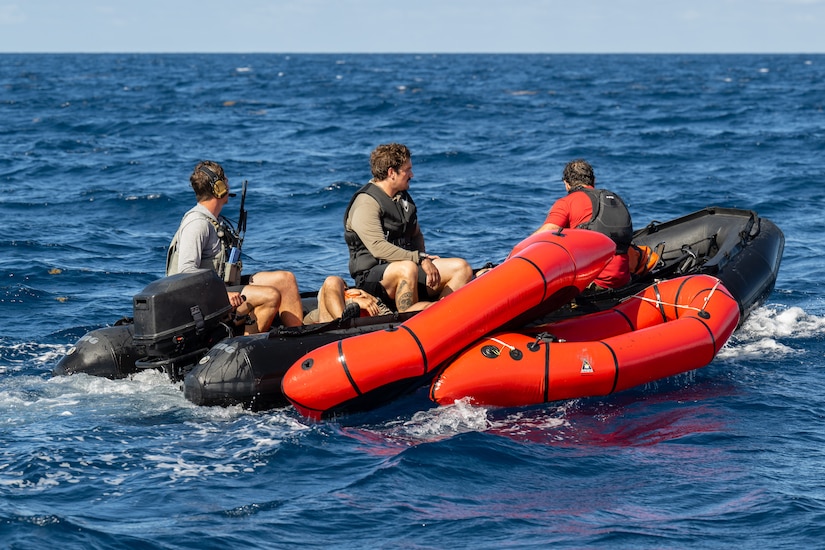
Three people sit in an orange and black life raft in the ocean.

 
In the first event, six pararescuemen and combat controllers were tasked with finding survivors floating in life rafts on the open ocean after their plane crashed at sea. Over the course of a 32-hour scenario, the airmen located the victims while flying over the crash site in a C-130J, parachuted into the ocean with two inflatable boats, provided on-scene medical care and controlled medical evacuations via helicopter hoist operations. 
 
"This was a particularly demanding scenario designed to test both the rescue capabilities and the survival skills of our airmen on the open ocean," the planner said. 
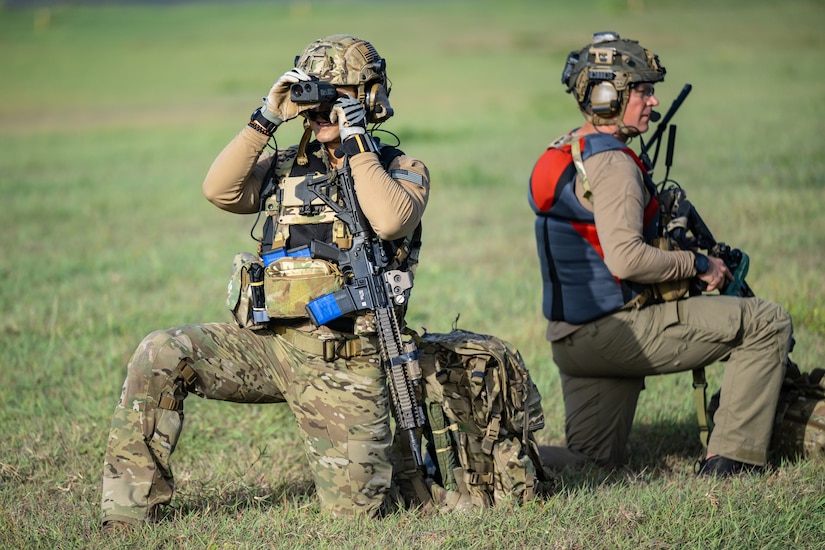
Two people wearing camouflage military uniforms kneel in a grassy field facing opposite directions. Both have weapons, and one is holding binoculars.

 
Other training included exfil and infil operations on land and sea from UH-60 Black Hawk helicopters, provided by the Mississippi Army National Guard's 185th Aviation Brigade, as well as a mass casualty exercise involving civilians wounded by an industrial accident. In that event, airmen were required to triage patients, provide battlefield medical care and control their evacuation via Black Hawk helicopters from the Virgin Islands Air National Guard Station. 
 
Such complex operations required coordination with numerous entities, the planner said, including the U.S. Coast Guard; the U.S. Virgin Islands Governor's Office, Police Department and Air National Guard; officials at Henry E. Rohlsen Airport; local marinas and dozens of area businesses. 
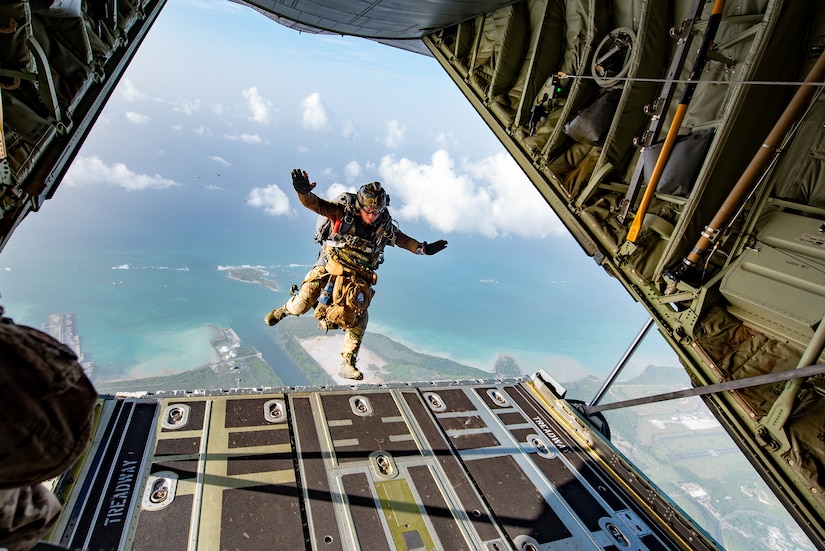
A man wearing a camouflage military uniform and parachute equipment jumps from a military aircraft. The rear of the aircraft is in front of him, and behind him is a blue sky with clouds.

 
The exercise also relied on essential capabilities provided by the squadron's combat mission support team, including radio technicians, diving gear specialists, parachute riggers, vehicle maintenance troops and administrative specialists. 
 
"An exercise of this scope, which has been in the planning stage for over a year, would not have been successful without the combined efforts of everyone involved, from our combat support troops to the governor's office to local citizens who were so supportive of our efforts to ensure our nation's security." 

Wednesday, August 26, 2015

Thai combat controllers, U.S. air support operations make it rain

by Staff Sgt. Wes Wright
JBER Public Affairs


8/26/2015 - JOINT BASE ELMENDORF-RICHARDSON, Alaska -- Fliers and ground crews got used to a lot of foreign accents throughout Red Flag Alaska 15-3.

However, for U.S. and coalition C-130 Hercules pilots, one unique accent that routinely pierced the steady droning noise of their Pratt and Whitney motors came from Royal Thai Air Force combat controllers.

Going by their call signs, RTAF combat controllers "Nok" and "Piglet," Flight Sgt. 1st Class Saknarong Wongin and Flight Lieutenant Phongsakron Namjit, worked with side-by-side with a U.S. Air Force air mobility liaison officer, Capt. Michael Spanogle from the 3rd Air Support Operations Squadron to drop common delivery system bundles and paratroopers from the back of coalition aircraft in simulated combat situations.

"This was a very unique opportunity for both parties," Spanogle said. "Just to see how their special forces and combat controllers operate is helpful. There are a lot of parallels when it comes to passing nine-lines, radio operations and things of that nature."

While there are vast differences and scopes of responsibility between not only AMLOs and CCTs, one constant is the ability to be a one-man air traffic controller in an austere location.

"Whenever there is an air drop, my job is to go out and survey the area, make sure it's safe for operations, and coordinate with the users," Spanogle said. "My job is to go out as a single resource, which is what I normally do, or, in this case, working with the Royal Thai Air Force to help train them."

The U.S.-Thai ground team focused on improving radio platform integration and streamlining communication.

"It was good working with the Americans to learn new communication techniques and procedures," Wongin said. "It was fun. [Spanogle] taught us a lot. We will use the lessons we learned in the future for improved cooperation."

While the U.S. AMLO and Thai CCT personnel were working to improve their craft, 3rd ASOS technicians, took the opportunity to install radio equipment onboard a Humvee. They were then able to test and demonstrate the improved voice and digital radio capabilities to the Thais.

According to Tech. Sgt. Mike Whiteman, 3rd ASOS support superintendent, the capabilities, tactics, techniques and procedures demonstrated to the RTAF CCT members shows how an improved radio platform can increase communication with both ground and air resources.

The combined efforts are representative of the learning processes required from international forces during large operations and continue to prove how crucial these events are to conducting streamlined operations for future exercises and real world operations, Whitman said.

In addition to radio communication, Spanogle, Nok and Piglet worked together to set up point-of-impact markings and landing zone panels to guide aircraft. They also shared techniques on recording data and how to best pass that information to an inbound aircraft.

"It's absolutely critical," Spanogle said. "From a flying standpoint, when integrating with other nations, you see a lot of dynamics and aspects come together. From the ground sense, it's a very unique opportunity. Learning how they think and operate is awesome. It teaches us how to make things more streamlined and safe. That way, if we do go to combat, those lessons will make us more effective when we integrate."

While the Thai CCT personnel and U.S. AMLO had  operational duties to perform together, the same amount of effort was put into solidifying their personal relationships.

A common understanding among participants at Red Flag was if you went near the Thai aircrew area around lunch time, you'd be invited to stay for food, according to several aircrews.

"Personal relationships are huge," Spanogle said. "That first day you get to meet someone really sets the tone for how things are going to go. I have nothing but accolades to sing for them. They were very professional and kind. They were here for more than to just drop things out of the back of an airplane. They were here to build a relationship with our forces."