Showing posts with label army special forces. Show all posts

Monday, January 19, 2026

Medal of Honor Monday: Army Sgt. Gordon Yntema

Army Sgt. Gordon Douglas Yntema, a Green Beret, fought until his last breath to make sure the Vietnamese troops with whom he served could withdraw in the face of a firefight they couldn't win. His selflessness and dedication to the cause earned him a posthumous Medal of Honor.
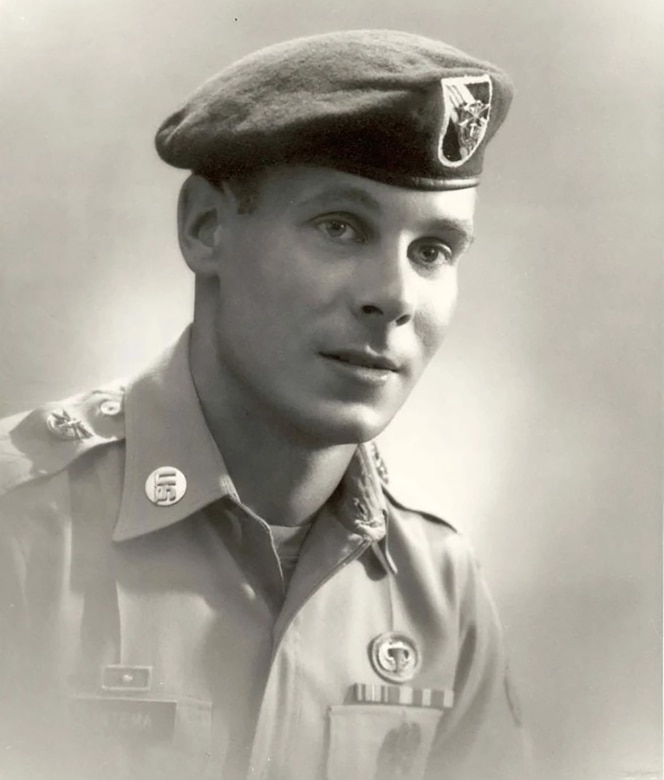
A man in a military dress uniform and beret poses for a photo.

Yntema was born June 26, 1945, in Bethesda, Maryland, to Dwight and Cynthia Yntema. He had a brother named David.

When he was a little more than a year old, the family moved to Holland, Michigan, so his father could work as a professor of business administration at Hope College, according to The Grand Rapids Press.

After first going to public school, Yntema attended two preparatory schools, Culver Military Academy in Indiana and Fountain Valley School in Colorado. His military education must have stuck with him because in July 1963, shortly after he turned 18, he enlisted in the Army.

Around the same time, Yntema married Peggy Brown, also from Holland. They had two daughters, Elizabeth and Jane.

After graduating from airborne school, Yntema was assigned to the 82nd Airborne Division, where he learned helicopter mechanics. After deploying for four months to the Dominican Republic in the summer of 1965, Yntema decided he wanted more of a challenge. He then went to U.S. Army Ranger School, qualifying in 1966, before joining Special Forces in January 1967, earning his green beret.

By this time, the U.S. military presence in Vietnam was building, so Yntema was sent to the country in October 1967 with a detachment assigned to Company D of the 5th Special Forces Group, 1st Special Forces. That same month, he received a Purple Heart for wounds he suffered while stationed in a Special Forces camp west of Saigon.
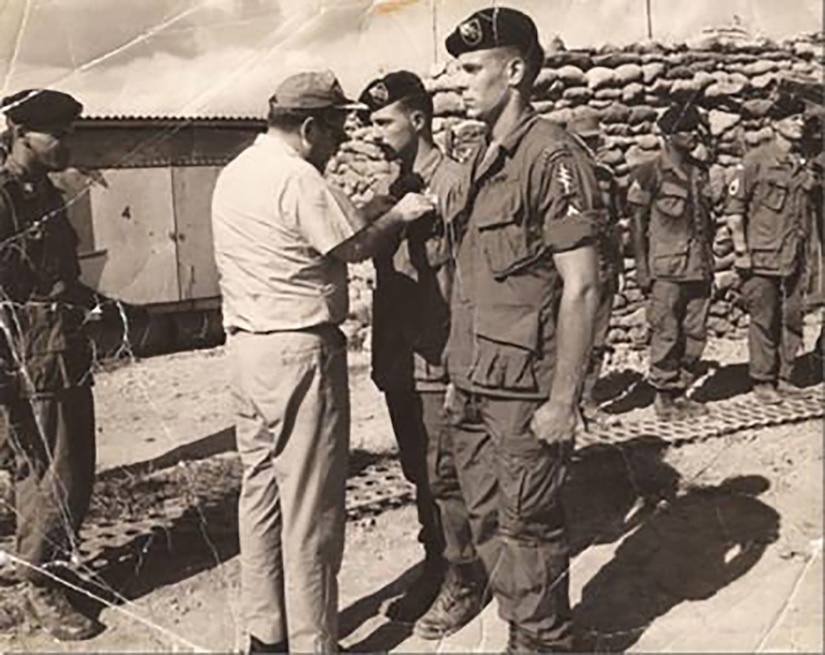
Two men in military uniforms stand at attention while a third man pins something to one of their uniforms. Other people in military uniforms stand at attention in the background.

By mid-January 1968, Yntema was serving as an advisor to a Vietnamese reconnaissance platoon at Camp Cai Cai, along the Cambodia border. On Jan. 16, 1968, his team and another platoon were sent to block enemy movements near the village of Thong Binh when a firefight broke out with the Viet Cong.

The group's friendly South Vietnamese commander was seriously wounded, so Yntema assumed control of the platoons and moved them forward to within 50 meters of the enemy's bunkers. After 30 fierce minutes of fighting, they were forced to pull back to a trench for better protection so they could still carry out their blocking mission.

The situation went from bad to worse. A company of enemy soldiers moved into a position that pinned the platoons down on three sides before unleashing a mortar barrage that inflicted heavy casualties on exposed soldiers. Yntema's remaining platoonmates were low on ammunition, so many of them chose to flee.

Yntema was seriously wounded and also ordered to withdraw, but he refused to leave his fallen comrades. As enemy fire continued, the sergeant carried the wounded Vietnamese commander and another mortally wounded U.S. Special Forces advisor to a small gully about 50 meters away to try and give them some form of protection.
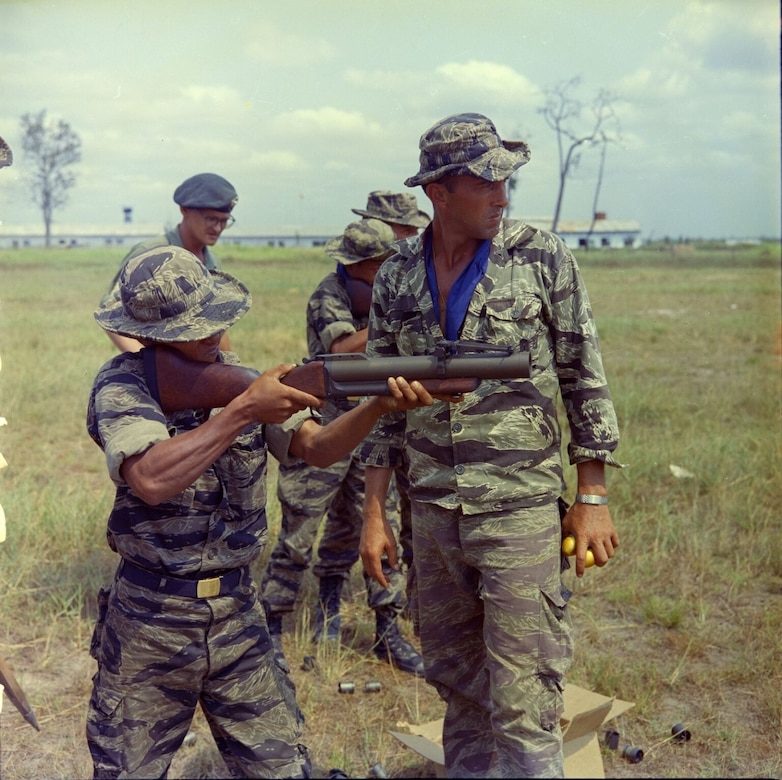
A man in a camouflage military uniform holds a grenade launcher against his shoulder while a man in similar attire beside him looks toward where it’s aimed. Other people in similar attire are standing in the grassy background.

He then continued to push back the attackers, who were trying to overrun the position, until he ran out of ammunition and was surrounded. The enemy gave him the opportunity to surrender, Yntema's Medal of Honor citation stated, but he refused. Instead, he used his rifle as a club to fend off about 15 Viet Cong. His resistance was so fierce that the enemy was forced to shoot him.

Despite insurmountable odds, Yntema refused to give up, instead giving his life to make sure his surviving platoonmates could escape.

For that supreme sacrifice, Yntema received a posthumous Medal of Honor from Vice President Spiro Agnew Nov. 18, 1969, during a White House ceremony. His wife, Peggy, accepted it on his behalf.

Yntema's body was eventually returned home and buried in the Pilgrim Home Cemetery in Holland.

His sacrifice has not been forgotten. A dining facility at the U.S. Army John F. Kennedy Special Warfare Center and School at Fort Bragg, North Carolina, is named in Yntema's honor. In 2011, a section of highway near his hometown was designated the "Medal of Honor Recipients Highway" in his honor and that of three other Michigan recipients: Army Sgt. Paul Chambers, Army Lt. Col. Matt Urban and Army Cpl. John Essebagger Jr. 

Monday, July 20, 2015

Combat Divers Endure Grueling Course to Tackle New Missions


By Amaani Lyle
DoD News, Defense Media Activity

NAVAL AIR STATION KEY WEST, Fla., July 20, 2015 – Two miles down a lengthy oceanside road into an outwardly “Navy” air station, there sits a compound where, just before sunrise, a class of rightfully exhausted yet bright-eyed Army Special Forces soldiers have already begun their hellish day.

The Army Green Berets, Rangers, and even a few West Point and ROTC students comprise the combat-dive certified hopefuls who volunteer for the rigorous and selective six-week, 28-acre Special Forces Underwater Operation School. They are trained to keep secrets -- albeit unofficially at times.

“I don’t tell [my mother] much of what we do because of the stress of the events and what could happen,” said Army 2nd Lt. William Ryerson, who recently commissioned from the University of Central Florida’s ROTC program. “It does not happen because of our training, but there’s potential harm that I cannot tell her about.”

The courses have five iterations per year, each with about 35 soldiers per session, including open- and closed-circuit diving, pool exercises, open-water and sub-surface training, and search and navigation.

Most students already have acquired specialized skills, such as Special Forces or Army Ranger qualifications, and all have passed a prerequisite maritime assessment course.

Rigid Training Style

Among the youngest students in the class, Ryerson, aspires to be a dive team commander. He said he looks not only to the instructors for mentoring, but also to his peers, who will also experience the cadre’s gradual transition from micromanagement to coaching as they progress in the class.

Underwater, one mistake can snowball, which keeps the instructors alert for even the smallest missteps.

“They put a lot of stress on you every day, but they do it for a reason, because the water is unforgiving. It does not care what you do,” Ryerson said. “The current will take you, the tide will take you, there’s marine life out there, which is why they make us pay attention to detail.”

And those who keep their wits about them still face what students describe as murky, low-visibility conditions with no margin for error in prepping and cleaning their equipment and maintaining and using their oxygen supplies.

“A problem with the equipment such as a retainer strap being twisted or a weight belt not being fed through properly … can lead to a catastrophic event out in the ocean,” Ryerson said.

He admitted to such a slip, a twisted strap that cost him precious energy when instructors demanded he perform lunges while shoulder carrying his 180-pound dive partner about 30 feet back and forth multiple times.

One Challenge Tops Them All

Ryerson acknowledged his older classmates might have a rougher go at the corrective tasks, but the strain remains on them all. “Being the youngest guy here gives me an advantage because of the physical strain on our bodies, but it still takes a toll -- the aches and pains in the morning.”

Most students seemed to agree that of the many crucibles they faced, the one-man competence exam in which a student is paired with an instructor in the deep end of the compound’s pool was particularly daunting.

“Each instructor takes the students’ … tank from their mouth and ties a deficiency in that air source,” said Army Capt. Brandon Schwartz, a dive team detachment commander at Fort Carson, Colorado. “So it’s up to the student to remain calm and trace his air source in order to breathe and stay conscious throughout the exam.”

Among the more experienced students, Schwartz said he volunteered for the class because of and not in spite of its rigorous reputation.

Depending on the day or hour, student divers could find themselves aboard Zodiacs, also known as combat rubber raiding crafts, kayaks, or even military aircraft, from which they jump to land on water targets.

That diversity of vessels and tactics is part of the course's water infiltration techniques that ease movement with minimal detection in varying water depths.

Evolving Training Techniques

Army Sgt. 1st Class Dennis Emmons, a Green Beret and class instructor, said the staff members make every attempt to train, teach, coach and mentor, especially in critical training aspects such as open- and closed-circuit dive training, which requires a deliberate and meticulous process.

“The training has evolved [and uses] a lot more pertinent information,” Emmons said. “Now a lot of it’s geared toward what’s going to be asked from the operational units.”

Expecting and embracing training stressors are a significant part of the mental requirements for students, but it doesn’t hurt to be in great shape, he said.

“He’s willing to sacrifice his body for a little bit of pain -- for the greater good,” Emmons said of the ideal student. “To see them show up timid and then to finish as a diver, fully qualified and proficient, to me, it’s awesome.”

Army Sgt. 1st Class Brian Gosselin, head of the force modernization program at the dive school, said maritime warfare is rapidly advancing worldwide.

“It’s our job to make sure we’re training the students with the most up-to-date equipment and techniques that are out there,” Gosselin said.

As such, the school house seeks joint and coalition situational awareness to exchange best practices and develop the equipment and curriculum for its students.

The Value of Calm

Army Sgt. Blake Gorey, who's soon heading to the 10th Special Forces Group at Fort Carson, Colorado, grew up on a sailboat and said he aspired to join Army Special Forces and serve on a dive team early on, despite coming from a long line of Naval operators. Still, he asserts, certain skillsets apply to each of the services.

“The biggest goal for us here as students is to learn how to remain calm under situations that you don’t think you’re going to make it out of,” he said.

Gorey recounted a day of closed-circuit dive training where he realized he was 1,500 meters off from a mark on the beach.

“You have to trust the skills that the instructors have taught you,” Gorey said. “You have to trust your navigation board, your compass, you have to trust your dive buddy to get through.”

But the divers and instructors at the school, about 166 miles southwest of Miami, share the vast Atlantic Ocean with much more than just each other. During a night training mission, Gorey said he held the compass to navigate for his dive buddy, when the two found out they had company.

“About 20 minutes into the dive, we start getting a tug on the buoy and the buddy line,” Gorey said.

He paused, noticed shadows around his dive buddy, and the two realized that dolphins apparently wanted to join the training.

A Storied History

According to the Army’s web site, the military has a storied connection to dive technology. In about 1943, an Army officer, along with representatives from the Army, the Army Air Corps, Navy, Marine Corps and Coast Guard, helped develop a recirculating oxygen rebreather -- the Lambertson Amphibious Respiratory Unit, which gave divers the ability to travel underwater farther and for extended periods of time.

This technology over years evolved into the Draeger underwater breathing apparatus, which protects combat divers by recycling the CO2 the body produces upon exhaling.

That history and evolution has culminated in a course that several students lamented for its imposing demands and day-to-day grind. They mentioned the relentless thirst and hunger as their bodies blaze through calories, and the unyielding need to stay mentally sharp. But at every turn, the instructor cadre is there to remind them why the pain is worth the gain.

“Someday when I go back to a team, the guy I’m teaching today is going to be the guy next to me subsurface, so I want to make sure that they’re safe, confident and smart,” Gosselin said.