Showing posts with label air national guard. Show all posts

Friday, September 18, 2026

Florida, Ohio Guard Units Strengthen Communications Partnership

Three men wearing camouflage military uniforms and hard hats work to open a manhole in a grassy field.

The Florida Air National Guard's 125th Fighter Wing recently joined forces with the Ohio Air National Guard's 220th Engineering Installation Squadron to improve communication infrastructure, strengthen mission readiness and provide hands-on training for airmen.

Earlier this summer, airmen assigned to the 220th Engineering Installation Squadron, who specialize in capabilities such as network infrastructure, communication systems installation and maintenance, and spectrum analysis, traveled to the Jacksonville Air National Guard Base, Florida, to assess and document its existing communication infrastructure; the mission served as an opportunity to integrate and provide expert support.

"We are documenting the layout of the communication infrastructure currently in place," said Air Force 1st Lt. Grant Warren, a cyberspace operations engineer assigned to the 220th. "We are making sure it's properly labeled and accurately updated within the digital repository used by communications squadrons and engineering installation units across the service."

The team traced communication pathways between facilities, confirmed cable routes, reviewed labels and updated infrastructure records.

A downward view of a man in a hard hat as he climbs down a ladder into a large pipe; another person’s arm is outstretched, handing him objects.

Accurate documentation is critical when communication systems are damaged or disrupted. If a cable is cut or a building experiences an outage, technicians must quickly determine where the problem occurred and how it affects the broader network.

Warren noted that keen, accurate insight into the communication infrastructure keeps the base out of the dark.

"We may know that it starts in one building and ends in another, but we need to know what happens in between," he said. "Having a better understanding of that infrastructure increases our strategic capabilities when it comes to the mission."

The assessment also supported long-term planning. By understanding which pathways and resources are available, the 125th can make informed decisions about future communication requirements, infrastructure upgrades and support for new mission systems.

Reliable communications enable command and control, aircraft operations, maintenance, logistics and coordination with military and civilian partners. According to Warren, that makes communication infrastructure critical to mission success.

A downward view of a man in a camouflage military uniform and a hard hat as he sits in a large pipe next to a ladder and takes notes on a clipboard.

"Without communications, many operational missions would not be possible," he said. "We provide that capability, and it's a critical linchpin to have individuals who are capable of meeting the standards, ensuring that missions can go uninterrupted."

This project also gives junior airmen new experiences outside of their normal day-to-day practice, giving them a greater sense of the capabilities and expectations of the communications squadron's mission.

"It's important to do the job right the first time, because that means less work for the airmen who come after us," said Air Force Airman 1st Class Jacob Brommeland, a radar, airfield and weather system specialist assigned to the 220th.

Brommeland said serving as a multicapable airman broadens his experience and gives him opportunities to work with his hands while learning different parts of the mission.

The partnership demonstrates one of the National Guard's key strengths: sharing expertise and resources across states. The 125th gained a clearer understanding of its communication network, while the 220th received realistic training in a different operational landscape.

By working together, both units improved their capabilities and contributed to a force that is always ready and always there.

Tuesday, July 21, 2026

New York Guardsmen, Greenland Airports Partner to Improve Lodging Facility

 July 21, 2026 | By Air Force Staff Sgt. Jocelyn Tuller, 109th Airlift Wing

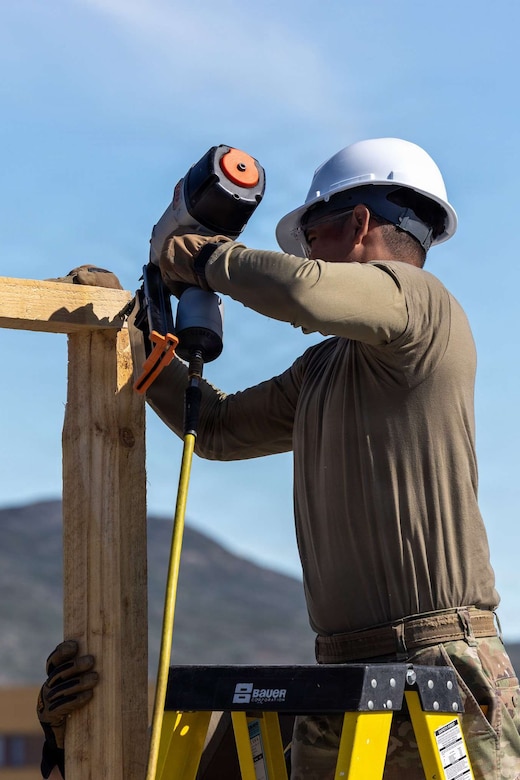
A man wearing a camouflage military uniform and hard hat stands on a ladder and uses a power tool to secure two wooden beams.
The New York Air National Guard, New York Army National Guard and Greenland Airports are working together to improve living conditions for airmen by repairing a long-standing roof issue at a lodging facility in Kangerlussuaq, Greenland. 
 
The project adds a new pitched roof over the building's existing flat roof to stop water from leaking into the facility. There have been two rotations of 46 soldiers so far, and construction is expected to be completed in August, following three rotations of soldiers assigned to the New York Army National Guard's 1156th Engineer Company. 
 
The soldiers are vertical engineers who specialize in building construction, maintenance and upgrades. 
 
"We've known for years that there's problems with the roof," said Air Force Col. Eric Underhill, deputy commander of the 109th Airlift Wing. 
 
The 109th Airlift Wing conducts mission-essential training and provides remote resupply support across the Greenland ice sheet each year, beginning in April and running through August. 
 
Underhill began working with Greenland Airports two years ago to discuss facility improvements as part of a new operating agreement.

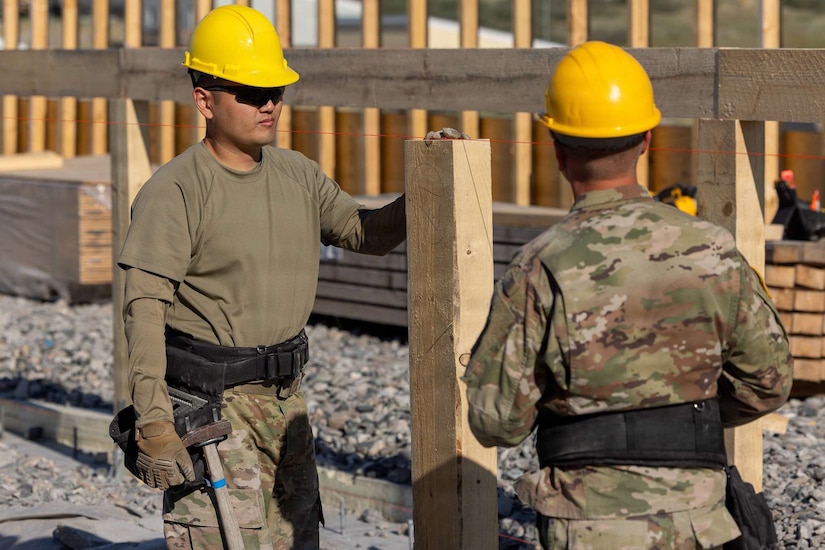
Two men wearing camouflage military uniforms and hard hats stand outside holding power tools next to a wooden building frame.

Greenland Airports, which owns the building, initially sought a contractor to complete the work. After no contractors accepted the project, Underhill proposed a partnership that would allow New York Army National Guard engineers to complete the construction during annual training.

Under the agreement, Greenland Airports designed the roof and purchased the construction materials, while the New York Army National Guard provided the labor. 
 
"This would not have happened if we didn't trust each other and we didn't have a good working relationship," Underhill said. 

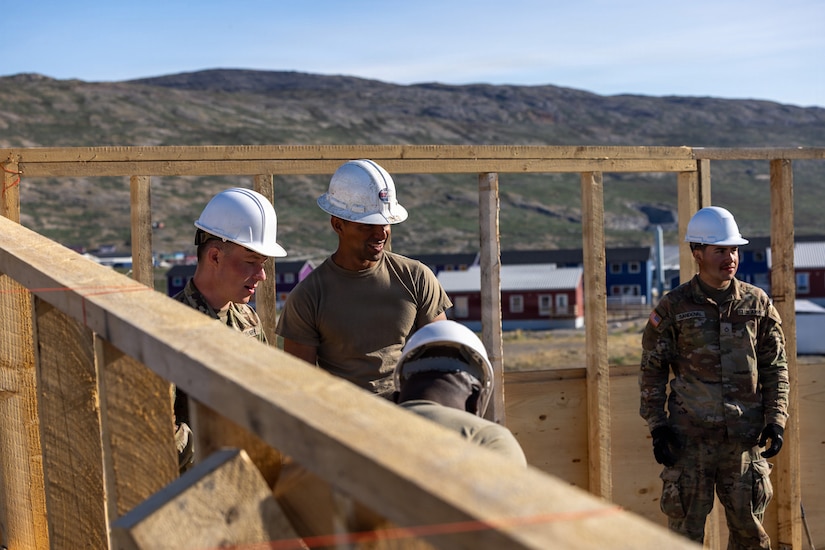
Four people wearing camouflage military uniforms and hard hats stand outside in a wooden building frame.

 
Army Chief Warrant Officer 3 Reid Duncan, an engineering technician assigned to the 1156th, worked with Underhill during multiple site visits to evaluate the project before construction began. 
 
The project builds on work completed by New York Army National Guard engineers during annual training last year. Underhill said the project demonstrated that the soldiers could successfully complete construction projects in Greenland's remote environment.  
 
Construction in Greenland requires months of planning, and the remote location creates additional challenges throughout construction. Underhill said logistics and sustainment make building in the region difficult. 
 
"If something breaks, or you are short on material, it is a long turnaround to get a replacement," Duncan said. 
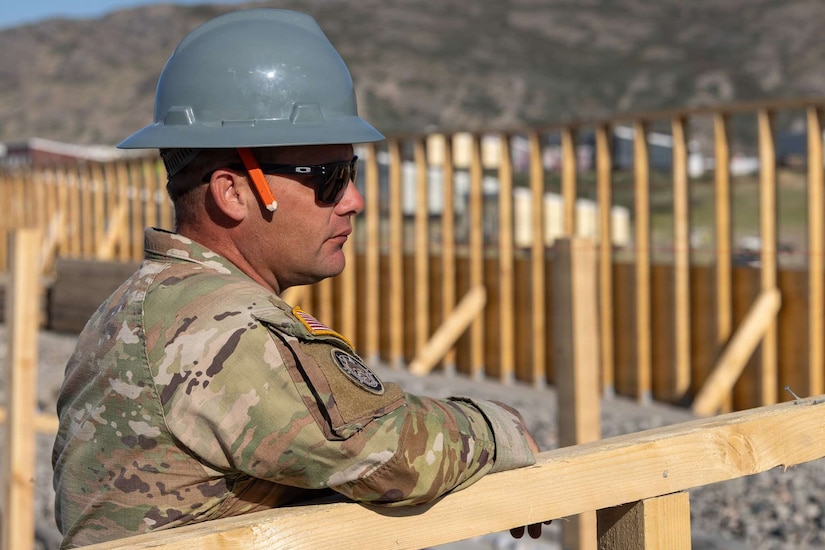
A man wearing a camouflage military uniform, hard hat and sunglasses leans against a wooden rail outside and watches something out of frame.

 
Rather than removing the existing roof, the soldiers are building a new pitched roof over the original flat roof. The new design will direct water away from the building instead of through the interior drainage system that contributed to years of leaks. 
 
"Jobs like this really show them what real construction is like," Duncan said. "We're not just building a 10-by-10 shed; this is a big job." 
 
Underhill said the completed roof represents more than a construction project. The project gives soldiers valuable experience completing a large-scale construction project while improving living conditions for airmen supporting the 109th Airlift Wing's Arctic missions. 

Thursday, September 11, 2025

Joint Service Teamwork Forged During Exercise Sage Eagle

Army Green Berets and supporting elements assigned to the 3rd Special Forces Group teamed with security forces airmen from the Air National Guard for Sage Eagle 25-4, a joint training exercise designed to enhance the services' interoperability and readiness, conducted in late August.

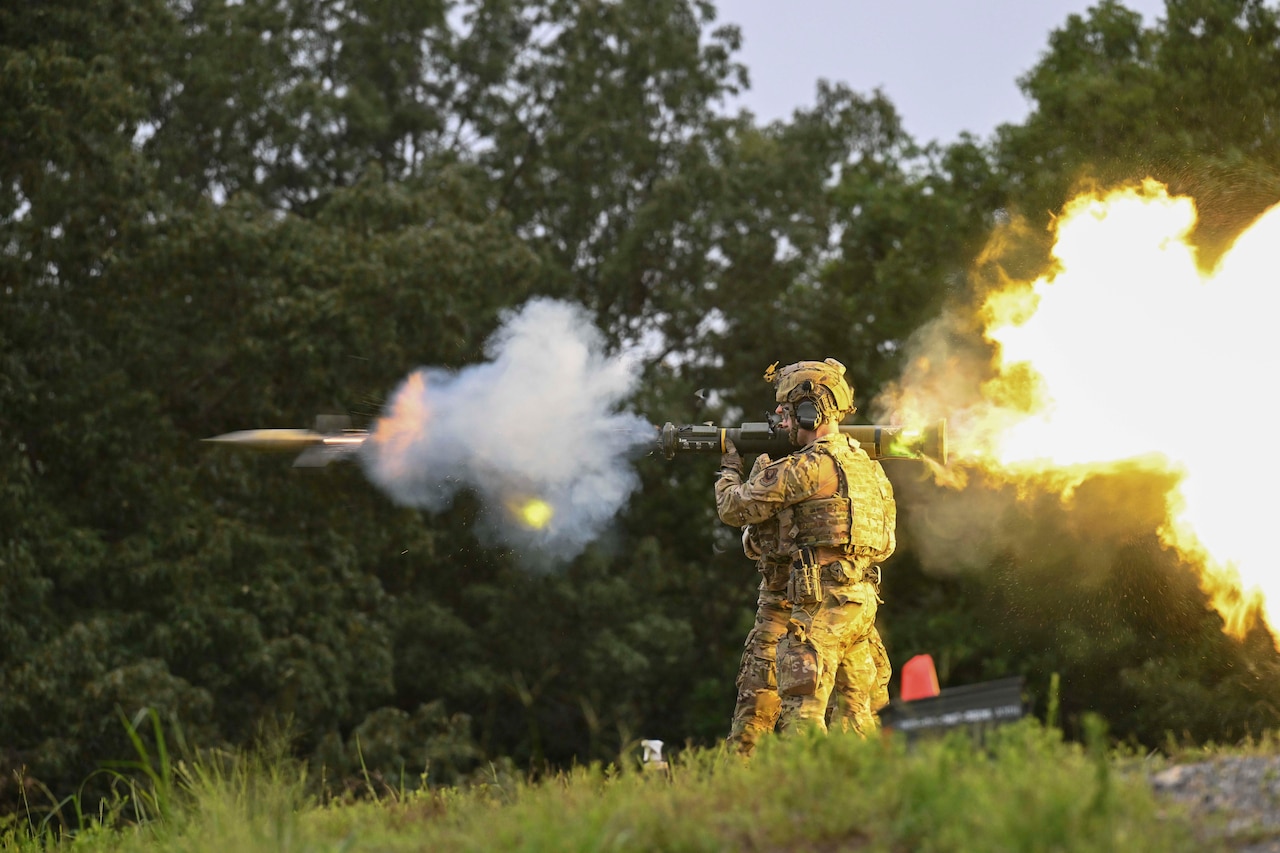
Two service members wearing camouflage stand close to each other as one fires a shoulder-launched missile that creates smoke in front and fire behind the launcher.

With a focus on small-unit tactics, joint mission planning and advanced combat scenarios, the training at Fort A.P. Hill, Virginia, aimed to better prepare special operations forces and the Air National Guard for real-world missions that reinforce their ability to jointly operate in diverse operational environments. 
 
Sage Eagle 25-4 commenced with weapons familiarization, pairing soldiers and airmen in a series of classes that built a foundational understanding of weapons handling and functions. Green Berets trained the airmen on multiple weapons systems, including the M320 grenade launcher and the M249 squad automatic weapon.  

Weapons training culminated in an M4 rifle qualification range before transitioning into advanced tactical training. From dawn to dusk, airmen repeatedly conducted realistic training simulations in small-unit tactics, including close-quarters battle drills, ambushes and raids, immersing them in the demanding tempo of special operations.  

"I think it's great to see the different ways that the Green Berets teach things, for example, room clearing," said Air Force Airman 1st Class Leann Minnick, a security forces airman assigned to the 193rd Special Operations Security Forces Squadron. "They taught us many ways to do it that I'm generally not trained to do, so I could bring that back to my unit." 
 
Following multiple days of weapons training, teams entered a five-day field environment, plagued with rugged terrain and dense vegetation, which challenged even the most experienced service members.  

Limited access to supplies and the need for covert movements through rugged landscapes added another layer of complexity to the training, requiring teams to adapt quickly or risk mission failure. Following days of training from the Army's elite, airmen applied what they learned to plan and execute simulated raids and ambushes, evading a multitude of different enemy threats to complete the mission. 

"[The Green Berets] are experts at detail, which is what it boils down to," said Air Force Tech. Sgt. Jason Tartaglia, a security forces airman assigned to the 166th Security Forces Squadron. "And that's really what makes them so great. Just thinking outside the box or looking at something from a different angle makes a huge difference." 
 
The training culminated in a realistic joint forcible entry exercise, leveraging the unique skills of each service in a mission to capture a high-value target. Soldiers breached the compound under simulated hostile fire, systematically clearing each floor of enemy threats and overcoming tight stairwell fighting positions, barricaded rooms and simulated casualties on every level.
 
While Green Berets maneuvered throughout the compound, the Air National Guard security forces secured the exterior of the compound, facing unruly crowds and demonstrators. Leveraging their training, the security forces mitigated all potential threats, enabling both services to seamlessly withdraw. 
 
Sage Eagle isn't just tactical training; it's a crucible for joint force integration. The exercise honed critical skills in cross-service communication, adaptive planning and mission execution in complex environments. Participants gained instrumental insights, directly enhancing current operations and fortifying readiness for future challenges. 
 
"This training pushed us to our limits, but that's how we get better," Minnick said. "When we walk away tired, dirty and more capable than before — we know it was worth it."

Thursday, June 15, 2023

Unlawful Transmission of Classified Information: Air National Guardsman Indicted

A member of the U.S. Air National Guard (USANG) stationed in Massachusetts has been indicted for unlawfully retaining and transmitting classified national defense information on a social media platform. Jack Douglas Teixeira, 21, of North Dighton, Massachusetts, faces six counts of willful retention and transmission of classified information relating to the national defense. Teixeira was arrested in April 2023 and remains in federal custody.

The indictment alleges that Teixeira, who held a Top Secret security clearance, willfully retained and transmitted classified information classified as "TOP SECRET" or "SECRET" and/or Sensitive Compartmented Information on a social media platform to unauthorized recipients. The charges state that Teixeira accessed classified documents from a classified workstation at the Otis USANG Base and transcribed and transmitted the information in written form to other users on the social media platform. Additionally, he posted images of classified documents, bearing standard classification markings, on the same platform.

Attorney General Merrick B. Garland emphasized the gravity of the charges, stating that Teixeira violated U.S. law and endangered national security by sharing classified information with unauthorized individuals. FBI Director Christopher Wray expressed the commitment of the FBI and its partners to hold accountable those who endanger national security, while Acting U.S. Attorney Joshua S. Levy stressed the importance of safeguarding classified information entrusted to individuals.

Each charge of unauthorized retention and transmission of national defense information carries a maximum sentence of up to 10 years in prison, three years of supervised release, and a fine of up to $250,000. The case is being investigated by the FBI, and Assistant U.S. Attorneys and Trial Attorneys from the National Security Division's Counterintelligence and Export Control Section are prosecuting the case.

It is essential to remember that a criminal complaint is an allegation, and all defendants are presumed innocent until proven guilty in a court of law.


Friday, July 31, 2015

Director of the Air National Guard visits Jefferson Barracks

by Staff Sgt. Brittany Cannon
131st Bomb Wing Public Affairs


7/27/2015 - JEFFERSON BARRACKS, Missouri  -- The director of the Air National Guard viewed missions firsthand, received a base tour and recognized Missouri Citizen-Airmen during his first-ever visit to Jefferson Barracks July 21.

Lt. Gen. Stanley E. Clarke III visited the historic Air Guard base, which is home to a number of 131st Bomb Wing units, along with the 157th Operations Group, 239th Combat Communication Squadron and 231st Civil Engineer Flight.

Clarke was able to visit with Missouri Air Guardsmen and see the unique capabilities they provide to the state of Missouri and the United States Air Force. The general received unit mission orientations and a walking tour of the historical Jefferson Barracks grounds.

Throughout the tour, Clarke met and "coined" several Airmen for their superior performance, including: Master Sgt. Carissa M. Correll, 131st Logistics Readiness Squadron; Tech. Sgt. Brian P. Conrey, 131st Civil Engineering Squadron; Master Sgt. Timothy J. Loyd, 239th CBCS, Staff Sgt. Kenneth A. Romero, 157th AOG and Maj. Bridget S. Zorn, 157th AOG.

"Guardsmen make the choice to defend their homeland every day," said Clarke before coining one of the Citizen-Airmen. When presenting the coin, he described his design, which includes his three Air Guard core competencies emblazoned on its face: warfighting, security cooperation and homeland operations.

"I was beyond ecstatic and completely honored that the director of the Air National Guard personally handed me his coin," said Romero. "It was a privilege I wasn't expecting."

"Our Citizen-Airmen are rightly proud to have had the opportunity to share about their roles and their missions with the Air National Guard's top leader," said Col. Michael Francis, 131st Bomb Wing commander.  "A critical mass of our 131st people - and a critically unique, high-tech and particularly effective slate of military capabilities - remains resident here at Jefferson Barracks  These capabilities set us apart in the Guard and across the entire Air Force."

Completing the visit, Clarke said he was pleased to have met so many superior performers throughout the wing and to have toured historic Jefferson Barracks, which remains the oldest continuously operated military installation west of the Mississippi river.