Showing posts with label Marine leadership. Show all posts

Friday, July 31, 2026

Face of Defense: Marine Caps Full-Circle Journey With Instructor of Year Honor

Marine Corps Sgt. Kade Prentice walked into a Portland, Oregon, recruiting office looking for a fresh start. Six years later, he stands at the head of a classroom at Naval Air Station North Island, California, in the same schoolhouse where he trained as a young Marine. Today, he teaches the next generation of technicians who keep Navy and Marine Corps aviation in the fight.
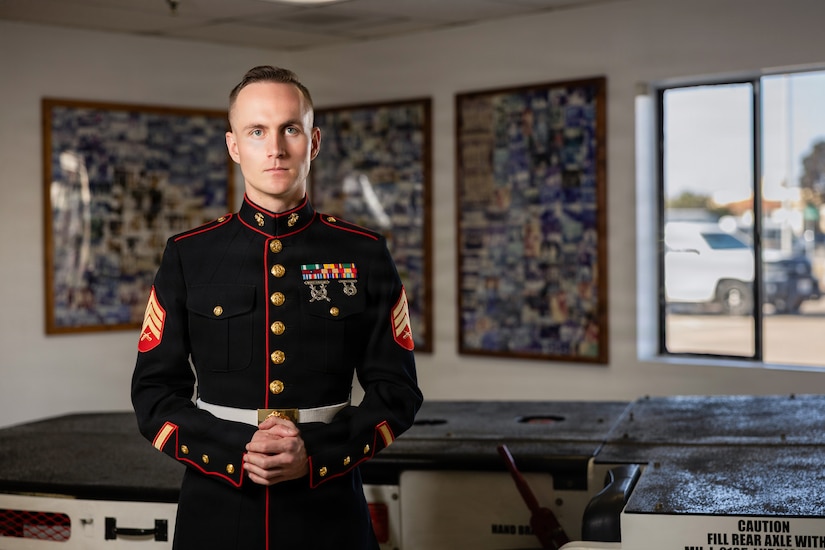
Marine Corps Sgt. Kade Prentice
A Marine stands in a room indoors, with framed photos on the wall behind him and a window.
Job: Aviation Support Equipment Instructor and Course Supervisor
Stationed: Naval Air Station North Island, Calif.
Unit: Center for Naval Aviation Technical Training Unit
Hometown: Happy Valley, Ore.
Prentice is an instructor and course supervisor at the Center for Naval Aviation Technical Training Unit North Island, a subordinate unit of the Center for Naval Aviation Technical Training and a learning center of Naval Education and Training Command.  

In fiscal year 2025, he was named the CNATT domain's Junior Instructor of the Year. The award caps a career that began in NETC's training pipeline, took him from a Marine aviation logistics squadron to a deployment with the 26th Marine Expeditionary Unit and brought him back to the schoolhouse where his own technical training began. 

From Happy Valley to the Pipeline
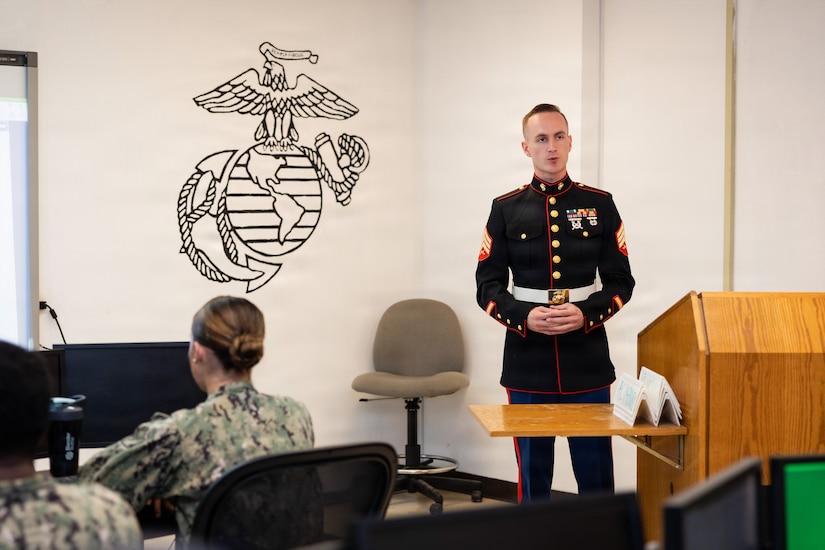
A Marine in a formal uniform stands in a classroom setting and speaks to people sitting at desks.

Prentice grew up in Happy Valley, Oregon, and graduated from Clackamas High School. He started college, but the math on a four-year degree did not add up. 

"I realized what continuing my education would cost, and I had always wanted to serve," he said. "I figured this was a good time to join the military and keep working on my education while I was in." 

His path to the recruiting office took longer than most, but the calculus was simple. 

"It was either take out the loans to finish my four-year degree or find a way to start my life," Prentice said. "Looking back on it, it felt like a no-brainer." 

In December 2019, he reported to Marine Corps Recruit Depot San Diego. After boot camp came Marine combat training at Camp Pendleton, California; the Aviation Support Equipment "A" school at Naval Air Station Pensacola, Florida; and the "C" school at CNATTU North Island, the same courses he now teaches. In February 2021, with the NETC pipeline behind him, he checked in to Marine Aviation Logistics Squadron 26 at Marine Corps Air Station New River, North Carolina, where he advanced to work center supervisor and earned qualifications as a production controller and full-systems collateral duty inspector. 

Tested at Sea

In December 2022, Prentice joined the 26th Marine Expeditionary Unit and deployed aboard the amphibious assault ship USS Bataan and the amphibious transport dock USS Mesa Verde. He served first as a work center supervisor aboard the Bataan before taking over as the support equipment noncommissioned officer in charge aboard the amphibious assault ship USS Mesa Verde. The Marine Corps promoted him to sergeant in January 2024.
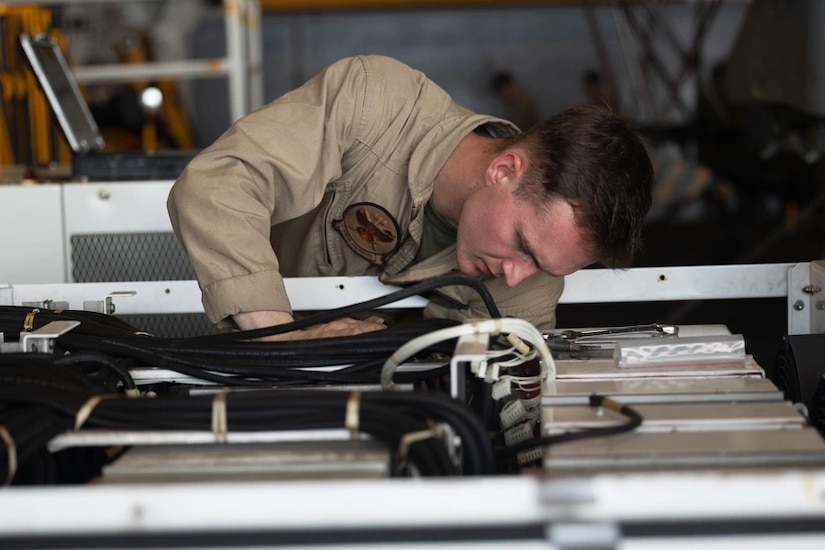
A Marine works on a piece of equipment with black cables on top of it.

Prentice credited the technical foundation he built in NETC schoolhouses with preparing him for the demands of deployment. His operational experience later inspired him to return to the classroom as an instructor. 

"Serving in these high-tempo operational environments highlighted the critical need for expertly trained Marines, which ultimately inspired my transition from the fleet to the classroom in August 2024," Prentice said. 

Back to the Schoolhouse
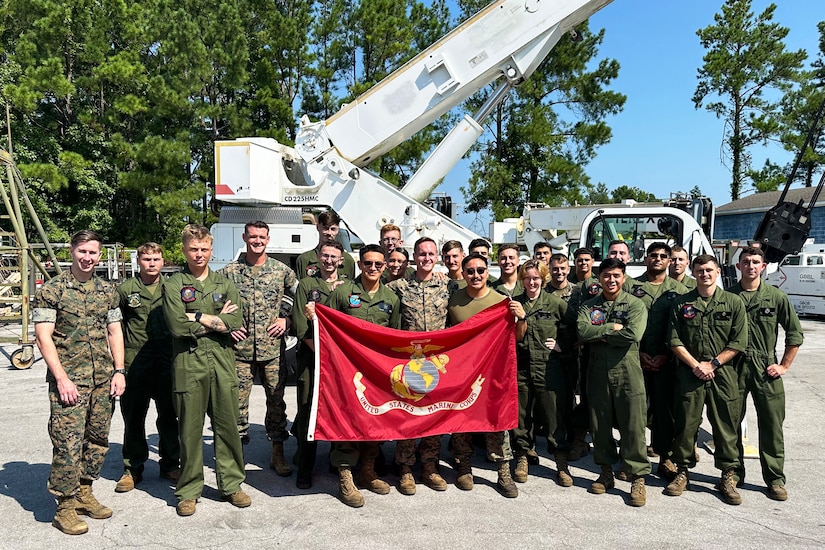
Marines stand as a group outdoors during daytime and smile for the camera, with two people in front holding a red Marine Corps flag.

That August, Prentice received orders to CNATTU North Island, the same schoolhouse he briefly attended as a student four years earlier. Within months, he was selected as a course supervisor, and by the end of the fiscal year, he had earned Junior Instructor of the Quarter and, ultimately, fiscal year 2025 Junior Instructor of the Year for the CNATT domain. 

The hardest part of being a Marine, he said, was never the technical material. 

"I was an awkward kid growing up. It was hard to stand in front of people and tell them what needed to be done," Prentice said. "I was not a leader before I joined, but I have grown into the role exponentially."

We as Marines are constantly told we have to hold a higher standard, and it gets ingrained into you. We are all individuals in the Marine Corps, but we all hold the title of Marine, and that is what binds us together. You just have to figure out what works for you in order to exemplify the title that you have earned."
Marine Corps Sgt. Kade Prentice

Prentice sees his job as building both the technical foundation and the confidence that makes it useful in the fleet. He recalled one junior Marine who arrived eager but was hesitant during practical applications. With extra time on the systems and targeted coaching, the change was hard to miss. 

"The initial awkwardness completely faded, replaced by a quiet, grounded confidence," Prentice said. "By the end of the course, not only had they mastered the technical expertise required for the fleet, but they were actively stepping up to assist their peers." 

Winning Junior Instructor of the Year is the proudest moment of Prentice's career, so far. It also serves as a reminder that the work he saw as routine was preparing Marines for the fleet. 

"Maybe what I feel is just a normal day is a lot more than that," Prentice said. 
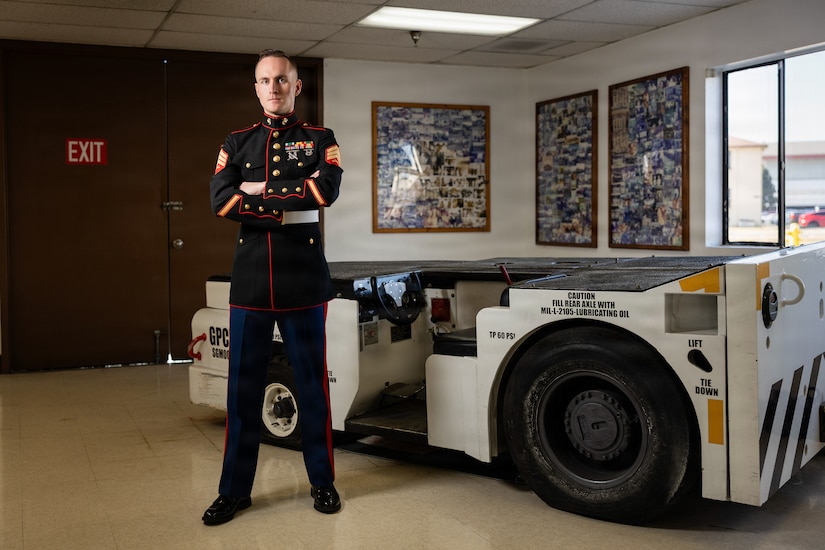
A Marine wearing a formal uniform stands with his arms crossed in a room near a short vehicle, with a window and framed pictures on the wall in the background.

He is about a year away from earning a bachelor's degree in business administration, and is weighing reenlistment, an officer package or a transition to the civilian sector. Prentice said NETC has given him the tools to succeed in any of those paths. 

"I have had a lot more days where I am so glad that I did this," he said, "than days where I am not."

Friday, January 02, 2026

Face of Defense: Marine on Faith, Family and the Silent Drill Platoon

Marine Corps Gunnery Sgt. Zackary Cox stands at the edge of the parade deck at Marine Barracks Washington, watching rifles spin through the air in perfect arcs. The Marines of the U.S. Marine Corps Silent Drill Platoon move as one, every step measured and every motion deliberate.  

To the public, their precision appears effortless. To Cox, it is the result of exhaustion, repetition and a refusal to settle for "good enough." 

"When you watch the shows, you see perfection," Cox said. "But to these Marines, being perfect isn't perfect. They'll drill one mistake until it's gone. That discipline, that mindset, that's what sets them apart."

Marine Corps Gunnery Sgt. Zackary Cox
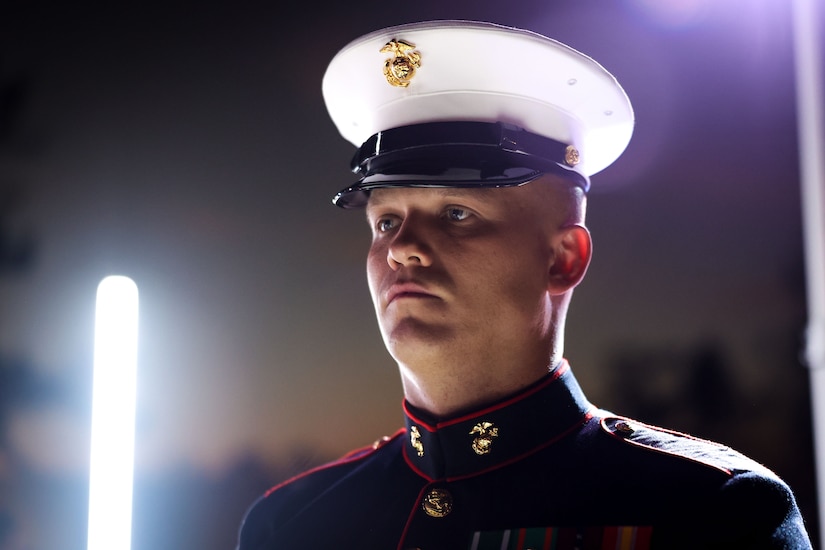
A Marine in formal silent drill platoon attire stands under a fluorescent light at night.
Job: Platoon Sergeant
Stationed: Marine Barracks Washington
Unit: U.S. Marine Corps Silent Drill Platoon
Hometown: San Bernardino, Calif.
Cox paused for a moment with his eyes fixed on the Marines crossing the deck. "It's humbling," he said. "These Marines live this life. They carry the weight of representing the Marine Corps every single time they step out there." 

Roots of Service 

Unlike many Marines, Cox didn't grow up in a long line of military service. His reasons for joining were personal. Raised in a large family without a steady father figure, he felt a need to step up for his younger brothers. 

"I wanted to be more than just a big brother," he said with a smile. "I wanted to be someone they could actually look up to." 

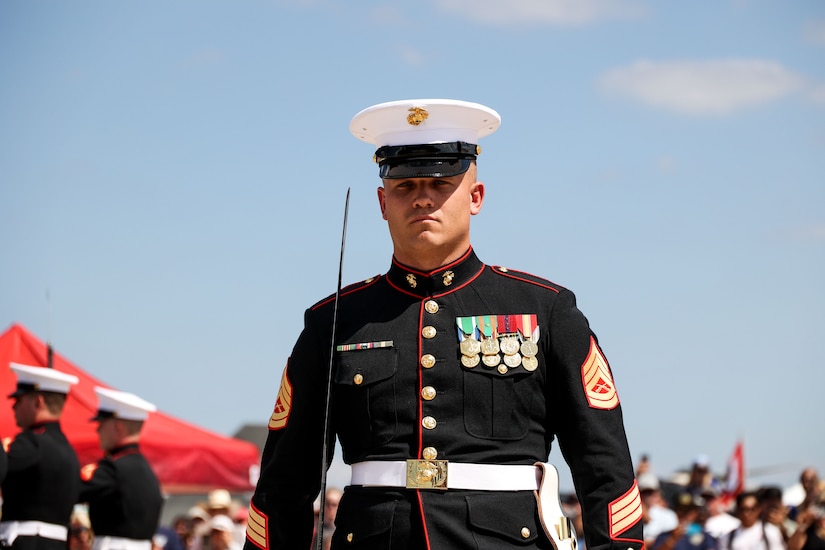
A Marine wearing formal black attire and a white cap stands at attention outside during the day.

That sense of responsibility deepened when he and his wife, Iris, started their own family and welcomed three sons. 

"There was a point where I thought about getting out," Cox admitted. "But fatherhood changes things. The Marine Corps wasn't just a career path anymore. It became the best way I could provide stability for my wife and kids. It was the right choice for all of us." 

Throughout his career, Cox has drawn inspiration from leaders who left a lasting mark. Marine Corps Sgt. Maj. Sean Blue was one of the first. What began as a professional relationship developed into something closer to family. 

"He's like the older brother or father figure I never had," Cox said. "He gave me patience, something I didn't have as a young sergeant. He taught me to slow down and see the big picture." 

Cox credits his wife for keeping him grounded and Marine Corps 1st Sgt. Mia Moffett for reminding him that professionalism and joy can coexist. 

"She taught me you can have fun while still doing your job right," he said. "That stuck with me. Sometimes Marines forget to breathe." 

Faith, he said, has carried him through it all. "I'm a God-fearing man," Cox said quietly. "Without Him, I wouldn't be where I am today. He lays the path. My job is to walk it." 

The Humanity Behind Precision 

By the time Cox arrived at the Silent Drill Platoon, he had served as a drill instructor, water survival instructor, force fitness instructor and infantry leader. None of it, he said, fully prepared him for this role. 

"You can hear stories, talk to the Marines who did the job before you," Cox said. "But nothing prepares you for the grind until you're standing there with them. It's like a whole different world inside the Marine Corps." 

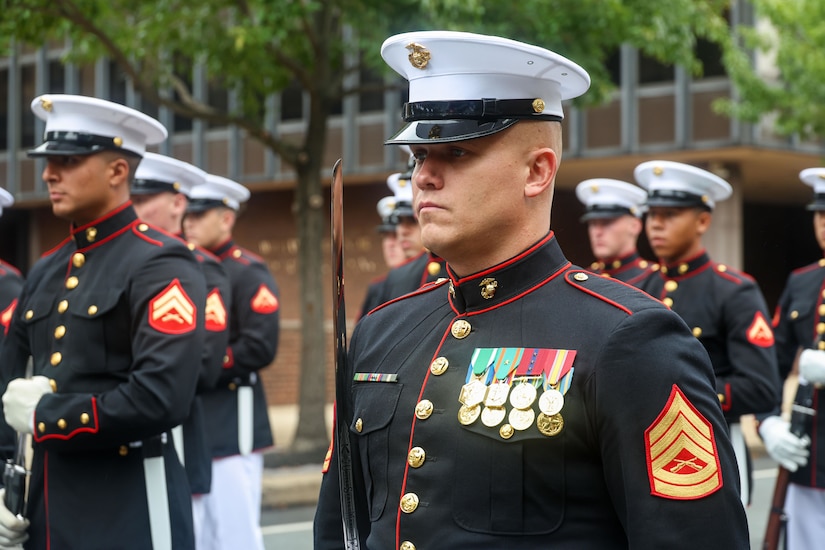
A Marine wearing black formal attire and a white hat stands at attention among other Marines outdoors.

The Silent Drill Platoon, known for its rifle drill precision without verbal cadence or commands, serves as one of the Corps' most visible symbols of discipline. Bearing is everything, and mistakes are rarely tolerated. Yet, Cox said, what the public doesn't always see is the humanity behind the precision. 

He pointed to Marine Corps Lance Cpl. Avery Nix as an example. When Nix first arrived, he wasn't part of the elite "Marching Twenty-Four," the core performers of the platoon. However, through persistence and discipline, he earned his place. 

"Now, he's on the deck, and he embodies what this platoon is about," Cox said. "That drive, that refusal to give up, watching him grow has been one of the best parts of this job." 

Pride, Every Single Time 

Cox initially turned down the opportunity to join the Silent Drill Platoon. When Marine Corps 1st Sgt. Brandon Pizano first suggested it, Cox thought staying with his infantry unit would be better for his career. But Pizano persisted, calling him repeatedly until Cox reconsidered. 

The selection call came unexpectedly while Cox was bowling in Okinawa, Japan. On the other end of the line was Marine Corps Sgt. Maj. Jimmy Richard from Marine Barracks Washington.

"He asked me who I'd been talking to, and why I wanted the billet," Cox said. "Then he told me I'd been selected. I was speechless. That moment will always stay with me." 

Being the platoon sergeant for one of the Marine Corps' most visible units comes with pressure, but Cox describes it as a different kind of weight than in the fleet. 

"With an infantry platoon, maybe five percent of the time is calm," he said. "Here, it's closer to half. The Marines are so disciplined and self-driven that I've been able to find peace here in a way I didn't expect." 

Still, the emotions run high every time the platoon performs. Cox compared the feeling to watching his sons play sports. 

"When my son scored his first goal, I felt this rush of pride," he said. "That's exactly what I feel when I see these Marines perform, every single time. It never gets old." 

Even if the performance misses the perfect standard the platoon trains to, Cox said the Marines handle it with bearing and professionalism. During a performance in Atlanta, one Marine dropped his rifle mid-routine. 

"To the audience, it looked like part of the show," Cox said. "That's how much control they have. They can make an error look intentional. That's professionalism." 

Cox doesn't dwell on legacy in terms of rank or position. For him, leadership comes down to one simple thing: caring. 

"Years from now, I just want the Marines I served with to say Gunnery Sgt. Cox was humble, that he cared," he said with pride. "Not just about their careers, but about them as people." 

That kind of leadership, he believes, lasts beyond service.

"At the end of the day, I want them to be good people," Cox said. "Good people make good Marines, and good Marines make the Corps stronger. If I've done my part to push them in that direction, then I've done my job." 

As he looks across the parade deck, watching the rifles rise and fall under the spotlight, Cox smiles. 

"They're the standard," he said. "What they do is magical, and I'm just grateful I get the chance to be part of it."