Showing posts with label DC National Guard. Show all posts

Thursday, July 16, 2026

D.C. National Guard Boosts Homeland Defense With First Maritime Security Vessel

The District of Columbia National Guard's 260th Special Purpose Brigade recently commissioned its first maritime security vessel, marking the first time an Army unit in the nation's capital has operated a dedicated waterborne platform.
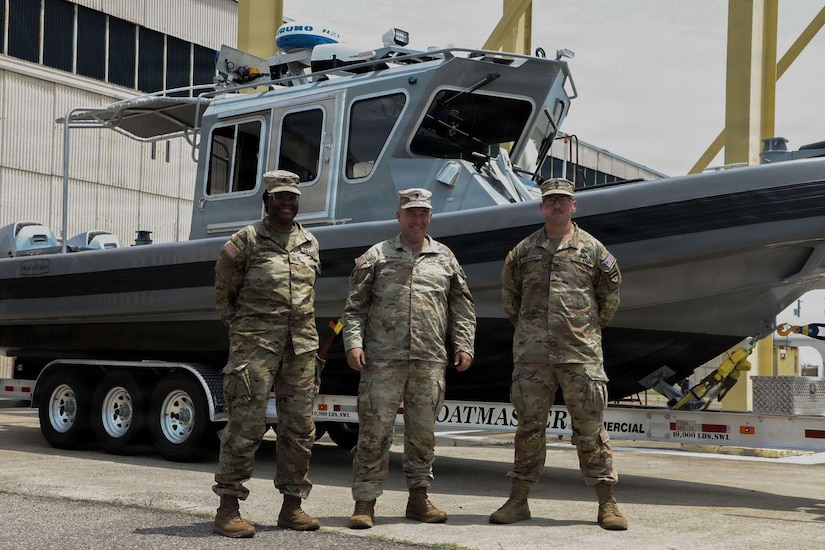
Three people wearing camouflage military uniforms pose for a photo while standing in front of a boat on a trailer.

The new capability strengthens the guard's ability to secure the district's waterways, critical infrastructure and major national events — a mission aligned with the National Defense Strategy's objective of defending the homeland. 

Army Brig. Gen. Leland D. Blanchard II, D.C. National Guard interim commander, said the organization's newest maritime capability reflects its legacy of service and its vision for the future. 

"For 224 years, the District of Columbia National Guard has answered our nation's call by evolving to meet the challenges of every generation," Blanchard said. "This new maritime capability is more than a vessel — it is an investment in the partnerships, readiness and modern capabilities that enable us to better support the local, state and federal agencies that protect our nation's capital every day." 

Created under an executive order, the brigade was designed to enhance coordination between military forces and the district's civilian security agencies.  

Army Col. Larry Doane, brigade commander, said the unit's role is straightforward: "Homeland defense is a team sport. We're the connective tissue between military response and the agencies that secure the capital every day."
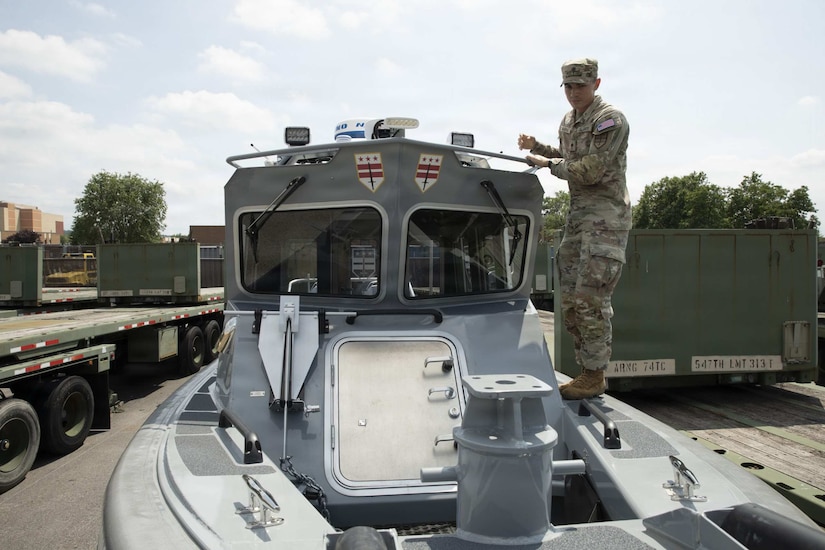
A man wearing a camouflage military uniform walks around the edge of a boat sitting on a trailer.

Washington's security environment is uniquely complex — protected airspace, dense federal infrastructure, overlapping jurisdictions, all within two bodies of water. Brigade soldiers routinely support local and federal law enforcement, fire and emergency services during national special security events.  

We do more national special security events in a year here than most places do in a lifetime, Doane said. 

Bounded by two rivers, the district requires a robust maritime security posture. The brigade's new vessel, sourced through a Navy partnership, will support waterborne operations during events such as the Fourth of July. It primarily serves as an observation and assessment platform enabling civil support teams to conduct hazard detection aboard vessels and expand overwatch alongside local units. 

"We're not replacing law enforcement — we're increasing their capacity," Doane said, emphasizing the guard's supporting role. "When the district needs more eyes, more reach, more resilience, that's where we come in." 

The waterborne vessel complements a broader modernization effort within the brigade's 547th Transportation Company, which now operates a growing fleet of tactical vehicles to maneuver through dense crowds and restricted urban terrain during events.
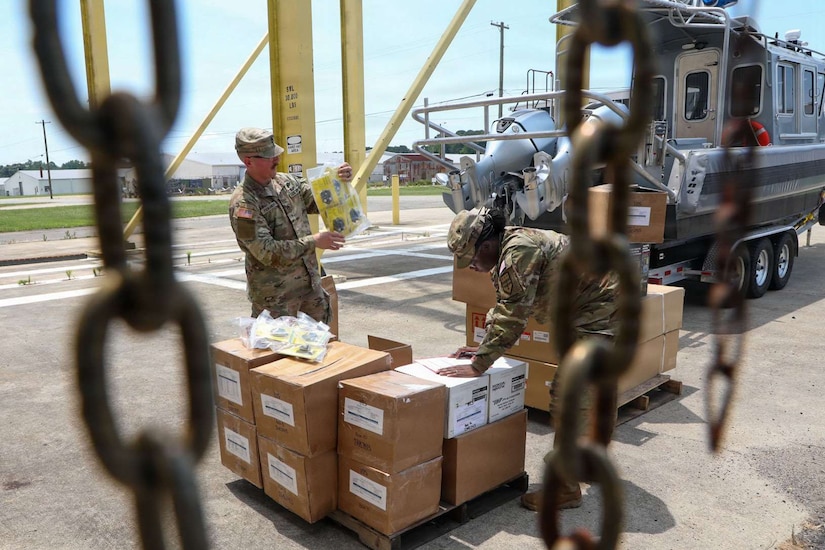
Two people wearing camouflage military uniforms inspect a pallet of packages while standing outside; there is a boat on a trailer in the background.

These assets support local and federal law enforcement armed overwatch, traffic control points, rapid movement across secured zones, medical services and dignitary protection missions — completing the brigade's evolution into a multidomain security force. 

"The 547th has to be not only one of the most effective, but one of the coolest transportation units in the world," Doane said. "Not only does it operate light medium tactical vehicles, and heavy tactical vehicles — but it has a fleet of [off-road tactical] vehicles and now a growing fleet of security vessels to support maritime security." 

The brigade's mission reflects a core principle of the National Defense Strategy: resilience deters adversaries. Doane noted that attackers study soft targets, but in Washington they find none. 

"When someone goes into our metros and sees you can't even get away with a purse snatching and petty crime, that matters," he said. "Presence prevents bad actors from believing an attack will succeed." 

During this year's Fourth of July celebrations, the brigade provided local and federal partners with critical capability enhancements, including additional traffic control points, crowd management, and medical support to help ensure a safe and successful event. 

What distinguished this year's support was the integration of enhanced capabilities designed to increase operational flexibility and response capacity. These included specialized response teams to complement local and federal law enforcement, maritime security assets and increased mobility to rapidly deploy personnel and resources wherever needed.  

Together, these capabilities strengthened the unified interagency response and improved the ability to adapt to evolving operational requirements in real time. 

"When symbols of freedom are center stage, like on the Fourth of July, some bad actors might see a target. In such cases, we pivot on a dime and defend the capital," Doane said. "But even more important than the pivot is the deterrence of presence, high-level training and equipment that prevents the attack in the first place." 

With one vessel operational and four planned, the brigade is working with the Navy to select platforms proven worldwide and interoperable with the local law enforcement fleet. The goal is seamless coordination across agencies responsible for defending the nation's capital. 

"We used to rely on the oceans for homeland defense," Doane said. "We can't rely on that anymore. We rely on resilience and deterrence — our enemies must know we're prepared." 

Monday, January 26, 2026

Steady in the Storm: Guardsmen Support D.C. Through Winter Weather

Snow fell steadily as a military Humvee eased through Washington's streets with tires crunching over packed ice and traffic lights reflected off slush-covered pavement. Inside the vehicle, Army Col. Larry Doane, commander of Joint Task Force District of Columbia, scanned a digital map, tracking patrols spread across the city as a winter storm tightened its grip.

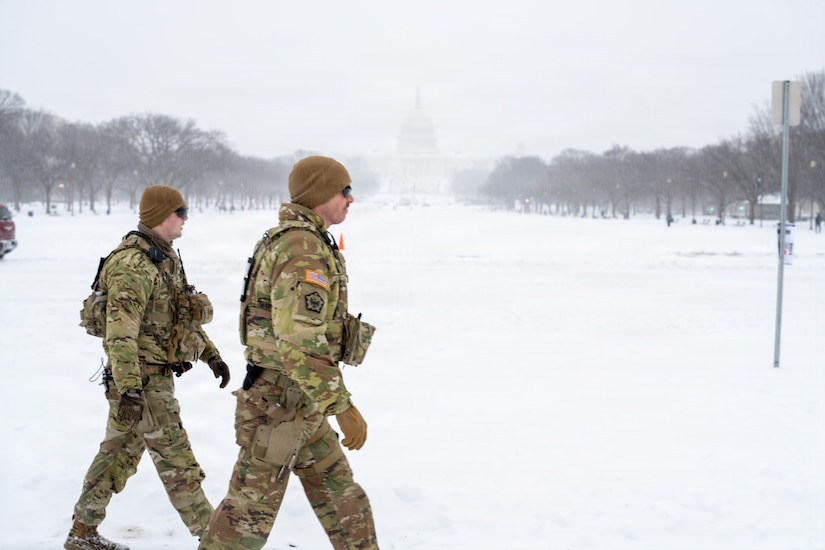
Two people in camouflage military uniforms walk along a snow-covered sidewalk in front of the U.S. Capitol.

"Slow and steady," Doane said, watching a civilian vehicle struggle for traction nearby. "Interesting driving choices out there today." 

The storm transformed the mission almost instantly. What began as routine presence patrols in support of the D.C. Safe and Beautiful mission shifted toward life-safety priorities — mobility, visibility and helping people navigate a city slowed by snow and ice. 

Across the district, National Guard soldiers and airmen moved deliberately through metro stations, neighborhoods and key corridors. Some checked on patrol teams braving long shifts in freezing temperatures. Others used high-mobility vehicles to assist first responders, transport personnel and help stranded motorists clear snowbanks and regain traction. 

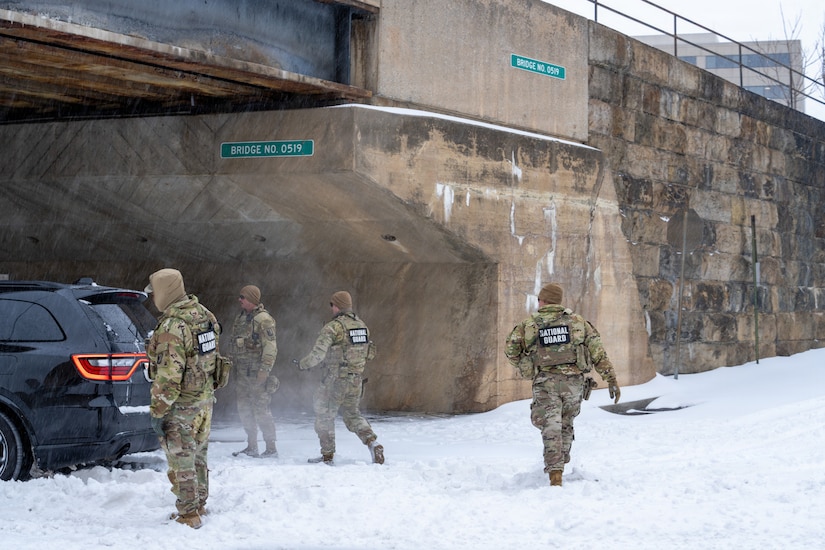
Four people in camouflage military uniforms stand outside in the snow, inspecting a black vehicle under a bridge.

"This is where the Guard fits naturally," Doane said, as the Humvee turned toward Union Station. "When conditions get tough, we bring mobility, manpower and discipline to support our partners and the community." 

Throughout the ride-along, Doane stopped repeatedly to speak with guardsmen on post — asking about their gear, their feet, their food and their radios. He reminded leaders to rotate personnel inside warming areas, keep one soldier alert at all times and watch for signs of cold-weather injuries.

"Those basic leadership things still work," he said. "Feet, hands, communication — take care of each other — and the mission takes care of itself." 

Outside, the storm revealed a different side of the mission. Guardsmen pushed vehicles out of snowbanks, guided pedestrians through icy intersections and checked on individuals waiting in the cold. In several cases, teams coordinated with district partners to escort people to warming shelters or help them reach safe transportation. 

"We're providing a lot of mobility today," Doane explained. "That's really what our partners need — getting officers, firefighters and medical personnel where they need to be, and helping civilians move safely through the city." 

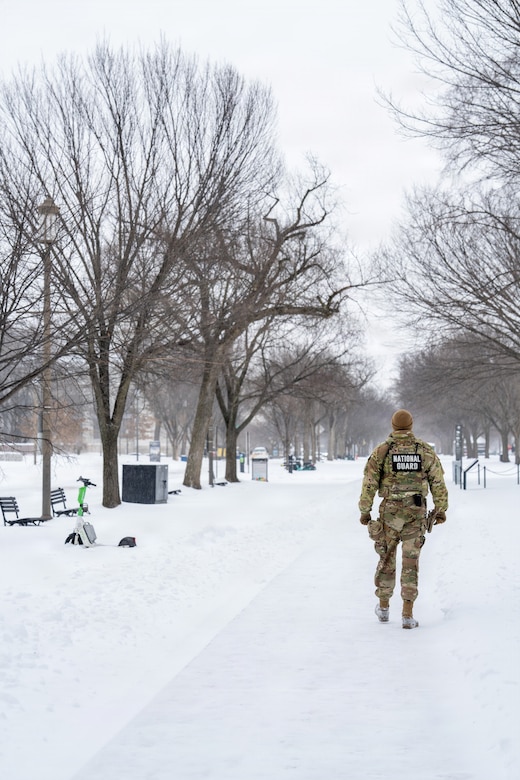
A person in a camouflage military uniform walks along a snow-covered street with rows of trees on either side.

Inside a metro station, Doane paused to observe soldiers standing watch near the turnstiles. Trains continued running despite the weather, and commuters moved through what one passerby called "the safest metro station in America right now." The guardsmen nodded, adjusted their posture and continued scanning the space — visible, calm and unintrusive. 

"That presence matters," Doane said. "Just being here brings the temperature down. People feel reassured." 

The winter storm did more than slow traffic; it tested systems, patience and readiness. Snow and ice complicated response times, narrowed streets and forced constant reassessment of risk. Guardsmen adapted quickly, shifting patrol routes, coordinating with law enforcement partners and prioritizing safety over speed. 

"Safety is No. 1," Doane reminded a team sheltering near a metro entrance. "No reason to stand out here and freeze. We'll get back to normal patrols when conditions allow." 

Despite the conditions, morale remained steady. Guardsmen shared hot drinks, swapped stories and laughed about snowball fights that never materialized. Civilians waved as the Humvee passed, some offering thanks, others simply relieved to see help nearby. 

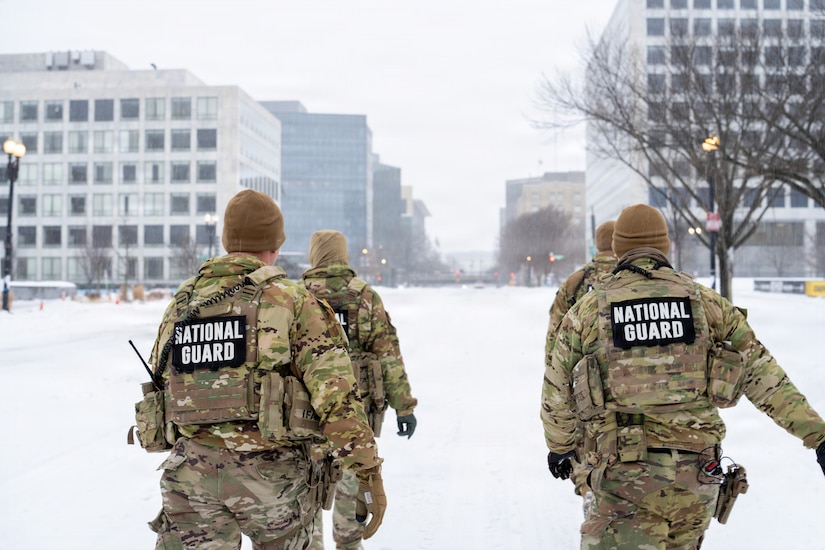
Four people in camouflage military uniforms walk along a snow-covered city street.

"I've gotten more waves today than I have in a long time," Doane said. "People remember what the Guard does during storms like this." 

As the night wore on, the mission continued, quietly, steadily and without ceremony. Patrols remained in place. Vehicles stayed ready. And across the city, guardsmen stood watch while Washington dug itself out. 

"What we do is important," Doane said as the Humvee rolled back into traffic. "But how we do it matters more. The way our soldiers carry themselves, the way they treat people — that's what builds trust." 

In a city shaped by movement and unpredictability, the storm underscored the Guard's enduring role: ready when conditions worsen, visible when reassurance is needed and committed to serving the community — no matter the weather.