Showing posts with label military medicine. Show all posts

Thursday, July 30, 2026

Walter Reed's Skull Base Team Performs Innovative Brain Surgery

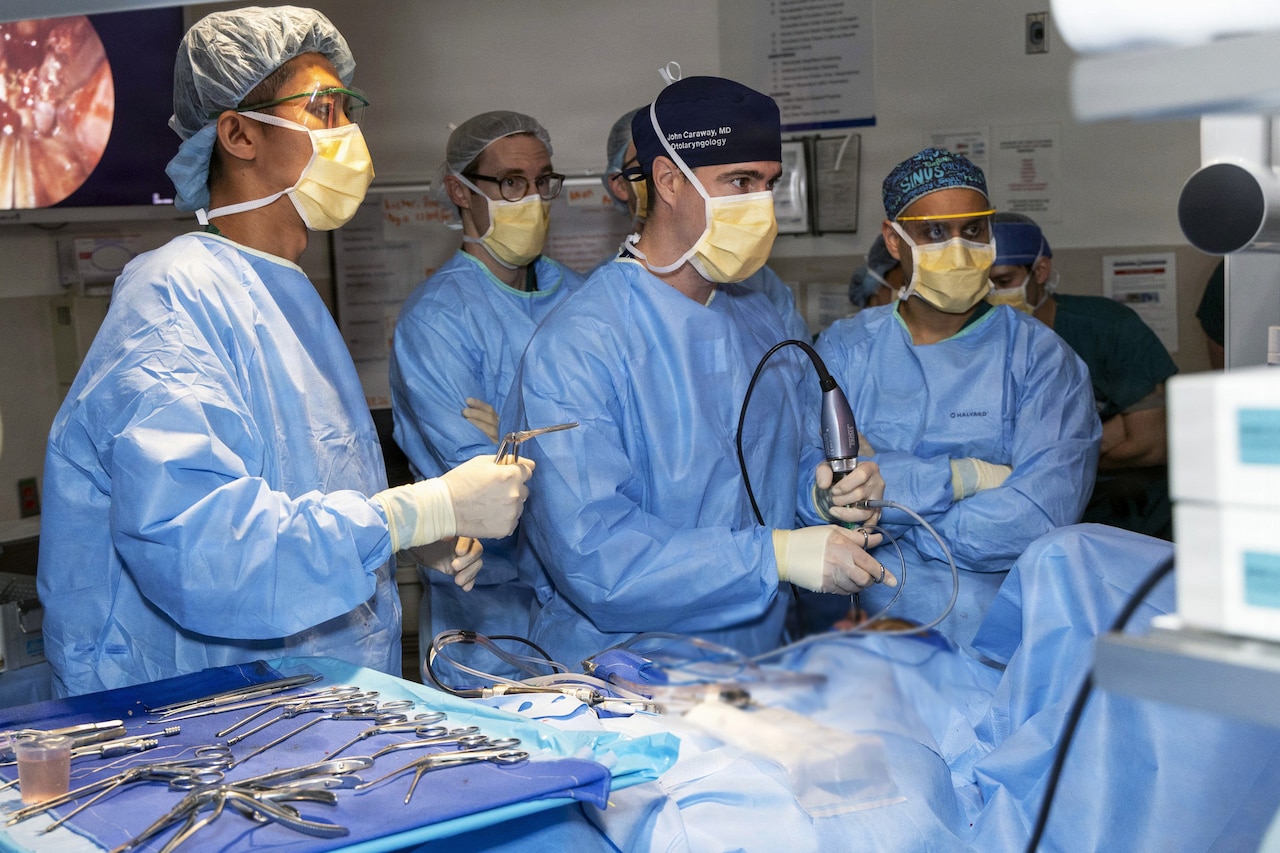
A man in medical scrubs performs surgery on a patient lying on a table as six other people in similar attire observe and assist.

For 15 years, Marine Corps Staff Sgt. Andy Archer lived with a relentless, everyday companion — a pounding headache. 

"I'd wake up with a headache and go to bed with a headache," Archer recalled.  

He chalked it up to severe allergies or sinus issues, relying on over-the-counter decongestants to get through his demanding days. 

For Archer, a former drill instructor at Marine Corps Recruit Depot Parris Island, South Carolina, and a current flight line mechanic at Marine Corps Air Station New River, North Carolina, pushing through the pain became part of his daily routine. But recently, Archer's vision began to blur. 

"I became nearsighted; it was bad," Archer said. "I thought I was getting old."  

He finally mentioned the chronic pain to his doctor, a provider with Marine Centered Medical Home New River. 

The doctor ordered an MRI that revealed a mass the size of a golf ball, measuring roughly 4.4 centimeters, sitting directly in front of his pituitary gland and pressing against his optic nerve.

Archer needed neurological care, and he needed it fast. It was suggested that he go to the premier medical hub for complex cases: Walter Reed National Military Medical Center in Bethesda, Maryland. 

At Walter Reed, Archer consulted with Army Lt. Col. Charles Miller, neurosurgeon, and Army Maj. J. Patel, anterior surgeon, both assigned to the hospital's skull base team. The specialized surgical team mapped out an innovative, minimally invasive procedure. 

The surgeons planned to extract the massive brain tumor entirely through Archer's nose.  

"Historically, most of these surgeries were done open, which is a much more challenging procedure for the patient," Patel said. "Today, if a tumor is the appropriate size and location, open surgery just isn't necessary. Through the nose, we get the best access and the best chance of complete removal." 

The procedure required a highly synchronized collaboration between two experts. Patel developed a plan to navigate the complex nasal anatomy and create a clear surgical pathway. Archer had a severely deviated septum, and Patel likened the fix to "removing the sheetrock but leaving the studs" so that the nose wouldn't collapse. 

Once the pathway was clear, Patel used an endoscopic camera to provide high-definition, close-up visualization on a surgical monitor. This allowed Miller the crucial two-handed freedom to dissect and extract the tumor safely. 

"If he needs to get to critical structures, I can drive the camera closer, so he has perfect visualization," Patel noted. "Dr. Miller takes on these complex cases when many surgeons wouldn't want to risk the complications or step out of their comfort zone. My skills in navigating the nasal approach are only useful because he is skilled enough to completely remove the tumor once we get there. Dr. Miller is very well equipped to do these surgeries. It is a true team effort." 

In July, the team successfully removed more than 99% of the benign mass. Still, a microscopic fraction of the tumor remained wrapped tightly behind Archer's optic nerve, that if removed, carried major risks. 

"You must ask, 'Is it worth giving the patient a stroke or permanently changing their perfect vision just to get that last millimeter?'" Patel said.  

Prioritizing the patient's health, the team decided to leave that final fraction, confident the tumor is highly unlikely to return. 

"The biggest thing was to get the tumor out safely," Patel said. "A minimally invasive approach through the nasal passages is more challenging and we are mindful that [the tumor] has to be in a certain spot to go through the nose." 

To complete the surgery, the team performed a reconstruction of the skull base, using a small graft taken from Archer's leg to seal the area.
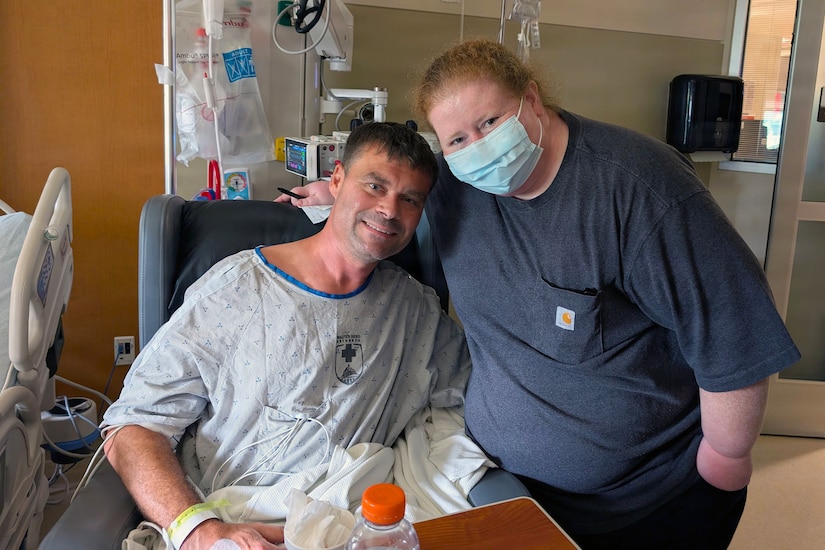
A man in a hospital gown poses for a photo with a woman in casual attire and a face mask while in a hospital room.

Just two days after surgery, sitting in the surgical intensive care unit at Walter Reed, there were no visible signs that Archer had just undergone major brain surgery. 

Archer's vision had already started to clear, and while he was dealing with expected post-operative headaches and leg soreness from the graft, his spirits were high. He and his wife, Rebecca, have been blown away by the hospitality and professionalism of the hospital staff. 

"The care has been awesome," Archer said, giving special praise to the nurses, as well as the physical and occupational therapy teams. 

Rebecca echoed his sentiments, noting that the on-campus Navy Lodge provided a comfortable, supportive environment for their recovery process. 

For surgeons Miller and Patel, and the Walter Reed skull base team, Archer's remarkable outcome highlights a broader mission: ensuring military beneficiaries know that they do not need to look to the civilian sector for cutting-edge medical care. 

"I don't think anyone else in the Defense Health Agency has this kind of team performing these complex skull base surgeries," Patel said. "Our goal is to make sure providers know this capability exists, so patients have the best options. Most patients are happy to stay in military healthcare." 

Thanks to an observant Navy doctor, a collaborative surgical team and the innovative capabilities of Walter Reed, Archer's toughest battle appears to be behind him.

Saturday, July 25, 2026

Historic Multinational Medical Team Integrates Aboard the USS Essex

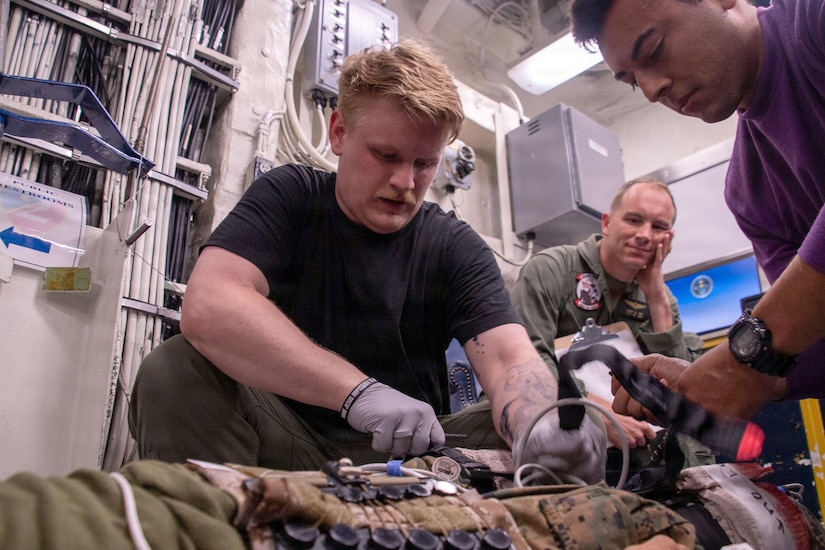
Two men tend to a simulated casualty while another man observes during a mass casualty exercise.

In a historic medical first, a multiservice, multinational team of American and Canadian military medical professionals successfully delivered seamless, life-saving trauma care afloat. 

Operating aboard the amphibious assault ship USS Essex during Exercise Rim of the Pacific 2026, this newly forged coalition of doctors, nurses, medics and combined operating room technicians proved they could run a fully functioning shipboard trauma center under the most intense combat and disaster conditions.

Traditionally, while multiservice and multinational hospitals have successfully operated on land during past conflicts, afloat environments have remained strictly isolated. The administrative intricacies of differing licensing, credentialing and clinical privileges across nations and branches have historically posed an insurmountable barrier. For this iteration of Exercise Rimpac, planners spent more than six months pushing paperwork up the chain of command to grant active clinical practice authority to Canadian and U.S. Army personnel aboard a Navy vessel, allowing them to physically treat patients for the first time.

"The medicine is pretty straightforward, and we all practice good, evidence-based medicine," said Navy Capt. David Foster, the USS Essex senior medical officer. "We didn't have to teach each other how to do medicine. What we did have to learn how to do was integrate and communicate as a team."

This unique integration allowed the Essex to fully flex its hospital capabilities, running all four of its onboard operating rooms simultaneously to manage a massive, simulated influx of critically injured casualties.

The combined force fused the organic crew of the Essex and the Navy's Fleet Surgical Team 5 with the Army's 147th Field Hospital and 105th Surgical Augmentation Detachment, alongside Canada's 1 Canadian Field Hospital and the Canadian Medical Emergency Response Team.

The joint team's capabilities were put to the ultimate test during a massive, two-phase casualty drill simulating the aftermath of a natural disaster. During the exercise, the integrated medical department managed a total of 17 simulated patients presenting with severe, life-threatening trauma — a fourfold increase from a smaller, four-patient trial run conducted days prior.

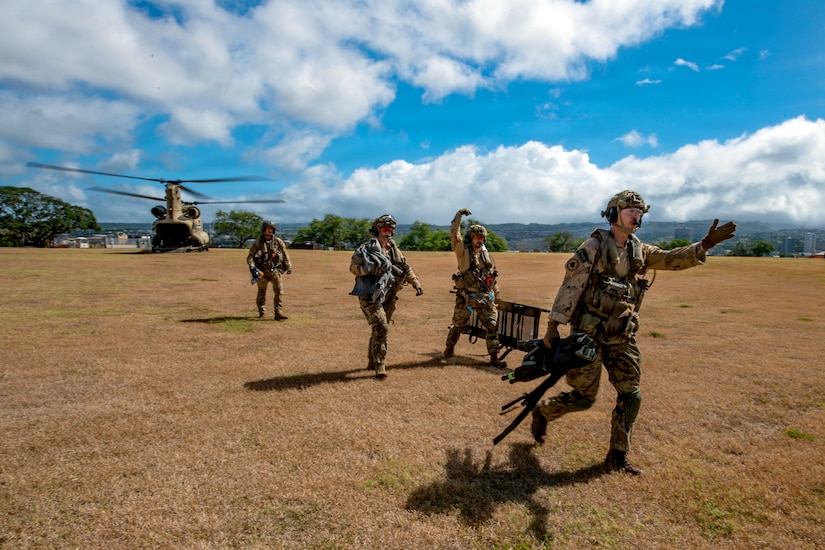
Casualties were transported from the point of injury by a diverse fleet of partner-nation aircraft and Army helicopters.

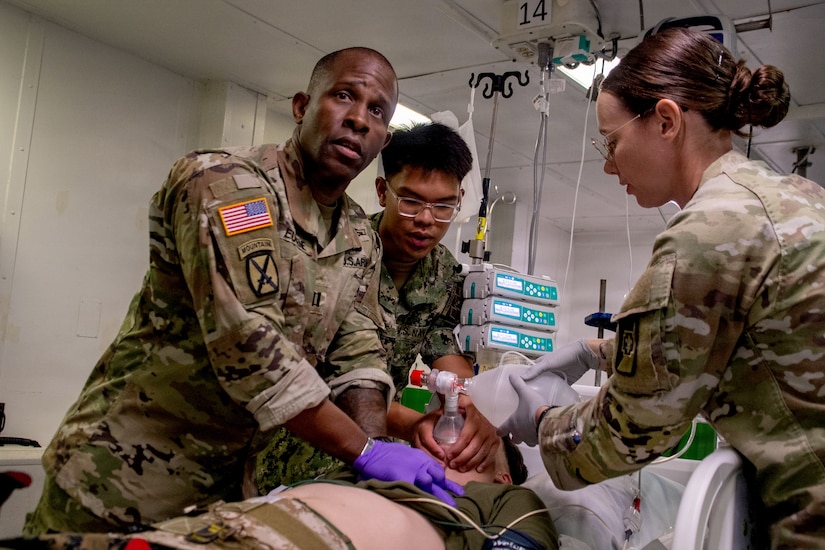
Three people dressed in camouflage military uniforms tend to a simulated casualty during a mass casualty exercise.

Significantly, the Canadian Medical Emergency Response Team acted as the en route care asset, picking up casualties from the point of injury and treating them in the air aboard a U.S. Army CH-47 Chinook. The Canadian team inside the cabin included emergency physician Capt. Richard Lee, flight nurse Maj. Nadine Verwey and paramedic Sgt. Nickolas Petuhoff performed aggressive, mid-flight resuscitations.

"The one that I was most involved in the care of was a patient who sustained facial trauma where they had a compromised airway," Petuhoff said. "They required some aggressive airway management ... so they had a surgical airway."

The team also had to contend with aircraft variations that disrupted their standard operating procedures. Verwey noted that the U.S. Army Chinook had a large internal fuel tank, which reduced cabin space compared to Canadian aircraft.

"We weren't able to just do what we normally do," she said. "We had to adjust our plan, which helps to build flexibility and resilience in the team."

Once the casualties crossed the threshold into the ship's medical bay, they were met by a unified trauma team that spent the preceding days actively ironing out communication and process bottlenecks.

"Somebody might call a piece of equipment a widget and somebody else might call it a thingamabob," Foster said. "As soon as we got underway together, we got the team leaders together, and we paired up and grouped up the folks of the same skill types together to clarify and level-set all of those communications."

The team also implemented a radical, bottom-up process improvement suggested by a junior crew member to reverse the physical flow of patients through the triage spaces. By replacing standard hand-carried stretchers with rolling gurneys and establishing a strict, one-way directional flow, the team drastically reduced transit time between the flight deck, triage area and operating rooms.

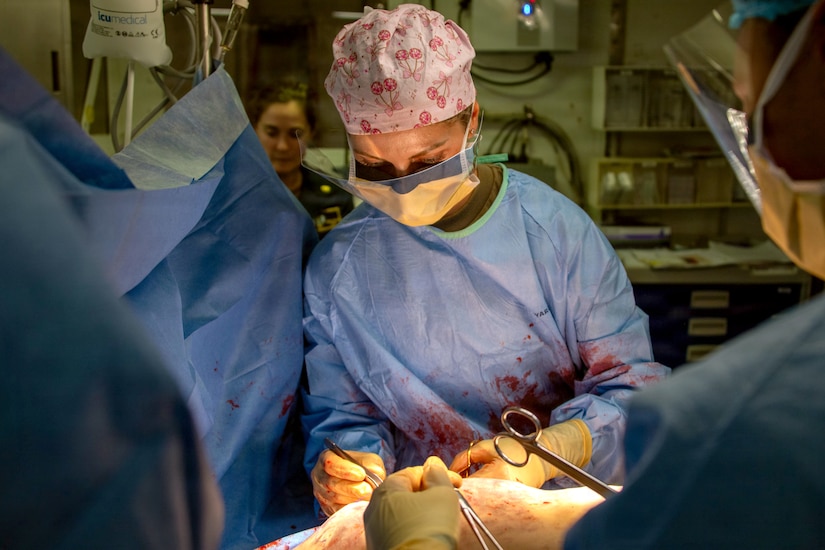
A woman dressed in a surgical gown, mask and cap operates on a simulated casualty during a mass casualty exercise.

"As small a difference as that might seem on the outside, it is actually a really significant change that really improves patient flow," said Lt. Cmdr. Sebastian Vuong, a Canadian anesthesiologist and transfusion medicine specialist.

Inside the operating suites, the realism of the training was elevated by hyper-realistic cut suits.

"The surgeon can actually cut through with a real scalpel. There [are] actual organs inside that actually bleed," said Navy Cmdr. Jesse Bandle, FST 5 officer in charge and commander of the Amphibious Task Force-Surgeon, Amphibious Squadron 5. "It really increases the level of fidelity of this surgical simulation."

Vuong, alongside an Army general surgeon, performed an emergency thoracotomy on a cut suit to open a patient's chest, control massive lung bleeding and administer blood transfusions. To manage resources efficiently, Vuong also provided intensive care unit sedation for a bilateral leg fasciotomy on an electrical burn patient to save the limb, freeing up the operating rooms for other critical cases.

"It's really not about the medical clinical care; it's about how to streamline the processes," she said. "Medicine really has no uniform."

The drill also forced the medical staff to navigate the grim realities of mass casualty triage and resource limitations. Facing a patient with an unsalvageable head injury and exposed brain matter, providers pivoted to expectant care, administering pain medications for comfort while bringing in the ship's chaplain to ensure a dignified death.

For veteran land-based providers like Army Col. Dennis Turner, a nurse anesthetist with 25 years of service, practicing medicine afloat introduced unique, eye-opening challenges. 

"I learned that I can do resuscitative immersion care pretty much in any environment now, even aboard ship," Turner said. 

He noted that, unlike a land-based Army field hospital, where supply replenishment is constant, shipboard medicine is far more isolated. 

"It seems like it's more resource-constrained here out in the middle of the ocean than we are on land," Turner said. "We don't have to worry about whether we're close enough to land to be able to receive more supplies and send away casualties."

Four people wearing camouflage military uniforms run from a helicopter during a mass casualty exercise.

While surgeons operated, the ship's dental crew activated a "walking blood bank," drawing fresh whole blood from the crew to sustain the trauma bay. Other teams managed complex abdominal laparotomies, packed open wounds and stabilized severe pelvic fractures.

"I learned how to be a bit more fluent, control the chaos, both outside and on the inside, a little bit better," said Navy Petty Officer 3rd Class Cole Krablin, search and rescue medical technician. "Stay ready, be ready."

Beyond the clinical success, the exercise highlighted the strategic advantages of using an amphibious assault ship like the USS Essex for humanitarian aid and disaster relief missions. While dedicated hospital ships like the USNS Mercy offer extensive clinical space, they are slower to transit and rely heavily on civilian hospital staffing. The Essex offers a highly mobile, tactically flexible alternative, combining robust Role 2 surgical suites with the organic heavy-lift capabilities of the Marine Corps.

"The Essex provides a unique ability to really incorporate the extra assets from the Marine Corps as far as airlift, transport and being able to put the Marines ashore to clear obstacles, restore operations at airfields, purify water and transport food," Bandle said.

By the end of the exercise, the multiservice, multinational team successfully rewritten the playbook for shipboard trauma care. At the patient's bedside, the boundaries between the U.S. Navy, U.S. Army and Canadian Armed Forces dissolved entirely, leaving behind a highly capable, unified force ready to face the world's next crisis.

"Medicine is a language that all of us speak with the same goal of providing excellent patient care," Verwey said.

Thirty nations, 30 surface ships, 5 submarines, 15 national land forces, more than 190 aircraft and more than 30,000 personnel participated in Exercise Rimpac 2026 in and around the Hawaiian Islands, June 24-31. The world's largest international maritime exercise provides a unique training opportunity while fostering and sustaining cooperative relationships among participants critical to ensuring the safety of sea lanes and security on the world's oceans. The exercise is the 30th in the series that began in 1971.

Thursday, July 23, 2026

Navy Nurse Awarded for Pediatric Trauma Care Research, Improvements

A nurse assigned to the Naval Medical Center Camp Lejeune in North Carolina is being recognized for her research and process improvement efforts in pediatric trauma care.

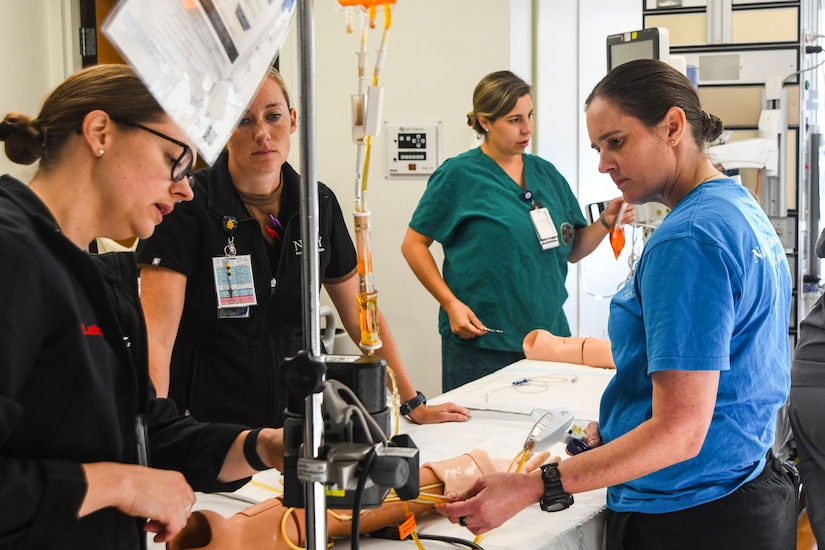
Four women wearing medical attire stand over an IV training arm with medical equipment attached; one provides instruction while the others observe.

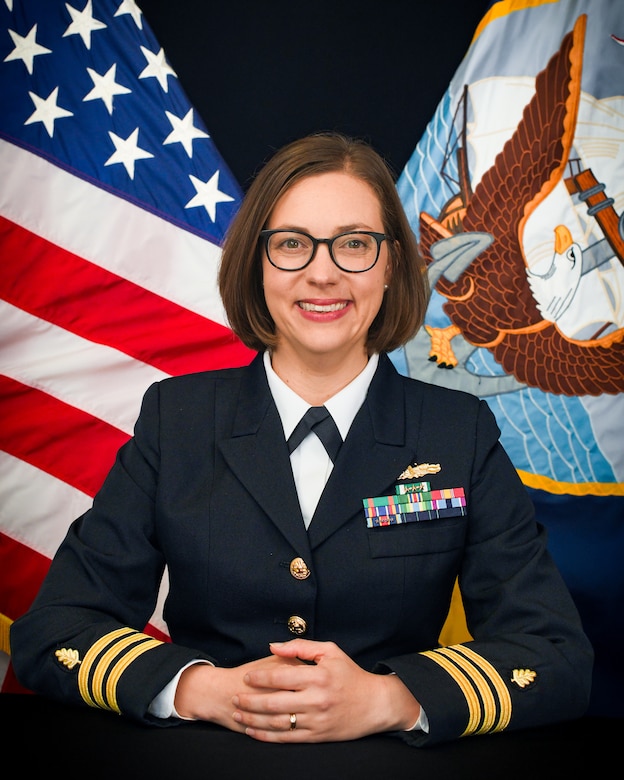
Navy Cmdr. Emily Latimer, an emergency clinical nurse specialist, was recently awarded the Defense Health Agency Nursing Award for Evidence-Based Practice. Latimer spearheaded a project to examine methods for administering blood specifically to pediatric trauma patients. 
 
According to Latimer, giving blood to a pediatric patient requires a different volume, specific needles or a smaller IV — meaning that blood systems used for adult patients don't always transition well for children. Latimer said she was inspired to pursue this project by past cases of critically ill children.

A woman wearing a formal military uniform poses for a portrait with an American flag and a Navy flag in the background.

"In a military treatment facility, a huge portion of our patients are pediatrics. For example, at our emergency department here, 25% of our patients are pediatrics. Being able to provide the care and, hopefully, be a source of trust and stability for their families – that's taking care of our military community," she said. 
 
Latimer and her team procured grant funding to purchase a manual blood infusion system for pediatric trauma patients, and nurses and paramedics tested the system for several weeks. Findings showed that a system designed to administer blood to pediatric patients was easier and faster for users and should be a component that trauma centers consider obtaining to ensure pediatric readiness capabilities. 
 
"Our job is to take care of vulnerable patients, and if we're finding ways to make improvements, we are doing our job to make things better for our patients," Latimer said. "Ultimately, if we are getting recognized for this work, that means the work we are doing is meaningful. It gives us an opportunity and a venue to share what we learned, so that maybe other people can implement similar solutions." 
 
Latimer noted that research on pediatric care is vital to the readiness component of military medicine.

"As much as our deployment training is focused on preparing to receive adult patients, in many deployed settings, we do take care of sick kids. Having the skills, the comfort and the experience with sick children in a military treatment facility prepares our healthcare workers for deployment medicine," she said.

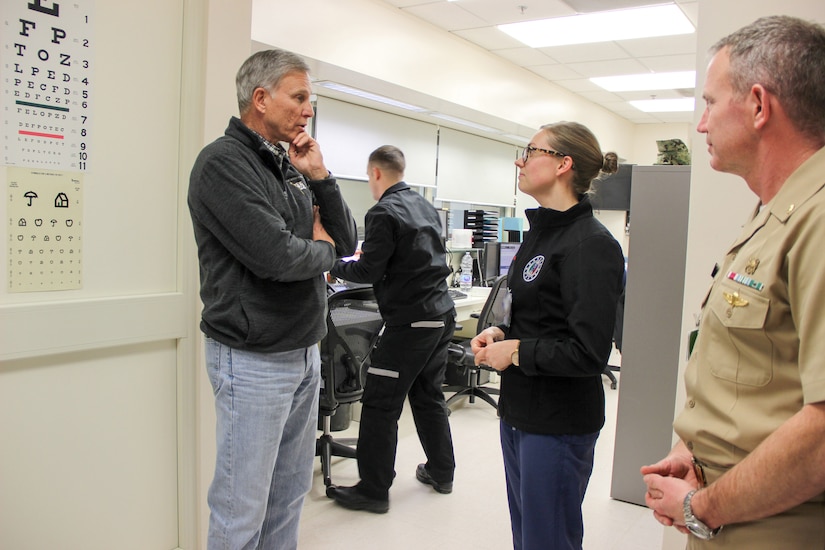
A man wearing casual attire speaks to a woman dressed in casual attire inside a medical facility.

Latimer was also awarded the Pediatric Readiness Improvement Award through the Emergency Nurses Association, recognizing her work on the blood project and other improvements for critically ill pediatric patients, such as medication and safety audits.  

However, Latimer does not take credit for the accolades; instead, she proudly attributes the success to her research team. 
 
"So much of this was a group effort," she said. "I feel really lucky that I was able to work with people that have such expertise and care and were willing to take time out of their day-to-day tasks to spend time dedicated to these projects." 
 
Latimer, a native of Lake Charles, Louisiana, has served 16 years in the Navy and will soon embark on her next journey as the department head for corpsman trauma training at University Hospitals Cleveland Medical Center in Cleveland.