Among rows of gray A-10C Thunderbolt IIs on the flight line at Moody Air Force Base, Georgia, one Thunderbolt aircraft commands attention before its engines even start.
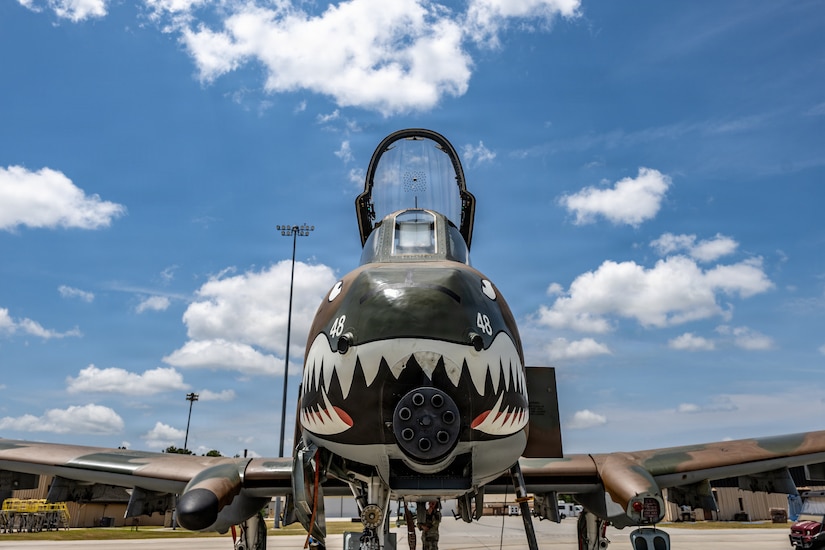
Sweeping camouflage stretches across the aircraft while a bold blue
fuselage stripe and the unmistakable Flying Tiger emblem cut through the
gray backdrop of modern airpower. More than heritage paint, the
aircraft serves as a tribute to Army Air Corps Brig. Gen. David Lee
"Tex" Hill, the legendary Flying Tigers and the combat legacy carried on
today by the 23rd Fighter Group stationed at Moody.
Hill was a member of Claire Chennault's American Volunteer Group,
famously known as the Flying Tigers, said William Godwin, 23rd Wing
historian. He flew P-40 Warhawks with the 2nd Pursuit Squadron as a
flight leader and was credited with 12 1/4 aerial victories during his
time with the World War II group.
On July 4, 1942, the group disbanded, and the 23rd Fighter Group was
activated. Hill joined the 23rd FG as a major and was the first
commander of the 75 Fighter Squadron; he took command of the 23rd a year
later. Hill would go on to fly the P-51 Mustang with the 23rd and
raised his total number of aerial victories to 18 1/4.
Aviation history runs deep on base. Hill served as a commander within
the American Volunteer Group, whose combat missions in the
China-Burma-India theater became legendary during the war. After the
group was disbanded, its mission and fighting spirit lived on through
the 23rd Fighter Group, with the 75th Fighter Squadron continuing that
lineage.
Today, that heritage is reflected not only in the aircraft's design
but in the airmen who brought it to life. Behind the scenes, 11 airmen
assigned to the 23rd Maintenance Squadron dedicated an extended amount
of time to transform the jet. The project demanded technical expertise,
coordination and attention to detail, ensuring the finished aircraft
honored both the squadron's heritage and the airmen who carried that
legacy forward.
"First, it was just another project to us, but once we got into it, we
realized it was something different," said Air Force Senior Airman
Memphis Waller, maintenance squadron aircraft structural maintainer. "It
gave us a chance to learn new techniques and be part of something we
knew people would remember. The process itself was a lot of work."
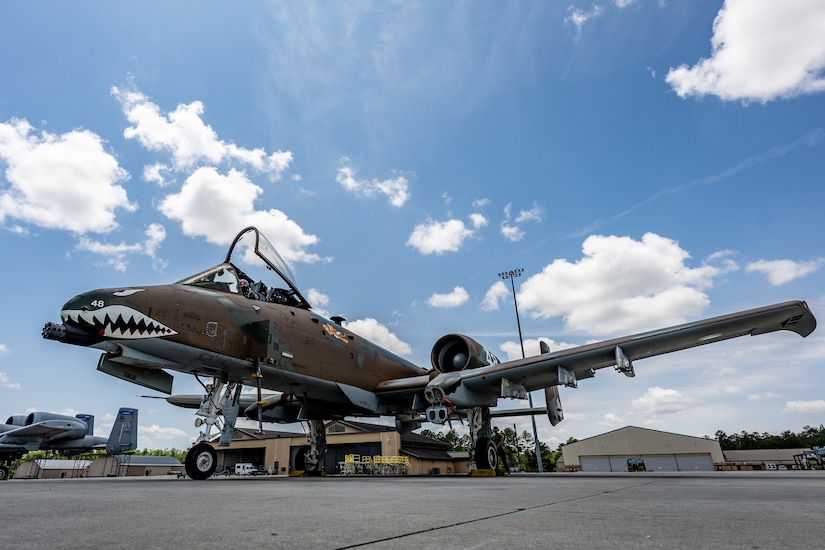
The team sanded the aircraft and cleaned up the old paint, then wiped everything down to ensure the surface was ready for the legacy design. After that, they had to prepare the plane and track down where every stencil belonged so they could repaint each one correctly.
"The [painting] process was different from what we usually do, so
there was definitely a learning curve, but seeing it all come together
made it worth it," Waller said.
The aircraft's story began long before the camouflage pattern and Flying
Tiger insignia took shape on the Moody flight line. Following an asset
transfer from South Korea, maintainers at Moody accepted and processed
the A-10 before taking on the extensive restoration project.
What started as a routine transfer quickly became something more, an
opportunity to transform the aircraft into a visual reminder of the
squadron's enduring history. For the airmen involved, the project
carried meaning beyond restoring an aircraft.
"When people see the heritage aircraft alongside the P-40 in the air
park, they can immediately connect the history," said Air Force Staff
Sgt. Tucker Lee, maintenance squadron noncommissioned officer in charge
of corrosion control. "It's a continuation of the Flying Tigers legacy,
and that's something this wing takes a lot of pride in. We just hope to
keep carrying that tradition forward.
"If the original Flying Tigers hadn't been successful, we wouldn't be
here today carrying that name and history," he continued. "The shark
teeth that people associate with the A-10 started back with the P-40s,
and now they've become part of what makes the Warthog iconic. Keeping
that heritage paint scheme and the nose art reminds us [of] where we
came from and pushes us to continue that legacy of success."
That pride was reflected in every stage of the project. From carefully
matching historical details to working long hours as a team, maintainers
ensured the aircraft would stand as a faithful tribute, reinforcing a
shared connection between generations of airmen, past and present.
Now complete, the aircraft serves a dual purpose: it remains a fully
mission-capable platform while also standing as a visible reminder of
the squadron's heritage. Each time it takes to the skies, it carries
forward a legacy that began with the Flying Tigers, proving that while
technology evolves, the spirit of the mission endures.
"[The] American Volunteer Group and the 23rd Fighter Group set the
standard for the Flying Tigers for future generations," Godwin said.
"The American Volunteer Group, in 1941, were told they would not last
two weeks. Eighty-five years later, the Flying Tigers are still going
strong. The men and women of the 23rd Wing are standing on the shoulders
of giants and leading the way with close air support and combat search
and rescue."


 Posts
Posts


No comments:
Post a Comment