Showing posts with label u.s. military. Show all posts

Friday, August 14, 2026

Southcom Mission Shifts to Protecting Sovereignty of U.S., Partner Nations

At the Combined Jungle Training Center-South in Cristobal Colon, Panama, yesterday, Secretary of War Pete Hegseth met with U.S. service members who are learning how to survive in the most brutal, unforgiving jungles of the Western Hemisphere, all while retaining their combat effectiveness.
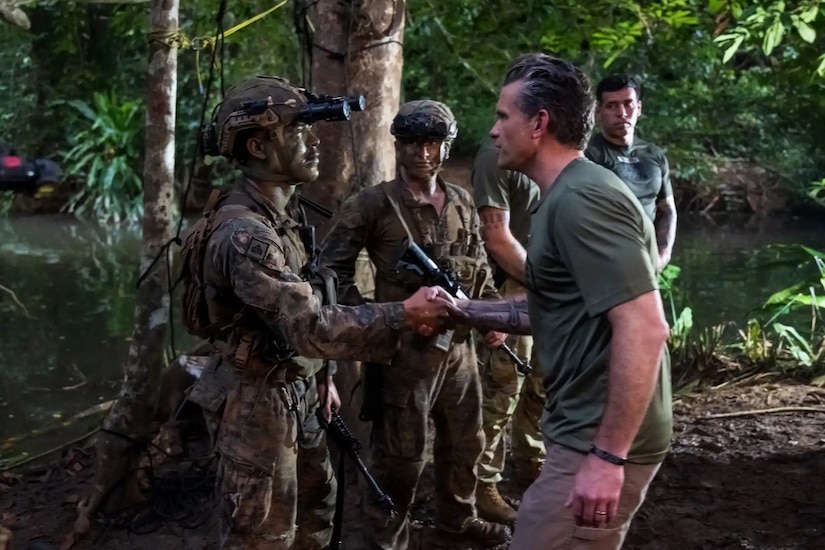
In a jungle environment, a man in casual attire shakes hands with a man in a camouflage military uniform and night vision equipment on his helmet while people in similar attire observe.

The visit coincided with the secretary's address during the Americas Counter Cartel Coalition, a U.S.-led multinational security and political alliance formed to combat transnational drug cartels, reduce illegal migration across the Western Hemisphere and limit foreign geopolitical interference. It also coincided with Exercise Panamax 2026, a multinational military exercise hosted by Panama and sponsored by U.S. Southern Command. 

In the dense jungle on the northern side of the Panama Canal, Hegseth told service members at the training center that what they are doing is exactly what he likes to see when he meets with warfighters. 

"I think this is what ... the warrior ethos looks like; it's what reestablishing it looks like," he said. "It happens in training centers like this, with Americans like this, who do really difficult things in really tough places." 

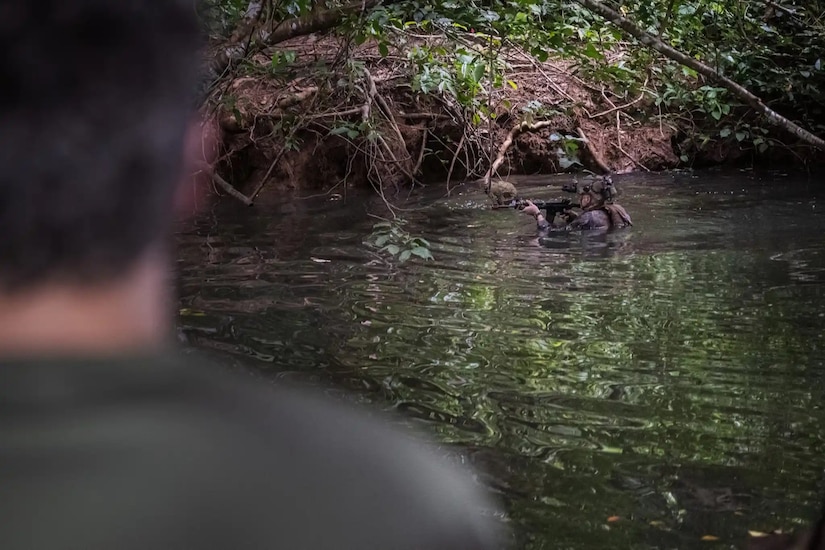
While at the training center, Hegseth met with instructors assigned to the Jungle Operations Training Course-Panama, along with Marines assigned to Littoral Combat Force-24, who were in Panama to participate in Panamax.
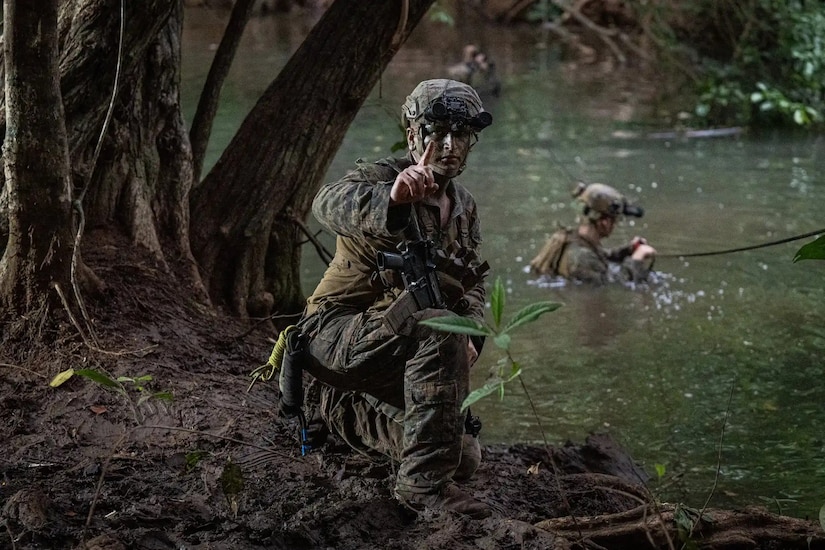
In a jungle environment, a man in a camouflage military uniform kneels on a riverbank as another man in similar attire stands in the water.
A rear-facing man observes two people in camouflage military uniforms as they move through water; one man carries a rifle.
The secretary said the service members who train at the center are willing to do things no other Americans are willing to do, to include helping U.S. allies in both Central and South America protect the nation's backyard. 

"That's what we're doing here with the A3C [and with] Panamax ... expanding peace through strength in our hemisphere, right here in the jungles with our partners," he said. 

Noting a big shift in the Southcom mission, Hegseth said that just 18 months ago, the command was less focused on protecting the Americas and deterring threats. 


"This is a different Southcom; this is a different mission," he said. "We are focused on military capabilities against real threats who need to be deterred and defeated, and we're going to give them everything they need to do it, on behalf of the American people." 

The secretary said that under President Donald J. Trump, Southcom's mission has focused on working with partners in the region to keep everybody safe from a variety of shared threats. 

"We know exactly what that mission looks like," he said. "We're empowering commanders like [Marine Corps Gen. Francis L. Donovan] to do it in Southcom; we're working with partners like Panama, like Ecuador, like Colombia ... they're going to send students here soon to swim across this very same river, [to] be a part of this very same training." 

The nations involved in the Americas Counter Cartel Coalition — 19 nations in all, with Colombia signing on just yesterday — are going to be involved in the same training as U.S. service members in Panama. The secretary said that the same things that necessitate American jungle training also motivate every other nation in the region. 

"It turns out, in the [Western] Hemisphere, they face the very same security challenges, the same threat of drugs, the same threat of criminal cartels that threaten their citizens, the same ones that threaten our citizens," Hegseth said. 

U.S. law enforcement personnel stationed at the U.S. southern border to stop illegal immigration and drug traffickers, combined with training across Central and South America in places such as Ecuador, Colombia and Panama, puts increasing pressure on shared threats. 

"That's going after the enemies of our country — designated terrorist organizations — unabashedly," Hegseth said. 

Earlier in the day, the secretary announced the new motto of the Americas Counter Cartel Coalition: "We do bad things to bad people." 

"For too long, bad people did bad things to good people, inside the United States of America and across Central and South America," he said. "We're going to empower great Americans and great partners to do really good stuff and be very capable about bringing violence against drug cartels and designated terrorist organizations, because we're dead serious about securing the homeland." 

A big part of that is the Trump corollary to the Monroe Doctrine. In 1823, President James Monroe articulated a foreign policy, now known as the Monroe Doctrine, which declared that the Western Hemisphere was off-limits to further colonization efforts or interference by European nations. Later, that expanded to include interference by any foreign power. 

In 1904, President Theodore Roosevelt added to that doctrine that the U.S. could intervene in the affairs of Latin America to protect U.S. interests. 

And now, Hegseth said, there is Trump's corollary to the Monroe Doctrine. 

"It is a recognition that [designated terrorist organizations] ... will not control our hemisphere ... and we will not allow foreign malign influence to take over ... key terrain like the Panama Canal," he said. 

Hegseth said Colombia's inclusion in the Americas Counter Cartel Coalition is significant. 

"The A3C had formed, but in some ways, it missed part of its core," he said. "Colombia is going to be [an] incredible partner. They offered to be a headquarters or a hub for the A3C as the brand-new 19th member. They've got ... hundreds of thousands of capable members of their military and decades of training with the United States ... that mil-to-mil relationship has been long-standing, and that's why they're coming to this jungle course soon."

Friday, August 07, 2015

Work Observes Large-Scale Military Exercise at Fort Irwin


By Terri Moon Cronk
DoD News, Defense Media Activity

ABOARD A MILITARY AIRCRAFT, Aug. 7, 2015 – The U.S. military faces multiple threats and it must be prepared for every contingency, Deputy Defense Secretary Bob Work said Aug. 5, after viewing night operations as part of the Joint Forcible Entry large-scale exercise at Fort Irwin, California.

The two-day exercise at the National Training Center is one of the most challenging and complex missions in the Army, with 1,500 fighting forces from the Army’s Special Operations Command, Joint Special Operations Command, XVIII Airborne Corps and the Air Force, according to Army officials.

“As all our senior leaders and [Defense Secretary Ash Carter] has said, the number of threats we face have multiplied and they’re all interconnected in different ways, and it requires a really strong military,” Work said.

DoD Focused on Five Threats

The deputy said Defense Department senior leadership is focused on what he called “five big threats.”

One is countering the extremist Islamic State of Iraq and the Levant. “It’s a fight that’s going to hold on for a while, so it is a fight we have to get ready for and we do it every day,” Work said. “Then we look where potential contingencies are: Iran, North Korea, the South China Sea or China and Eastern Europe.”

Fort Irwin’s National Training Center hybrid warfare exercises reflect those concerns. “We have so many threats, the Army has to be prepared for every [contingency],” the deputy defense secretary said.

For that reason, the training center is reorienting its approach to exercises, Work said.

Training Meets Today’s Needs

The NTC has changed its focus from conventional warfare, Work said, to hybrid and counterinsurgency warfare.

With special operations forces integrated into the exercises, one group focuses on Europe, another on Africa, and one on the Far East, he explained.

Special operations forces are in good shape today with about 70,000 personnel and significant capabilities, Work added. Special operators, he said, were heavily employed during 13 years of war in Iraq and Afghanistan.

And as Afghanistan moves toward 2016, DoD hopes to “maintain a sustainable pace” of operations, Work said.

Army’s at the Right Strength

The deputy secretary defended criticism of the Army’s strength as being either too large or too small.

“The last two years, we’ve said an Army of 450,000 active, 335,000 National Guard and 195,000 in Army reserves [that] total 980,000 is the right Army,” Work said. “It’s an army we can afford and one we believe can be shaped to handle the full range of threats our nation faces.”

President Barack Obama has said, “‘We will protect any NATO ally,’” so the Army has to be prepared, the deputy secretary added.

But U.S. military strength is not just about numbers or equipment, Work said.

“What underlines our military is our people,” he said. “Our people are endlessly innovative themselves.”

Wednesday, December 19, 2007

Report Reflects Future for Military's Unmanned Systems

By Gerry J. Gilmore
American Forces Press Service

Dec. 18, 2007 - A new Defense Department report reflects
military needs and goals in acquiring improved unmanned systems during the decades ahead, a senior official told Pentagon reporters here today. Titled, "Unmanned Systems Roadmap: 2007-2032," the report looks at how the U.S. military should proceed in developing, acquiring and integrating air-, land- and sea-based unmanned technology over the next 25 years, Dyke Weatherington, deputy director of the Unmanned Aircraft Systems Task Force, said at a news conference. The task force is within the office of the undersecretary of defense for acquisition, technology and logistics.

"The publication of this most-recent roadmap will further our strategic planning and our overall objective of developing, procuring and integrating unmanned systems into the force structure of the Department of Defense to support our various
military mission capabilities," Weatherington explained.

The document is the result of more than 18 months of work between the department, the services and other
military and government agencies, Weatherington said.

Past reports mostly focused on unmanned aircraft systems, Weatherington said, noting the new document addresses land-and maritime-operated unmanned systems, as well.

"It is the department's firm belief that the integration of all the unmanned domains – air, ground and sea – are the future of DoD integrated operations, not only from a systems perspective, but (also) from a joint-service perspective, and in many cases, a coalition perspective," Weatherington said.

Drone aircraft and ground-based robots already are proving their worth in Iraq and Afghanistan, Weatherington said. The new report discusses those successes, he said, while also pointing out additional requirements cited by combatant commanders.

Among commanders' recommendations, Weatherington noted, is the need to develop an integrated infrastructure so that information and intelligence data provided by unmanned systems can be more rapidly and readily shared among users, including allies and coalition partners.

Weatherington also said a special task force set up by Deputy Defense Secretary Gordon England is studying the
Army Predator and Air Force Sky Warrior unmanned aerial vehicle programs with an eye toward reducing costs, if possible.

"We're attempting to better synergize and coordinate those development and procurement activities" for the Predator and Sky Warrior programs, Weatherington explained.

Army and Air Force developmental plans for unmanned systems are to undergo executive review in the spring by John J. Young Jr., the undersecretary of defense for acquisition, technology and logistics, Weatherington said.

The new report also reflects commanders' requirements for better sensor technology used by unmanned systems to identify underwater mines and land-based improvised explosive devices, Weatherington said.

Today, unmanned systems have proved their
military worth in Afghanistan and Iraq, Weatherington pointed out. The technology has saved servicemembers' lives, he said, while improving battle space efficiency across the terrestrial, airborne and maritime realms.

Continued development of artificial intelligence (robotics)
technology may one day produce autonomous, "thinking" unmanned systems that could, for example, be used in aerial platforms designed to suppress enemy air defenses, Weatherington said.

"Certainly, the roadmap projects an increasing level of autonomy," Weatherington said, adding, as "the autonomy level increases, we do believe that that will open the avenue for additional mission areas."

Thursday, November 08, 2007

Civilian Conference Participant Connects with Troops

By Fred W. Baker III
American Forces Press Service

Nov. 7, 2007 - Wearing a protective vest and Kevlar helmet and carrying an M-16 rifle, Fassil Gabremariam struggled to climb into the turret of an armored Humvee. It was hot, and he was sweaty and tired. But as he poked his head through the gunner's access hole in the top of the
military vehicle, Gabremariam was taken from a training exercise in the jungles of Guam to the streets of Baghdad and, in an instant, he saw with fresh perspective some of the realities of those serving in the war.

"It ... brought me in touch with those Humvees that I see on television in Iraq and these young kids ... out there sacrificing themselves in the line of fire. And I was sort of visualizing. My mind was focusing on that Humvee on the streets of Baghdad," he said.

"When I was ... standing there, I was really connected. I was connected with the
military. I was not a soldier. I was not in the military, but I was connected psychologically," Gabremariam said.

The retired telecommunications senior executive is part of the nearly 40 civilians who traveled to this remote U.S. territory island as part of the Joint Civilian Orientation Conference on the first stop of a week-long expedition to U.S. Pacific Command. The JCOC is a defense secretary sponsored program for U.S. civic and business leaders who want to broaden their knowledge of the military and national defense.

Yesterday the group toured the island's
Air Force efforts, headed by the 36th Wing. The wing provides day-to-day mission support to more than 8,500 military, civilian and retired personnel and their families and 15 associate units on the base.

During the day, the group helped evacuate "casualties" in a mock airplane crash exercise, assembled bombs at a munitions depot and got behind the controls of a back-hoe at the construction site for a new home for a unit of
Air Force combat engineers.

They also were able to crawl into the boom operator's bubble on a KC-135 Stratotanker air refueler, and the finale was an up-close and personal look at the high-tech, stealthy B-2 bomber. The bomber was the only thing during the day that the participants were not allowed to touch.

At the start, participants were faced with "victims" screaming and frantic with mock burns, gashes and other injuries. They were taken through the triage process, helped evacuate the injured from the site, and provided convoy security to the medical-evacuation site and even loaded victims onto the helicopter.

At the construction site, conference participants tried their hands at using heavy equipment to lift a softball off of an orange-colored cone marker and dropping it into a bucket. At the munitions depot, they toured bunkers and then donned gloves and steel-toed boots to attach tail fins to bombs.

Organizers of the conference ensured that each stage was as hands-on as possible and kept briefings to a minimum. The goal was to give the group as much face-to-face time as possible with airmen and to let them experience the training first-hand.

For Gabremariam, this approach helped him connect with what servicemembers go through to perform their missions. "I was struggling; just putting the helmet on and having that vest on, it was demanding," he said. "I could not feel everything they feel, because I was not in a live-fire situation, but I can relate to how difficult it is, how tough it is, to operate in that type of environment, and these young men and women are doing a formidable job doing it."

Gabremariam is a naturalized citizen from Ethiopia. His father was a life-long public servant there and taught him to respect service, he said. At 24 Gabremariam came to America to go to
college and went on to make a career here. He never served in the military, nor did any of his immediate family, but he said he has always had admiration for those serving, Gabremariam said.

"The American
military, I think, is probably one of the most respected institutions in the world. It gives opportunities to young people to shape their lives, to grow, to change, to aspire and achieve their dreams," he said.

"It lifts them up to a challenge that's bigger than themselves," he said. "That's service."

Gabremariam said he admires
U.S. military servicemembers for their discipline and integrity. While conference participants are briefed on impressive military operations and strategic plans and see high-tech military equipment, getting to talk to, and work and train with troops is the true value of the conference, he said.

"That is one of the most important elements, because the military is not made up of concrete and metal and bombs and airplanes. It takes people -- human beings -- to operate and run it. They are the ones who make it happen," Gabremariam said. "So for me, this trip is about connecting and knowing more about the military -- not only what they have, what type of equipment they have, but the morale and the attitudes and the aspirations of the young people."

The retired executive from Florida said so far this trip has reaffirmed his confidence in the young fighting men and women of the
U.S. military, and he said he is impressed at their willingness to sacrifice for their service. "They love their job; they are very loyal, and they are very committed, and these young people elevate my spirit," he said.

He said the visit has helped him connect with servicemembers like he never could have otherwise. "I have never thought that I had that strong of a feeling about (military service) until today, and I never felt that connection until I was inside that Humvee, and someone said, 'Go up the turret.' And when I went there, I felt like I was one of them."

Gabremariam was nominated for the conference by senior
military officials. He said he feels that the program should be expanded so others can gain the same insights into military service.

"What it does is take out the fluff. It takes out the noise, and puts you right there in front of the troops with the troops, doing the things they do with them," he said. "It takes all of the political garbage out of it, and you say, 'That's why we need to support these guys.'"

Wednesday, November 07, 2007

Pacific Command Hosts Joint Civilian Orientation Conference

By Fred W. Baker III
American Forces Press Service

Nov. 5, 2007 - About 40 civilians with little or no previous
military experience gathered in this tropical paradise today to get their marching orders for a week-long expedition that will take them across the Defense Department's largest combatant command. There was little time for umbrella-donned drinks though. Participants of the Joint Civilian Orientation Conference had to prepare for a 2 a.m. wake-up to start what promises to be a very busy itinerary. Over the next week participants will fly to a handful of countries where they will see first-hand the efforts of servicemembers in each of the five services working in the U.S. Pacific Command.

The JCOC is a defense secretary sponsored program for U.S. leaders who want to broaden their knowledge of the military and national defense. JCOC is the oldest existing Pentagon outreach program. This is the 74th JCOC since it started in 1948.

"My hope for the participants is that we have a phenomenal experience in exploring the different cultures, but also that they get an understanding of both the strategic importance of the region and its increasing importance to international
security," said Anne MacDonald, JCOC director.

MacDonald said the itinerary is built around providing the group the most basic understanding of what the
U.S. military is doing "day-in and day-out in the field."

Because of security concerns in some of the regions in which the group will travel, itinerary details were not disclosed to participants until today. Specific sites visited can only be reported after each visit, conference officials said.

Geographically, PACOM is the largest combatant command, covering from the U.S. West Coast as far as Mongolia and China, and from Alaska south to Antarctica. Its area of responsibility covers more than half of the earth's surface – about 105 million square miles – and includes nearly 60 percent of the world's population. About 300,000
military members from all branches comprise the command.

During the week, participants will receive briefs on each of the services' roles within the command and view related training. Then they will roll up their sleeves and participate. The group will dine with servicemembers in the field, fire
military weapons, jump in the cockpit of a fighter jet simulator, rappel down walls, drive a Coast Guard boat and become part of a simulated mass-casualty exercise. Officials want the trip to be as "hands-on" as possible, they said.

Trip planning starts about five months before the conference and includes hundreds of man-hours in preparation. Servicemembers from each of the services volunteer to serve as team leaders for the groups. A handful of other volunteers help round out the efforts.

David Evans, acting director of the Defense Department's Community Relations and Public Liaison office, said this type of conference is critical to giving community
leaders an accurate picture of military life.

"The reason it's so important now is we have an entire generation that was not obligated to serve time in the
military. They don't have a good idea of what the military is really about except what they see on T.V. So it is critical that we take these leaders out there to see what our military is doing day to day in forward deployed locations," Evans said.

Participants are nominated for the conference by senior
military officials or alumni of the program and selected because of their influence. A conference fee paid by the participants covers their costs. This year's group includes doctors, government officials, businessmen and women and educators.

"What we're looking for is a good mix of
business leaders, educators, centers of influence in metro areas -- places where there may not be a military installation and we think this might be something that will be worthwhile for them to experience," Evans said.

This is
Coast Guard Lt. Sara Wallace's third JCOC to serve as a team leader. She has witnessed the enlightenment that happens as members of the group meet and talk with servicemembers and are able to see what they do in the field, Wallace said.

"By the end of the week the biggest change you see in the participants is just the awe, the wonderment. They can't say enough about the amount that each of the branches of service does. The amount of education they walk away with almost dumbfounds them," she said. And it's not the high-tech equipment that makes the biggest impression either, Wallace said.

"Usually it's just the (servicemembers) themselves. Every time someone goes on this trip they usually walk away impressed with the amount of responsibility that these young men and women are charged with and how much they have to handle," Wallace said.

The trip finishes back here Nov. 11 with a Veterans Day ceremony at the historic National Memorial Cemetery of the Pacific, also known as the Punchbowl. More than 44,000 U.S. war veterans and family members are buried in the 112-acre cemetery.

Tuesday, November 06, 2007

NOMINATION SEASON OPEN FOR 2008 SECRETARY OF DEFENSE EMPLOYER SUPPORT FREEDOM AWARD

National Guard and Reserve members and families encouraged to nominate supportive employers

The Department of Defense has opened the nomination season for the 2008 Secretary of Defense Employer Support Freedom Award. National Guard and Reserve members and their families are eligible and encouraged to nominate employers who have gone above and beyond in their support of military employees. Nominations will be accepted at
www.esgr.mil from November 1, 2007 to January 21, 2008. The Secretary of Defense Employer Support Freedom Award is the U.S. Government’s highest recognition given to outstanding employers.

The 2008 recipients will be announced in the spring and honored in Washington, D.C. at the 13th annual Secretary of Defense Employer Support Freedom Award ceremony on September 18, 2008. Recipients of the 2007 Freedom Award met with President George W. Bush, Vice President Richard Cheney and Secretary of Defense Robert Gates; Vice Chairman of the Joints Chiefs of Staff Gen. James Cartwright presented the awards at a ceremony attended by members of Congress and senior government and military officials.

Almost one-half of the
U.S. military is comprised of the National Guard and Reserve. The Department of Defense shares these citizen warriors with their civilian employers, many of whom provide significant support to their employees who serve in the National Guard and Reserve. Past recipients of the Freedom Award have provided full salary, continuation of benefits, care packages and even home and lawn care to families of employees fulfilling their military obligation.

The Freedom Award was instituted in 1996 under the auspices of the National Committee for Employer Support of the Guard and Reserve (ESGR) to recognize exceptional support from the employer community.

ESGR is a Department of Defense agency established in 1972. Its mission is to gain and maintain employer support for Guard and Reserve service by recognizing outstanding support, increasing awareness of the law, and resolving conflicts through informal mediation.

Previous Freedom Award recipients have included such large businesses as General Motors, Starbucks, Home Depot, American Express, Sears, General Electric, DuPont, and United Parcel Service; state and local governments, including the State of
Tennessee and the Commonwealth of Massachusetts; and small businesses including the family owned Augustine & Sons farm in Rose Hill, IA and Turbocam International.

For questions regarding the nomination process, please contact Commander Craig Kujawa at 703.696.1386 x514.

Saturday, November 03, 2007

Gates Honors Military Women During Memorial Celebration

By John J. Kruzel
American Forces Press Service

Nov. 3, 2007 - Defense Secretary Robert M. Gates today paid tribute to women who have answered America's call to duty since the nation's founding during the Women in
Military Service for America Memorial's 10th anniversary celebration here. Located here at the entrance to Arlington National Cemetery, the memorial is the only major national monument dedicated to all women who have defended America from the Revolutionary War through current operations in Afghanistan and Iraq. The memorial was dedicated Oct. 18, 1997, and opened to the public on October 20, 1997.

Gates, who served as the celebration's keynote speaker, said that women's
military role has expanded since the memorial's dedication a decade ago.

"Consider that in 1997, when the memorial was new, few women staffed the crews of aircraft carriers. It is routine now," he told several hundred audience members gathered near the memorial's 30-foot high curved entrance.

"In 1997, women were new at
training to be fighter pilots. Within weeks of September 11, 2001, female pilots were in the skies above Afghanistan – a reality that must have been a grim and galling surprise for the Taliban, who would not let a woman drive, educate herself, or even walk down a public street unescorted," Gates said as the crowed cheered boisterously.

"In every war and in every generation, American women have served the cause of freedom, going all the way back to the Revolution," Gates said of the roughly 2.5 million women who have served in the
U.S. military. "A good deal has happened since the memorial went up ... (but) what has not changed is our respect for women throughout history who have stepped forward in defense of their families, their communities, and their country."

The secretary said women have "shared in the burdens and the tragedies of war," noting that nearly 100 women have been killed, and more than 550 wounded in Operation Enduring Freedom and Operation Iraqi Freedom.

Dawn Halfaker, a retired
Army captain injured in Iraq, was one of seven female servicemembers who addressed the audience during a portion of the ceremony called "Voices of the Women." A rocket-propelled grenade severely wounded Halfaker in 2004 while she was deployed with the 3rd Infantry Division.

Speaking on behalf of female servicemembers wounded in current U.S. operations, Halfaker told the hundreds of former female
military members in the audience that the women of her generation are inspired by their great example.

Other women servicemembers joining Halfaker onstage were Lorraine S. Dieterle, a former member of the
Coast Guard who photographed the Victory in Japan Day celebration in New York City's Times Square, and who helped establish the women's memorial, and Marsha L. Four, who served in the 18th Surgical Hospital in Vietnam as an intensive care nurse with the Army Nurse Corps.

Navy Capt. Maggie L. Richard, a 22-year veteran nurse, Air Force Brig. Gen. Michelle D. Johnson, Air Force director of public affairs, and Lance Cpl. Sona P. Babani, a native Iraqi turned U.S. citizen, represented the other "Voices of Women" speakers. The niece of Esther P. Corcoran, a 101 year-old who was one of the highest-ranking female officers in the Women's Auxiliary Army Corps, and who fell ill before today's ceremony, addressed the crowed on her aunt's behalf.

Gordon H. Mansfield, acting secretary of Veterans Affairs, said the Women's Memorial reminds the country that equality in America was forged in large part by the courage and perseverance of military women.

"Today, in this time of war, Americans know and understand that women in uniform are and have been, a vital part of our national defense," he said. "Every day, American service women are putting their lives on the battle line.

"And because of that fact," he continued, "there is no question that they have earned and deserve our nation's honor, respect and gratitude."

Mullen Discusses Initiatives, Progress in First Podcast

By Jim Garamone
American Forces Press Service

Nov. 3, 2007 - The chairman of the Joint Chiefs of Staff reported on progress in his three initiatives yesterday during an interview for his first "podcast" as chairman.
Navy Adm. Michael G. Mullen had done regular podcasts when he served as Chief of Naval Operations and said he plans on continuing the practice as chairman. He assumed the position Oct. 1.

Developing a
military strategy for the Middle East is top priority, Mullen said, and the United States has clear vital national interests in stability in the region.

"That is clearly a part of the world that needs our continued focus," the chairman said.

"It's very important that we continue to focus on Iraq and Afghanistan, but it's larger than that," Mullen said. "Certainly there are significant challenges being continuously raised by Iran. There is this concerted effort on the part of our government to work the Israeli-Palestinian issue. We've had some challenges with Syria."

The chairman said any strategy for the region must encourage the moderate countries in the region and strengthen the important friends the country has in the Persian Gulf.

"The idea is to have a
military strategy across the full capabilities that we have and to do so in a way to stabilize that part of the world," he said.

The chairman's second priority is to reset, revitalize and reconstitute U.S. armed forces – especially the
Army and Marine Corps. The ground forces have been "very pressed" since September 11, 2001 and they will continue to be worked hard for the foreseeable future, he said.

The chairman said he will look for ways to relieve the stress the forces face. While people are paramount, there are other considerations, he said.

"It's not just about people," he said. "It's about training and equipping now, and in the future as well. So when I talk reset, revitalize and reconstitute I want to talk and focus on all three of those aspects: people, training and equipment."

The military cannot concentrate on the Middle East and Central Asia to the exclusion of the rest of the world, Mullen said. The
military needs to "balance or re-balance" the risks worldwide. The U.S. military has challenges and responsibilities worldwide.

"I want to look to balance these risks given the commitments we have and the challenging world that we're living in," he said.

The first trip the chairman took was to Iraq and Afghanistan. He said it was important to him that those were his first destinations.

"I found our troops just performing magnificently with good morale," he said. "(They were) carrying out their missions with great pride, making a difference. Yet they are tired."

The chairman met troops in the 14th month of a 15-month deployment.

"I can't overstate how great they've been in carrying out the mission they've been asked to do," he said. He said the 15-month deployments are long. Most of the soldiers will have a dwell-time at home for a year and then will go back to a
combat zone. "I believe, we've got to move from this 15-month deployment and 12 months back to 12-month deployments and 15 months back, as soon as possible," he said.

The chairman also traveled Fort Sill, Okla., and Fort Riley, Kan., to meet with soldiers, especially mid-level NCOs and officers.

"They are looking for a break. They want to spend time with their families. They love what they're doing, yet they have long-term concerns as to whether this is the right career path for them," the chairman said. "I tell them this is the most combat-hardened force that we have ever had. They are so valuable. They are the seeds for getting our Army and
Marine Corps, Navy and Air Force right for the future."

Mullen said he wants servicemembers to know that Defense Department leaders understand and acknowledge these problems and challenges exist, "and we're doing a lot to work on them to solve them, to get it right for their future so that we get it right for the future of our armed forces."

Families are a continued focus for Mullen and other
military leaders.

"We have to take into consideration families' needs when we move people around or we don't move people around," he said. "We have to give them more stability."

The
military needs to provide more stability and more predictability, "as best we can do that in what is a pretty unpredictable world," Mullen said. "We have to take families into account as we make career decisions about where we move soldiers. So many young officers I spoke to last week in Fort Riley and Sill had moved several times. That's tough for the families."

Tuesday, October 30, 2007

Gates Considers Extending Brigades in Europe

By Jim Garamone
American Forces Press Service

Oct. 30, 2007 - Defense Secretary Robert M. Gates is leaning toward approving a proposal to temporarily hold two
Army brigade combat teams in Europe rather than move them to the United States, a defense official said today. Pentagon spokesman Bryan Whitman said that Army Gen. Bantz J. Craddock, commander of U.S. European Command, has proposed a short-term solution that would keep a greater force presence in Europe to accomplish theater security engagement missions.

"It's not a request for an indefinite period," Whitman said.

Four brigades are currently based in Europe: 2nd Stryker Cavalry Regiment, in Grafenwoehr, Germany; 173rd Airborne Brigade, in Vicenza, Italy; 2nd Brigade, 1st Armored Division, in Baumholder, Germany; and 2nd Brigade, 1st Infantry Division, in Schweinfurt, Germany.

Craddock's proposal would keep the two brigades due to rotate back to the United States in Germany for another year, Whitman said. This will enable Craddock to carry out EUCOM's theater engagement mission of
military-to-military contacts among European nations and the U.S. military, U.S. Army Europe officials speaking on background said.

EUCOM officials have expressed concern that a reduction to two brigade combat teams would cut manpower on the continent to a point that the organization could not meet currently scheduled theater cooperation exercises.

Keeping the two brigades in place "would enable the
U.S. military to continue engaging with the new democracies and our established allies in Europe," the official said.

Defense officials are looking at the proposal and working out issues that would be raised if the brigades remained in place. Among them are Base Realignment and Closure issues, building at stateside bases, and closing bases in Germany.

Unless Gates approves the extension, the brigades are due to rotate back to the United States in fiscal 2008 and 2009.

Defense Official Calls U.S-India Partnerships Critical

By Donna Miles
Special to American Forces Press Service

Oct. 30, 2007 - Broad-based partnerships between the United States and India are critical as the South Asian republic increasingly exerts its influence on the world, a senior Defense Department policy maker said today. "The U.S.-India strategic potential is very, very profound," James Clad told online journalists and bloggers during a conference call from the Pentagon. Clad is deputy assistant secretary of defense for South and Southeast Asia. "It's been slow in coming - I think it will be slow in coming in the future - but it is steady. The trend lines are unmistakable," he said.

While India's sometimes contentious neighbor, Pakistan, continues to search for Osama bin Laden and help wage the global war on
terrorism, Clad explained, the U.S.-Indian relationship is more important in the long run.

"India simply must, as a long term consideration, matter more for us than Pakistan," he said. "India, I think, is seen as a potentially a power with global reach."

India is on a major course to ramp up its
military infrastructure, Clad said, with a multi-billion budget at the ready to purchase, among other equipment, 126 multi-role combat aircraft.

"It is the largest external-announced defense procurement budget in the world," Clad said. "And people are obviously interested in this."

Clad noted that 52 U.S. defense corporations, including "brass nameplates" like Boeing, Lockheed-Martin, Ratheon, Honeywell and General Electric, have all set up offices in India. "That's a lot."

Each
U.S. military service participates in training exercises with Indian troops, Clad explained, and Indian ports welcome U.S. Navy ships. He noted a recent visit by the USS Nimitz to Chennai, an Indian city situated along the Bay of Bengal.

"The visit was an enormous success, greeted with great interest by the people of the city," he said.

The
U.S. Navy also recently refurbished its former USS Trenton and presented it as a gift to the Indian navy, Clad explained. "This is a substantial vessel which has been very well received in Indian naval circles."

Besides
military partnerships, Clad said, Indian-American economic partnerships also are important, and in many cases already are in place.

"You hit a golf ball on the Bangalore golf course, and that ball, unless you're careful, is going to go right through a window of IBM, which is right next to Infosys, which is an Indian firm staffed by Indian-Americans who are also listed on the New York Stock Exchange. So it's a much bigger relationship."

That relationship, Clad explained, consists of multiple, rich layers.

"The India relationship now is more comprehensive in trade, information technology, movement of its peoples, he said. "There are 2 million Indian-Americans now living in the United States."

Rather than fear India's global transformation, Clad said, The United States should embrace the opportunity to assist and advise the country.

"It's about maintaining a type of equilibrium, about accepting India's rise into a type of maturity and power and prowess I think we broadly welcome," he said. "We're coming into something that's naturally there. It's like a seat which is already at the table, and we're sliding into it."

(David Mays is assigned to New Media at American Forces Informations Service.)

Monday, October 29, 2007

Defense Logistics Agency Supports Wildfire Relief Effort

American Forces Press Service

Oct. 29, 2007 - In the midst of fires raging in
California, the Defense Logistics Agency, the Defense Department's largest combat support agency, has come to the aid of the thousands of evacuees and Marines and sailors supporting wildfire relief efforts by supplying the Federal Emergency Management Agency with meals and other supplies necessary to sustain the evacuees and fight fires.

DLA's Joint Logistics Operations Center is the DLA office responsible for coordinating and monitoring the agency's support to federal and other Defense Department and government agencies. In response to a FEMA tasking, the JLOC and Defense Distribution Center coordinated the shipment of packaged meals from Defense Distribution Depot San Joaquin, Calif., to March Air Reserve Base, just north of San Diego near Riverside, Calif.

Defense Distribution Depot San Joaquin worked with the
California Highway Patrol to coordinate escort assistance to ensure the trucks transporting the meals could quickly and safely get to displaced residents affected by the fires.

"I want to congratulate the warehousing team at (the depot) for their mobility and flexibility to meet the challenge of resources," said the depot's Shipping Division chief, Bob Mahan. "I stand in awe of the folks in shipment planning, truck control and customer service who never thought of getting up from their desks to leave at 3:30 p.m., but hunkered down and got the food rolling to those in need."

Two hundred fourteen active-duty personnel, 72 Defense Department civilians and 2,492 National Guardsmen are engaged in either ground or airborne firefighting or
security and relief operations, Pentagon spokesman Bryan Whitman said.

FEMA requested 42,624 packaged meals on Oct. 23, and the
Marine Corps requested seven truckloads of the meals be delivered to Camp Pendleton, Calif. -- totaling 120,000 meals -- and an additional 600 meals went to the Naval Special Warfare Group at San Diego.

DLA also augmented FEMA's National Response Coordination Center with an onsite liaison officer to facilitate DLA support In addition to supporting FEMA, the Joint Logistics Operations Center also coordinated DLA's
military support.

Defense Distribution Depot San Joaquin also shipped 200 fire retardant gloves and 200 fire retardant coveralls to Camp Pendleton. Defense Supply Center Philadelphia coordinated the delivery of 200 additional fire retardant coveralls directly from vendors.

"The (packaged meals) will augment local-level efforts to provide subsistence to evacuees," said Marine Lt. Col. Todd Lloyd, the JLOC's operations information management chief. "The fire retardant material will enable the
United States Marine Corps to execute its mission in assisting the firefighting efforts.

"DLA stands ready to respond to any request for assistance that is received from FEMA, U.S. Northern Command or the
military services" he said. "The JLOC is operating 24 hours a day, seven days a week, until further notice in order to receive, process and support requests for assistance."

DLA provides supply support, and technical and logistics services to the
U.S. military services and several federal civilian agencies. With headquarters at Fort Belvoir, Va., the agency is the source for nearly every consumable item, whether for combat readiness, emergency preparedness or day-to-day operations inside the Department of Defense.

(From a Defense Logistics Agency news release.)

Saturday, October 27, 2007

Mullen Pledges Best Effort 'To Prevent Forces From Breaking'

By John J. Kruzel
American Forces Press Service

Oct. 26, 2007 - U.S. ground forces are not broken, but they are capable of breaking, the
military's highest-ranking officer said last night, while vowing to make relieving strains on troops a top priority. In his first public speech as chairman of the Joint Chiefs of Staff, Navy Adm. Michael G. Mullen said he aims to "reset, reconstitute, and revitalize our forces," by overseeing a reduction of deployment length, an increase in the overall force size and improvements to incentives the military offers potential recruits.

"Are the ground forces broken? Absolutely not," Mullen told the audience at the Center for a New American Security here. "Are they breakable? They are. And I will do everything I can to prevent them from breaking."

Now approaching the sixth year of war, the
Army and Marine Corps have been stretched, Mullen said. The Army is on a 15 month-deployment, 12 months-home rotation cycle, and the Marines are on a seven month-deployment, seven months-home cycle.

"Many of them have done two, three, and four deployments," he added, "and that's tough."

The chairman praised Defense Secretary Robert M. Gates for his decision in January to limit deployments to 15 months in theater with 12 months home. He added that Gen. George W. Casey Jr.,
Army chief of staff, said he needs to move soldiers toward 12 month deployments and 15 months of "dwell time" as rapidly as possible.

Operational requirements are driving the need for such lengthy deployments, Mullen said. "We are still very much in the mission-accomplishment mode," he said. "We have a mission to accomplish, and we have to take all of this into consideration in balancing the risks that are associated with the mission as well as with the force."

Mullen spent two days this week meeting with soldiers at Fort Riley, Kan.; Fort Leavenworth, Kan.; and Fort Sill, Okla. "A common theme during my visits was that the Army was stretched," he said. "Our troops' desires to take care of their families was also prominent in the questions they raised routinely."

During recent trips to Iraq and Afghanistan, Mullen said, he was struck by the high morale of soldiers on the ground. "(Morale) is good, but they are tired, and in particular, one of the groups I spoke with had been there 14 months," he recalled. "They were ready to come home, and their families were ready to have them come home."

Mullen said that while troops and their families make sacrifices to support the pace of operations, their resilience has limits.

To alleviate troop strains, Mullen said, the
Army will increase in size by more than 60,000 soldiers, and the Marine Corps by nearly 30,000 Marines. Such additions will allow the U.S. military to "preserve our ability to respond to other crises and contingencies around the world well into the future," he added.

"I know the increase in end strength won't relieve the pressure on our ground forces right away, but over time, it will certainly help," he said. "And in this era of persistent engagement and conflict, I don't see our global responsibilities diminishing any time soon."

During a recent meeting with some 30 Army majors at Fort Leavenworth, one officer asked Mullen how the
U.S. military would compete against employers in the private sector or elsewhere.

"I gave an answer about how important it was, one, for the leadership to recognize we are in a competition," he said. "And we do need to incentivize this."

Mullen acknowledged that the current landscape for recruiting is harsh. Nevertheless, he said, the all-volunteer force is exceptionally capable.

"I know we are recruiting at a time that is a very, very tough time to recruit. The propensity to serve is going down," he said. "The influencers -- parents and coaches and teachers -- are not as inclined to recommend the
military, and yet, when I go out and see them, they are the best military, the most professional, capable group of young people that I have ever served with in almost 40 years.

"What we have over anybody else is a noble calling where you, when you join, make a difference not just for yourself, but for those around you and for people throughout the world," he added.