Showing posts with label mental grit. Show all posts

Monday, September 21, 2026

Mental Grit Propels Champions at 2026 Air Force Marathon

Every mile of a race is a physical negotiation — a stark reminder that while the human body has limits, the mind can be trained to push past them. 

More than 9,000 people across 50 states registered for the 2026 Air Force Marathon, testing their mental and physical endurance across several race categories Sept. 18-19. Races took place at Wright-Patterson Air Force Base, Ohio, and outside of the National Museum of the U.S. Air Force at Wright-Patterson Air Force Base, and Wright State University in Dayton, Ohio. 

A woman smiles as she reaches a marathon finish line. Two people wearing camouflage military uniforms hold a red, white and blue finish line ribbon with “U.S. Air Force Marathon 2026” on it.
A man reaches a marathon finish line. Two people wearing camouflage military uniforms hold a red, white and blue finish line ribbon with “U.S. Air Force Marathon 2026” on it.

Leading the charge were full marathon champions Space Force 1st Lt. Nicholas McKenzie, assigned to Vandenberg Space Force Base, California, with a time of 2:34:31, and Kayla Rice, a Wright-Patterson Air Force Base employee, with a time of 2:56:39. 

"I'm ecstatic — it's a great day with super energy out on the course and beautiful weather," McKenzie said. "This is my second time running the Air Force Marathon, and I'm super grateful for all the volunteers, the support and all the other runners out here getting it done today."

However, for McKenzie, the mental turning point came during the race's most solemn stretch. 

"Around mile 21, it definitely starts to get hard. But running and seeing the tributes to our fallen service members was emotional and heartwarming. It really helped me stay motivated to get to the end," he said. "Seeing that helps you realize the ultimate sacrifice they gave, and it motivated me to dig a little deeper."

For Rice, crossing the finish line as the women's champion marked the culmination of years of dedicated training right on her home base at Wright-Patterson Air Force Base. 

"I feel incredible. This has been a goal I've been working toward for the past few years, and it's great to finally achieve it," Rice said. "This is my fourth time running it, so every year it's been my goal to just get a little bit faster and eventually get where I am today. It was a big personal record for me, and getting to see all my friends, family, coworkers and teammates out on the course was amazing."

Sharing the spotlight were half-marathon champions Simon Heys, a civilian runner at 1:05:45, and Air Force 2nd Lt. Allyson Peterson, assigned to Ramstein Air Base, Germany, with a time of 1:19:10. 

For Heys, pushing through the half-marathon course was a personal way to show gratitude for military service members. 

"It was special," Heys said. "I really wanted to come here and just run as hard as I could. I wanted to put the grind out there, like the men and women who fight for this country do every day."

Peterson, competing in her first half marathon, relied on strategic pacing and late-race momentum to win. 

"I've been looking forward to this race," she said. "I had a great group of guys to chase coming down for the last like 6 miles. So, I was just focusing on closing that gap."

Beyond individual determination on the course, Air Force leaders underscored how physical discipline and community support directly reinforce the strength and readiness of the joint force. 

"If I have one message for you today, thank you for showing up to do hard things," said Matthew L. Lohmeier, Air Force undersecretary. "Thank you for working together as a community, both to support the 30th Air Force Marathon and to make the Department of the Air Force and the entire joint force a better place to work, a more lethal, ready force. And thank you for taking care of yourselves to be a part of our ready force."

As the cheers from the finish line festival filled the air and the champions took their places at the awards ceremony, the legacy of the 2026 race extended beyond the trophy stands. For the thousands who crossed the finish line, the race was more than an athletic showcase. It was a masterclass in mental readiness, proving that when the mission demands endurance, disciplined preparation always carries you through. 

Here's a look at the top three men's and women's finishers in the full marathon and half marathon: 

Unofficial times according to RacePenguin, the Air Force Marathon's race tracker: 

  • Men's Full Marathon — first: Nick McKenzie 2:34:31; second: Hunter Boyer 2:40:01; third: Jack Walker 2:41:24 
  • Women's Full Marathon — first: Kayla Rice 2:56:39; second: Lindsay Babish 3:09:12; third: Kristen Petrosky 3:14:06 
  • Men's Half Marathon — first: Simon Heys 1:05:45; second: Peter Allegre 1:11:01; third: Patrick Konecny 1:11:13 
  • Women's Half Marathon — first: Allyson Peterson 1:19:10; second: Kelsi Harris 1:24:52; third: Corinne Yorkman 1:26:26 

Wednesday, July 01, 2026

Face of Defense: Airman Conquers 7 World Marathon Majors in 365 Days

Six days after crossing the finish line in Boston, one Air Force colonel laced up again and ran the London Marathon. 

Still sore and fatigued, Air Force Col. Alfredo "Juny" Laboy knew quitting was not an option because he was too close to completing his goal of becoming the only active-duty service member to complete all seven Abbott World Marathon Majors within a single calendar year.

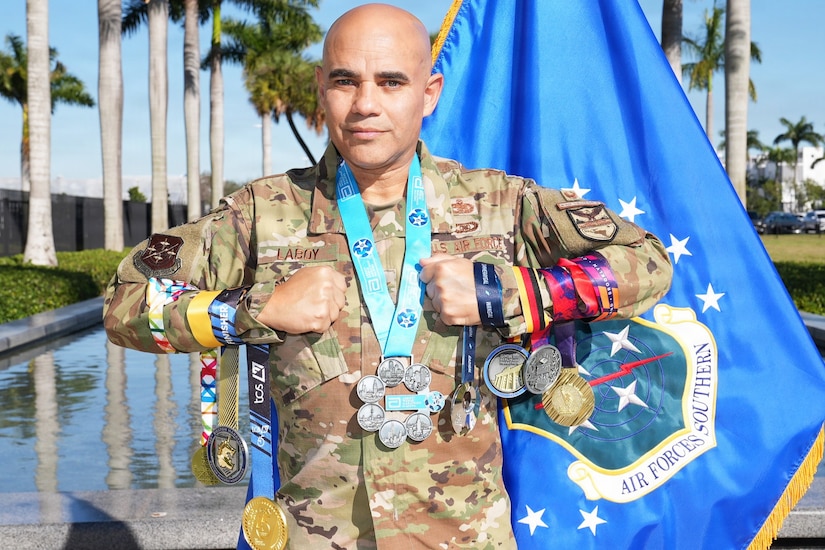
Air Force Col. Alfredo "Juny" Laboy
An airman wearing a camouflage uniform stands outdoors during daytime and holds seven medals wrapped around his arms; another large medal hangs around his neck, with a flag, tall trees and a reflecting pond in the background.
Job: Liaison Officer
Stationed: U.S. Southern Command Headquarters, Doral, Fla.
Unit: Air Forces Southern
Hometown: Humacao, Puerto Rico
According to Abbott World Marathon Majors data, he is also among just 44 athletes worldwide to accomplish this milestone for the first time within a single year. The World Marathon Majors are considered the pinnacle of endurance racing, consisting of premier marathons hosted across the globe. 

In 2025, Sydney was added as the seventh major, requiring Laboy to incorporate a new benchmark, along with additional travel, recovery and preparation within an already compressed timeline. 

That back-to-back stretch captured what defined Laboy's entire year: the ability to adapt when the conditions change and remain ready when the mission demands it. 

Throughout 2025, Laboy, 54, ran marathons in Tokyo, Boston, London, Sydney, Berlin, Chicago, Arlington, Virginia, and New York City, all while serving as the Air Forces Southern liaison officer to U.S. Southern Command. 

"I was driven by a combination of curiosity and purpose," Laboy said. "After completing marathons on all seven continents, I asked myself what would truly challenge me next. Completing all seven World Marathon Majors in one year wasn't about chasing a medal — it was about testing discipline, consistency and resilience, the same traits the Air Force has demanded of me throughout my career." 

Pursuing Excellence

For Laboy, the pursuit was inseparable from his identity as a service member, woven together through physical, mental and professional readiness; the thread linking the racecourse to the operations center. 

"Understanding what the achievement represented made it feel bigger than a personal milestone," he said. "Becoming the only active-duty service member to earn the Six Star Medal and complete all seven World Marathon Majors in a single year carried a strong sense of pride and responsibility. 

"This accomplishment allowed me to represent the United States Air Force and my hometown in Humacao, Puerto Rico, while also showing that being over 50 is not a limitation," Laboy added. "You can pursue excellence in fitness and set meaningful goals at any stage of life."

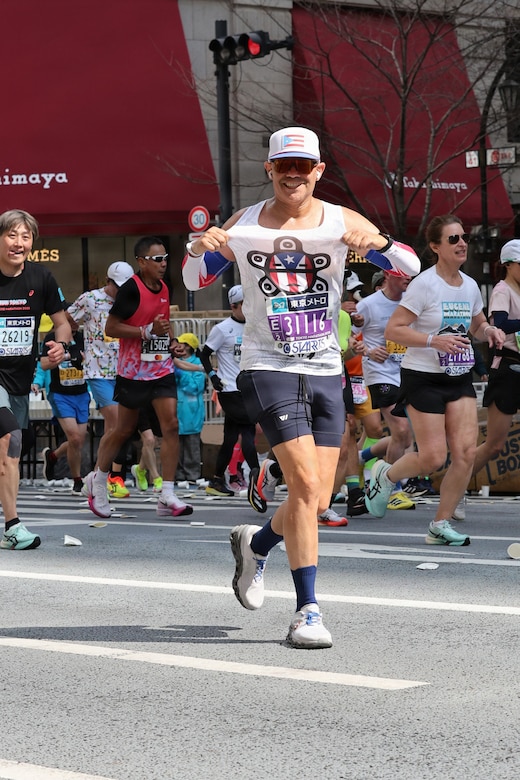
An airman wearing running gear stretches his shirt with both hands while jogging on a road during daytime, with other people in athletic attire running in the background.
An airman wearing running gear holds both arms in the air on a road during daytime, with other people in athletic attire standing in the background.
An airman wearing running gear holds one hand in the air and smiles as he jogs on a road during daytime, with other people in athletic attire also running in the background.
That readiness was tested repeatedly. Among the seven races, the Boston-to-London sequence required Laboy to compress recovery, recalibrate his physical expectations and execute without the preparation that most elite runners consider a minimum standard. 

"The London Marathon was the most challenging because I ran it just six days after completing the Boston Marathon," he said. "Physically, my body was still fatigued, and mentally, it took every ounce of focus and determination to push through with almost no recovery time." 

The effort mirrored another demanding stretch later in the year, when he completed the Marine Corps Marathon, followed by the New York City Marathon just one week later. Sustaining that output alongside a full-time operational workload required the same kind of structured adaptability Laboy applies to planning missions. 

"Balancing training with my role required flexibility," Laboy said. "Most runs happened during the workday, fitting them in between meetings, when possible, while weekends were reserved for longer distances. That structure allowed me to stay consistent without stepping away from my operational responsibilities." 

Finding His Stride

This approach also supported Secretary of War Pete Hegseth's military fitness guidance, which emphasizes physical training as a daily duty requirement for service members. Laboy approached physical performance and professional execution with the same framework. 

"I treated training like operations — plan, execute, assess and adjust," he said. "Consistency mattered more than intensity, and everything had to complement the mission, not compete with it." 

Adaptability was not an option; it was a defining trait. Midway through the year, Laboy was diagnosed with an umbilical hernia, a development that would have ended the pursuit for most. Instead of quitting, he persevered. He restructured his approach and pressed forward.

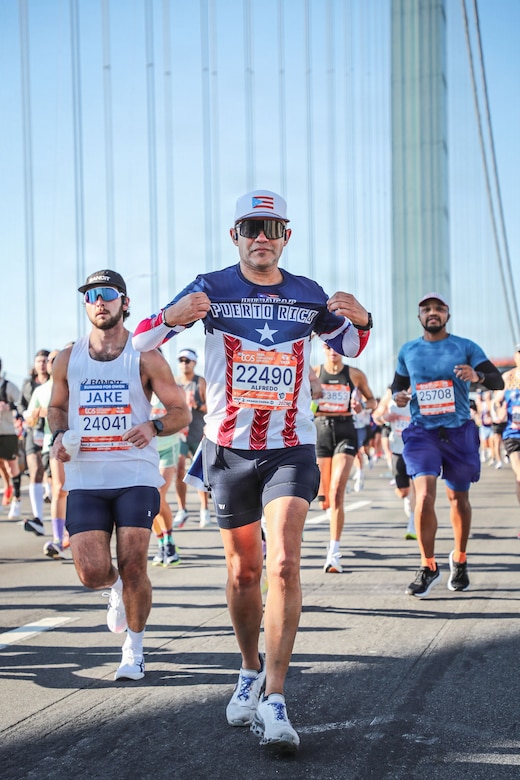
An airman wearing running gear stretches his shirt with both hands while jogging on a bridge during daytime, with other people in athletic attire running in the background.
An airman in winter athletic gear and carrying Puerto Rico's flag on his back runs on ice during daytime; a snowy mountain is in the background.
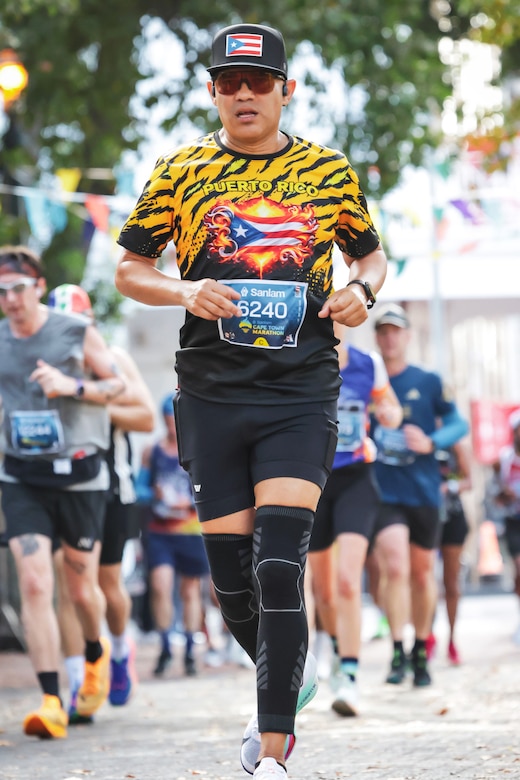
An airman wearing running gear jogs on a road during daytime, with other people in athletic attire also running in the background.
"There were moments of doubt, especially after I was diagnosed with an umbilical hernia following the London Marathon," Laboy said. "Under strict medical guidance, I was able to delay surgery and complete the remaining races safely." 

Laboy also managed preexisting conditions throughout the year, including bilateral hip bursitis, plantar fasciitis and vestibular neuritis, a condition that affects balance. Each of these conditions required ongoing adjustments to keep him mission-capable on and off the course. 

"Following medical guidance and adjusting expectations allowed me to keep moving forward without missing a single day of work due to running-related injuries," he said. 

'There Are No Shortcuts'

Overcoming these obstacles further reinforces that the parallels between endurance sports and military leadership are direct, not metaphorical, according to Laboy. 

"There are no shortcuts," he said. "Both require preparation, accountability, adaptability and the ability to lead yourself before leading others." 

Air Force Lt. Gen. Evan Pettus, Southcom deputy commander, said Laboy's accomplishment is a model of the readiness and adaptability the command requires of its leaders. 

"I've had the opportunity to follow and talk with Juny throughout this journey, and what stands out isn't just the mileage — it's the discipline behind it," Pettus said. "He never let a demanding schedule or personal setbacks distract him from the mission. He trained around his responsibilities, not the other way around. That balance and commitment to excellence while remaining fully engaged in the fight reflects the steady resilience and adaptability we expect from our leaders."

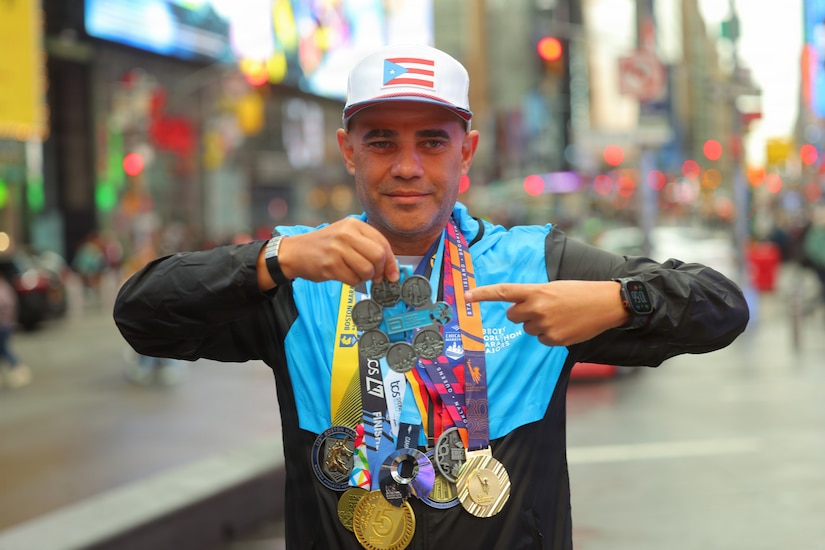
An airman wearing athletic attire and a hat and standing outdoors during daytime holds up a large medal with one hand and points at it with his other hand; around his neck are multiple other medals.

Laboy said the year reinforced that readiness is not a product of youth, but of discipline sustained over time. 

"Readiness isn't limited by age, but it's sustained by mindset," he said. "Resilience is built over time through discipline, physical fitness and mental toughness. When airmen take care of themselves, they're better prepared to take care of the mission." 

More Miles To Go

Standing at the finish line of his final race, Laboy said gratitude outweighed his exhaustion. 

"I felt gratitude for my health, my mother, my kids and everyone who supported the journey," he said. "I also felt excitement for what comes next and the goals still ahead." 

In April, Laboy completed the Coast Guard Marathon in Elizabeth City, North Carolina, followed by the Cape Town, South Africa, Marathon in May. Finishing the Cape Town race, now recognized as the eighth Abbott World Marathon Majors event, makes him one of fewer than 2,000 runners in the world to complete the entire series.

Looking forward, Laboy is scheduled to run the Air Force Marathon in September at Wright-Patterson Air Force Base, Ohio, and in October, the Army Ten-Miler in Washington, which completes the Armed Forces Series Challenge.  

Additionally, he aims to position himself among the first athletes in the world eligible for the Nine Star Medal, expected to be introduced in December 2027, pending the Shanghai Marathon's formal acceptance as the ninth and final World Marathon Major. 

Beyond these milestones, Laboy is setting his sights on the ultimate test of endurance: running at the geographic North Pole. By racing on ice floes covering 12,000 feet of the Arctic Ocean, he hopes to earn membership in the exclusive Marathon Grand Slam Club — a distinction reserved for elite athletes who successfully complete a marathon on all seven continents, plus the grueling North Pole Marathon.