By Jim Garamone, Defense.gov
ARLINGTON, Va. -- t is a dangerous and unpredictable time,
and the United States must reverse any erosion in its military capabilities and
capacities, the chairman of the Joint Chiefs of Staff said at the Military
Reporters and Editors conference here Oct. 26.
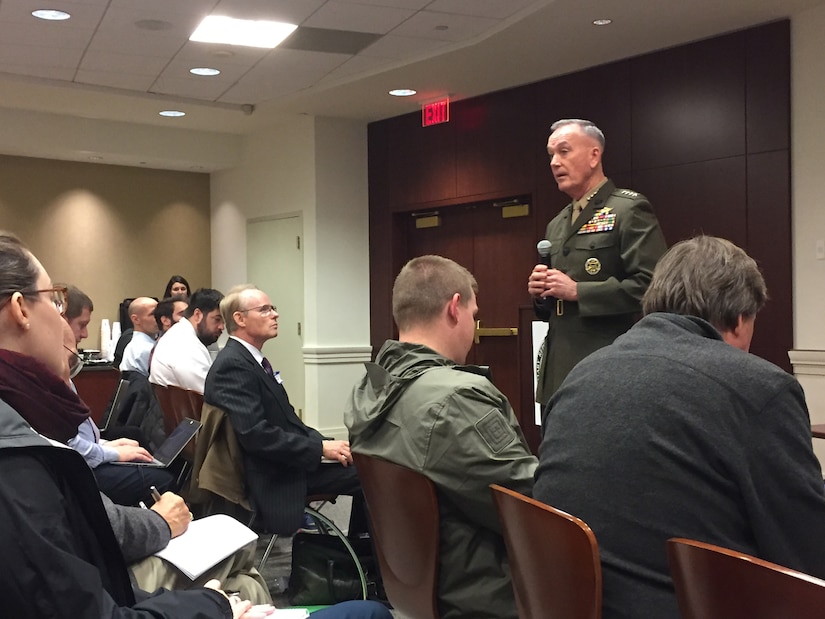
Marine Corps Gen. Joe Dunford is confident the U.S. military
can protect the homeland and fulfill its alliance commitments today, but he must
also look at the long-term competitive advantage and that causes concern.
He said the competitive advantage the U.S. military had a
decade ago has eroded. “This is why our focus is very much on making sure we
get the right balance between today’s capabilities and tomorrow’s capabilities
so we can maintain that competitive advantage,” Dunford said.
Strategic Alliances Provide Strength
The greatest advantage the United States has – the center of
gravity, he said – is the system of alliances and partners America maintains
around the world.
“That is what I would describe as our strategic source of
strength,” he said.
This network is at the heart of the U.S. defense and
security strategy, Dunford said. “We really revalidated, I think, what our
threat assessors have known for many years, is that that network of allies and
partners is truly unique to the United States of America and it is truly
something that makes us different,” the general said.
A related aspect is the U.S. ability to project and maintain
power “when and where necessary to advance our national interests,” Dunford
said.
“We have had a competitive advantage on being able to go
virtually any place in the world,” he said, “and deliver the men and women and
materiel and equipment, and put it together in that capability and be able to
accomplish the mission.”
This is what is at the heart of great power competition, the
general said. “When Russia and China look at us, I think they also recognize
that it is our network of allies and partners that makes us strong,” he said.
Challenges Posed by Russia, China
Broadly, Russia is doing what it can to undermine the North
Atlantic Alliance and China is doing what it can to separate the United States
from its Pacific allies. Strategically, Russia and China are working to sow
doubt about the United States’ commitment to allies. Operationally, these two
countries are developing capabilities to counter the U.S. advantages. These are
the seeds to the anti-access/area denial capabilities the countries are
developing. “I prefer to look at this problem less as them defending against us
and more as what we need to do to assure our ability to project power where
necessary to advance our interests,” Dunford said.
These are real threats and include maritime capabilities,
offensive cyber capabilities, electromagnetic spectrum, anti-space capabilities
and modernization of the nuclear enterprise and strike capabilities. These
capabilities are aimed at hitting areas of vulnerability in the American
military or in striking at the seams between the warfighting domains.
“In order for us to be successful as the U.S. military,
we’ve got to be able to project power to an area … and then once we’re there
we’ve got to be able to freely maneuver across all domains … sea, air, land,
space, and cyberspace,” the chairman said.
This requires a more flexible strategy, he said. During the
Cold War, the existential threat to the United States emanated from the Soviet
Union and strategy concentrated on that. Twenty years ago, this was different.
The National Security Strategy of 1998 didn’t address nations threatening the
U.S. homeland.
“To the extent that we talked about terrorism in 1998, we
talked about the possible linkage between terrorism and weapons of mass
destruction,” Dunford said. “For the most part, what we talked about were
regional challenges that could be addressed regionally with coherent action
within a region, not transregional challenges.”
Different Threats
Transregional threats are a fact of life today and must be
addressed, the general said. “What I’m suggesting to you, is in addition to the
competitive advantage having eroded, the character of war has fundamentally
changed in my regard in two ways,” he said. “Number one, I believe any conflict
… is going to be transregional –
meaning, it’s going to cut across multiple geographic areas, and in our case,
multiple combatant commanders.”
Another characteristic of the character of war today is
speed and speed of change, he said. “If you’re uncomfortable with change,
you’re going to be very uncomfortable being involved in information technology
today,” the general said. “And if you’re uncomfortable with change, you’re
going to be uncomfortable with the profession of arms today because of the pace
of change. It’s virtually every aspect of our profession is changing at a rate
that far exceeds any other time in my career.”
He noted that when he entered the military in 1977, the
tactics he used with his first platoon would have been familiar to veterans of
World War II or the Korean War. The equipment and tactics really hadn’t changed
much in 40 years.
But take a lieutenant from 2000 and put that person in a
platoon “and there’s virtually nothing in that organization that hasn’t changed
in the past 16 or 17 years,” Dunford said. “This has profound impacts on our
equipment, our training, the education of our people.”
This leads, he said, to the necessity of global integration.
“When we think about the employment of the U.S. military, number one we’ve got
to be informed by the fact that we have great power competition and we’re going
to have to address that globally,” he said.
The Russian challenge is not isolated to the plains of
Europe. It is a global one, he said.
“China is a global challenge” as well, Dunford added.
Global Context
American plans have historically zeroed-in on a specific
geographic area as a contingency, the general said. “Our development of plans
is more about the process of planning and developing a common understanding and
having the flexibility to deal with the problem as it arises than it is with a
predictable tool that assumes things will unfold a certain way in a
contingency,” he said. “So we’ve had to change our planning from a focus on a
narrow geographic area to the development of global campaign plans that actually
look at these problem sets in a global context. When we think about contingency
planning, we have to think about contingencies that might unfold in a global
context.”
This has profound implications for resource allocation,
Dunford said. Forces are a limited resource and must be parceled out with the
global environment in mind. “The way we prioritize and allocate forces has kind
of changed from a bottom-up to a top-down process as a result of focusing on
the strategy with an inventory that is not what it was relative to the
challenges we faced back in the 1990s,” he said.
In the past, the defense secretary’s means of establishing
priorities came through total obligation authority. The secretary would assign
a portion of the budget to each one of the service departments and the services
would develop capabilities informed by general standards of interoperability.
At the time, this meant the American military had sufficient forces that would
allow it to maintain a competitive advantage.
“Because the competitive advantage has eroded, in my
judgment, the secretary is going to have to be much more focused on the
guidance he gives,” Dunford said. “He not only has to prioritize the allocation
of resources as we execute the budget, but he’s got to five, seven or 10 years
before that, make sure that the collective efforts of the services to develop
the capabilities that we need tomorrow are going to result in us having a
competitive advantage on the backside.”
This fundamentally changes the force development/force
design process, he said. “This is not changing because of a change in
personalities. It’s not changing because different leaders are in place,” the
general said. “It’s changing because the character of war has changed, the
strategic environment … within which we are operating today and expect to be
operating in five to seven years from now, will change. Frankly, were we to not
change the fundamental processes that we have in place inside the department,
we would not be able to maintain a competitive advantage five or seven years
from now.”




 Posts
Posts

