Monday, September 22, 2025

In the Cockpit: Docuseries Captures Intensities of Elite Fighter Pilot Training

 Sept. 22, 2025 | By Katie Lange, Pentagon News

While movies like "Top Gun" and "Top Gun: Maverick" show people a glamorized version of military fighter pilot life, most people really have no idea what it takes to become an elite aviator, until now.  

A new National Geographic docuseries called "Top Guns: The Next Generation," follows a handful of Navy and Marine Corps officers as they go through advanced strike fighter training — the last, hardest and most unforgiving phase of fighter pilot qualification training.

A person stands at a podium at the front of a movie theater filled with people. The screen reads, “Top Guns: The Next Generation” and depicts four people walking toward an aircraft.

The show's producers chose to film that phase because of its intensity, but it's also what audiences are most familiar with. The show skips past the classroom training and highlights when students go beyond being "just a pilot" to what it takes to become a fighter pilot.  

"It's the most crucial point of their training. It's really the point in which they can fail, and their dreams of becoming a fighter pilot are over," said Karen Edwards, the series' showrunner. "They spent years getting to this point, and now it's all on the line." 

When choosing candidates for the show, Edwards said they met with about 30 trainees assigned to Training Wing One, based at Naval Air Station Meridian, Mississippi, where most of the series was shot for more than a year. They selected a variety of students with different backgrounds, experience levels and skills.  

"One of the participants used to be a yoga teacher and is now a Marine," Edwards said. "Another guy talked about how he was adopted at birth and how that has impacted him and his religion. For others, it's in the family blood."  

Marine Corps Capt. Micah Nissly was the adoptee Edwards mentioned. He said his dad, a pastor, impressed upon him the importance of public service and giving back, so he enlisted in the Marines. After eight years of service, he went to officer candidate school before starting aviation training. 

"I think it's important for individuals to know that, regardless of their upbringing and how they came into this, they have this opportunity," Nissly said. "Naval flight training is truly the great equalizer: you give it all. You make it or you don't. And I think your background matters so little … what matters is your performance." 
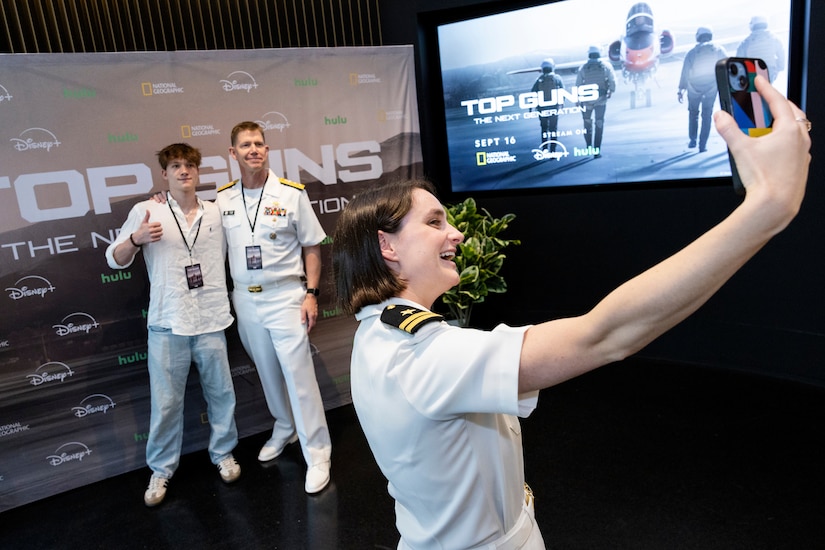
A woman wearing a formal military uniform takes a selfie with two men in the background, standing in front of a large poster. One of the men is dressed in casual attire, and the other is wearing a formal military uniform.

Initial Reluctance

When the documentary opportunity arose, Nissly said he initially denied the offer to preserve the legacy of the "quiet professional," as he knew most in the jet community to be. But then his wife convinced him that it's something his 6-year-old daughter could one day look back on with pride. 

"I really hope the viewers … see that behind every flight is a naval aviator committed to teamwork, integrity and self-improvement. They'll see our ups and downs, but humility and accountability define us way more than the egos," Nissly said.

Marine Corps Capt. Stephanie Harris was also reluctant to be part of the production because she didn't want it to take away from her focus on training. But she eventually agreed. 

"I've looked up to so many people who walked this path before me," she said. "Providing an example of the kind of people that do this — and not just your stereotypical version — felt important to me."

Stunning Cinematography With a Focus on Accuracy

Some of the series' filming also took place at Naval Air Facility El Centro in the California desert. El Centro specializes in teaching trainees strike training — how to accurately drop bombs and other ordnance. A small portion of filming also took place at Naval Air Station Key West, so the students could access the aircraft carrier USS Dwight D. Eisenhower. These locations helped crews capture stunning aerial visuals that included precision bombing drills, dogfighting, evasive maneuvers and carrier landings.  

"[Students learn this] in a really short period of time, and it's a lot to ask, which makes it all the more amazing when they achieve it," Edwards said.

To get the shots, the production team put cameras inside T-45 Goshawk training aircraft using in-cockpit mounts designed, fabricated and installed by Naval Air Systems Command and the Naval Air Warfare Development Center. When the students are flying, the audience can hear minute by minute what they're saying. 

"Everything that happens inside the jet is caught in real time," Edwards said. "You hear them being taught — what they get right, what they get wrong, how they can improve." 
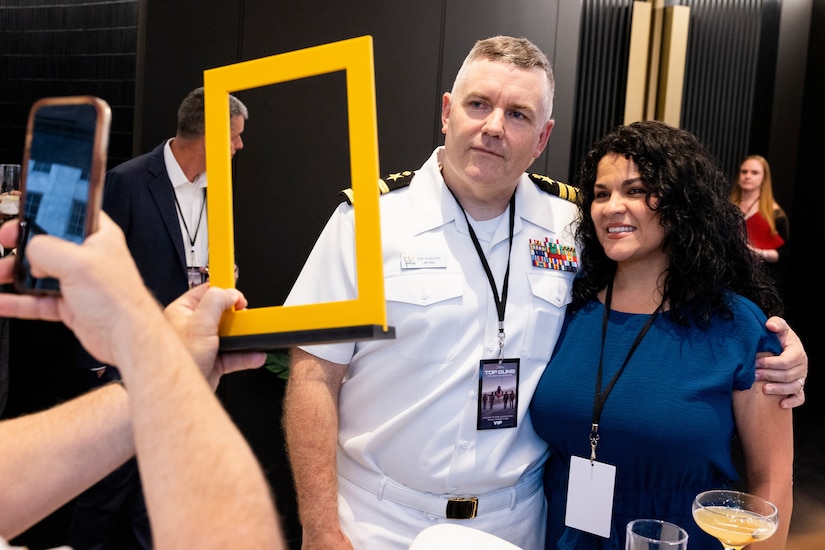
A man in a formal military uniform poses for a photo with a woman in business attire as another person, not pictured, holds up a phone and a yellow, square picture frame.

To ensure safety wasn't compromised, the production team had instructors and professionals fly the aircraft for the external cockpit-to-cockpit scenes, recreating the flights the students had taken. 

"We filmed them externally using the same film crew as they used for 'Top Gun: Maverick' … because that is so dangerous," Edwards said.  

Nissly said he thinks the series did a great job of focusing on authenticity.  

"They did an amazing job filming the honest struggles. There's no do-overs for this," he said. "This is real life, and the stakes were as high for us then. What you see is what you get." 

"It's inspiring to hear and see up close the authentic stories of those serving in our Navy today," said Navy Rear Adm. Ryan M. Perry, the service's chief of information. "It's about young men and women chasing a dream to fly, and the intense training and challenges they go through to achieve their goals."                    

Emotions Run High 

For many of the participants, the high-stakes, life-or-death training takes an emotional toll, which is also captured on camera.

"All of them come back and share and have moments where it's like, 'Am I good enough? Am I going to pass tomorrow? Will I make the grade?'" Edwards said. "That is crucial to their training. They can never become complacent or confident. They're always being pushed to the next level." 

At one point in the series, Nissly gets sick while practicing dogfighting with a senior officer in the jet with him. The fact that it was an incident beyond his control was something he struggled with.  

"Getting through that mental block of, 'Will this happen again? Is this going to be a common occurrence? How am I going to fight through that?' It was definitely something I had to get over," Nissly said, before joking, "Humility also comes in and will always keep me on the straight and narrow."  

Nissly said he's driven by the desire to support enlisted troops — which he was, once — fighting on future battlefields. Similarly, Harris said the hardest part of her training was the thought of those troops on the ground someday and knowing that she needed to hit her targets for them.  

"[Strike training] is one of the most difficult missions that we do. So that phase, for me, felt the most intense," she said.  

When asked what drives her, Harris said some of it is the fear of letting other people down. "Not being prepared enough when the moment comes," she said. "Fear that I won't be ready, and that drives me in tremendous ways."  

The Takeaway 

For the Navy and Marine Corps, the goal of capturing the intense demands of this program on film was to highlight what it truly takes to be a naval aviator — even if it shows failure that inevitably happens.

"These are real human beings, real people who are really giving it their all," said Navy Lt. Cmdr. Joseph "Bones" Pfaff, entertainment liaison at Navy Office of Information West, which led the project. Based in Los Angeles, the office works with entertainment industry professionals to ensure an authentic, accurate portrayal of the Navy's assets, policies and people in television and film. 

"We have a very strenuous and challenging pipeline to go from being an unwinged aviation student to actually earning their wings. Not everybody succeeds, and that’s OK," Pfaff continued.  

"It doesn't end when they finish fighter pilot school," said Marine Corps Maj. Hector Alejandro, director of the Marine Corps Entertainment Office in Los Angeles. He explained that the trainees who earn their wings continue training at their squadrons in the fleet. "Someday, a 19-year-old Marine is going to be pinned down on a hillside, and he'll be looking to the sky for help. The person in that cockpit has to be the one who won't fail him. Our selection and training pipeline is ruthless because we're building pilots worthy of that trust." 

Series producers said they expect the audience to connect with the dedicated men and women highlighted in the show — and learn that it’s not like what they see in the movies.  

"It's not just about going up and having some fun in the jets on a daily basis. This is a job. They are careful. They're trained by very, very experienced people," Edwards said. "You take the audience into a privileged world that they would never, ever be able to see." 

"Top Guns: The Next Generation" airs on Tuesdays on National Geographic and streams the following day on Disney+ and Hulu. 

Medal of Honor Monday: Marine Corps Cpl. Jack Davenport

Do I save others or save myself?  

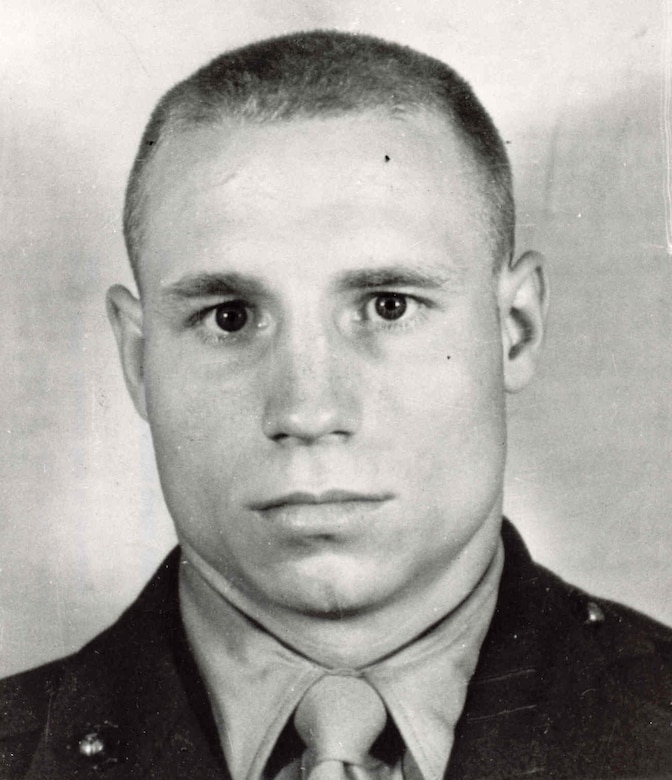
That's a question an unknown number of service members have asked themselves during battle throughout the ages. It's one Marine Corps Cpl. Jack Arden Davenport didn't hesitate on. During an attack in Korea, he chose to save his comrade's life instead of his own. That selfless decision led him to receive a posthumous Medal of Honor.  

A man looks stoically at the camera for a photo.

Davenport was born Sept. 7, 1931, in Kansas City, Missouri, to Fred and Gloria Davenport. He had a sister named Jane and a twin brother, Karl, who served in the Navy.  

Davenport was an active child who always liked to be on the go, his parents told the Kansas City Times in 1952. Throughout high school, he played baseball and was a paperboy for the Kansas City Star newspaper, where his father worked.  

After graduating from Paseo High School in 1949, Davenport studied for a year at the University of Kansas, where he played on the school's football team. He was also an amateur boxer who participated in at least one Golden Gloves tournament.  

However, when the Korean War broke out, Davenport decided to trade in studying for the fight against communism. He enlisted in the Marine Corps July 1950. After basic training, he was stationed at Camp Pendleton outside of San Diego, where he earned the nickname "Dynamite" from other Marines. In December of that year, he was deployed to join the 3rd Battalion, 5th Marine Regiment, 1st Marine Division in Korea.  

According to newspaper reports of the time, Davenport was on the front lines almost continuously until the day he made the ultimate sacrifice.  

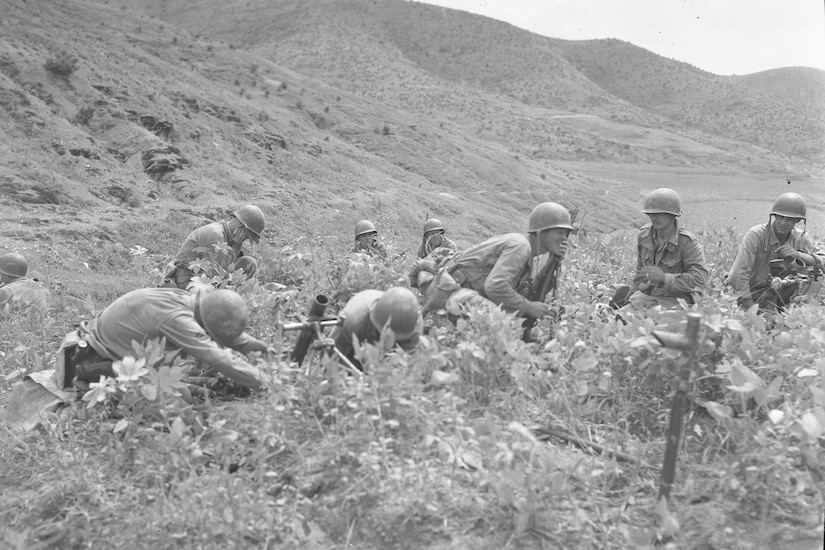
Early on Sept. 21, 1951, Davenport was serving as a squad leader with Company G in the Songnae-dong area of Seoul, South Korea, when they were attacked by enemy troops trying to infiltrate their sector.  

Nearly a dozen people in combat uniforms and helmets huddle in tall grass.

Davenport directed his comrades to defend their position. He and a fellow Marine, Pfc. Walter Barfoot, were doing so from a foxhole. Suddenly, an enemy grenade fell at their feet.  

Without any concern for his own life, Davenport jumped on the deadly projectile, which killed him. Barfoot was spared, however, and their unit managed to repulse the enemy, largely in part to Davenport's calm leadership.  

Many of Davenport's fellow Marines wrote to his family after his death, according to a December 1952 issue of the Kansas City Times.  

"He was the best. They didn't come finer or more courageous that little ole Dynamite," one Marine wrote to Davenport's mother.  

The fallen 20-year-old's body was returned to the U.S. in January 1952 and buried in Mount Moriah Cemetery in Kansas City.  

About a year later, Davenport posthumously received the nation's highest honor for valor. The Medal of Honor was presented to his father on his behalf during a Pentagon ceremony. Davenport's brother, Karl, was flown in by the Navy from Japan on special leave for the ceremony.  

In the late 1980s, a gymnasium at Camp Pendleton was named in Davenport's honor.  

Friday, September 19, 2025

Department of War and Mongolian Ministry of Defense Conduct Bilateral Defense Framework

Mr. Alvaro Smith, Deputy Assistant Secretary of War (DASW) for China, Taiwan, and Mongolia and Major General Gankhuyag Davagdorj, State Secretary of the Ministry of Defense of Mongolia (MOD) conducted the annual U.S.-Mongolia Bilateral Defense Forum (BDF) meeting on September 19, 2025. 

The two officials affirmed their commitment to deepening bilateral defense relations based on mutual interest and a common-sense approach to security and prosperity in the Asia-Pacific region. They discussed regional security matters as well as concrete opportunities to further enhance security cooperation, including through exercises, training, security assistance, and defense equipment sales. They also discussed areas where additional defense expenditure by Mongolia could significantly improve the Mongolian Armed Forces' capabilities and readiness.

DASW Smith commended Mongolia for its embodiment of the warrior ethos and its engagement in peacekeeping operations. Mongolia and the United States emphasized the importance of their Strategic Third Neighbor Partnership in advancing the security and economic prosperity of both countries.

Army Enhances Border Security Through Partnership, Unique Capabilities

 Sept. 19, 2025 | By Army Capt. Samuel DeWerth-Jaffe, Joint Task Force Southern Border

Joint Task Force Southern Border demonstrates an unprecedented level of interoperability with partner agencies as part of their whole-of-government approach to secure the southern border. 

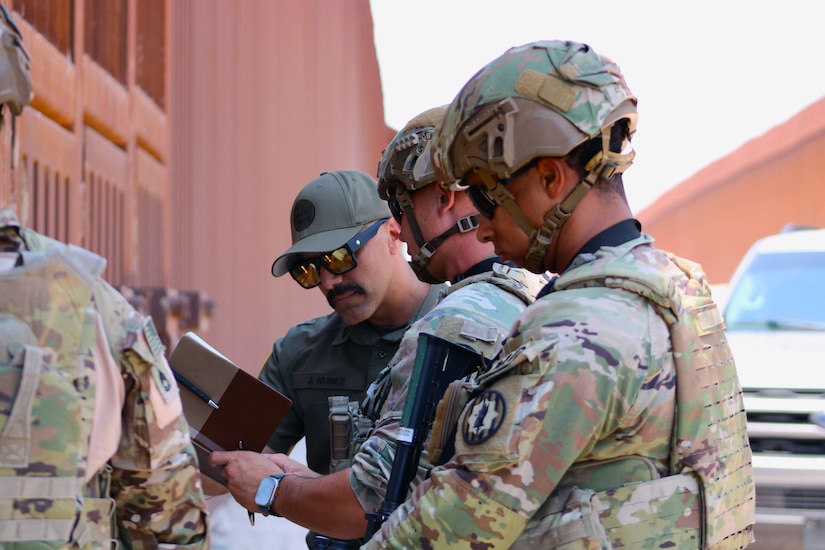
From the headquarters down to squad-sized elements directly on the border, task force personnel are working alongside U.S. Border Patrol every day, ensuring synchronized efforts to deter illicit activities. 

Two soldiers speak to a person in a baseball cap outside, with a large structure and vehicle in the background and another person nearby.

"My experiences in past deployments and working in Europe have reinforced the importance of partner collaboration — a principle directly applicable to our current mission with Border Patrol," said Army Lt. Col. Cris Gasperini, commander of the 1st Battalion, 41st Infantry Regiment, 2nd Stryker Brigade Combat Team, 4th Infantry Division, assigned to JTF-SB. "The integration of our organic assets with those of Border Patrol has been exceptionally effective, demonstrating the necessity of a whole-of-government approach to border security." 

The task force's integration has proven critical to operations across the southern border's diverse terrain. Along the 1,954 miles of the border lie cities, deserts, thick vegetation, rivers and rural communities. 

The varied terrain along the border presents distinct security challenges. These are addressed through both the organic assets of JTF-SB and the complementary capabilities of interagency partners. 

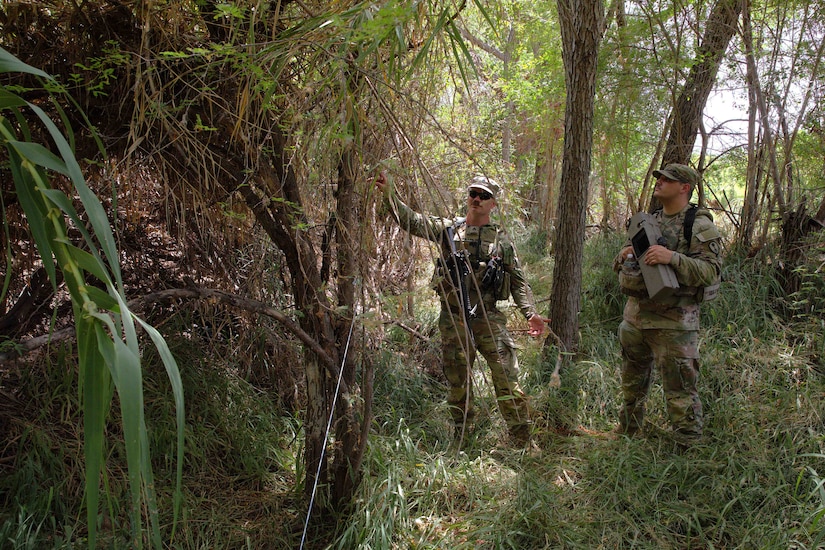
Two soldiers wearing camouflage military uniforms look at a brush covered area while standing in a forest.

The AN/MPQ-64 Sentinel radar is one of the unique capabilities that the task force uses to address these security challenges at the border and enable U.S. Border Patrol's law enforcement role while also providing defensive capabilities against small unmanned aerial systems. 

The U.S. Border Patrol El Paso Sector, which oversees 268 miles of the southern border in Texas and New Mexico, is one of nine sectors that has seen the benefits of an integrated approach with the task force. 

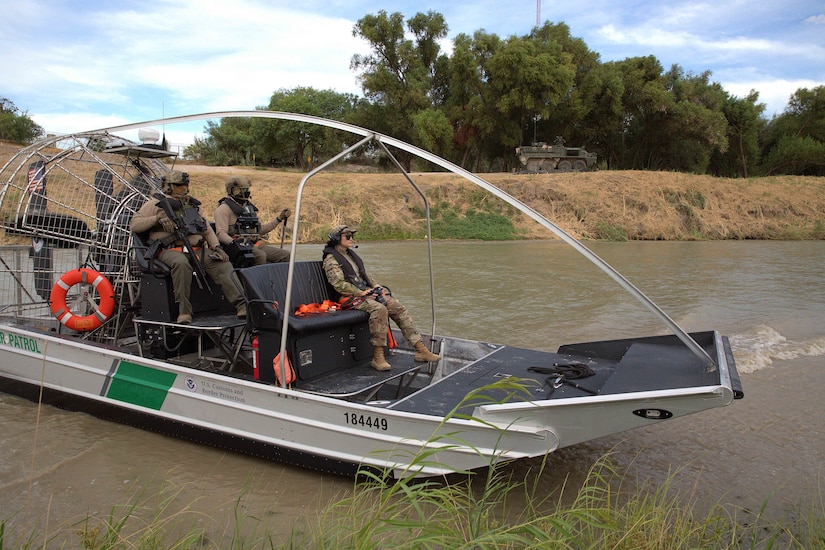
Three people sit in a metal boat on a small body of water under blue skies with trees and tall grass in the background.
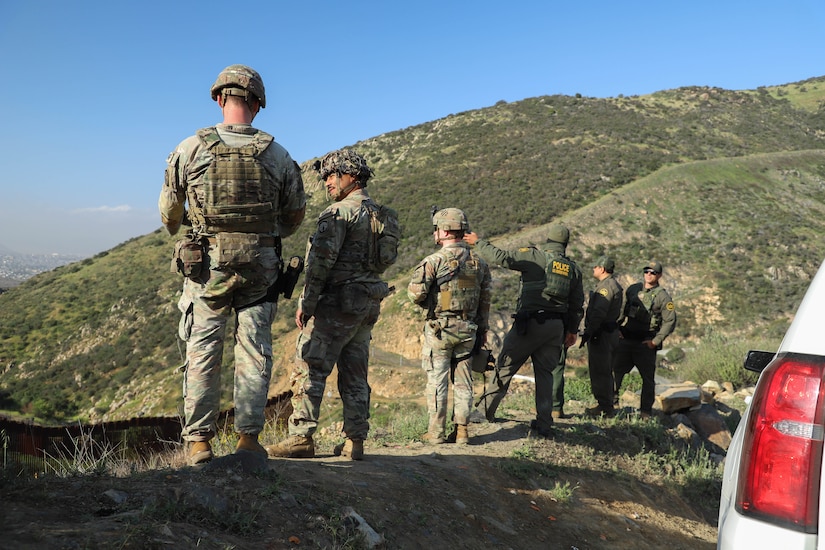
Three soldiers wearing camouflage military uniforms stand on a hill next to three other people in green police uniforms. One of the men is pointing toward the valley below.
"The Border Patrol in El Paso focuses on collaboration with various agencies and the Department of War's JTF-SB to enhance border security to target hostile drones and the challenges they pose," said Walter N. Slosar, chief patrol agent with the El Paso Sector. "Enhanced detection capabilities between JTF-SB and U.S. Border Patrol give us full spectrum capabilities to track, identify and mitigate aerial threats." 

JTF-SB and U.S. Border Patrol remain committed to strengthening this vital partnership and continued innovation in the face of evolving threats with a broad range of capabilities. This collaboration serves as a model for future interagency cooperation and underscores the importance of a unified approach to national security. 

Thursday, September 18, 2025

Secretary of War Hegseth, U.S. Army Chief of Staff Gen. Randy George Host the 2025 Department of War National POW/MIA Recognition Day Ceremony

Sept. 18, 2025

Secretary of War Pete Hegseth and U.S. Army Chief of Staff Gen. Randy George, will host the Department of War 2025 National POW/MIA Recognition Day ceremony to honor those who were held captive and returned, as well as those who remain unaccounted for from past conflicts, on Friday, Sept. 19, 2025, at 10 a.m. EDT on the Pentagon River Terrace Parade Field. The program will include remarks by Secretary Hegseth and Gen. George.

The ceremony will also be livestreamed on War.gov and broadcast on Channel 2 in the Pentagon.

This is an open press event, except for TV/video coverage, which will be pooled. All journalists covering the ceremony must obtain a wristband from security screening. Journalists without a Pentagon access badge must go through security screening at the base of the River Entrance Pedestrian Bridge and will be escorted to the ceremony from there. Security screening will begin at approximately 8:00 a.m.; have proof of affiliation and two forms of photo identification. Security screening at this location will close promptly at 8:30 a.m. EDT. Journalists with a Pentagon access badge, and whom have entered the building prior to 8:30 a.m. EDT, may go through security screening at the River Entrance to obtain their wristband; please obtain your wristband at the River Entrance by 8:25 a.m. EDT. All journalists covering the ceremony, including those with a Pentagon access badge, must be in place no later than 8:30 a.m. EDT. Once security screening has been initiated at the base of the bridge, all journalists entering the building via the bridge for any reason, including those with a Pentagon facility access card not covering the arrival ceremony, must undergo security screening.

Media interested in covering this event must RSVP by 12 p.m. EDT Thursday, Sept. 18, to be submitted for approval. Please respond to Ms. Riley Podleski at riley.p.podleski.civ@mail.mil with name, outlet, position, email and phone number. 

Please call 703-697-5131 with any questions.

U.S. Soldiers to Compete in International Handgun Championships


Army Sgt. Aaron Eddins and Staff Sgt. Jacob Hetherington will compete at the 2025 International Practical Shooting Confederation World Shoot Handgun Championships in South Africa Sept. 22-27. 

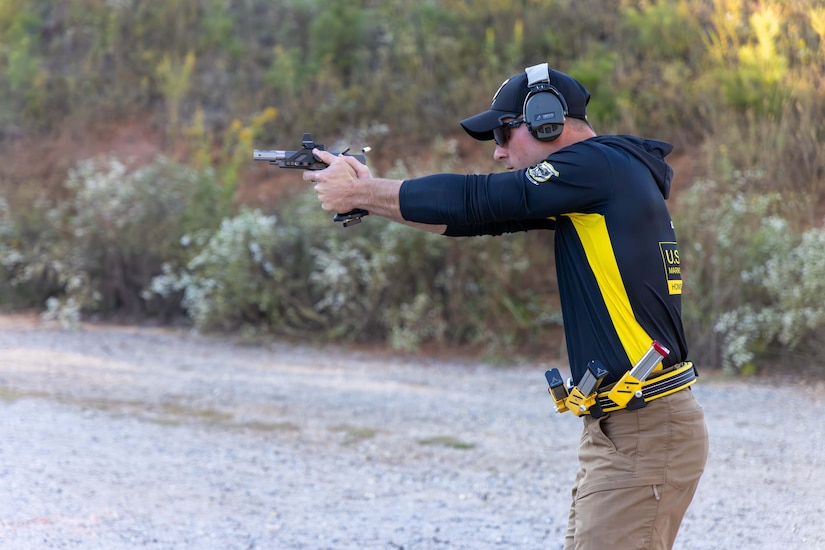
A man wearing a hooded shirt, hat, hearing protection and a belt carrying three magazines fires a handgun in front of a brush hill. A bullet casing flies out of the gun in the air.

Eddins and Hetherington are instructors and competitive shooters assigned to the Army Marksmanship Unit at Fort Benning, Georgia, and part of the U.S. Practical Shooting Association Team representing the United States at the 30-stage, five-day handgun championships.

More than 1,700 marksmen from at least 50 countries qualified to represent their countries at this elite competition, making it an honor to attend, Eddins said.

Some of the countries represented include Poland, Czech Republic, Italy, Brazil, Venezuela, Kenya, China, Serbia, Ukraine, Zimbabwe, New Zealand, Ecuador, Papua New Guinea, Republic South Africa, Sri Lanka, Germany, Paraguay, France, Canada and Philippines. 

"The IPSC World Shoot is the Olympics of practical shooting. It takes place every three years but has recently changed to every four to match the Olympic schedule," Eddins said. 

The first World Shoot was in Zurich in 1975 where American marksman Ray Chapman won the gold medal. As firearms developed and the number of competitors increased, changes were inevitable. In 1990, American Doug Koenig became the first marksmen to win the World Shoot using a red dot sight. In the following 1993 World Shoot, competitors were divided into divisions based on equipment. For example, marksmen competing with optical sights were in the open/modified division, while competitors with iron sights were the standard division. 

This year's World Shoot has six divisions that include classic, open, production, production optics, revolver and standard.  

To qualify for the 2025 World Shoot, athletes had to compete in four qualifying matches. From those four, the top three scores were combined, Eddins said. 

"The top four in each country [for each division] are selected to be on that country's national team," he said. 

Eddins will represent Team USA in the open division alongside civilian marksmen Christian Sailer, Bryan Jones and John Vlieger. These four Americans will vie for the gold against 358 other individual competitors. They will also compete as a divisional team against 35 other countries. 

Hetherington will represent Team USA in the production optics division alongside civilian marksmen JJ Racaza, Tom Castro and Jay Beal. These four Americans will seek the gold against 447 other individual marksmen and 40 other country teams. 

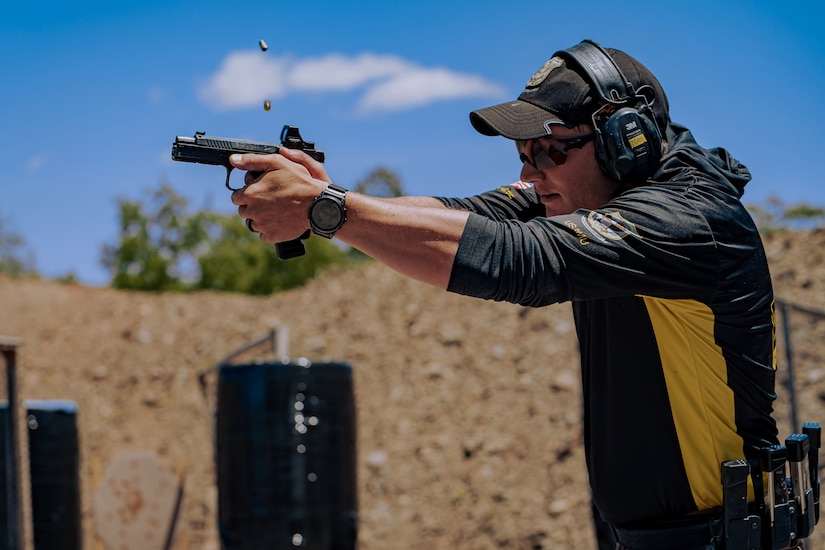
A man wearing a hooded shirt, hat and hearing protection fires a handgun in front of a brick wall. Bullet casings fly out of the gun in the air.

Competing internationally is not new for the USAMU Action Shooting Team. Years ago, the team competed at IPSC Championships regularly. USAMU veterans such as Travis Tomasie, Max Michel, KC Eusebio and Shane Coley have competed and medaled in several IPSC World Shoots over the years. In fact, in 2008, USAMU Action Shooting Team soldiers swept the podium when Eusebio, Brad Balsley and Coley won the gold, silver and bronze in the junior category. 

Although the Action Shooting Team stepped away from international competitions for several years because of a variety of administrative challenges, there is now a refocused effort. The 'Home of Champions' is well known for international shooting sports like the 10m air rifle, 50m smallbore, trap and skeet since they have had a strong presence at the Olympics in those sports. 

Across the nation, the Action Shooting Team is well known in practical shooting, precision rifle series and multi-gun competitions, and since the IPSC World Shoot is similar in nature to the unit's Olympic presence in other shooting disciplines, it's in-line with the unit's mission to win on a global stage, said Army Sgt. 1st Class Christopher Workman, USAMU Action Shooting Team chief. 

"It is important for these world-shooters to be able to represent the U.S. Army and the Army Marksmanship Unit on an international stage, not only matches within [the United States]," Workman said. 

To prepare for this competition, Eddins said he competed in seven international competitions over the last three years. Hetherington, who earned the highest qualifying points in the production optics division, earned his spot on the World Shoot by competing at French Nationals, Extreme Euro in the Czech Republic and the Viking Extreme in Denmark. However, this is not his first World Shoot. He competed in the championships before joining the Army. 

"The last World Shoot I shot was in 2014. I was on the U.S. Junior Production Team and earned a silver medal. The U.S. Team won the gold medal for team production," Hetherington said. 

Like the Olympics, the IPSC Championships will be intense, not only with competition but in course of fire as well. U.S. Practical Shooting Association competitions typically have between nine and 12 stages over two to three days. The international competition is more like a marathon with 30 stages over five days. Those stages are broken up into three courses, short (12 rounds or less), medium (13-24) and long (25-32), making each competitor prove their skills are fast and accurate with nearly 600 rounds. 

Team USA will begin competing Sept. 22, with the 30 stages broken down into five areas, meaning they will complete six stages per day.

Wednesday, September 17, 2025

Secretary of War Praises K-12 Grade Civics Organization on Constitution Day

Secretary of War Pete Hegseth today offered praise to a national organization that teaches civics to school children in kindergarten through 12th grade during a private ceremony in Washington's National Archives building.

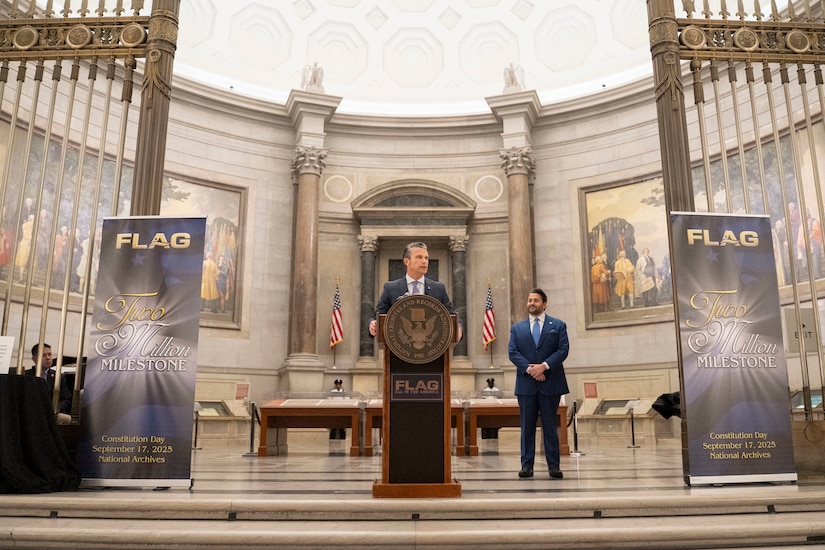
A man in business attire is standing behind a podium delivering remarks in a large, circular ornate room with marble walls. There are two American flags behind him, and another man off to the side observing him. On either side of the podium are banners that read “FLAG - Two Million Milestone.”

The ceremony, which was held on Constitution Day and Citizenship Day, commemorated the Foundation for Liberty and American Greatness having achieved the significant milestone of reaching 2 million children since the organization was founded in 2016. 

Hegseth spoke about the importance of the work that FLAG does in teaching school children American civics. 

"I hope you understand how important this is; what we pour into the next generation will determine whether we keep our republic or not," Hegseth said of the importance of civics in the classroom. 

Speaking with the Constitution as his backdrop and stating what an honor it was to "stand in the shadow of such brilliance" of the Founding Fathers' generation, the secretary talked about the significance of our country's founding. 

"That type of brilliance didn't come out of thin air. It was first inspired by God [and] inspired by an understanding of human history, an understanding of biblical history [and] an understanding of Western civilization philosophy and theology and civics poured into a generation of men and poured into an American experiment — it wasn't an accident," Hegseth said. 

He then jumped ahead to the present day and discussed the importance of instilling American values in the country's young people from an early age. 

"We need to go to the youngest and plant a love for America on [their hearts] early, with knowledge about where it comes from," Hegseth said. 

A non-profit organization, FLAG is "dedicated to educating Americans about the values and principles that make our nation exceptional," according to the organization's website. 

Some of the products the organization uses to teach those values include a version of the Constitution written for young students and the "Citizens Guide to the Electoral College."

Tuesday, September 16, 2025

Hegseth Welcomes Top Army Rangers to Pentagon

 Sept. 16, 2025 | By Matthew Olay, Pentagon News

Secretary of War Pete Hegseth hosted a pair of U.S. Army Rangers at the Pentagon today, following the soldiers having won the Army's 41st Annual David E. Grange Jr. Best Ranger Competition earlier this year. 

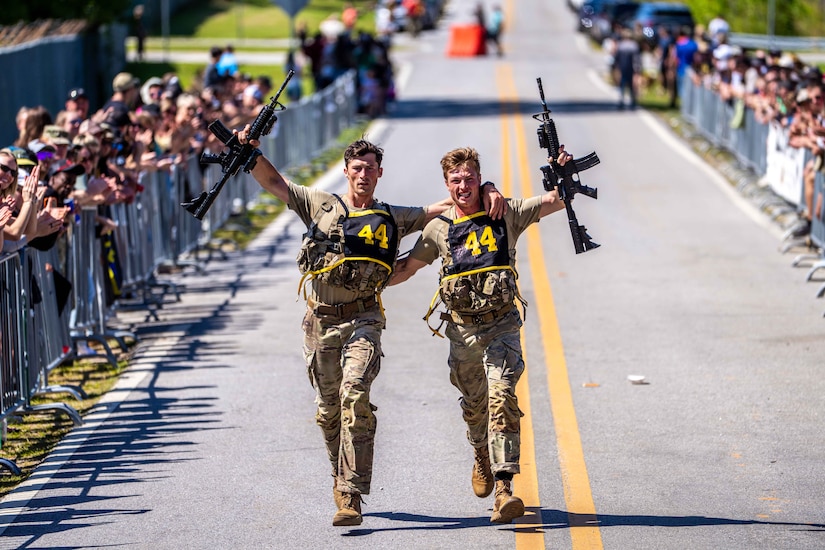
Two men in camouflage military uniforms run on a road with their arms around each other while holding rifles in the air. On either side of the road, long lines of spectators cheer them on.

Hegseth invited Army Capt. Kevin Moore and Capt. Griffin Hokanson — both from the 75th Ranger Regiment, and both of whom were first lieutenants at the time — to the Pentagon via social media, shortly after the two secured victory at the competition, April 13.  

Hegseth said he wanted to invite the soldiers to Washington because they exemplify the warrior ethos, a topic of which's restoration the secretary highly prioritizes within the War Department. 

"I think how you prepare is indicative of how you might perform, and preparing by performing at the highest level is exactly what we would want everybody to aspire to," Hegseth said after meeting with the Rangers in his office. 

He went on to say that the best of the best Army Rangers and the Best Ranger Competition embody the highest level of competition, and that bringing the Rangers to the Pentagon was a way to showcase excellence.  

"That's what it is: excellence … Our enemies know what we're capable of … [and] these two captains embody that," he added.  

Both Moore and Hokanson agreed that the annual event is directly linked to the warrior ethos.  

"I think competition is an extremely important part of that warrior ethos, driving everybody to higher levels and greater heights," Moore said, adding that he thinks the competition works to make the Army, as a whole, better.  

"For me, the warrior ethos is being an expert in your craft. And, as members of the [75th] Ranger Regiment, I feel like … that warrior ethos has always been there; and I think you can see that by the Ranger Regiment's performance in the Best Ranger Competition," Hokanson said.  

Prior to meeting with Hegseth, the two Rangers received a roughly 45-minute, private tour of the Pentagon that heavily focused on the Army's history. 

"The Pentagon tour, it's great. Coming from the Ranger Regiment, you kind of reflect on what the [Regiment's] been doing over the past 20-plus years, going back to the terrorist attacks that sparked our conflicts that we've lived through," Hokanson said.  

"I was a history major in college … [so] most of the stuff on that tour was actually quite interesting to me, and it's just very interesting to see everything that's out there," Moore said of the tour, adding that this was his first visit to the Pentagon. 

"It's been really incredible," he said.  

Held from April 11 to 13 at Fort Benning, Georgia, the 2025 Best Ranger Competition saw 52 teams from an assortment of Army units — including the Army National Guard — competing against each other in a series of challenges.  

Each day saw a number of teams getting cut from the competition, with Moore and Hokanson placing first in the competition's final event just prior to being named the competition's overall winners. 

This was the fourth year in a row that soldiers from the 75th Ranger Regiment were victorious in the competition. 

"Most people can't do 10 minutes of what you did, and yet, you did it for days and days on end and at a really high level," Hegseth told Moore and Hokanson while commenting on their success at this year's BRC. 

"That's why we wanted to celebrate and recognize [you]."  

Air Force Celebrates 78 Years of Air Superiority

 Sept. 16, 2025 | By David Vergun, Pentagon News

The Department of the Air Force was established 78 years ago on Sept. 18, 1947, making it the third military department, alongside the Departments of the Army and Navy.

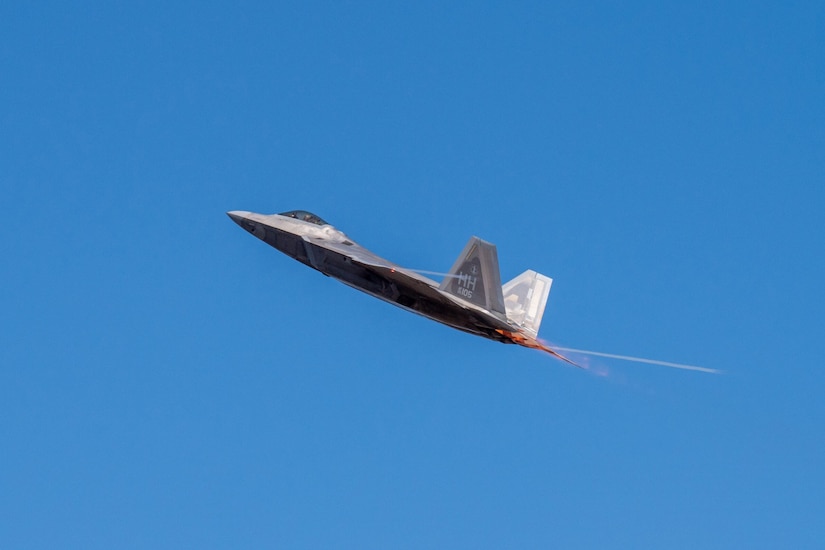
A jet takes off at a 45-degree angle against the backdrop of a blue sky.


Its creation was the result of the National Security Act of 1947, which formed the National Military Establishment. Less than two years later, the establishment became the Department of Defense, and on Sept. 5, 2025, President Donald J. Trump signed an executive order renaming DOD as the War Department.

Included in the Department of the Air Force are the Air Force, Space Force, Air Force Reserve, Air National Guard and the Civil Air Patrol. The Air National Guard is the Air Force's component of the National Guard Bureau, along with the Army National Guard. 

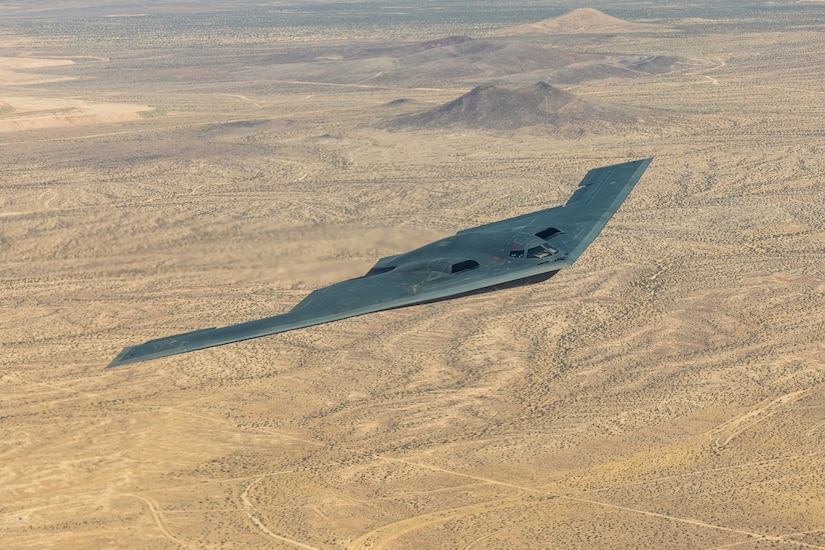
A triangular-shaped jet soars over a brown desert.

The Air Force mission is to fly, fight and win — airpower anytime, anywhere. It is achieved by air superiority, global mobility in troop movement and munitions for the joint force and maintaining two legs of the nuclear triad: bombers and intercontinental ballistic missiles.  

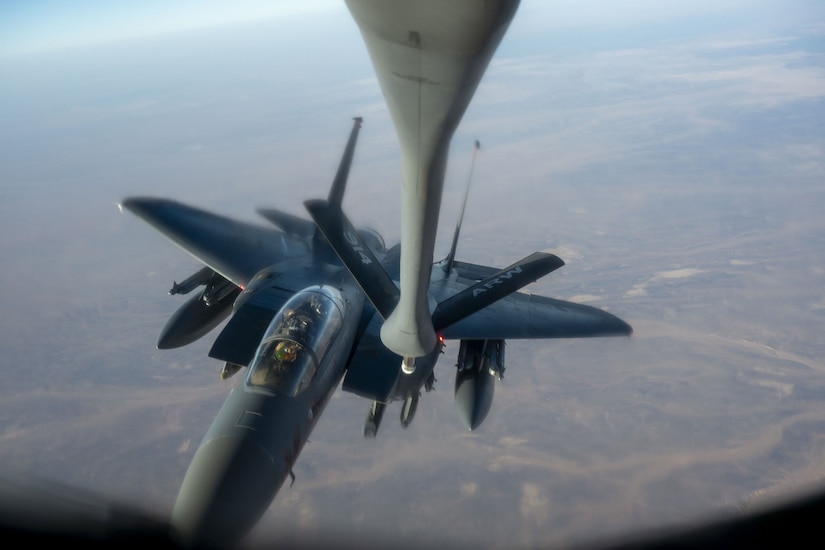
A nozzle extends down toward a jet flying high above a hazy terrain.
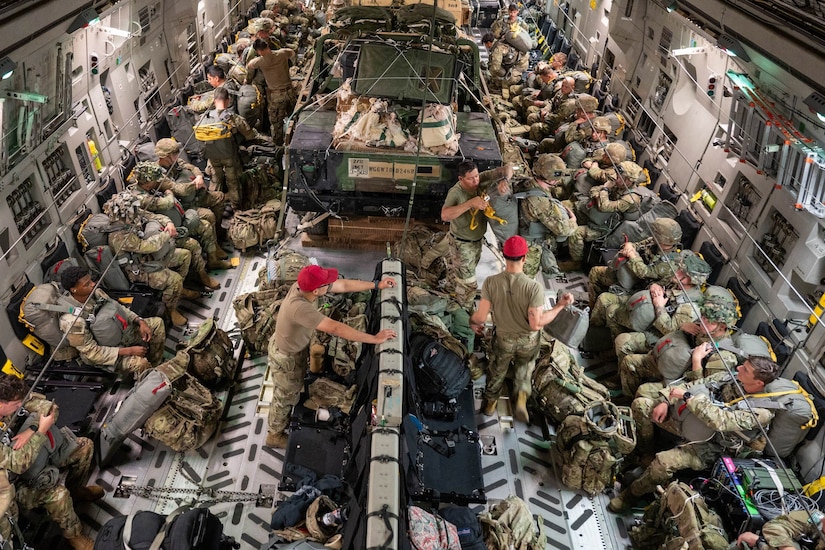
Dozens of troops in camouflage uniforms wearing parachutes sit inside an aircraft.
The Air Force also supports humanitarian and natural disaster missions. 

The Air Force was originally a part of the Army beginning in 1908, when the service received its first powered military aircraft from the Wright brothers. 

During World War II, the air arm of the Army was known as the Army Air Forces, a designation that lasted until the creation of the Air Force. 

The Army was never eager to give up its air branch, particularly for close air support. In the 1950s, the service began taking delivery of helicopters, thereby effectively re-creating an air arm for troop movements and fire support. 

The Navy and Marine Corps fared better, as they retained all their fighter and transport aircraft.

Pinning the Rank: Tradition, Symbolism, and Community in Military Promotions

In the United States armed forces, promotion ceremonies are not merely administrative events; they are traditions that carry symbolic and cultural weight. Central to these ceremonies is the ritual of “pinning,” when new rank insignia is physically attached to a service member’s uniform by family, mentors, or fellow service members. More than a gesture, the pinning tradition reflects the institutional values of duty, honor, and shared sacrifice that define military life.

Historical Origins

The origins of pinning ceremonies can be traced to longstanding military customs in which the conferral of new status was marked by public recognition. As uniforms became standardized in the 19th century, insignia evolved into clear symbols of authority and responsibility. According to the U.S. Army Center of Military History (2010), rank insignia not only distinguished hierarchy but also became central to military discipline and cohesion. The act of pinning continues this lineage, signifying the official recognition of advancement while embedding the event in ritual form.

The Ceremony Itself

A promotion ceremony generally begins with the reading of promotion orders, often followed by remarks from a commander or senior leader. The centerpiece of the ceremony is the actual pinning of insignia on the uniform collar, chest, or shoulder, depending on the branch and rank. Family members, mentors, or close colleagues are invited to perform the pinning, underscoring that promotions represent both personal achievement and communal support. The U.S. Navy’s ceremonial guidance emphasizes that this ritual honors the “trust and confidence” placed in the promoted service member (U.S. Navy, 2018).

Symbolism of the Pinning

Pinning is rich with symbolism. The insignia itself represents not just higher pay grade but increased responsibility, leadership, and expectations of service. Having loved ones or mentors affix the new rank highlights the sacrifices of families and the mentorship that fosters professional growth. Scholars of military tradition argue that such rituals serve as “rites of passage,” reinforcing identity and cohesion within the force (Janowitz, 1960). In this sense, pinning embodies both the professional and personal dimensions of military life.

Variations Across Branches and Ranks

Though the core ritual is consistent, traditions vary across branches. In the Army and Marine Corps, pinning frequently involves family members and occurs in both formal and field environments. The Air Force often incorporates the recitation of the Airman’s Creed or words from the chain of command. The Navy’s tradition of “wetting down” parties, often accompanying officer promotions, demonstrates cultural variations tied to branch heritage (U.S. Navy, 2018). At higher ranks, such as general or flag officer, ceremonies are conducted with heightened formality, sometimes involving senior officials and larger audiences.

The Role of Family and Community

One of the most meaningful aspects of pinning ceremonies is the inclusion of family and community. Spouses, children, and parents are often invited to participate, acknowledging the sacrifices endured by families during deployments, relocations, and long working hours. This shared moment affirms that promotions are not achieved in isolation. According to Segal and Segal (2004), military family traditions like pinning ceremonies strengthen bonds between the military institution and the civilian community, ensuring recognition of both individual achievement and collective sacrifice.

Modern Adaptations

While rooted in tradition, pinning ceremonies have adapted to contemporary circumstances. During overseas deployments, ceremonies may take place in austere environments, with photographs or livestreams shared with families back home. In the COVID-19 era, some units conducted virtual pinning ceremonies, balancing public health with the need for ritual recognition (Department of Defense, 2020). These adaptations demonstrate the resilience of the tradition while maintaining its symbolic power.

Conclusion

The tradition of pinning in military promotion ceremonies represents far more than a formal acknowledgment of advancement. It is a ritual that connects the individual to their service, their family, and the long history of the armed forces. By combining institutional symbolism with personal involvement, pinning ceremonies remind service members and their communities that each promotion is both a personal milestone and a reaffirmation of collective duty. As such, the act of pinning endures as a cornerstone of military culture, bridging past and present, family and service, individual and nation.


References

Department of Defense. (2020). Military ceremonies in the time of COVID-19. Washington, DC: U.S. Government Printing Office.

Janowitz, M. (1960). The professional soldier: A social and political portrait. New York, NY: Free Press.

Segal, D. R., & Segal, M. W. (2004). America’s military population. Population Bulletin, 59(4), 3-40.

U.S. Army Center of Military History. (2010). American military history, volume I: The United States Army and the forging of a nation, 1775–1917. Washington, DC: U.S. Army.

U.S. Navy. (2018). Navy ceremonies and traditions manual. Washington, DC: Department of the Navy.


Monday, September 15, 2025

Medal of Honor Monday: Army Sgt. 1st Class Jared Monti

 Sept. 15, 2025 | By Katie Lange, Pentagon News

In June 2006, high above a valley in Afghanistan, 16 soldiers on patrol valiantly tried to stave off a huge swarm of insurgents. It was on that ridge that Army Sgt. 1st Class Jared Christopher Monti gave his life while attempting to protect one of his comrades. That moment of courage and selflessness led him to receive a posthumous Medal of Honor.  

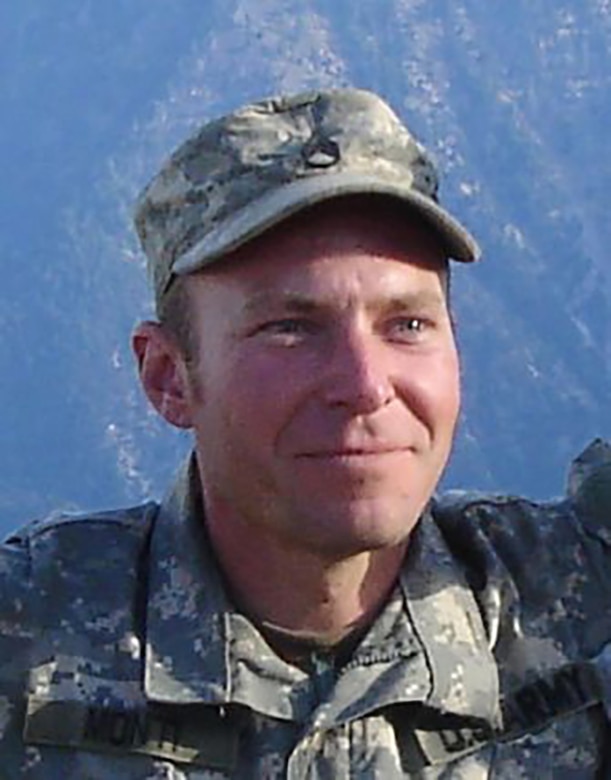
A man in a military camouflage uniform smiles for a photo.

Monti was born Sept. 20, 1975, in Abington, Massachusetts, to Paul and Janet Monti. He had a sister, Nicole, and a brother, Timothy. 

When the family moved to nearby Raynham, Monti began to develop a sense of adventure and a love of sports, of which he played several. At Bridgewater-Raynham Regional High School, he participated in triathlons and wrestled, even earning the under-17 New England weightlifting championship. He also volunteered with an after-school program for children at a local YMCA where his mother taught preschool.  

Monti was determined to join the Army, so in March 1993, he enlisted in the service's delayed entry program. He went to basic training between his junior and senior years of high school. After graduating in 1994, he went on active duty and became a fire support specialist, supporting intelligence and targeting in field artillery units. 

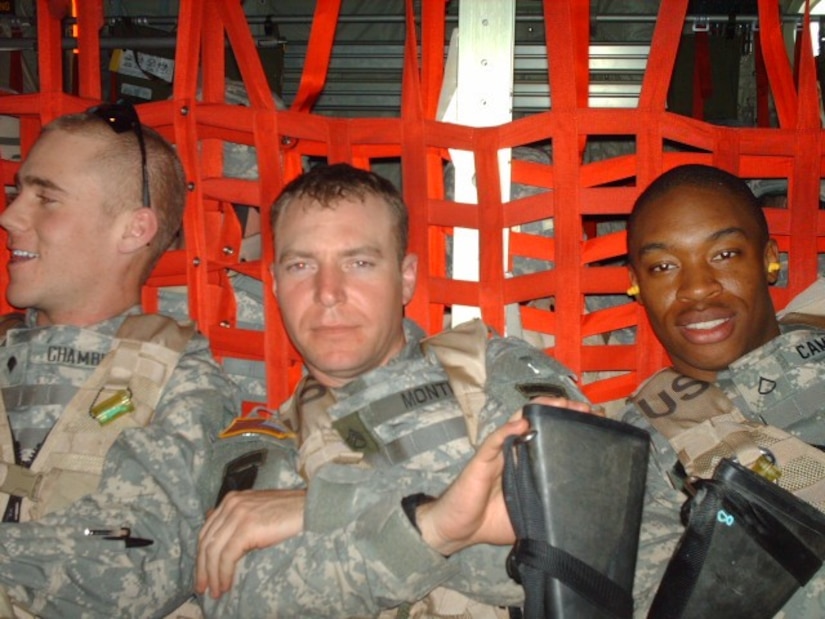
Three men wearing military camouflage uniforms lie down in a cargo aircraft bay holding long guns and posing for a photo.

Over the next several years, Monti served twice in South Korea and trained as a paratrooper. In 1999, he went on a two-year deployment to Kosovo. During that time, he was injured in a parachute jump, but he refused to take a medical discharge and instead reenlisted.  

Monti was eventually assigned to the 10th Mountain Division at Fort Drum, New York. In 2003, he deployed to Afghanistan with the division's 32nd Infantry Regiment, 3rd Brigade Combat Team. Before returning home, he received an Army Commendation Medal and a Bronze Star for his actions during an insurgent ambush.  

In February 2006, Monti returned to Afghanistan for a second deployment, this time with the division's 3rd Squadron, 71st Cavalry Regiment, 3rd Brigade Combat Team. 

On June 21, 2006, Monti was serving as a team leader in the area of Gowardesh in northeastern Afghanistan, along the Pakistani border. Monti led a 16-man patrol with the goal of setting up a small base on a ridge to gather intelligence and direct fire against the enemy in support of a larger Army operation in the valley below.

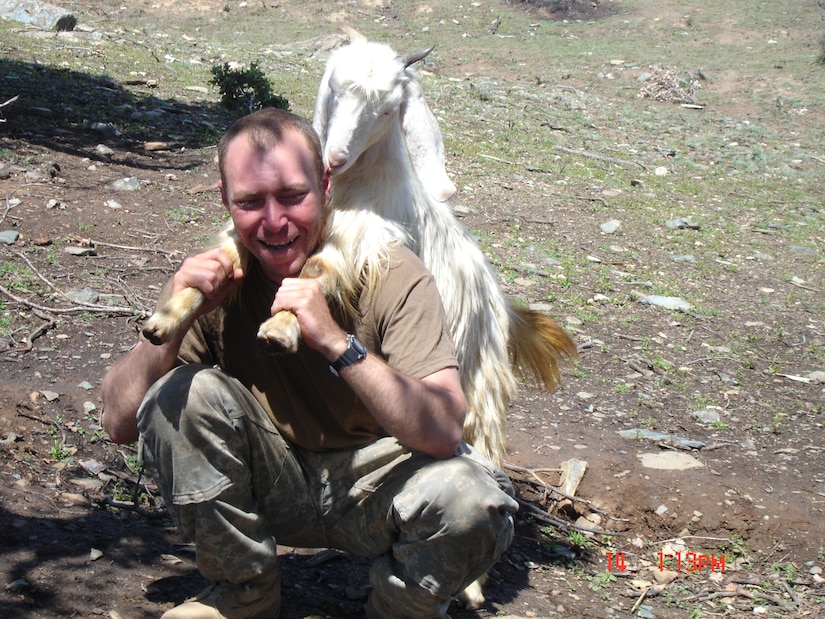
A smiling man who is kneeling down holds a goat's front legs over his shoulders.
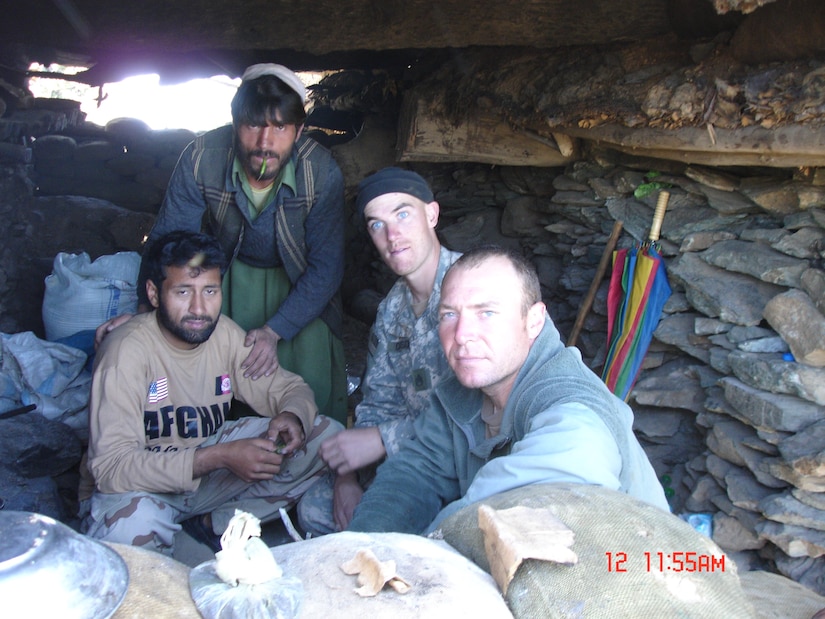
Two men in camouflage military uniforms and two men in casual attire pose for a photo inside a rudimentary hut made of stone.
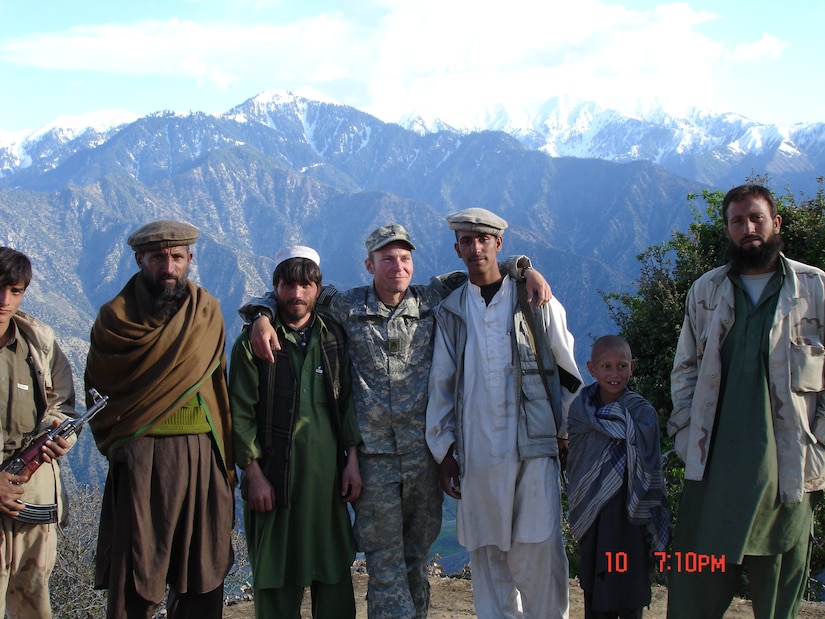
A man wearing a military camouflage uniform, center, five other men and a child pose for a photo with mountains in the background.

Unfortunately, the larger operation was delayed, which caused Monti's team to run low on provisions and require aerial restocking. The helicopter that brought them supplies also revealed their position to insurgents. Soon after, their patrol was attacked by as many as 50 enemy fighters, who set up two positions about 50 yards above Monti's team on the ridge.  

It was clear to Monti that his team would soon be overrun, so he quickly directed his men to fire back from behind a rock formation that could shield them. He then called for indirect fire support on top of the enemy, which was closing in fast. He also fought off insurgents using his rifle and a grenade, successfully disrupting an attempt to flank his patrol.  

But then Monti saw Army Spc. Brian Bradbury lying severely wounded out in the open, and he knew he had to get to him. Another soldier said he would try to rescue Bradbury, but Monti ordered the soldier back, saying, "That's my guy. I'm going to get him." 

Twice, Monti disregarded his own safety to try and reach Bradbury. Both times, he was forced back by relentless enemy fire.  

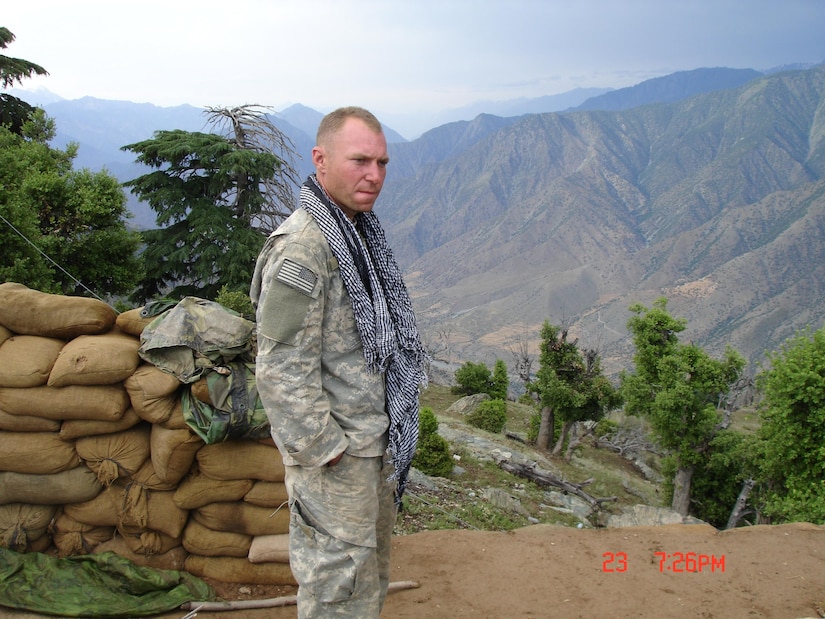
A man in a camouflage military uniform looks into the distance as he stands on the side of a mountain. There are trees and a mountain range in the background.

On his third attempt, Monti was hit by a rocket-propelled grenade. He tried to crawl back to cover but didn't quite make it. However, he was in earshot of his comrades, who said he told them that he'd made his peace with God, and to tell his family he loved them.  

A few minutes after Monti died, the air support he called in finally arrived, killing several insurgents and dispersing the rest, which saved the remaining members of his patrol.  

Unfortunately, Bradbury didn't survive. He died when a medevac's hoist broke as it tried to lift him into a helicopter. Two other patrol members, Army Staff Sgt. Patrick Lybert and Army Staff Sgt. Heathe Craig, also died during the 18-hour battle.  

Monti's body was eventually repatriated and buried in Massachusetts National Cemetery in Bourne, Massachusetts.  

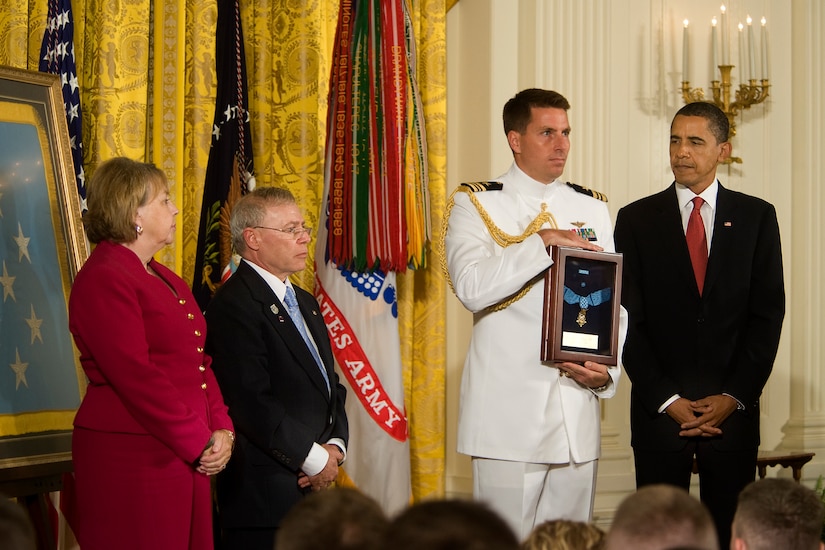
A man in a dress military uniform stands holding an encased medal while three people in business attire solemnly stand to each side of him.

On Sept. 17, 2009, Monti's parents received the Medal of Honor on his behalf from President Barack Obama during a White House ceremony. He was the second service member to receive it for actions taken in Afghanistan.  

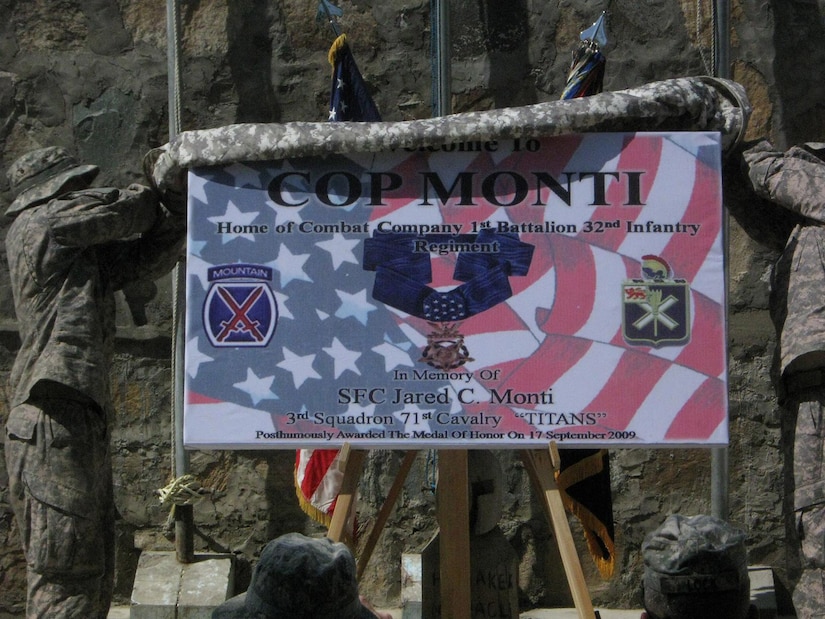
Monti has been remembered as a humble and giving man. His name adorns many landmarks and buildings, including in the military community. In 2009, a combat outpost in Afghanistan was renamed COP Monti. That same year, a bridge near his hometown was renamed the Sgt. 1st Class Jared C. Monti Bridge. In the years that followed, a fitness center at Fort Drum and a training facility at Fort Sill, Oklahoma, were also named in his honor. 

In 2014, country musician Lee Brice put out a song titled "I Drive Your Truck" that was inspired by a radio feature in which Monti's father reminisced about his son and the truck he drove in remembrance of him. The song was named song of the year during the 49th annual Academy of Country Music Awards.  

Two men in camouflage military uniforms pull a blanket off a sign to unveil it.

This past April, the new Sgt. 1st Class Jared C. Monti Soldier and Squad Research Facility at the Army Natick Soldier Systems Center in Natick, Massachusetts, was dedicated to him. Monti's sister, who spoke at the ceremony, said the family wasn't sure what to do with all his medals, uniforms and other military memorabilia until this opportunity arose.  

"We wanted them to go where we knew they'd be honored," Nicole Monti-Alicea told the crowd during the dedication. "After our meeting, we knew that Jared's highest honors belonged here … and my mother finally got the one thing she always wanted — for her son to finally rest in peace."   

During the ceremony, Brice performed an acoustic version of his award-winning song for the crowd, using Monti's actual pickup truck as a backdrop for the touching tribute.  

Friday, September 12, 2025

Lieutenant Earns His Bars the Hard Way

 Sept. 12, 2025 |Pentagon News

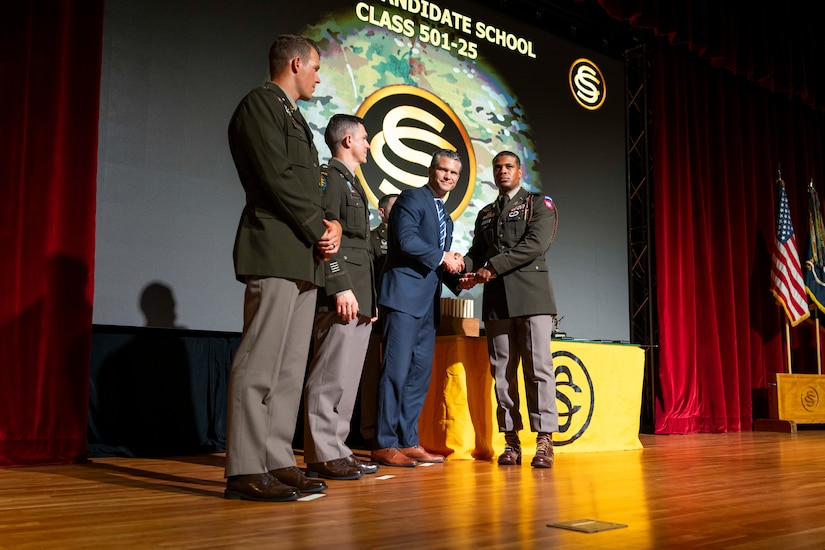
The Army's newest officers pinned on gold bars at Fort Benning, Georgia, Sept. 4, as Officer Candidate School Class 501-25 crossed the stage during a graduation ceremony. Secretary of War Pete Hegseth was the guest speaker.  

A person in a blue suit and tie hands an item to a soldier in a green uniform as two other soldiers look on.

Among the graduates was Army 2nd Lt. Darren Greene, a prior enlisted paratrooper, whose decade in uniform began in basic training and now turns toward leading soldiers. 

"I'm living the life right now," Greene said after the graduation. 

Greene called the ceremony "perfect," the culmination of a well-rehearsed week. In the days leading up to graduation, he said the class "rehearsed constantly, nonstop" from Monday through Thursday to make sure every movement landed on time and to standard. 

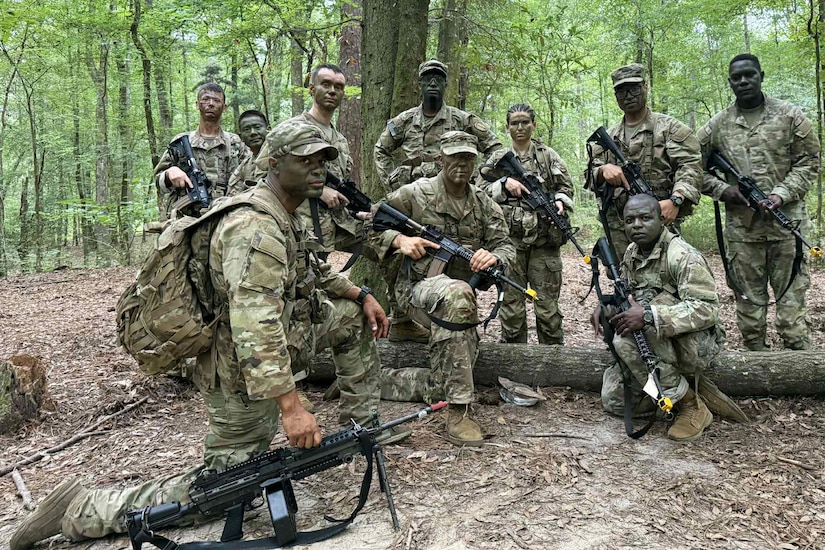
Soldiers in camouflage uniforms with guns mill about in the forest.

Greene's path to becoming a commissioned officer did not follow a straight line. He first entered military training as a college student at West Virginia University, where ROTC shared space with big campus distractions.  

"I kind of got sucked into the big party, school lifestyle, frat parties, house parties," he said.  

Greene left Morgantown without a commission, enlisted in 2014 and went to infantry training and Army Airborne School before reporting to the 82nd Airborne Division. 

From 2016 through 2017, Greene deployed to Iraq during Operation Inherent Resolve, supporting missions that moved from Baghdad northward. The experience cemented his decision to make the Army a career, and he began chipping away at the college credits he needed to finish his degree.  

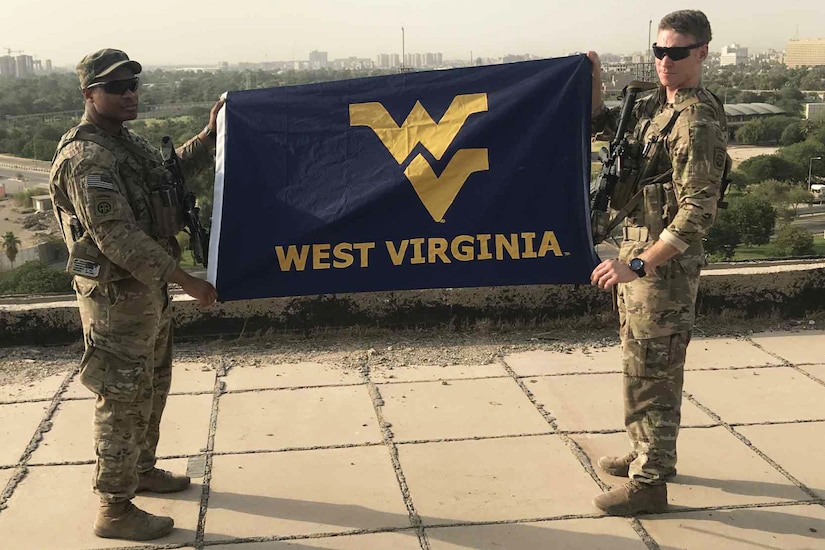
Soldiers in camouflage uniforms hold up a University of West Virginia flag.

"I took the long route to my college graduation, right?" he said, describing years of part-time coursework that ultimately led back to West Virginia University and a completed capstone in 2023. 

Greene advanced from private to sergeant and served overseas in Italy before returning to the 82nd Airborne Division, where familiar leaders noticed his trajectory. He credits mentors for hammering home expectations he intends to carry into his commission.  

"The two biggest things that you are responsible for are yourself and the reputation of your unit," Greene said. "If you're not the standard-bearer, you can't, like, you can't expect people to follow you." 

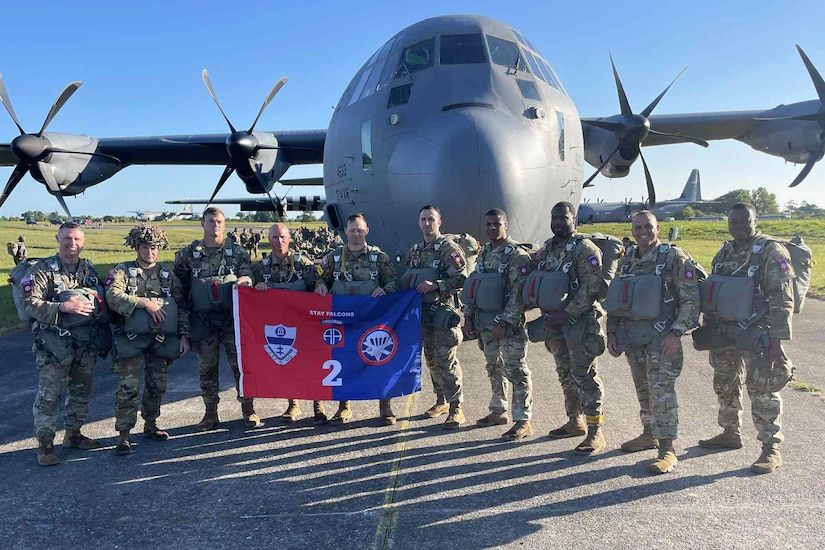
Soldiers stand in front of a four-propeller aircraft on a runway.

Hegseth's message to the class echoed that mindset and the school's motto.  

"It is great to be here at Fort Benning. And it is Fort Benning," he emphasized, before praising the OCS creed of "standards, no compromise."  

Hegseth urged graduates to anchor their leadership in fundamentals and preparation, invoking a battlefield lesson popularized by Army Lt. Gen. Hal Moore: "There's always one more thing you can do to increase your odds of success."

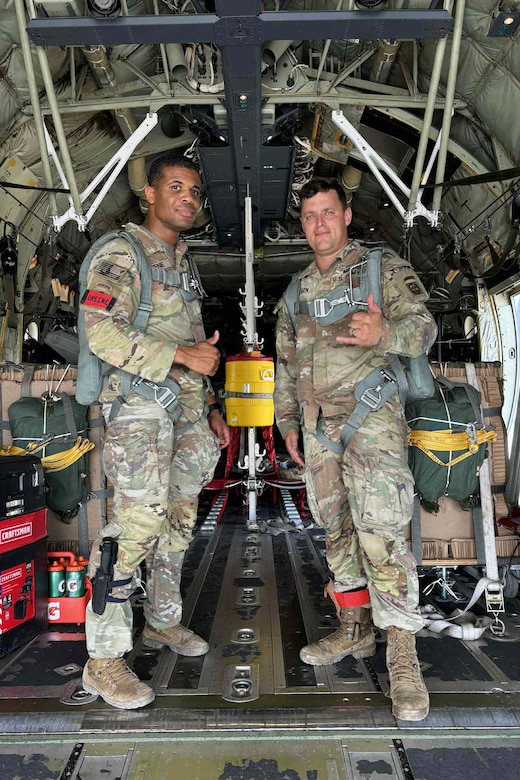
Two soldiers in camouflage uniforms stand in the back of an aircraft, each making a signal with one hand.

That preparation, he said, begins with knowing the mission, the terrain and the formation, then trusting and leveraging experienced noncommissioned officers. The secretary also emphasized decentralized decision-making in combat.  

"We're going to make sure that decisions are pushed down to the lowest possible level where they should be made," Hegseth said. 

OCS's 12-week crucible is designed to make those expectations real. The class's prior service population — including soldiers like Greene, who had already led squads and teams — brought practical experience to land navigation, small-unit tactics and troop-leading procedures. The transition now moves from OCS to the Basic Officer Leader Course, where lieutenants learn branch-specific skills before reporting to their first platoons. 

Greene understands that the work ahead will test his time-management skills as much as his tactics. He and his wife are raising two young sons, ages 3 and 1, and BOLC will mean months away from home. But he views the sacrifice as an investment in the soldiers he will soon lead and the noncommissioned officers he plans to rely on. 

Greene's deployment and subsequent years in airborne formations shaped a leadership philosophy that fits OCS's emphasis on standards and accountability. He talks about earning trust through preparation, showing up ready and listening hard to the NCOs who own the craft. Those habits — and his insistence that a leader's personal reputation is inseparable from the unit's — mirrored the ceremony's themes and the charge delivered from the lectern. 

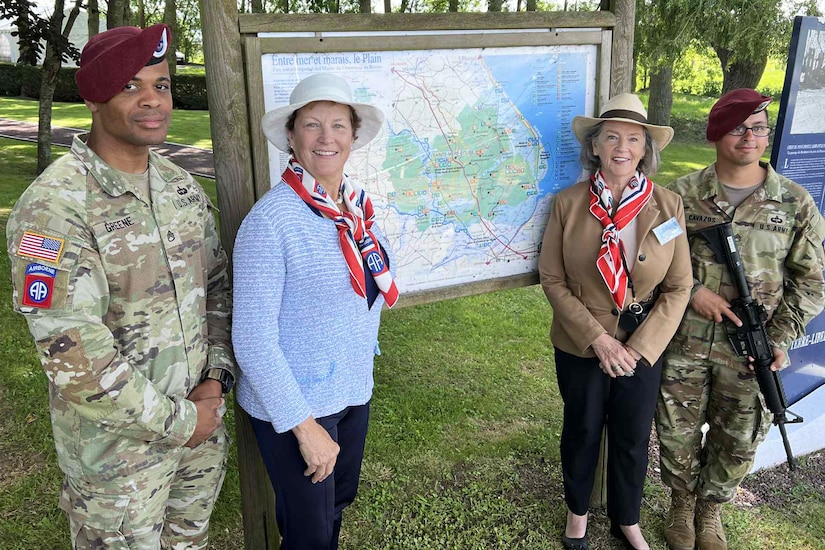
Two soldiers in camouflage uniforms, one holding a rifle, stand next two people dressed in civilian clothing near a map displayed in a grassy area, with trees in the background.

"You have been forged and now you will forge," Hegseth told the graduates.  

The line landed as both a compliment and a warning: the hard part starts next. The 12-mile rucks and field problems will give way to training calendars, maintenance meetings and the daily work of building lethal, disciplined teams that can execute under pressure. 

Greene, for his part, leaves OCS clear-eyed about that responsibility. The pride of crossing the stage quickly yields to the reality of a first platoon sergeant waiting on a new lieutenant to set a tone. Standards, he knows, flow from the front — and they are contagious.

Thursday, September 11, 2025

Armed Forces Medical Examiner Accelerates Colony Glacier Mission

 Sept. 11, 2025 | By Army Staff Sgt. Noah Coger, Armed Forces Medical Examiner System

It's been 73 years since a C-124 Globemaster II, carrying 52 military members, tragically crashed into Mount Gannett in the Chugach Mountains of eastern Alaska, 40 miles from its destination of Joint Base Elmendorf-Richardson.

It's believed the crash created an avalanche that, in some places, caused debris to be covered in hundreds of feet of drifted snow. Because of extremely challenging conditions, recovery efforts were terminated after one week, leaving the service members and their memories frozen in time for six decades. Then, in 2012, a survival raft was discovered on the north-flowing Colony Glacier, roughly 12 miles from the original crash site, just above Lake George.

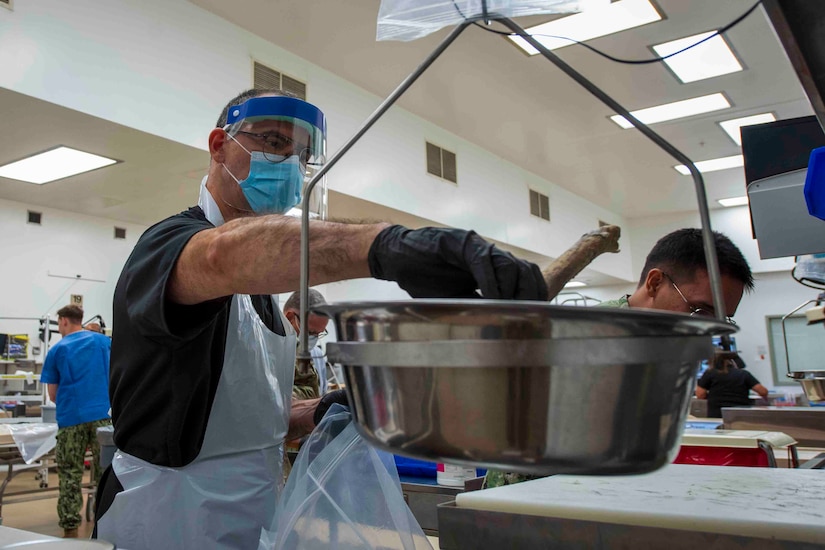
A man wearing a protective face shield and a plastic apron places human remains on to a scale. There is a man in the background also wearing a protective face shield taking notes and a man wearing a camouflage military uniform.

Since the discovery, members from numerous organizations have gathered every summer to search the glacier for more remains in Operation Colony Glacier, an effort to identify and bring home the men who perished. Among the organizations that are a part of the operation, the Armed Forces Medical Examiner System plays a crucial role.

For the past eight years, Carlos Colon, Armed Forces Medical Examiner System medicolegal death investigator, has been a part of the operation.

"So, 2017 was the first time I flew onto Colony Glacier," Colon said. "That trip was basically a site visit where we assessed a number of things. After that trip, we started discussions about the benefits of having somebody from AFMES being involved in the search and recovery."

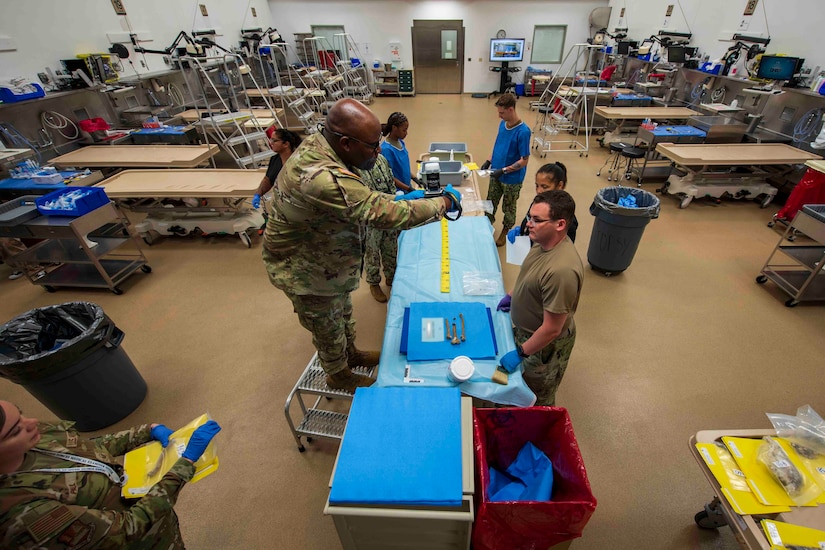
A man dressed in a camouflage military uniform and standing on a foot stool is taking a photograph of human remains. There are several others in similar attire watching or taking notes.

Colon was chosen to participate in the operation not only as subject matter expert on the identification and collection of remains, but also because of his background in search and recovery.

"As medicolegal investigators we have training in search and recovery and we do response to aircraft mishaps," Colon said. "A lot of our aircraft mishaps have highly fragmented remains. It can be difficult to discern those remains from things like rocks or wood, especially when they have been exposed to extreme elements for so long. By the time I went to Colony Glacier, I had already seen remains being sampled here at AFMES for two years, so I was already very familiar with what to look for out there."

Along with the type of knowledge that investigators like Colon bring, comes the continuity that is essential to an operation like Colony Glacier.

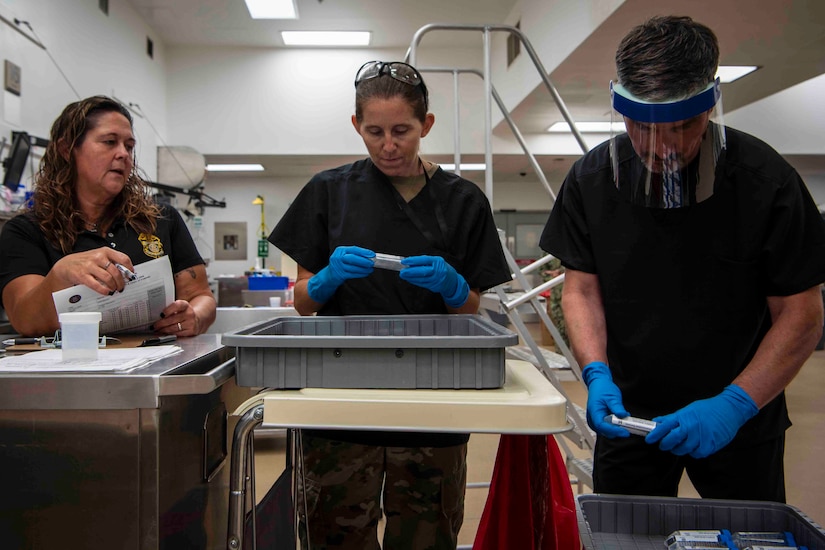
A woman at the center of the image dressed in black scrubs looks at human remains, as a man to her right in similar attire and wearing a protective face shield also looks at human remains, while a woman on the left also in similar attire takes notes.

"Most people on the team are only there for one year," Colon said. "Usually, the officers in charge of ground forces and the commander from the Air Force Mortuary Affairs Operations will have been on the team two years at max. So, we're [medicolegal investigators] really bringing that knowledge of not only what human remains look like, but also bringing insight on how remains are triaged, sampled and tested here at AFMES. It's extremely beneficial for the people on the ground to be speaking the same language as the people doing the sampling, and the DNA folks actually doing the testing because we're always thinking, 'how can we maximize our chances of getting new identifications?' Whether that be advising on refocusing efforts to find more osseous material, teeth or soft tissue, or concentrating on other locations that have samples we know will likely produce a good DNA profile. We are always thinking more about the identifications and the forensic sciences behind the recovery."

The glacier, however, presents a special set of challenges that make traditional recovery methods extremely difficult.

"With the glacier, everything is ephemeral," Colon said. "Things shift on the glacier and the glacier itself moves; it's basically a moving river of ice. We found pretty quickly that a lot of prior methods being used, which are typically really thorough and great for documenting a scene, documenting a recovery and knowing exactly where everything was found, were not working well and it's because those traditional techniques are for sites that are static."

New methods had to be employed along with a different mindset of how to navigate the recovery in this desolate and ever-changing landscape.

"Together, AFMAO and AFMES, realized that there has to be a little bit more urgency," Colon said. "AFMAO is primarily concerned with finding as many personal effects as possible and for AFMES, we want to get as many remains and samples as possible. So, we started refocusing our priorities on getting as many samples from different parts of the glacier with as much variety as possible, to hopefully increase the chances of making new identifications."

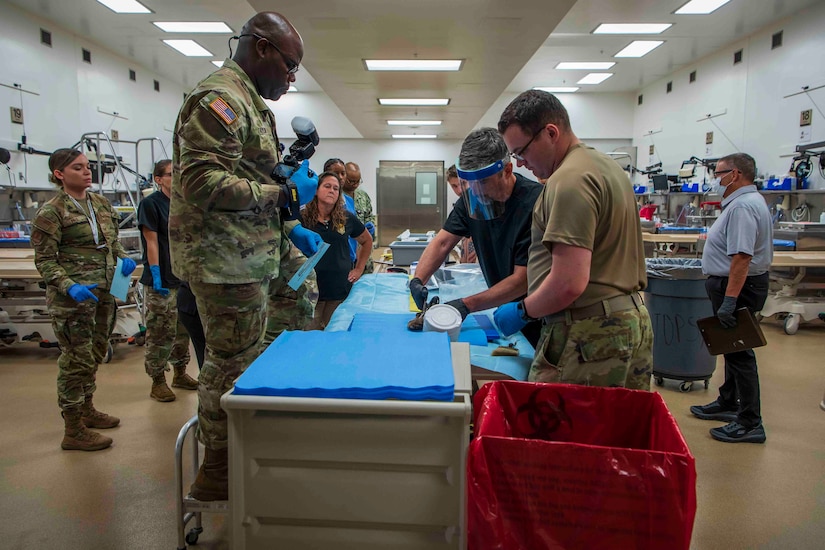
A man wearing a face shield, cuts open a boot as several people dressed in camouflage military uniforms or civilian attire watch in a laboratory setting. There is one man standing at an elevated position holding a camera.

This forensic approach has helped shape ongoing recovery efforts; everything from training, managing timelines and resources and bringing a new perspective to the operation as a whole.

"Before we even go out, I'll provide necessary training to our folks," Colon said. "I'll give presentations, show them what things look like, inform about what happens at AFMES post-recovery, how remains get to Dover, how our mortuary affairs specialists, medical examiners and medicolegal death investigators triage, photograph, sample and submit to DNA. I also provide summaries on adipocere, mummification, skeletonization and patterns of decomposition that are more relevant to what we see on the glacier."

This methodology means that time and resources are amplified to the fullest extent.

"We've lost a lot of the glacier," Colon explained. "It's very dynamic compared to a standard anthropological site, and the way we're operating now is more focused on knowing that we have limited amount of time and resources. We only have four weeks each year to conduct this recovery so we're always trying to get the most out of the time we have left with the debris field, because it's moving further down-glacier. Our goal is always to be more conscious of how we spend our time. We know if we are not efficient with our resources at the site, it will lead to our medical examiners and DNA technicians' time not being used properly back at AFMES. Having said that, every year our lab gets better, there is always a new process or new technology, so in the field we try and adjust and be more efficient and better every year as well."

The samples collected in the field are sent back to the AFMES where the Armed Forces DNA Identification Laboratory will compare extracted DNA against a robust database of family member references that have been gathered over decades. Family members can donate DNA samples through requesting a sample kit or attending a family member update or an annual government briefing hosted by the Defense POW/MIA Accounting Agency.

To date, 50 of the 52 fallen members have been identified. The 50th identification was made just this year.

Army Air Forces Airman 3rd Class James Ronald Kimball, a flight steward, a career field similar to a modern-day crew chief, was assigned as a crew member on the flight.

"This was a big deal," Colon said. "Kimball was the one that we were told we had very little shot of identifying because he had no family member DNA reference; he was adopted with no children. But what he did have was a very specific fingerprint pattern on his right thumb and what looks like a burn scar on his right index finger. Fortunately, we knew this because of the fingerprints that were on file."

Even more fortunate, his personnel files survived a devastating 1973 fire, which destroyed between 16-18 million official military personnel files in the National Personnel Records Center in St. Louis.

"During our second trip out there, I received a radio call from one of the team members, [Air Force 1st Lt. Mason] Tarkenton," Colon said. "They were searching a smaller debris field, that was not previously found, in the upper limits of our established area. He said 'Carlos, I found a right hand up here near what looks like a crew jacket,' and I was like 'there is no way,' because Kimball was the last crew member that was still missing. The hand was so well preserved that, once I got back to the morgue, I was able to send pictures to our fingerprint expert at the FBI, and within six hours they were able to make a positive ID. That was exciting; it was the fastest identification we've made."

Prior to the AFMES' involvement, 585 specimens were recovered for sampling over a period of five years. In the first five years of the AFMES' involvement, 4,520 specimens were recovered, with a total of 6,528 specimens recovered since 2017. This year alone, 373 samples were collected and accessioned for DNA testing in a record five days. Each year the team becomes more exact in carrying out this mission, as they strive to bring closure to families who have had to wait so long.

"We've had really great collaboration with our partners at AFMAO," Colon said. "We always go out there as Team Dover, and ultimately, we want the same exact thing, which is for all of the members on board to be accounted for."

Joint Service Teamwork Forged During Exercise Sage Eagle

Army Green Berets and supporting elements assigned to the 3rd Special Forces Group teamed with security forces airmen from the Air National Guard for Sage Eagle 25-4, a joint training exercise designed to enhance the services' interoperability and readiness, conducted in late August.

Two service members wearing camouflage stand close to each other as one fires a shoulder-launched missile that creates smoke in front and fire behind the launcher.

With a focus on small-unit tactics, joint mission planning and advanced combat scenarios, the training at Fort A.P. Hill, Virginia, aimed to better prepare special operations forces and the Air National Guard for real-world missions that reinforce their ability to jointly operate in diverse operational environments. 
 
Sage Eagle 25-4 commenced with weapons familiarization, pairing soldiers and airmen in a series of classes that built a foundational understanding of weapons handling and functions. Green Berets trained the airmen on multiple weapons systems, including the M320 grenade launcher and the M249 squad automatic weapon.  

Weapons training culminated in an M4 rifle qualification range before transitioning into advanced tactical training. From dawn to dusk, airmen repeatedly conducted realistic training simulations in small-unit tactics, including close-quarters battle drills, ambushes and raids, immersing them in the demanding tempo of special operations.  

"I think it's great to see the different ways that the Green Berets teach things, for example, room clearing," said Air Force Airman 1st Class Leann Minnick, a security forces airman assigned to the 193rd Special Operations Security Forces Squadron. "They taught us many ways to do it that I'm generally not trained to do, so I could bring that back to my unit." 
 
Following multiple days of weapons training, teams entered a five-day field environment, plagued with rugged terrain and dense vegetation, which challenged even the most experienced service members.  

Limited access to supplies and the need for covert movements through rugged landscapes added another layer of complexity to the training, requiring teams to adapt quickly or risk mission failure. Following days of training from the Army's elite, airmen applied what they learned to plan and execute simulated raids and ambushes, evading a multitude of different enemy threats to complete the mission. 

"[The Green Berets] are experts at detail, which is what it boils down to," said Air Force Tech. Sgt. Jason Tartaglia, a security forces airman assigned to the 166th Security Forces Squadron. "And that's really what makes them so great. Just thinking outside the box or looking at something from a different angle makes a huge difference." 
 
The training culminated in a realistic joint forcible entry exercise, leveraging the unique skills of each service in a mission to capture a high-value target. Soldiers breached the compound under simulated hostile fire, systematically clearing each floor of enemy threats and overcoming tight stairwell fighting positions, barricaded rooms and simulated casualties on every level.
 
While Green Berets maneuvered throughout the compound, the Air National Guard security forces secured the exterior of the compound, facing unruly crowds and demonstrators. Leveraging their training, the security forces mitigated all potential threats, enabling both services to seamlessly withdraw. 
 
Sage Eagle isn't just tactical training; it's a crucible for joint force integration. The exercise honed critical skills in cross-service communication, adaptive planning and mission execution in complex environments. Participants gained instrumental insights, directly enhancing current operations and fortifying readiness for future challenges. 
 
"This training pushed us to our limits, but that's how we get better," Minnick said. "When we walk away tired, dirty and more capable than before — we know it was worth it."