Showing posts with label national archives. Show all posts

Wednesday, September 17, 2025

Secretary of War Praises K-12 Grade Civics Organization on Constitution Day

Secretary of War Pete Hegseth today offered praise to a national organization that teaches civics to school children in kindergarten through 12th grade during a private ceremony in Washington's National Archives building.
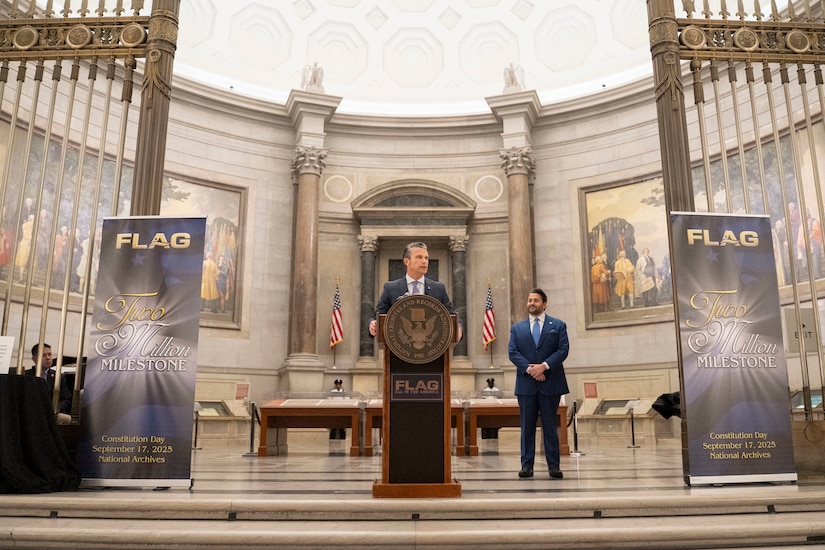
A man in business attire is standing behind a podium delivering remarks in a large, circular ornate room with marble walls. There are two American flags behind him, and another man off to the side observing him. On either side of the podium are banners that read “FLAG - Two Million Milestone.”

The ceremony, which was held on Constitution Day and Citizenship Day, commemorated the Foundation for Liberty and American Greatness having achieved the significant milestone of reaching 2 million children since the organization was founded in 2016. 

Hegseth spoke about the importance of the work that FLAG does in teaching school children American civics. 

"I hope you understand how important this is; what we pour into the next generation will determine whether we keep our republic or not," Hegseth said of the importance of civics in the classroom. 

Speaking with the Constitution as his backdrop and stating what an honor it was to "stand in the shadow of such brilliance" of the Founding Fathers' generation, the secretary talked about the significance of our country's founding. 

"That type of brilliance didn't come out of thin air. It was first inspired by God [and] inspired by an understanding of human history, an understanding of biblical history [and] an understanding of Western civilization philosophy and theology and civics poured into a generation of men and poured into an American experiment — it wasn't an accident," Hegseth said. 

He then jumped ahead to the present day and discussed the importance of instilling American values in the country's young people from an early age. 

"We need to go to the youngest and plant a love for America on [their hearts] early, with knowledge about where it comes from," Hegseth said. 

A non-profit organization, FLAG is "dedicated to educating Americans about the values and principles that make our nation exceptional," according to the organization's website. 

Some of the products the organization uses to teach those values include a version of the Constitution written for young students and the "Citizens Guide to the Electoral College."

Tuesday, December 11, 2007

The INF Treaty and the Washington Summit: 20 Years Later

D.C., December 10, 2007 - Previously secret Soviet Politburo records and declassified American transcripts of the Washington summit 20 years ago between President Ronald Reagan and Soviet General Secretary Mikhail Gorbachev show that Gorbachev was willing to go much further than the Americans expected or were able to reciprocate on arms cuts and resolving regional conflicts, according to documents posted today by the National Security Archive at George Washington University (www.nsarchive.org).

Today's posting includes the internal Soviet deliberations leading up to the summit, full transcripts of the two
leaders' discussions, the Soviet record of negotiations with top American diplomats, and other historic records being published for the first time.

The documents show that the Soviet Union made significant changes to its initial position to accommodate the U.S. demands, beginning with "untying the package" of strategic arms, missile defense, and INF in February 1987 and then agreeing to eliminate its newly deployed OKA/SS-23 missiles, while pressing the U.S.
leadership to agree on substantial reductions of strategic nuclear weapons. Gorbachev's goal was to prepare and sign the START Treaty on the basis of 50 percent reductions of strategic offensive weapons in 1988 before the Reagan administration left office. In the course of negotiations, the Soviet Union also proposed cutting conventional forces in Europe by 25 percent and starting negotiations to eliminate chemical weapons.

The documents also detail Gorbachev's desire for genuine collaboration with the U.S. in resolving regional conflicts, especially the Iran-Iraq War, Afghanistan, the Middle East, and Nicaragua. However, the documents show that the U.S. side was unwilling and unable to pursue many of the Soviet initiatives at the time due to political struggles within the Reagan administration. Reading these documents one gets a visceral sense of missed opportunities for achieving even deeper cuts in nuclear arsenals, resolving regional conflicts, and ending the Cold War even earlier.

The documents paint the fullest declassified portrait yet available of the Washington summit which ended 20 years ago today and centered on the signing of the Intermediate Nuclear Forces (INF) Treaty--the only treaty of its kind in actually eliminating an entire class of nuclear weapons. By eliminating mainly the missiles based in Europe, the treaty lowered the threat of nuclear war in Europe substantially and cleared the way for negotiations on
tactical nuclear and chemical weapons, as well as negotiations on conventional forces in Europe.

Under the Treaty, the Soviet Union destroyed 889 of its intermediate-range missiles and 957 shorter-range missiles, and the U.S. destroyed 677 and 169 respectively. These were the missiles with very short flight time to targets in the Soviet Union, which made them "most likely to spur escalation to general
nuclear war from any local hostilities that might erupt." These weapons were perceived as most threatening by the Soviet leadership, which is why the Soviet military supported the Treaty, even though there was a significant opposition among them to including the shorter-range weapons.

The Treaty included remarkably extensive and intrusive verification inspection and monitoring arrangements, based on the "any time and place" proposal of March 1987, which was accepted by the Soviets to the Americans' surprise; and the documents show that the Soviets were willing to go beyond the American position in the depth of verification regime. The new Soviet position on verification not only removed the hurdle that seemed insurmountable, but according to then-U.S. Ambassador to the USSR Jack Matlock, became a symbol of the new trust developing in U.S.-Soviet relations, which made the treaty and further progress on arms control possible.

The documents published here for the first time give the reader a unique and never-previously-available opportunity to look into the process of internal deliberations on both sides and the negotiations both before and during the summit in December 1987.

Visit the Web site of the National Security Archive for more information about today's posting.
http://www.nsarchive.org