Showing posts with label joint force readiness. Show all posts

Thursday, March 05, 2026

While Improving Quality of Life, Navy Remains Ready to Fight

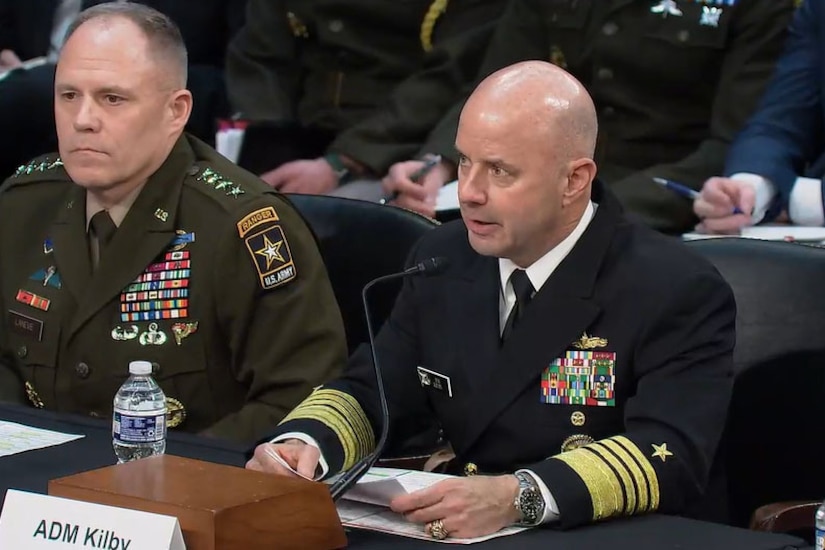
The Navy is participating in exercises and operations worldwide, said Navy Adm. James W. Kilby, vice chief of naval operations, who, along with other service leaders, testified yesterday at a Senate Armed Services Committee hearing in Washington on joint force readiness.

A man in a military dress uniform is seated at a table speaking into a microphone. There is another man in similar attire seated next to him.

Last year in the Middle East, the Navy executed strikes against adversaries during Operations Rough Rider and Midnight Hammer, while defending regional allies and partners. 

This year, the Navy participated in Operation Absolute Resolve in the Atlantic, while sailors operate every day to deter China and build partnerships in the Pacific, Kilby said. 

Currently, the Navy is supporting Operation Epic Fury. On March 3, a Navy fast attack submarine sank an Iranian combatant ship with the Mark 48 torpedo. 

The Navy's primary weapon system is its sailors, the admiral said, noting that the service exceeded its recruiting goals last year and is successfully working to increase retention. 

To further support sailors, the Navy is focused on improving quality of life through a new initiative that provides permanent shore-based housing so that no sailor is required to live aboard a ship while on shore duty, he said. Efforts also include expanding child care, improving fitness facilities and expanding meal selections with healthy options. 

Always looking for ways to improve, the service is increasing platform readiness by reducing maintenance delays, investing in shipyard infrastructure optimization and developing the civilian workforce. Advanced technologies such as conditions-based maintenance and advanced additive manufacturing are being used to optimize systems. 

"The Navy continues to drive toward our goal of 80% combat surge-ready ships, aircraft and submarines with urgency and accountability," Kilby said, adding that he's concerned with the material condition of amphibious ships and is working to improve that. 

Thursday, February 12, 2026

Senior Enlisted Advisor to Chairman Testifies on Quality of Life

Warfighters are the foundation of War Department lethality, said Senior Enlisted Advisor to the Chairman David L. Isom, who testified before the Senate Armed Services Committee's personnel subcommittee on service member and family quality of life, yesterday.

The love and support from their families make their service possible, he added.

As the joint force works tirelessly to ensure the safety and security of the nation, DOW and the nation must also work tirelessly to ensure service members have full support and that they have what they need to fight and win when called upon, the SEAC said.

"Humans are more important than hardware, because the true strength of our military isn't just in our ships and our tanks or our aircraft. It's the unwavering spirit and the trusted hands of our people, our total joint force," Isom said.

The U.S. Capitol building is flanked by trees in the winter with two flags flying to the left of the dome.

Isom told the subcommittee that he and Air Force Gen. Dan Caine, chairman of the Joint Chiefs of Staff, have three priorities:

  • First, the joint force must be properly armed — the right capabilities and capacity when needed to fight and win.
  • Second, the joint force must be globally integrated across all domains — with interagency, industry and with allies and partners.
  • Third, DOW must build a ready joint force. Being ready is about repetitions, tough training and building muscle memory. This also includes being clear-eyed about the future and being candid with the force and its families.

"Underpinning these priorities is our most important asset, and that's our people," Isom said. "We recruit America's best, and we must retain this talent by taking care of them and taking care of their families."

Senior enlisted leaders from all the service branches also testified.

Friday, January 02, 2026

449th AEG Airmen Test Readiness During Exercise Pale Serpent

Airmen assigned to the 449th Air Expeditionary Group, in conjunction with Army, Marine Corps and Navy partners, conducted readiness training at Camp Lemonnier, Djibouti, during Exercise Pale Serpent, Dec. 26–29, 2025.

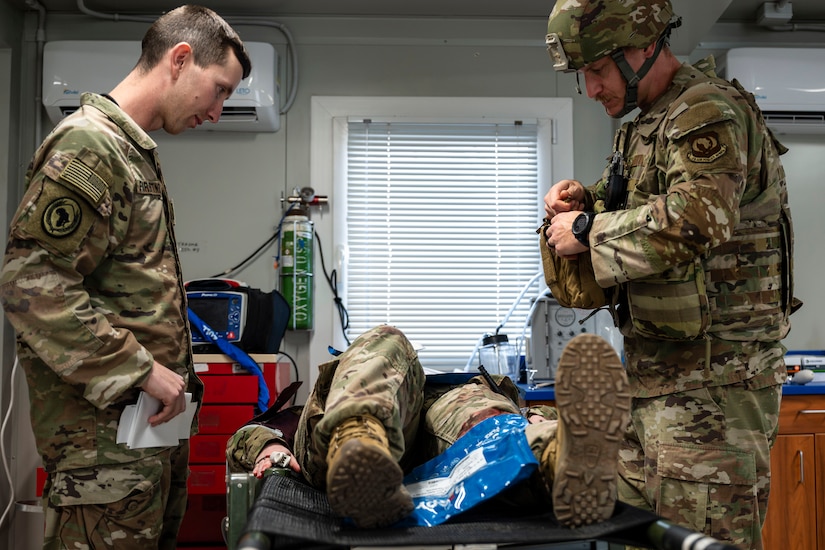
Two soldiers look down at a soldier lying on a medical bed.

The joint exercise prepared units to respond to real-world contingencies across East Africa. 

The exercise placed different 449th elements into parallel training scenarios designed to test how each mission set could operate in a high-tempo environment, from trauma care to aeromedical evacuation. 

At Chabelley Airfield, Djibouti, Air Force medical personnel assigned to the 776th Expeditionary Air Base Squadron treated simulated casualties inside the installation's medical treatment facility alongside partner medical teams, practicing trauma care, triage and patient stabilization. 

"Triage took place outside, and then we were assigning casualties into the appropriate rooms," said Air Force Tech. Sgt. Gracie Livengood, 776th Expeditionary Air Base Squadron, aerospace medical service technician. "The most immediate patients came into the trauma bay, and we treated them while delayed and minimal patients were handled in the other bays." 

The scenario forced medics to manage multiple patients at once while working through limited space, equipment and personnel, requiring constant communication and rapid decision-making across the treatment teams.

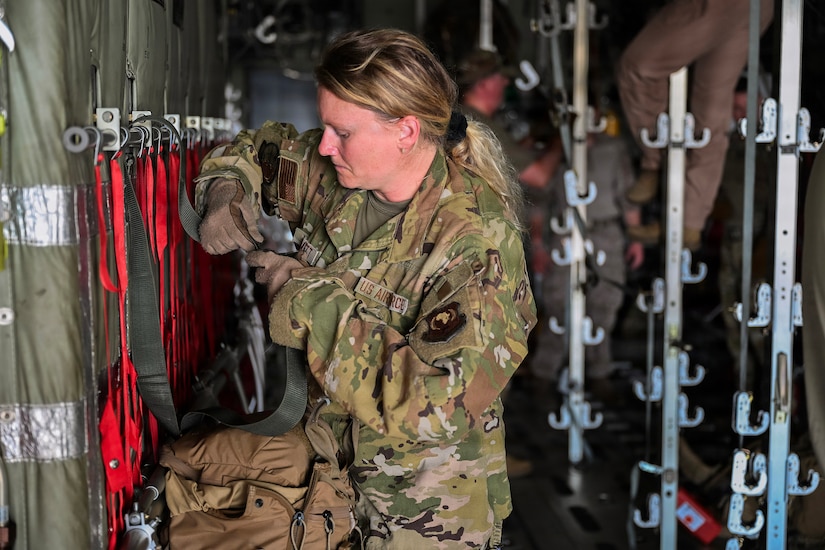
An airman works on adjustable wall fixtures as fellow service members work in the background.

"This training helps us get prepared if an actual emergency happens," Livengood said. "It ensures our skills are up to date, that we're doing everything properly and that we have the equipment we need to provide the best quality of care." 

Livengood said the exercise also highlighted the importance of teamwork in high-stress medical situations. 

"There are always challenges, especially when we're relatively short-staffed for a mass-casualty exercise," Livengood said. "But everyone did really well, helping each other out, moving from bed to bed and making sure people were taken care of." 

While medical teams trained at Chabelley, aeromedical evacuation personnel assigned to the 10th Expeditionary Aeromedical Evacuation Flight conducted parallel readiness training at Camp Lemonnier, preparing to move patients from the expeditionary medical facility to higher levels of care. 

During Pale Serpent, the 10th EAEF employed its full aeromedical evacuation capability, including a critical care air transport team consisting of a physician, critical care nurse and respiratory therapist, along with two flight nurses and four aeromedical technicians.

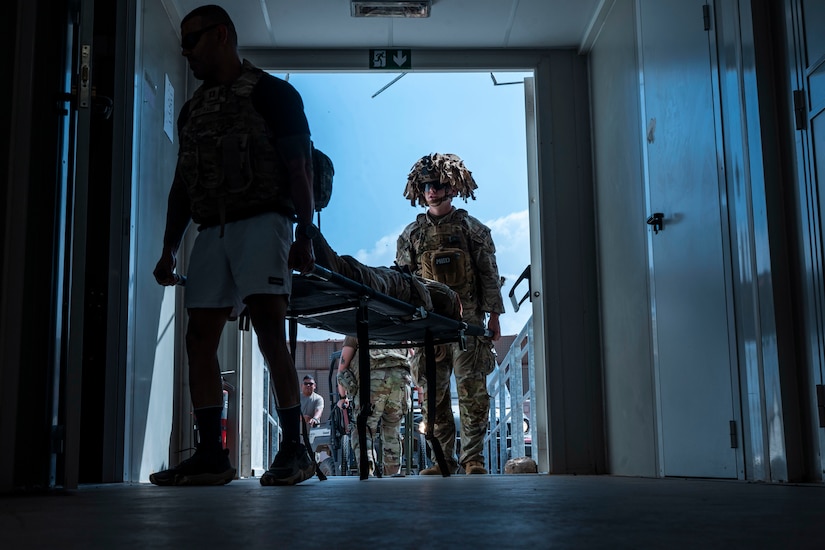
Two soldiers bring a person into a building on a gurney.

"Having aeromedical evacuation capabilities in this region is important so we can quickly move patients to a higher echelon of care," said Air Force Maj. Christina Newby-Martinez, 10th EAEF commander. "We're trained to provide the capability to rapidly move large numbers of patients by air during mass casualty events, which ensures timely redistribution of casualties to appropriate medical facilities." 

When this capability is integrated with critical care air transport teams specialized in transporting critically ill patients who require advanced, intensive and continuous medical care en route, there is a seamless transition of care across the full spectrum of patient acuity, Newby-Martinez explained. 

Exercises like Pale Serpent are essential for preparing crews to operate under pressure. 

"Training like Pale Serpent tests how quickly our teams can respond, pushes them to work outside of their normal crew complement and forces them to be ready for the unknown injuries that could arrive on an aircraft," Newby-Martinez said. "It also helps us see where we need to improve communication when we're working in a multi-service environment." 

Although 449th AEG elements trained in different locations, their efforts strengthened their ability to respond immediately and effectively to mass-casualty emergencies, reinforcing crisis readiness at one of U.S. Africa Command's most operationally critical hubs in East Africa.