Showing posts with label drone defense. Show all posts

Tuesday, June 30, 2026

JIATF 401 Leaders Visit Whiteman Air Force Base to Strengthen Counter-Drone Operations

Joint Interagency Task Force 401 leaders recently visited Whiteman Air Force Base, Missouri, to learn about the installation's counter-unmanned aerial systems operations and initiatives in advance of the upcoming directed energy pilot program.  

The visit highlighted how the 509th Bomb Wing and the 131st Bomb Wing have strengthened base defense by combining advanced technologies with physical defenses and operational procedures.  

During the visit, leaders discussed infrastructure upgrades, engagement authorities and how best to overcome integration hurdles, as well as strategies for safely employing counter-UAS engagement options within the homeland. The meeting also highlighted how base leaders are successfully using locally developed concepts of operation in their strategy.  

Security forces personnel demonstrated how they are employing the systems provided by JIATF 401 to further strengthen their capabilities. 

"The tools and training we've received from JIATF 401 allow us to respond faster and more effectively to drone threats," said Air Force Tech. Sgt. Brent Keefler, 509th Bomb Wing section chief for counter-UAS and small UAS. "Having both the technology and training to act gives our team confidence to protect the base and our airmen." 

The visit underscored the War Department's ongoing commitment to partnering with and delivering state-of-the-art counter-drone solutions to warfighters to defend personnel as well as critical facilities and assets. 

"When looking at an installation's counter-drone capabilities, I don't focus solely on the equipment or the array of assets on a map," said Army Brig. Gen. Matt Ross, JIATF 401 director. "I ask who the commanders are that have the mission to defend the base from drones. Whiteman's leadership and airmen are demonstrating exceptional initiative and capability in this mission." 

Wednesday, June 03, 2026

Joint Interagency Task Force 401 Conducts Multicommand Counter-UAS Qualification

Airmen assigned to the 90th Missile Wing joined personnel assigned to the Air Force Global Strike Command, Air Combat Command, U.S. Strategic Command and the Air National Guard for a counter-small unmanned aircraft systems firing qualification conducted in partnership with Joint Interagency Task Force 401 at Camp Guernsey Joint Training Center, Wyoming, May 14-15, 2026. 

As the battlefield continues to evolve, tactics, techniques and procedures must adapt alongside emerging threats. One of the most rapidly developing areas is the counter-small UAS environment, where technology, training and operational requirements are transforming quickly. 

Two people wearing camouflage military uniforms tie yellow latex balloons to a string attached to a drone flying in the blue sky overhead.

In August 2025, the War Department established JIATF 401 as the lead organization for synchronizing efforts to rapidly deliver counter-small UAS capabilities at scale to defend the homeland, protect U.S. and allied forces, defend critical infrastructure and assist federal agencies.  

The task force has one measure of effectiveness: rapidly delivering state-of-the-art counter-small UAS capabilities to warfighters at home and abroad. 

The two-day firing qualification tested and enhanced operators' ability to engage ground and aerial targets at varying distances using technologically advanced small-arms target acquisition systems. 

"Protecting our power projection platforms is a critical component of enhancing warfighter lethality," said Army Brig. Gen. Matt Ross, JIATF 401 director. "I am grateful for the partnership with the 90th Missile Wing, Air Combat Command and Air Force Global Strike Command that is enhancing [counter]-UAS training to keep our warfighters, installations and critical assets safe from drone threats." 

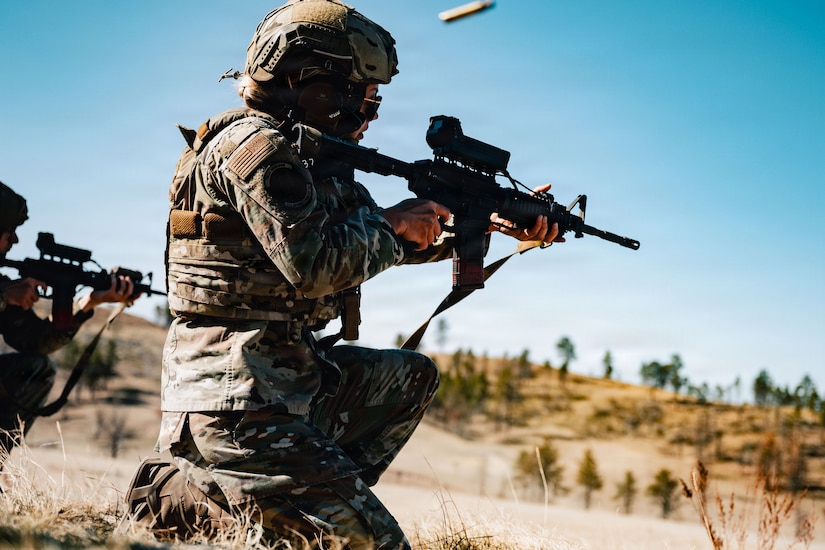
A person wearing a camouflage military uniform and helmet kneels in a grassy terrain and fires a military weapon; an ammunition round disperses out of the weapon.

Beyond supporting department-level counter-small UAS objectives, the qualification also provided 90th Missile Wing personnel with hands-on experience using emerging capabilities that support the Air Force Global Strike Command's broader modernization efforts and strengthen the wing's national security mission. 

The qualification comes as the Air Force Global Strike Command continues to modernize the tools and platforms that support missile field security and nuclear deterrence. With the transition from Humvees to Joint Light Tactical Vehicles and the replacement of UH-1N Hueys with MH-139A Grey Wolf helicopters, the command is adapting its capabilities to meet current and future security demands.  

Counter-small UAS training represents another layer of that modernization, preparing defenders to counter emerging unmanned threats to critical assets, personnel and the intercontinental ballistic missile mission. 

A close-up view of hands holding a flip-up remote control with levers, buttons and a screen.
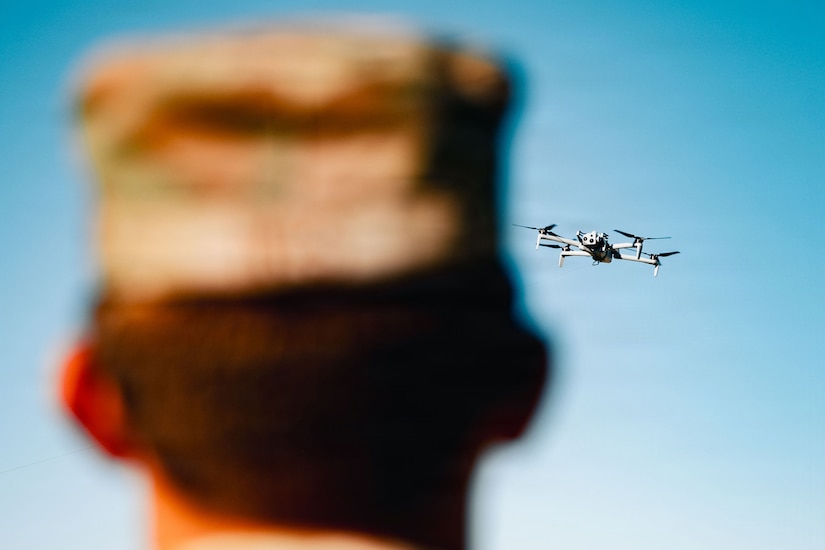
A close-up view of a rear-facing person watching a drone fly through a blue sky overhead.

"The system is a game changer," said Air Force Col. Jeremy Sheppard, 90th Security Forces Group commander. "When you hear one of our young defenders say they feel more confident and prepared, that's the metric that matters most to me as a commander. That confidence, born from having the best tools and training, translates directly into a more lethal and decisive force on the ground. This isn't just about fielding new technology; it's a direct investment from our [major command] in our most critical weapon system: the individual defender. We are sharpening the spear at every level, and this is what it looks like." 

For the airmen who participated, the qualification offered direct experience with systems designed to counter emerging threats and improve defender readiness in operational environments. 

"This training makes me more effective by giving me hands-on experience with systems designed to counter hostile drones," said Air Force Senior Airman Preston Reiger, a small UAS specialist assigned to the 90th Missile Security Operations Squadron. "It shows the wing is taking [counter-small UAS] seriously and actively building another layer of defense to protect our mission, assets and personnel." 

The qualification provided practical experience with capabilities designed to meet an evolving threat environment. Through continued collaboration with JIATF 401, the 90th Missile Wing is strengthening its ability to defend the nation's intercontinental ballistic missile mission today, while preparing for the security challenges of tomorrow.

Tuesday, March 10, 2026

Army Tests APEX Counter-UAS Round in Arizona

The Yuma Test Center at U.S. Army Yuma Proving Ground, Arizona, recently tested a new 30 mm Aviation Proximity Explosive round, primarily developed for firing from the AH-64 Apache helicopter.

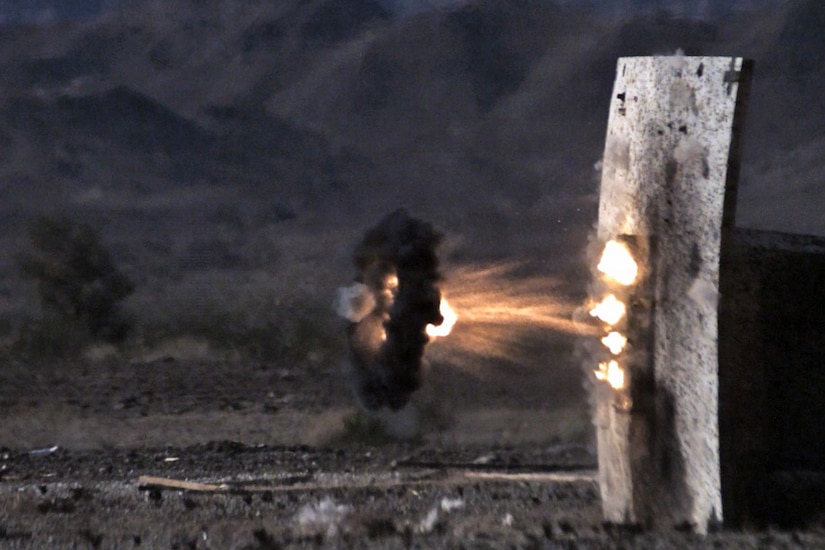
A small circle of black smoke radiates from a military round that explodes near a target on a range.

The APEX closely resembles the fielded M788 training round and M789 high explosive dual-purpose round. 

Walter McCormick, a test officer at the proving ground, explained that the APEX is designed to integrate with the existing M230 gun already mounted on the Apache. 

"The APEX round was developed to be a [fragmented] round that would [explode] in front of the [unmanned aerial system] and make a [small] pattern that would take out a UAS," McCormick said, adding that the need for counter-UAS solutions is urgent. 

In recent years, the UAS has become the weapon of choice on the battlefield, as seen in Ukraine and Russia. Army Secretary Daniel Driscoll is pushing for the Army to focus its efforts on UAS and counter-UAS technology. In fact, the Yuma Test Center has been designated as the primary, dedicated interagency counter-small UAS test and training range.

During testing, the center performed two subtests: the first to assess and compare it with the legacy M789 rounds, and the second test was to engage a UAS. Crews fired approximately 1,200 rounds across the two variants at both short and long ranges.

"We engaged a couple [of] different UASs and a few different ground targets," McCormick said.

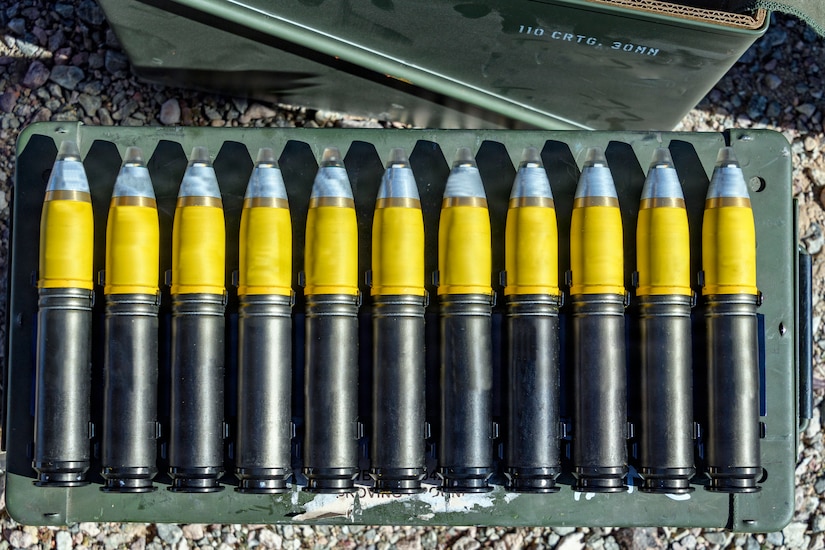
Eleven large munition rounds are lined up on a case outside.

Yuma Proving Ground has nearly 2,000 square miles of restricted airspace and year-round sunshine, which makes it ideal for aerial testing.

"They have done ground testing at other ranges. The problem is they don't have the land or airspace to do aerial firing from a helicopter. So, that's a big benefit. Plus, all the unique instrumentation YPG offers," McCormick said.

During the APEX test, the proving ground used its full arsenal of support capabilities to collect data, including air-to-ground assets such as chase pilots from UH-60 Black Hawk helicopters flying overhead for scoring, tracking mounts, telemetry, high-speed video, still photographers and data collectors.

These assets are readily available to industry partners testing at the proving ground.

"The Black Hawk was used primarily for overhead [scoring], so we can assess where rounds are impacting based on [the] firing point of the aircraft. The other benefit of surrounding ground camera angles was having a 360-[degree] view of the situation," McCormick said.

The next step for the APEX is to undergo airworthiness release based on the current test results. This will provide a safety release for the APEX to be fired from Apaches by soldiers when rounds are available. The airworthiness release is a milestone on the road toward materiel release and fielding.