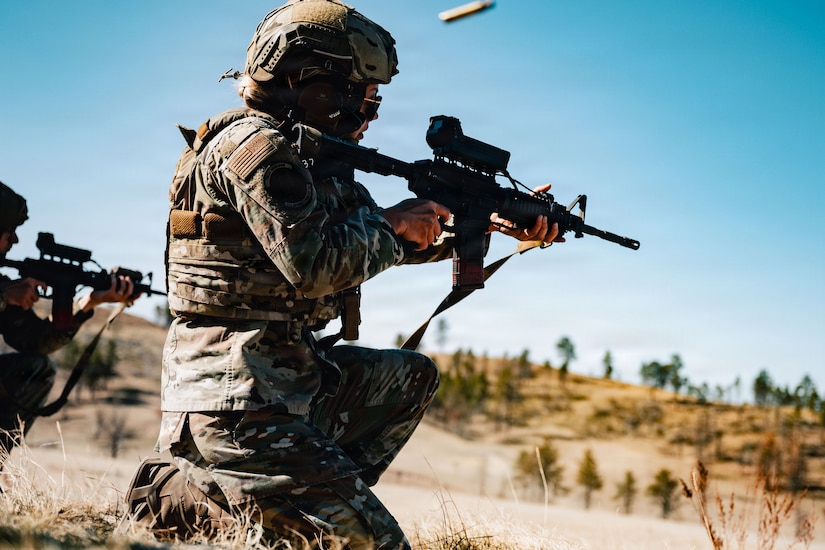
Airmen assigned to the 90th Missile Wing joined
personnel assigned to the Air Force Global Strike Command, Air Combat
Command, U.S. Strategic Command and the Air National Guard for a
counter-small unmanned aircraft systems firing qualification conducted
in partnership with Joint Interagency Task Force 401 at Camp Guernsey
Joint Training Center, Wyoming, May 14-15, 2026.
As the battlefield continues to evolve, tactics, techniques and
procedures must adapt alongside emerging threats. One of the most
rapidly developing areas is the counter-small UAS environment, where
technology, training and operational requirements are transforming
quickly.
In August 2025, the War Department established JIATF 401 as the lead
organization for synchronizing efforts to rapidly deliver counter-small
UAS capabilities at scale to defend the homeland, protect U.S. and
allied forces, defend critical infrastructure and assist federal
agencies.
The task force has one measure of effectiveness: rapidly delivering
state-of-the-art counter-small UAS capabilities to warfighters at home
and abroad.
The two-day firing qualification tested and enhanced operators'
ability to engage ground and aerial targets at varying distances using
technologically advanced small-arms target acquisition systems.
"Protecting our power projection platforms is a critical component of
enhancing warfighter lethality," said Army Brig. Gen. Matt Ross, JIATF
401 director. "I am grateful for the partnership with the 90th Missile
Wing, Air Combat Command and Air Force Global Strike Command that is
enhancing [counter]-UAS training to keep our warfighters, installations
and critical assets safe from drone threats."
Beyond supporting department-level counter-small UAS objectives, the
qualification also provided 90th Missile Wing personnel with hands-on
experience using emerging capabilities that support the Air Force Global
Strike Command's broader modernization efforts and strengthen the
wing's national security mission.
The qualification comes as the Air Force Global Strike Command
continues to modernize the tools and platforms that support missile
field security and nuclear deterrence. With the transition from Humvees
to Joint Light Tactical Vehicles and the replacement of UH-1N Hueys with
MH-139A Grey Wolf helicopters, the command is adapting its capabilities
to meet current and future security demands.
Counter-small UAS training represents another layer of that
modernization, preparing defenders to counter emerging unmanned threats
to critical assets, personnel and the intercontinental ballistic missile
mission.
"The system is a game changer," said Air Force Col. Jeremy Sheppard,
90th Security Forces Group commander. "When you hear one of our young
defenders say they feel more confident and prepared, that's the metric
that matters most to me as a commander. That confidence, born from
having the best tools and training, translates directly into a more
lethal and decisive force on the ground. This isn't just about fielding
new technology; it's a direct investment from our [major command] in our
most critical weapon system: the individual defender. We are sharpening
the spear at every level, and this is what it looks like."
For the airmen who participated, the qualification offered direct
experience with systems designed to counter emerging threats and improve
defender readiness in operational environments.
"This training makes me more effective by giving me hands-on
experience with systems designed to counter hostile drones," said Air
Force Senior Airman Preston Reiger, a small UAS specialist assigned to
the 90th Missile Security Operations Squadron. "It shows the wing is
taking [counter-small UAS] seriously and actively building another layer
of defense to protect our mission, assets and personnel."
The qualification provided practical experience with capabilities
designed to meet an evolving threat environment. Through continued
collaboration with JIATF 401, the 90th Missile Wing is strengthening its
ability to defend the nation's intercontinental ballistic missile
mission today, while preparing for the security challenges of tomorrow.







 Posts
Posts

