Showing posts with label c-130j super hercules. Show all posts

Friday, October 16, 2026

Navy Accepts Next-Generation Aircraft to Modernize Strategic Communications

The Navy accepted a newly manufactured C-130J-30 Super Hercules aircraft from Lockheed Martin during a ceremony in Marietta, Georgia, Oct. 15, marking the first step toward fielding the future E-130J Phoenix II.

A large military aircraft is parked on a flight line at dusk, and an aircraft hangar is in the background.

The aircraft will serve as the host platform for the Navy's next-generation "Take Charge and Move Out" mission system, providing survivable, reliable and secure communications among the president, the secretary of war and U.S. Strategic Command.

The new airframe begins a planned transition, honoring decades of service from the legacy E-6B Mercury aircraft while laying the foundation for the future fight. The program designation Phoenix II symbolizes rebirth and nods to the EC-130Q Hercules platform the Navy used to execute the Take Charge and Move Out mission during the Cold War.

This modernized capability ensures the nation's nuclear command, control and communications architecture remains resilient and reliable. The updated platform also delivers the enhanced endurance, capacity and operational reach necessary to support mission success in complex global environments.

The event spotlighted the close partnership between the Navy and the defense industrial base. The newly delivered aircraft is the extended C-130J-30 variant, part of an initial procurement of three aircraft the Navy acquired in September 2024.

During the ceremony, Lockheed Martin representatives presented a commemorative plaque and ceremonial key to Navy Capt. Roger Davis, Airborne Strategic Command, Control and Communications Program Office commander.

Two men in formal military uniforms smile and pose holding a glass aircraft, with an American flag in the background.

"Today's delivery from the historic Marietta line represents far more than a new airframe; it marks the foundation of our future strategic deterrence posture," Davis said. "Through our close partnership with Lockheed Martin and our industry team, we are ensuring our nation maintains an unshakeable communications lifeline to our ballistic missile submarine fleet."

The ceremony also recognized the sailors assigned to Strategic Communications Wing 1 at Tinker Air Force Base, Oklahoma, who will operate and maintain the modernized fleet. Before the ceremony, select sailors participated in a fleet engagement day, which included simulator flights, production line tours and program briefings.

"Strategic deterrence is only as credible as our ability to communicate, and that mission rests in the hands of SCW-1's world-class sailors," said Navy Capt. David Gardner, the wing's commodore. "The E-130J will provide our sailors unmatched capability and next-generation survivable and reliable communications, ensuring our team continues to be the unbreakable link between the president and strategic nuclear forces."

Friday, October 02, 2026

Kentucky Guardsmen Sharpen Capabilities Alongside NATO Partners

Two people jump out of the back of a military aircraft over water while a third person in a camouflage military uniform looks on.

Airmen assigned to the Kentucky Air National Guard enhanced their global capabilities while training alongside NATO partners from the United Kingdom and Canada in Scotland this summer. 

The guardsmen deployed four C-130J Super Hercules aircraft, 62,000 pounds of equipment and 60 personnel to Glasgow Prestwick Airport in South Ayrshire, Scotland, Aug. 14-22. 

While there, they conducted specialized fueling operations, low-level formation flying and rapid-reaction aircraft launches to maintain combat mission certifications. The airmen also completed maritime equipment and personnel airdrops, including two open-ocean rescue scenarios with a helicopter unit assigned to the British Royal Navy. 

"The deployment was designed to accomplish a large amount of C-130J continuation and tactical training while taking advantage of an unfamiliar overseas operating environment and opportunities to work directly with allied partners," said Air Force Lt. Col. Nick Reinke, the mission commander and a C-130 pilot assigned to the 165th Airlift Squadron. 

He added that while many of the individual training events could be conducted in the U.S., it is much harder to reproduce an unfamiliar environment.  

A large military aircraft flies over a green, hilly terrain.

"At home station, crews know the airspace, air traffic control procedures, airfields, support agencies and local practices," Reinke said. "In Scotland, even something as routine as a proficiency circuit required crews to understand and coordinate with a different [air traffic control] system." 

Reinke said coordination with host nation agencies was critical to the exercise's success. 

"That forces crews to solve the kinds of interoperability, communication, planning and adaptation problems they encounter when operating globally. Worldwide capability is more than simply being able to fly across the Atlantic. It means arriving with the people and equipment needed to operate, understanding an unfamiliar airspace and support structure, integrating with allied forces, adapting when weather or circumstances change the plan, and continuing to accomplish the mission." 

Reinke added that the deployment also underscored the importance of relationships. 

The Kentucky unit, based in Louisville, worked closely with civilian support agencies at Glasgow Prestwick Airport to complete specialized fueling operations, during which a C-130J was refueled while its engines were still running. Reinke said this "hot pit" method validated the airport's ability to support the technique and provided practical experience to host-nation fuel personnel. 

"That partnership leaves behind a more capable location for follow-on and allied forces in the future, rather than the benefit ending when our deployment ended," he noted. 

One of the deployment's key accomplishments was a five-ship formation flight, conducted with four Kentucky aircraft and one C-130J from the Royal Canadian Air Force. 

"The Canadian aircraft commander was actually a U.S. Marine Corps exchange pilot," Reinke said. "That meant our mission planning and briefing had to reconcile U.S. Air Force, Royal Canadian Air Force and U.S. Marine Corps procedures and terminology to make sure everyone had the same understanding before execution. That is exactly the kind of interoperability that is difficult to simulate." 

The silhouettes of three people standing in the back of a military aircraft while looking at another military aircraft on a runway.

The deployment's other main focus was open-ocean rescue. 

The scenario required a U.S. Air Force C-130 crew to locate a stranded airman floating in a life raft on the Atlantic Ocean, miles from shore. Loadmasters then airdropped an inflatable motorboat near the victim, and three special tactics airmen used precision jumpmaster techniques to parachute into the ocean, deploy the boat and provide first aid. Once complete, they coordinated with the Royal Navy's 814 Naval Air Squadron to execute helicopter hoist operations and extract the victim as the C-130 provided overwatch. 

"The integration with the Royal Navy was one of the highlights of the exercise," Reinke said. "It allowed our pararescue personnel and C-130J crews to integrate fixed-wing airdrop, maritime rescue, rotary-wing insertion and recovery, and on-scene command and control with a NATO partner." 

A pararescue flight chief for the special tactics team described the operating environment in Scotland as "vastly different" from training locations in the United States. 

"It's a lot colder here, and the salt water is an unusual factor for us," he said. "The Royal Navy also uses different geolocation methods, and they have different tactics and techniques than we typically employ." 

He noted that the Royal Navy's helicopter, a Merlin Mk2, generates substantially more rotor wash than the UH-60 Black Hawk. 

"Those are the kinds of things you don't anticipate, but we were able to work through them and figure out what worked best for their guys and for us," the airman said. "We had to be flexible on the spot to get the mission done." 

Royal Navy Capt. James Hall said the exercise provided valuable opportunities for the Merlin Mk2 force to enhance capabilities outside of its normal role in antisubmarine warfare. 

A man wearing a flight suit lies on his side in the back of a military aircraft and peers off into the distance.

"Exercises such as this, conducted alongside our United States Air Force partners, enable our crews to maintain and enhance critical search and rescue skills, while strengthening the interoperability that underpins NATO's collective security," he said. 

Royal Navy Lt. S. Cass, a flight commander assigned to the 814 Naval Air Squadron, agreed, adding that he hopes to continue working with "our friends across the pond" in the years to come. 

Reinke called the deployment an unqualified success, not necessarily for any single event but for the readiness training they were able to layer into one exercise. 

"We were able to use legitimate flight training requirements to generate maximum value, ensuring worldwide readiness while working with our international partners," he said. "We also were able to build strong human relationships with the men and women of our partner nations, laying the kind of foundation that makes coalition operations successful."

Thursday, June 11, 2026

Carrying the Torch: 815th Airlift Squadron Assumes Airlift Mission in Africa

There was no formal ceremony marking the transition at Camp Lemonnier, Djibouti. No guidon passed from one commander to another. Instead, a moment represented something larger; the passing of a torch that lights the path of Air Force airlift across the U.S. Africa Command area of responsibility.

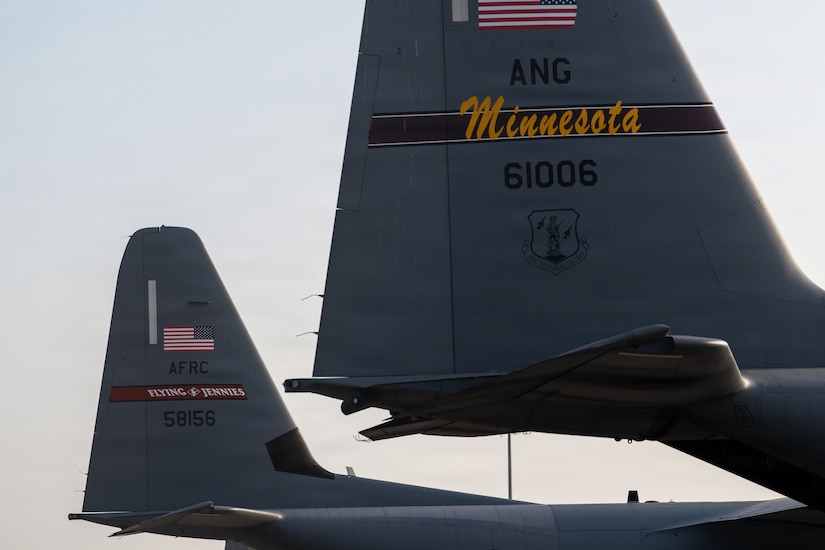
The back of two military aircraft parked side by side.

After months of operations throughout Africa, airmen assigned to the Minnesota Air National Guard 133rd Airlift Wing concluded a historic deployment for their wing as airmen assigned to the Air Force Reserve 815th Airlift Squadron, known as the Flying Jennies, carry on the torch for the next rotation. 
 
For the 133rd Airlift Wing, the deployment carried significance as the wing's final planned deployment with the Air Force C-130H3 Hercules. It concludes a 30-year era of trusted service with the C-130H model aircraft, which is being replaced across the wing by the newer C-130J model as part of the Minnesota Air National Guard's ongoing modernization efforts. 
 
"The men and women of the 133rd Airlift Wing are closing out a truly historic deployment," said Air Force Lt. Col. Denny Paulsen, outgoing commander of 75th Expeditionary Airlift Squadron. "The significance of this being our final planned deployment with the C-130H model added meaning to every mission and fueled an elevated level of motivation across our team."

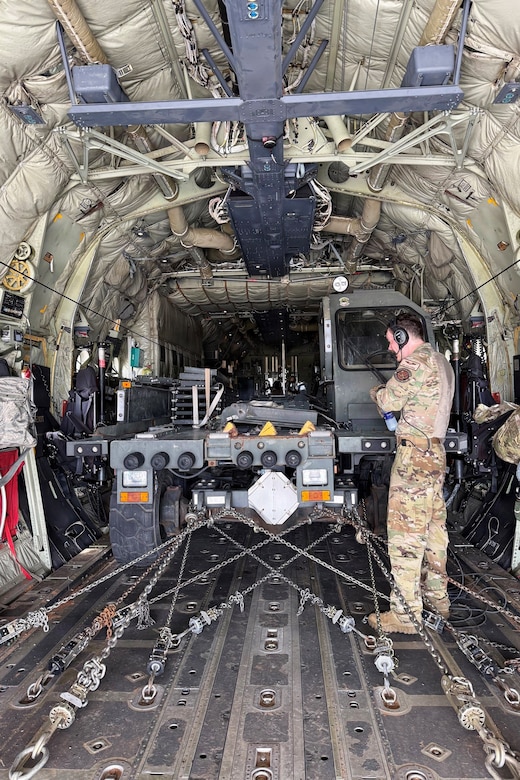
A man wearing a camouflage military uniform stands in the back of a military aircraft while looking at a military loading vehicle.
The 75th Expeditionary Airlift Squadron, under the 449th Air Expeditionary Group, carries a high operational tempo, being the sole Air Force airlift capability for the African continent. The mission demands no-fail execution, ensuring cargo and personnel reach their destinations on time.

Their efforts included supporting operations driving security, economic, humanitarian and anti-terrorism efforts designated among Africom's highest priorities, earning recognition from senior leaders across the Horn of Africa. 
 
"This deployment brought an operations tempo and urgency that exceeded what is typical," Paulsen said. "The dedication, professionalism and skill of our squadron were on full display through multiple high-visibility operations that demanded absolute precision." 
 
According to Paulsen, the 133rd Airlift Wing leaves behind a legacy built from decades of service with the C-130H, capping a deployment that showcased the aircraft's enduring value and the professionalism of the airmen who flew and maintained it. 
 
"All of Minnesota can be proud of what the airmen of the 133rd Airlift Squadron have accomplished," Paulsen said. "Their performance has left a lasting mark on our state and on the legacy of the C-130H." 
 
Now, the Flying Jennies assigned to the Air Force Reserve 815th Airlift Squadron from Keesler Air Force Base, Mississippi, take the reins. Flying the Air Force C-130J-30 Super Hercules, the airmen and airframe bring expanded airlift capabilities and a history of operational excellence. 
 
Under the leadership of Air Force Lt. Col. Stephanie Brown, incoming commander of the 75th Expeditionary Airlift Squadron, the squadron arrives ready to provide tactical airlift, contingency operations, aeromedical evacuation and rapid mobility support to increase operational capability across Africa. 

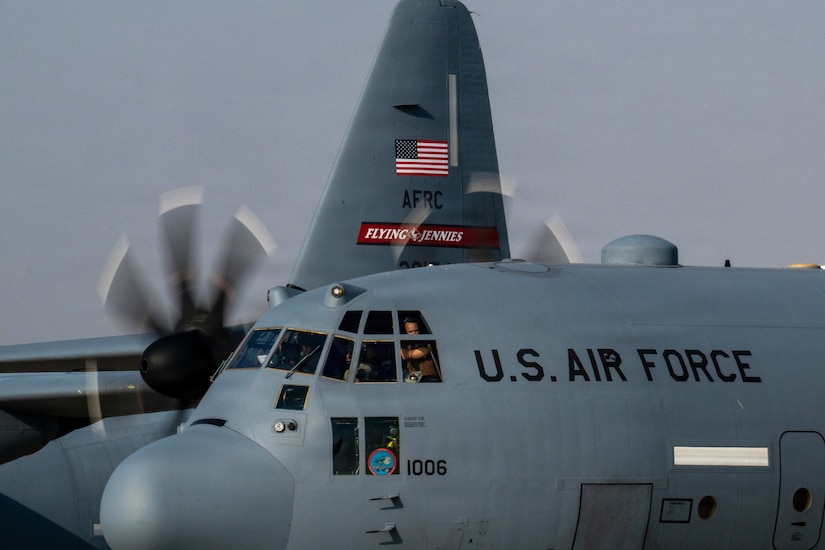
A military aircraft taxis on a flight line. The pilots are in the cockpit.

 
"The airmen and team of the 815th Airlift Squadron stand ready to support the Africom and Combined Joint Task Force – Horn of Africa area of responsibility," Brown said. "This deployment is the culmination of a two-year Air Force's force generation 'level 300' training plan and Air Force Reserve Command certification." 
 
That two-year preparation consisted of a series of highly complex, joint and international exercises to stress test their tactical capabilities to ensure the team was ready to sustain full-spectrum readiness in their area of responsibility. 
 
The transition reflects one team completing its chapter while another immediately carries the mission forward. The final C-130H crews of the 133rd Airlift Wing passed the torch to the Flying Jennies to continue redefining responsive air mobility support for the joint force, allies and partners across the African continent.

Wednesday, December 10, 2025

Operation Christmas Drop: DOW's Longest-Running Humanitarian Mission in Pacific

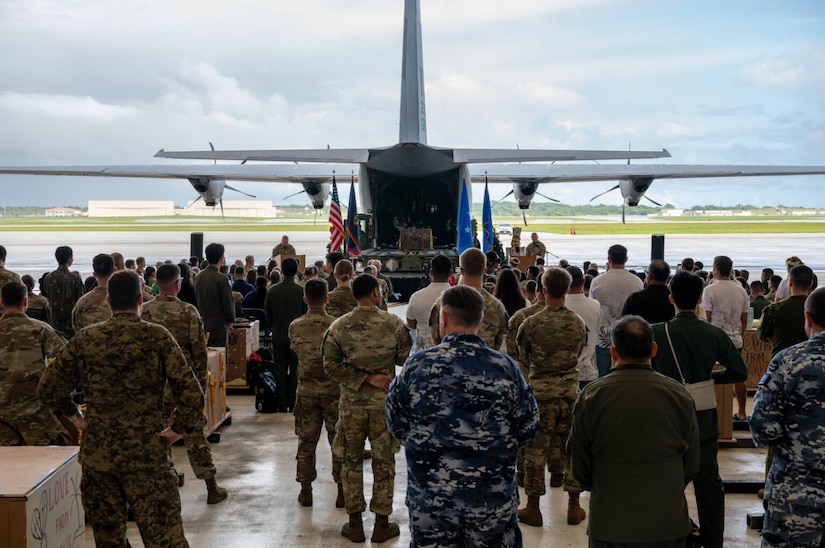
Leaders from the U.S. Air Force, partnering nations and community members gathered for a traditional "push ceremony," marking the official beginning of Operation Christmas Drop 2025 at Andersen Air Force Base, Guam, Dec. 8, 2025.

A group of service members and civilians stand behind an open military aircraft in a hangar.
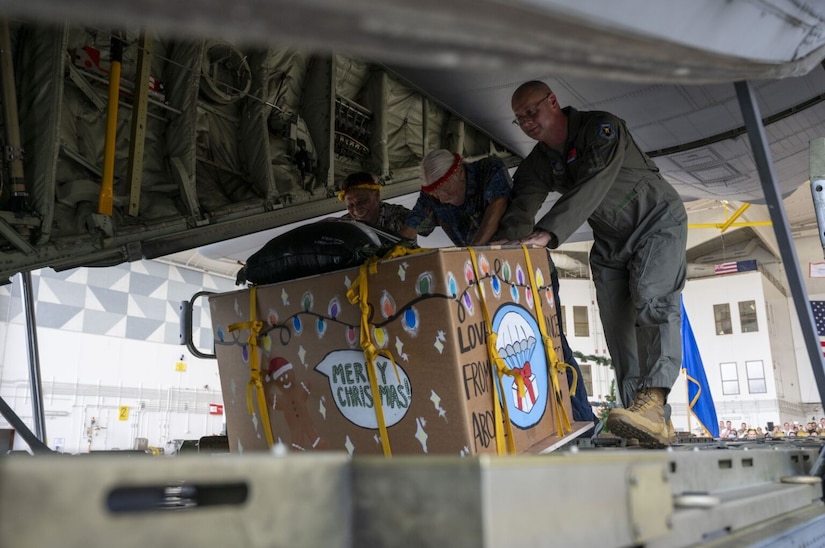
Three men push a large box down the back of a military aircraft.
The event served as the symbolic opening for the 74th iteration of the operation, the War Department's longest-running humanitarian airlift mission. It began in 1952 after an Air Force B-29 crew flying near Guam spotted islanders waving from below and dropped supplies as an act of goodwill.
 
"Operation Christmas Drop delivers more than just supplies," said Aren Palik, vice president of the Federated States of Micronesia. "It delivers hope, connection and the reassurance that even across a vast ocean, we remain part of one family. It is an accomplishment that speaks to the steadfast commitment of the United States and its Pacific partners to care for our people and our communities."

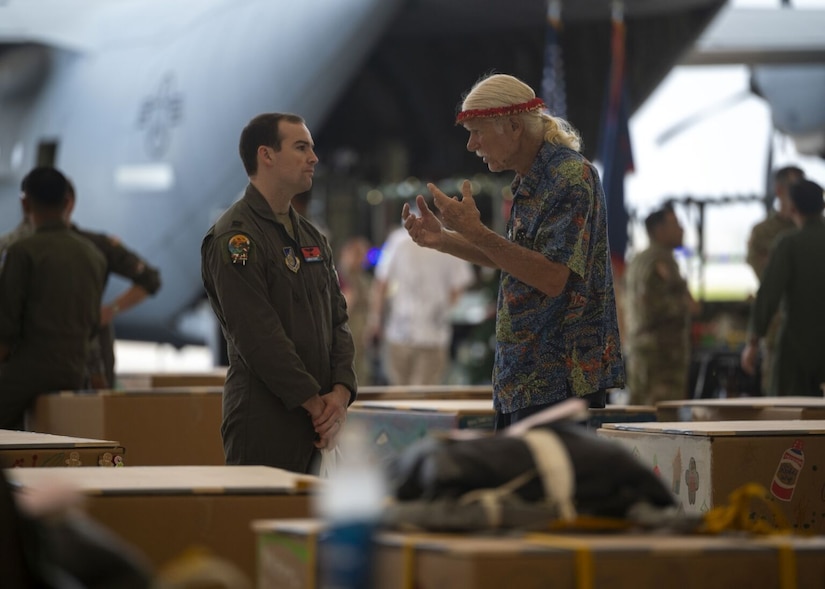
Two men, one a service member and the other a civilian, chat amongst a sea of supply boxes in an aircraft hangar. A military aircraft is in the background.

 
The ceremony concluded with Palik, Bruce Best — known at Operation Christmas Drop as "Brother Bruce" — and Air Force Col. Richard McElhaney, 374th Airlift Wing commander, loading the first official bundle into the cargo bay of a C-130J Super Hercules assigned to the 36th Airlift Squadron, operating under the 374th Expeditionary Wing.
 
"These bundles supply 56,000 people across 59 islands each year, but I don't think we can truly grasp that impact until we see the families wave and jump up and down in excitement as we fly by," McElhaney said. "While this is an amazing humanitarian mission, it's also an invaluable training event for participating aircrews. This training, and the work we do here, matters and translates to our readiness."

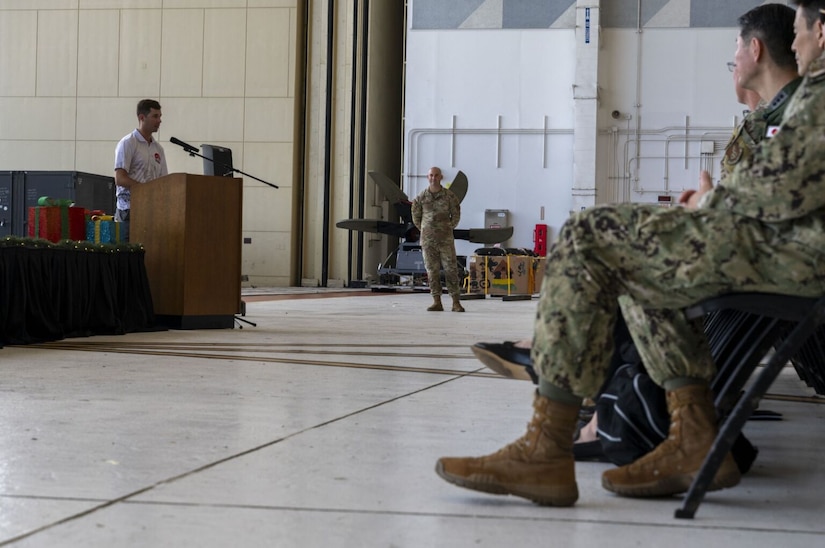
A man stands at a lectern and gives a speech to a seated crowd of civilians and service members inside an aircraft hangar.
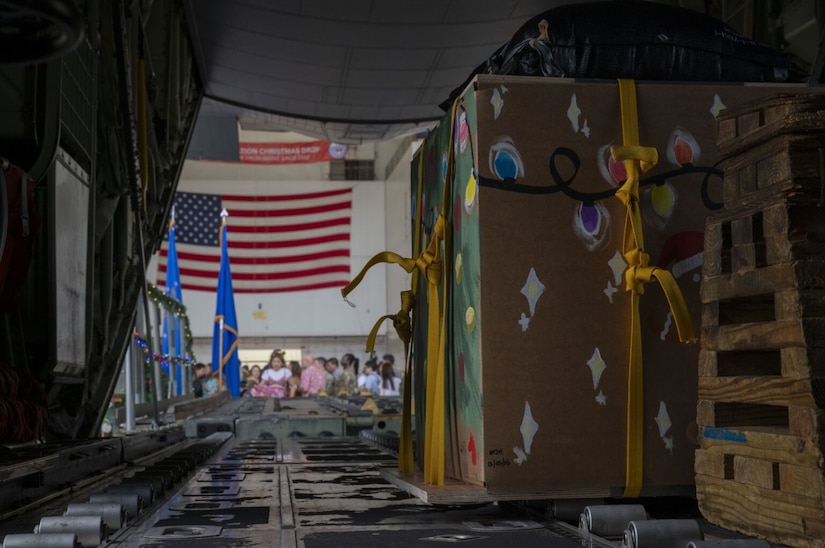
Large boxes sit inside the back of a military aircraft.
Throughout the remainder of the operation, the Air Force and partnering nations will airdrop a total of 270 bundles filled with critical supplies to remote communities across the Pacific, delivering humanitarian assistance while simultaneously conducting valuable low-level flight, precision-airdrop and logistical coordination training — skills that strengthen the ability to execute rapid global airlift missions across the Indo-Pacific region.
 
"The people of the Federated States of Micronesia extend our deepest gratitude," Palik said. "Beyond the food, tools, fishing gear, school supplies and gifts, you deliver something far more valuable: the spirit of compassion that defines this Christmas season." 

Monday, July 20, 2015

US, Bulgarian forces synchronize training to strengthen future

by Senior Airman Nicole Sikorski
86th Airlift Wing Public Affairs


7/20/2015 - PLOVDIV, Bulgaria  -- Airmen from Ramstein Air Base, Germany, went wheels up for a bilateral training exercise with the Bulgarian air force, July 14 through 24.

More than 100 Ramstein Airmen deployed with three C-130J Super Hercules from the 37th Airlift Squadron, to Plovdiv, Bulgaria. The deployment allowed NATO allies to train together while maintaining joint readiness and building interoperability capabilities.

"This is the sixth year we have participated in this exercise," said Bulgarian air force Col. Petar Tsolov, 87th Division air force headquarters tactical branch commander. "The training we do together is very useful and beneficial to everyone involved. I can recall a few years ago, there was mistrust between pilots, so missions were flown separately. We as a smaller air force, have a lot to learn and the U.S. is one of the best to learn from."

Airmen and Soldiers from more than 50 career fields came together to carry out the mission, which not only strengthened NATO partnerships, but highlighted a shared commitment to ensure global deterrence of common threats.

The deployment involved low-level training flights, unimproved surface landing zone training on grass, airdrop training and nighttime flying.

According to U.S. Air Force Capt. Derek Patrick, 37th AS pilot and exercise mission commander, this annual training is crucial to building friendships, all while keeping up with the needs of Air Force training requirements.

"It's great to be able to practice night flying, low-level formations and unimproved surface landing training out here," said Patrick. "These components are critical because they allow us to operate anywhere that (United States Air Forces in Europe) tasks us to be, at a moment's notice."

Ensuring regional security and air operational readiness is a task that cannot be accomplished alone, said Lt. Col. Ryan Barney, 435th Contingency Response Group commander.

"Our Bulgarian partners are not just our allies, they are also our friends," said Barney. "The days are in the past when the U.S. could succeed alone, we can't do it by ourselves now, nor do we want to."

This annual exercise will continue to strengthen current bonds between the U.S. and it's allies and aid in securing the future of NATO.