Showing posts with label Washington Guard. Show all posts

Tuesday, August 11, 2026

National Guard Continues Washington Wildfire Support

 Aug. 11, 2026 | By Joseph Siemandel, Washington National Guard

As wildfires burn across the state, the Washington National Guard continues to provide aviation, hand crew and security support to communities and firefighters working to contain them. 

Since the wildfire response began July 19, National Guard aviation crews have flown 225 flight hours, dropping more than 1,400 buckets and nearly 1.2 million gallons of water on fires across eastern and central Washington. 

While weather, winds and smoke conditions play a major part in day-to-day operations, for the aircrews flying those missions, the overall conditions pose unique challenges. 

"These aircrews are performing some of the most tactically and technically challenging flying they will experience in their entire careers," said Army Lt. Col. Kevin Robillard, a pilot assigned to the 96th Aviation Troop Command. 

Robillard said crews are navigating high altitudes, high winds, limited visibility, heavy smoke and extreme heat, while operating around civilian aircraft, firefighters on the ground and areas where radio communications can be limited. 

"I would argue that, in many respects, this flying is every bit as challenging — if not more challenging — than combat flying," he said. 

The mission requires more than skilled aircrews. Fuelers, maintainers, flight operations personnel and military liaisons work behind the scenes to keep aircraft in the air and crews ready to respond. 

"And so far, our crews are doing an absolutely fantastic job," Robillard said. "I'm incredibly proud of our aircrews and our ground support personnel. They are absolutely crushing it while operating in some of the harshest conditions and most demanding flying environments an aircrew will ever experience." 

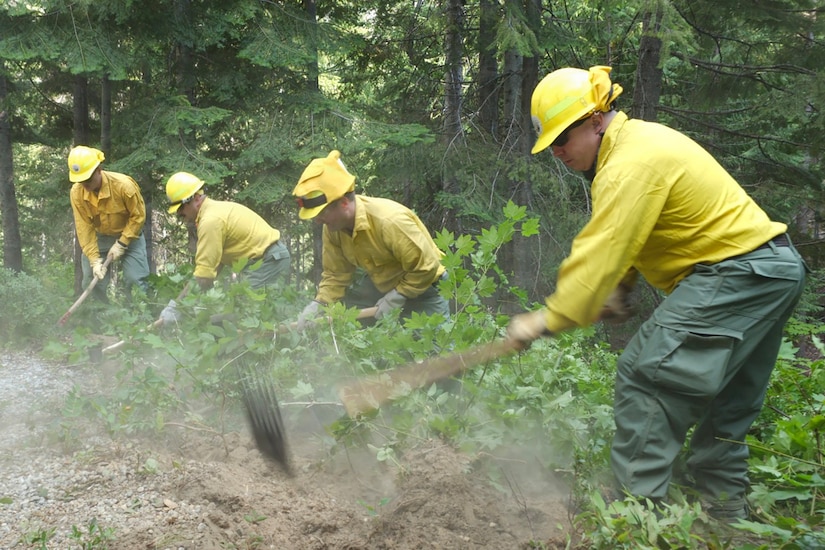
The National Guard's support also extends to the ground. Since Aug. 1, hand crews have been working alongside firefighting agencies from across the country. Crews are conducting fire line construction, hose lays, mop-up, debris clearing, brushing and chipping operations at a fire near Leavenworth, Washington. The hand crews have provided additional manpower for demanding ground operations. 

"Your [National Guard] team is great," said Craig Covey, incident manager for the fire near Leavenworth. "We have 105 go-getters that come in and say, 'What can we do?' And they work all day until we tell them it's time to stop. We really enjoy having them here."  

U.S. Rep. Kim Schrier, Washington's 8th Congressional District representative, recently visited guard personnel and firefighters supporting the fire mission near Leavenworth to give thanks. 

"I can't tell you how much I appreciate you and everything that you are doing for Washington," Schrier said. 

In Spokane, Washington, National Guardsmen are supporting local authorities by manning 20 traffic control points for the Spokane Police Department and the Spokane County Sheriff's Office.  

For Army Lt. Col. Dan Wessman, Washington National Guard, the mission has provided a unique opportunity to serve his community. 

"As a Spokane guy myself, I am truly humbled about the community and the outpouring of support for all our soldiers and airmen and the first responders who are here to help," Wessman said.
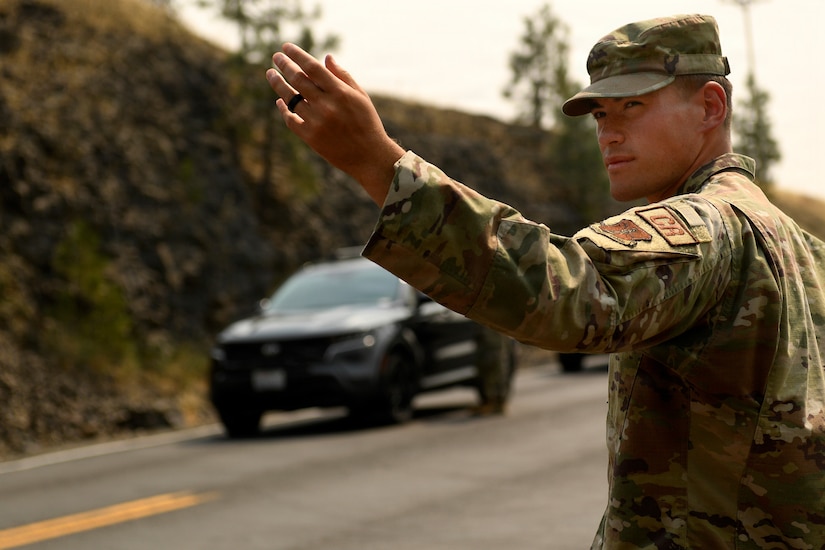
A man wearing a camouflage military uniform guides traffic while standing on the side of a road.
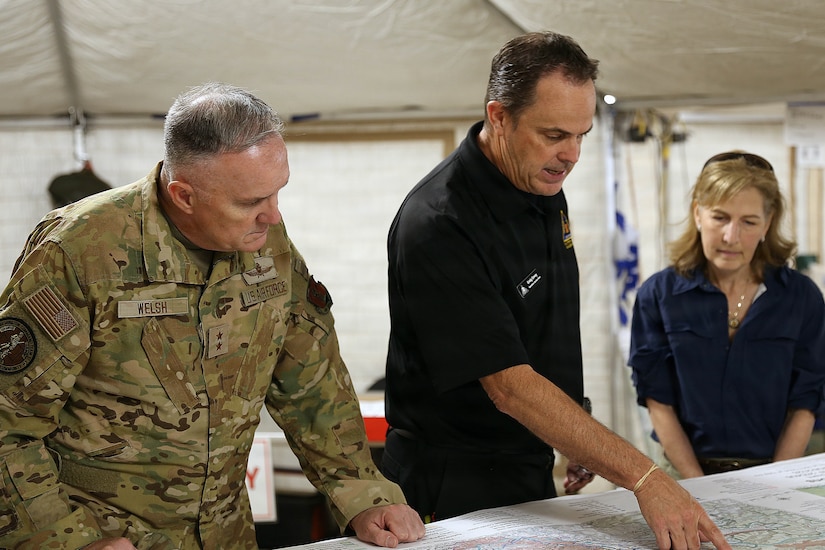
A man wearing business attire points to a map while speaking to a woman in similar attire and a man in a camouflage military uniform; they are all standing inside a large tent.
Currently, 345 Washington National Guardsmen, as well as 20 Washington State Guard members, are activated in support of wildfire missions. Their impact can be felt in the communities they are serving. 

"Our job is to be there when Washington needs us, and that's exactly what our soldiers and airmen are doing," said Air Force Maj. Gen. Gent Welsh, Washington National Guard adjutant general. "We're bringing the capabilities of the National Guard to the table, working alongside the agencies leading these responses and doing whatever we can to help protect Washington communities. Whether it's putting water on a fire, building fire lines, clearing debris or supporting local law enforcement, our people are ready to serve wherever they're needed."

Tuesday, August 04, 2026

Washington National Guardsmen Support Statewide Wildfire Response

As wildfires spread across Washington state recently, Washington National Guardsmen joined the firefight working alongside state and local partners to protect threatened communities, property and critical infrastructure.  

On July 19, Washington Army National Guard aviation crews began providing sustained aerial firefighting support using two UH-60 Black Hawk helicopters and a CH-47 Chinook helicopter, based out of Deer Park, Wash.

Four men wearing firefighter gear use garden tools to dig up brush from a wooded area.

Operating under demanding conditions that include intense heat, smoke and rapidly changing fire behavior, crews have flown repeated daily missions to deliver water directly onto active fires and support firefighters.  

By the end of the 15th day of aviation operations, National Guard aircrews had accumulated 146.5 flight hours and dropped 1,181 buckets, or approximately 970,000 gallons, of water.  

"Wildfire suppression operations is hands down the most physically and mentally demanding task an Army aviator will perform," said Army Lt. Col. Adam Hanisch, Washington Army National Guard state aviation officer. "These missions require constant communication with firefighters on the ground, as well as with multiple aircraft from various agencies supervising and participating in a visually degraded environment with zero margin of error. We take this extremely seriously from preparation through execution and are honored to provide this service to Washington state."  

As new fires broke out through late July, National Guard hand crews, ground personnel, were requested July 28 by the Washington Department of Natural Resources for support at a fire north of Leavenworth, Wash. On July 31, more than 100 guardsmen, including five 20-person hand crews, mobilized to Pangborn Memorial Airport to in-process and receive their equipment before heading to the fire camp in Plain, Wash.

"This is a mission we train for long before wildfire season arrives, so when we get the call from our partners at the Department of Natural Resources, we're ready to go," said Air Force Maj. Gen. Gent Welsh, Washington National Guard commander. "I'm incredibly proud of these men and women who have stepped forward to support this mission and [I] am confident they'll bring hard work and professionalism to the fire line. They're taking on demanding, dangerous work to protect our communities, and I hope everyone will do their part to keep them, and everyone working around the clock to fight these fires, as safe as possible."  

Wildland firefighting has become a recurring domestic response mission for the Washington National Guard. Each year, guardsmen train alongside the Washington Department of Natural Resources and other firefighting agencies to prepare for the possibility of being called to support wildfire response. That preparation allows service members to integrate quickly with civilian agencies while remaining under the direction of the incident command system.  

The mission is one Washington National Guardsmen have answered repeatedly over the past three decades. From the large-scale response to the 1994 wildfire season to recent activations across the state, soldiers and airmen have supported wildland firefighting efforts from the air and on the ground.  

On Aug. 1, multiple fires erupted near the city of Spokane, Wash., forcing residents to evacuate a heavily populated area. The Washington National Guard immediately activated 100 service members to support local law enforcement officers with traffic control point operations, helping residents get to safety.   

"Answering the call when our state needs us is at the very core of who we are. This is the spirit of the guard," said Air Force Col. Carrie Wentzel, Washington National Guard director of joint operations. "We train for these critical missions, prepare our force to the highest standards, and when the call comes, we respond alongside our partners in the field. Our soldiers and airmen are Washingtonians, and they are fully committed to helping our communities protect lives, homes and property during wildfires."

Friday, June 05, 2026

Washington National Guard Builds Counter-UAS Partnerships Ahead of World Cup 2026

As unmanned aerial systems continue to evolve from recreational tools into potential threats to public safety, critical infrastructure and major public events, the Washington National Guard is positioning itself at the forefront of counter-UAS training and readiness.

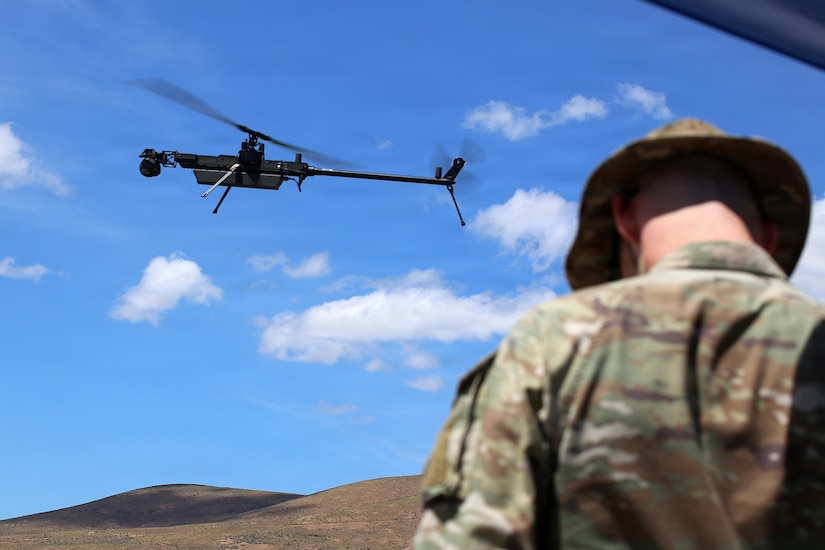
A drone flies in a blue sky with clouds as a rear-facing person in a camouflage military uniform looks down to pilot it; hills are in the distance.

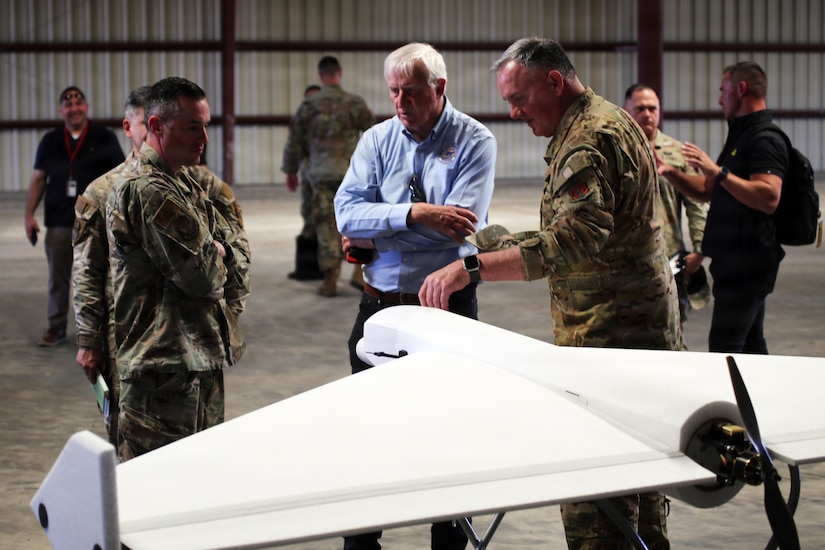
Representatives from federal, state and local law enforcement agencies gathered for a counter-UAS field demonstration day at the Yakima Training Center, Washington, June 2.  
 
The event included multiple active-duty and National Guard units, state defense forces, the Washington Emergency Management Division and the Civil Air Patrol. It showcased emerging technologies and operational tactics designed to detect, track and mitigate drone threats while highlighting the Washington National Guard's growing role in developing a regional schoolhouse for counter-UAS training and innovation. 
 
Air Force Maj. Gen. Gent Welsh, the adjutant general and homeland security advisor for Washington, said the event represents a milestone not only for Washington but for the nation. 

Nearly a dozen people, some in camouflage military uniforms and others in casual attire, stand and talk in a hangar; a white drone sits on the floor in the foreground.

 
"When you look at all the FIFA states, all the FIFA cities and all the different challenges that people are dealing with, Washington is the only state that actually brought people together to rehearse and discuss any of this stuff," Welsh said. "This is the only one-of-its-kind event in the entire country that's going on." 
 
The demonstration marked the latest step in a yearlong effort by the Washington Military Department and Washington National Guard to build a comprehensive counter-UAS program ahead of the FIFA World Cup 2026, which will bring millions of visitors to the greater Seattle area. 
 
Recognizing the growing threat posed by UASs, the Washington Military Department hosted a counter-UAS summit in late 2025, which brought together leaders from government, public safety, academia and industry to discuss emerging challenges and opportunities in the rapidly evolving drone environment. The summit laid the groundwork for expanded partnerships and highlighted the need for a coordinated approach to airspace security. 
 
Building on that momentum, the Washington National Guard's Western Regional Counterdrug Training Center launched a counter-UAS fundamentals course to provide military, law enforcement and public safety professionals with foundational training in drone detection, identification, legal authorities and response planning. The program has attracted interest from agencies across the region as organizations prepare for large-scale public events and the growing presence of drones in everyday life. 
 
"A year ago, we were not in this space," said FBI agent Phil Randolph. "A year ago, we wouldn't have thought about drone detection around NFL stadiums. Now we're leaning forward." 
 
Among those preparing for the challenges ahead is the Seattle Police Department, which sent officers to specialized counter-UAS training in Huntsville, Alabama, as part of its preparations for the FIFA World Cup.  
 
While preparations for the World Cup have helped accelerate the effort, Welsh emphasized that the challenge extends far beyond a single event. 
 
"Don't just look at this as, 'Hey, we've got to get through FIFA, and then we'll go back to work,'" Welsh said. "We're going to be dealing with the threat for the rest of our lives." 
 
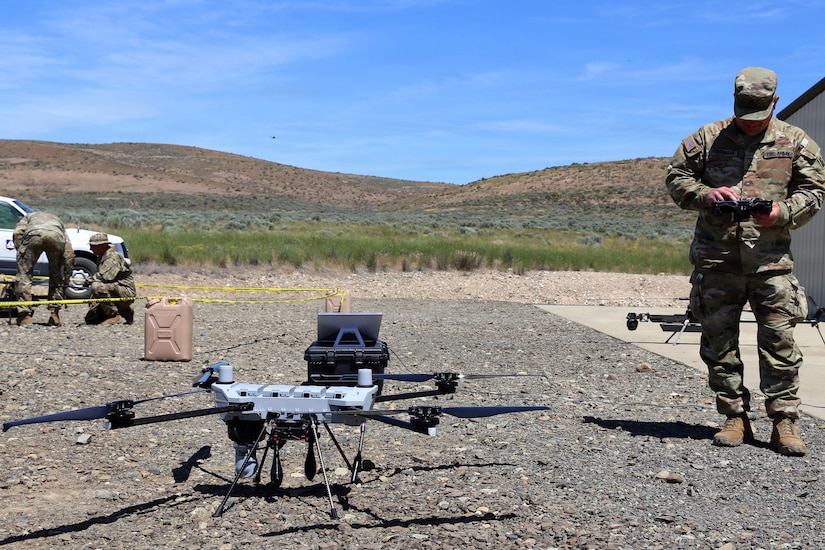
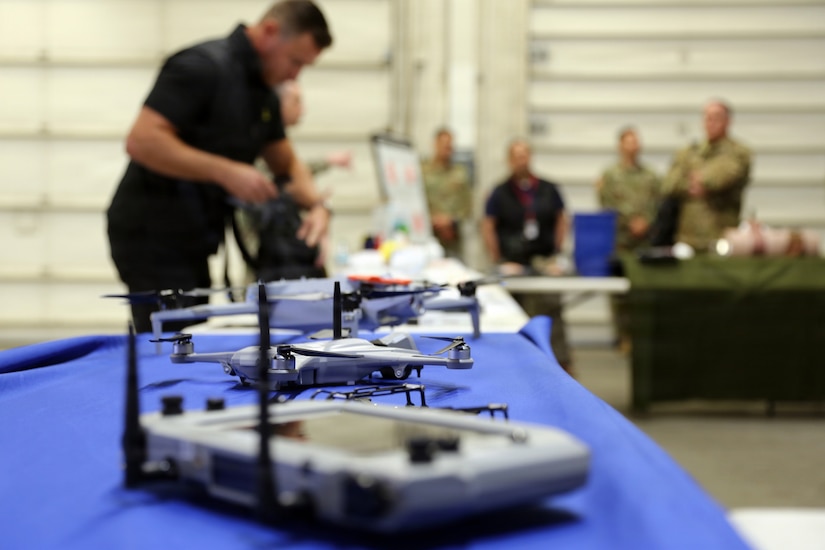
During the counter-UAS field demonstration day, participants observed a series of live demonstrations showcasing drone detection systems, swarm operations, interception techniques, radio-frequency mitigation capabilities and render-safe procedures. Attendees evaluated emerging technologies while discussing how those capabilities could be integrated into real-world operations. 

A drone sits on rocky terrain as a man in a camouflage military uniform looks down to pilot it; people in similar attire are in the background, and hills are in the distance.

 
For Washington National Guard leaders, Yakima Training Center also offers an ideal location to expand those efforts. 
 
"This really is the Kevin Costner moment from 'Field of Dreams,'" said Army Col. Phillip Lamb, Washington National Guard's senior Army advisor. "We have 327,000 acres of untouched, unobstructed training area right here at Yakima Training Center." 
 
Lamb, who served as the garrison commander for Joint Base Lewis-McChord, Washington, which also covers Yakima Training Center, said the installation's vast maneuver space provides a unique environment for agencies to train together, test emerging technologies and conduct realistic counter-UAS operations. 
 
"We can do a lot here and host so many organizations here," he said. "This space is underutilized, and I would love to see Yakima Training Center become that place that leads the way in counter-UAS." 
 
That vision extends beyond individual demonstrations and training events. 
 
"We want to build an Army counter-UAS center of excellence right here at Yakima Training Center," said Army Col. Craig Broyles, Washington National Guard's counterdrug program director. 
 
Broyles noted that the installation already possesses many of the resources necessary to support a comprehensive training pipeline. 
 
"We have the classroom space for the beginner-level instruction and the training areas needed for practical exercises and advanced courses," he said. 

A close-up of several drones and remote controls sitting on a table; people in camouflage military uniforms and others in casual attire stand in the background.

 
Welsh said recent organizational changes have further strengthened the state's ability to address emerging aerial threats. 
 
"Bringing the Civil Air Patrol under the Washington Military Department has elevated our capabilities in the counter-UAS environment," he said. 
 
As drone technology becomes increasingly affordable and accessible, public safety officials continue working to develop policies, procedures and capabilities that can keep pace with a rapidly evolving threat environment. 
 
"Unmanned aircraft systems provide significant benefits for commercial, agricultural and public safety applications, but their potential misuse requires government agencies to remain vigilant," Welsh said. "Some people look at these drones and see a great tool to do agricultural spraying with; I look at these things, and I literally see an [improvised explosive device] with wings." 
 
For the Washington National Guard, the demonstration represented more than a technology showcase. It provided a glimpse into the future of counter-UAS training and highlighted Washington's efforts to bring together military, law enforcement, emergency management and industry partners to stay ahead of emerging threats.  
 
As preparations continue for the FIFA World Cup and other major events, leaders believe the partnerships, training opportunities and capabilities developed at the Yakima Training Center will help shape the future of counter-UAS operations not only in Washington but across the nation.