Showing posts with label Ukraine. Show all posts

Thursday, September 24, 2015

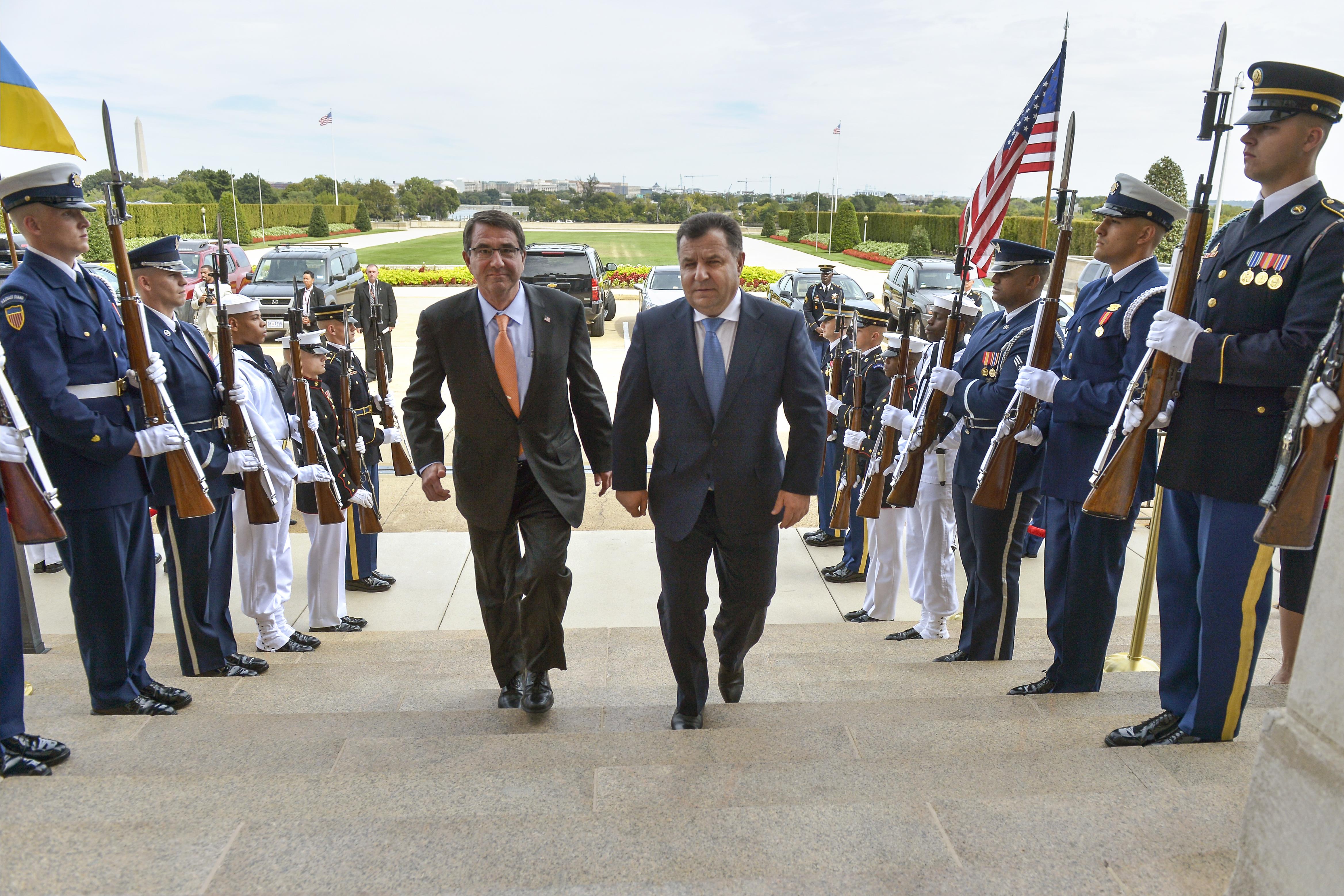
Carter Reaffirms U.S. Commitment to Ukraine


By Terri Moon Cronk DoD News, Defense Media Activity

WASHINGTON, September 24, 2015 — The United States will continue to back the Ukrainian military’s right to defend itself when Russian-separatist forces attack its positions, Defense Secretary Ash Carter said today.

In a joint news conference with Ukrainian Defense Minister Col.-Gen. Stepan Poltorak following their meeting during Poltorak’s first visit to the Pentagon, Carter reaffirmed the U.S. commitment to Ukraine and praised his counterpart for his leadership and fortitude “at a critical time for the security of his country, the region and the world.”

Ukraine has made “a genuine effort to live up to its Minsk commitments, and has shown considerable restraint in the face of provocations and attacks,” the secretary said, referring to a February ceasefire agreement.

Carter said the U.S. message to Russia stands firm as the United States is “adjusting its posture and investments to deter Russian aggression, and working with NATO and other security partners to do the same.”

The Defense Department will continue ongoing U.S.-Russia military talks on issues in Syria and countering the extremist Islamic State of Iraq and the Levant, where mutual interests overlap, he said. But those talks will neither take away from the strong U.S. condemnation of Russian actions in Ukraine nor change U.S. sanctions and security support in response to destabilizing actions, he added.

Productive Meeting

The two leaders met previously at the recent NATO defense ministerial conference and discussed their nations’ strong defense relationship, Carter said.

“Today, we had a productive meeting and built on that discussion in Brussels [to find] ways to sustain and strengthen those commitments, including ongoing security assistance to Ukraine’s armed forces and border guard service,” the secretary said.

“[Poltorak] described to me today the very admirable steps he’s been taking to strengthen the Ukrainian armed forces, and I was very impressed,” he added.

While recent reports of a general reduction of violence in Ukraine are encouraging, the secretary said, the United States still sees a failure to fully uphold the Minsk commitments by Russia and the separatists. “That’s why we’re committed to helping Ukraine safely and effectively operate, secure and defend its border, and preserve and enforce its territorial integrity,” he said.

The secretary noted the United States has provided Ukraine with more than $244 million in equipment and training, including Humvees, counter-mortar radar, night vision gear, body armor and medical equipment, and he said strengthening Ukraine's training capacity will strengthen its defense capability. And by the end of November, he added, “we will have trained 900 Ukrainian national guard personnel, and we are commencing training the regular Ukrainian armed forces.

Grateful for Support

Thanking all the nations that support Ukraine during what he called “a difficult time, Poltorak emphasized the particular importance of U.S. support as his country fights for its democracy.

The minister described the U.S.-Ukraine relationship “as good as ever before,” and said he invited Carter to visit his country and see the many changes made to its economy and its armed forces and how the nation is “building a Ukraine that will be a European country with democratic values in which its people are treated as [the] first priority.”

The United States and Ukraine must stand together going forward “to overcome all the challenges we’re facing right now,” the minister said.

“I’m very happy the United States and other countries … are supporting us,” he added. “Together, we will win.”

Tuesday, September 25, 2012

Wisconsin Guard cadets part of international exchange


Wisconsin National Guard Public Affairs Office

Two Wisconsin Army National Guard Soldiers participating in the Reserve Officer Training Corps (ROTC) program at the University of Wisconsin-Whitewater were among six cadets to spend a month abroad recently in a cultural exchange program, teaching English as a second language to military cadets in other nations.

Cadet Derek Kumrow, 24, of Random Lake, Wis., is a member of the 829th Engineer Company. The business graduate student taught English through the Cultural Understanding and Language Proficiency (CULP) program. He described the trip as a once-in-a-lifetime experience.

"I was completely on the opposite side of the world learning what it takes to become an officer in other countries' military," Kumrow said. "I met people and experienced things that I would have never got the chance to do any other time in my life."

Cadet Daniel Kaiser, 22, of Appleton, Wis., is a member of the 1st Battalion, 105th Cavalry and also is the ROTC cadet battalion commander at UW-Whitewater. The sociology and criminal justice senior taught English to cadets in Lithuania, and said the trip raised his awareness of the differences between cultures.

"As future leaders, it is important for cadets to realize that policies that are made often have a father reaching influence than what first comes to mind," Kaiser said. "It is important to look at all variables. This trip has given me a tendency to think about things in a broader perspective."

Other cadets visited Hanoi, Vietnam; the Ukraine, and South Korea. Besides teaching English, the cadets were charged with creating better bonds with residents in the countries they visited.

To prepare for the CULP trip, cadets had to complete courses through the State Department and Department of Defense, learn how to teach English as a second language, learn some of the language and customs of the nation they would visit - and, of course, receive vaccinations.

UW-Whitewater launched its CULP program in 2009, and first sent students to Ghana in 2011 as part of an internship program.

Information for this article was provided by the UW-Whitewater Royal Purple.

Thursday, September 13, 2012

CNE-CNA Fleet Master Chief Meets Ukraine's First MCPON


From Commander, U.S. Naval Forces Europe-Africa/Commander, U.S. Sixth Fleet Public Affairs

SEVASTOPOL, Ukraine (NNS) -- The fleet master chief (FLTCM) of U.S. Naval Forces Europe-Africa spent two days touring facilities and meeting junior and senior Ukrainian sailors along with the recently selected first Ukrainian master chief petty officer of the navy (MCPON) in Sevastopol, Ukraine, Sept. 11.

While in Ukraine, FLTCM JoAnn Ortloff visited Ukrainian MCPON Riabtsev Serhii, toured the naval academy, spoke with Ukrainian sailors and toured the command and control Ukrainian ship Slavutich.

 "This is the first time I've had the chance to visit Ukraine and it's a true honor to meet with Ukraine's first MCPON," said Ortloff. "This trip gave me the opportunity to speak to many different Ukrainian sailors and talk about the issues they deal with every day. These sailors are very intelligent and are extremely proud to serve their nation; they asked many of the same questions our [U.S.] Sailors ask."

A highlight was meeting with 15 Ukrainian female sailors, where a myriad of topics were discussed, including the differences between the U.S and Ukrainian navies.

 "I really enjoyed the presentation," said Ukrainian Petty Officer 2nd Class Tsokur Olga. "There is a big difference between the U.S. and Ukrainian navies; the U.S Navy has more opportunities for women and I hope that our navy will, one day, have some of the same opportunities."

 Ukrainian MCPON Serhii noted that the Ukrainian fleet is young and is working hard to develop its petty officers.

 "My vision is that the petty officers be an integral part of the leadership link," said Serhii. "During my short tenure as MCPON, I'm doing the best I can to change the mindset of senior officers and Fleet Ortloff's visit is reinforcing the same things I teach daily."

 Lt. Cmdr. Gary Hunter, U.S. Naval Forces Europe's Black Sea/Eurasia maritime affairs officer, commented on the importance of Fleet Ortloff's visit.

 "The level of tasking that MCPON Serhii has been given is incredibly large," said Hunter. "Fleet Ortloff's interaction with him was been invaluable to the future development of Ukraine's petty officers."

 The final event of the trip was a visit to the command and control ship Slavutich, where Ortloff met with the ship's senior leadership and held an all-hands call with its petty officers.

 "The crew was very squared away and represented themselves and the Ukrainian navy extremely well," said Ortloff. "They had interesting questions and were very engaging."

U.S. Naval Forces Europe-Africa/U.S. Sixth Fleet, headquartered in Naples, Italy, conducts a full range of maritime security operations and theater security cooperation missions in concert with coalition, joint, interagency, and other parties in order to advance security and stability in Europe and Africa.

Thursday, June 14, 2012

Reduction Focus Shifts From Nukes to Bio Threats


By Cheryl Pellerin
American Forces Press Service

WASHINGTON  – The 21-year-old program to reduce weapons of mass destruction in the former Soviet Union is shifting focus from nuclear to biological threats and from Russia to Southeast Asia and Africa, the assistant secretary of defense for global strategic affairs told a Senate panel yesterday.

Madelyn R. Creedon said the Cooperative Threat Reduction Program, established in 1991, is gradually shifting to more of a biological threat reduction effort as the program adapts to take on emerging weapons of mass destruction, or WMD, threats in other regions.

“With all the work that's gone on in Russia over the better part of the last 20 years,” she added, “a tremendous amount has been accomplished” in reducing the threat from legacy WMD programs of the former Soviet Union.

Creedon testified before the Senate Armed Services subcommittee on emerging threats and capabilities, which met to review President Barack Obama’s fiscal year 2013 $3 billion budget request for programs at the departments of Defense and Energy that seek to stem the flow of nuclear, biological and chemical weapons.

“We do continue to do a variety of work with Russia and in time that will phase down a bit,” Creedon said. “But we also value the relationship with Russia and in that context are seeking an extension of the umbrella agreement that allows for the work in Russia.”

An extension of the agreement, which expires in 2013, would allow work to continue “in some of the areas of sustainment, chemical weapons and some small amount of additional destruction work,” she added.

“We also continue to work in the states of the former Soviet Union,” said Creedon, adding that large biological security programs are ongoing in Kazakhstan, with similar programs in Ukraine.

During the Cold War, the Soviet Union military industrial complex transformed viruses and bacteria to weapons of war, and industrial-scale biological weapons facilities were built to win the germ war arms race, according to the Defense Threat Reduction Agency website.

With the collapse of the Soviet Union, newly independent republics faced the challenge of dealing with deadly pathogens at sites left unprotected and vulnerable to theft.

Now, Creedon said, “we are beginning to shift focus in the biological program to Africa and the Middle East, so in time we will transition over to those areas of the world as well.”

During 2011, Creedon testified, the CTR program built new nonproliferation partnerships in Africa, the Middle East and South Asia. Each country’s agreement will be based on its needs and requirements.

For countries like Kazakhstan that are more advanced in such biological work, Creedon added, “you look at things like, how many collections of dangerous pathogens do they have? How are they secured? Should they be consolidated? Should you combine veterinary pathogens and human health pathogens, or does it make more sense to keep them apart?”

In accordance with the CTR’s historical focus, DOD tries to consolidate such biological sites according to a country’s requirements, and monitors each site’s security.

In countries with more advanced facilities, Creedon said, including Kazakhstan and Ukraine, DOD checks the biological safety level of the facilities and determines whether they meet international health regulations and standards.

“We also look at the overall disease surveillance capabilities of the country, because … it's a national security requirement to make sure that our troops in the area, our families in the area, are protected,” she added.

“We want to make sure, particularly in countries that have a naturally occurring incidence of diseases that could be weaponized, that we know whether or not an outbreak is manmade or … natural, Creedon said.

As the biological program expands, Creedon said, “these are the things that we're going to look at with respect to each country, each agreement.”

In the United States, such programs are vetted across federal agencies through a process led by the White House staff, she added. International agencies as well as the U.S. Centers for Disease Control and Prevention and the Department of Health and Human Services are included.

Testifying at the same hearing was Kenneth Myers III, director of the Defense Threat Reduction Agency and the U.S. Strategic Command Center for Combating Weapons of Mass Destruction.

He told lawmakers CTR and other nonproliferation programs “are based upon a cooperative relationship with a country, based upon a nonviolent environment where those programs can be carried out.” Myers is also associated with the Joint Forces Headquarters for Elimination, established this year by Stratcom.

“The standing Joint Force Headquarters is designed to be able to provide the same type of capability in a nonpermissive environment,” he said, “or one in which we are not permitted a cooperative opportunity to reduce weapons of mass destruction.”