Tears pooled in Army Staff Sgt. Deedra Irwin's eyes as she stood at the starting line of the National Biathlon Centre in the Zhangjiakou cluster, a mountainous stretch of land three hours northwest of Beijing.
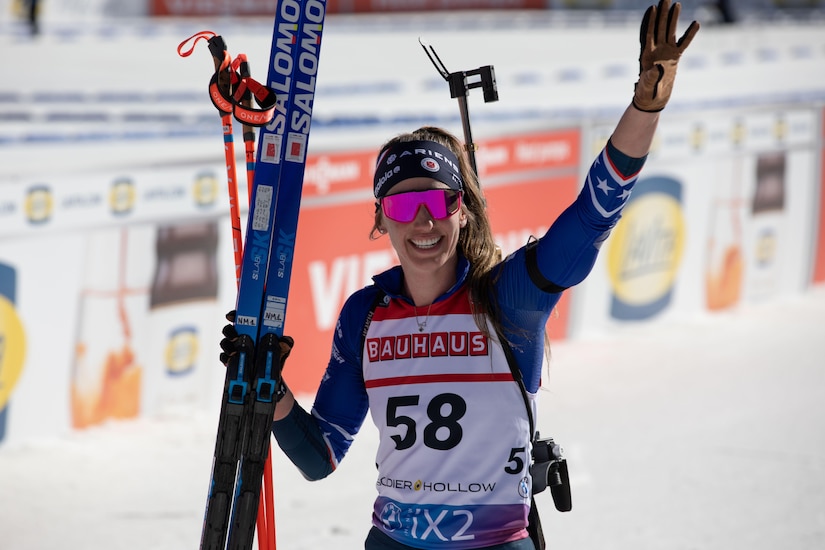
As the soldier breathed in the piercing cold, she reflected on the journey that brought her to her first Olympic Games in 2022.
"I definitely was like, once I start this race, I'm an Olympian," said Irwin, a member of the Army World Class Athlete Program. "And I think that kind of emotion kind of just like came over me like, I get to say that."
She quickly wiped the tears away before they froze on her face. The soldier clutched her ski poles tighter to keep the blood circulating in her fingers and narrowed her focus.
Irwin took an unorthodox path to become an Olympian, from training as a cross-country skier in Idaho to attending her first biathlon camp in upstate New York and finally to an enlistment in the Army.
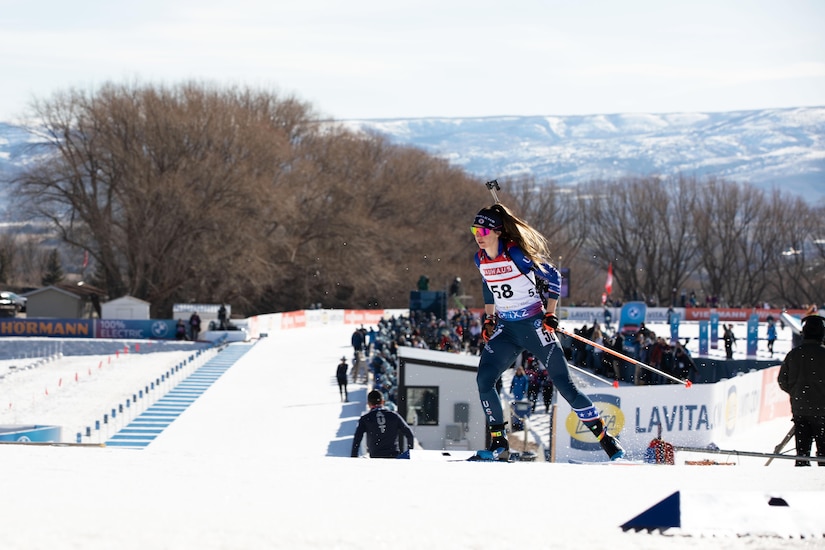
As a child watching the 2008 Summer Olympics, she dreamed of one day reaching the pinnacle of track and field. Days before her first Olympic race, she attended the opening ceremonies at Beijing National Stadium, in the same city that captivated her on television.
"It felt definitely full circle for me to kind of have those first memories growing up," Irwin said. "The Olympic dream kind of was always there."
At the time, Irwin didn't rank among the top 50 female biathletes in the world. But that day she would ski faster and fire more accurately than ever before.
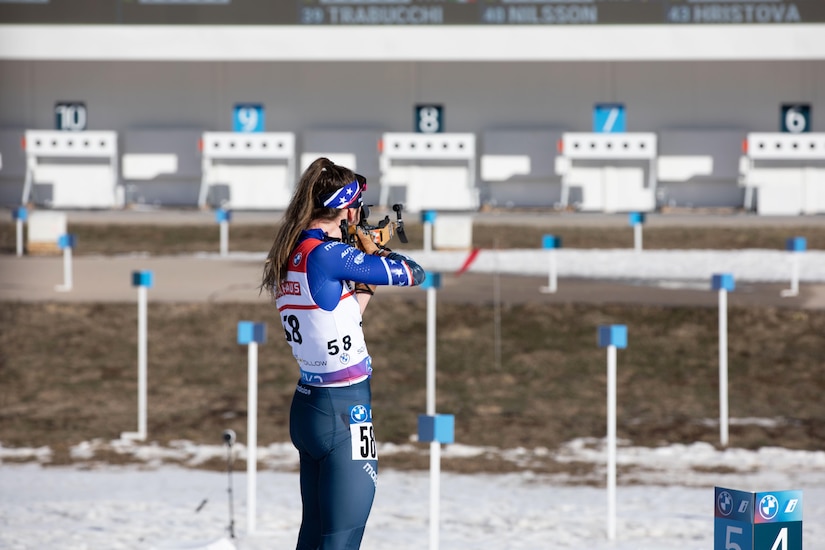
The temperature grew so cold that Irwin couldn't feel her fingers during shooting sessions, yet she still hit 19 of 20 targets. The cold didn't faze Irwin, as she finished in seventh place, the highest 15-kilometer finish ever by a U.S. biathlete. Irwin fell a single shot shy of winning the first U.S. Olympic medal in the sport.
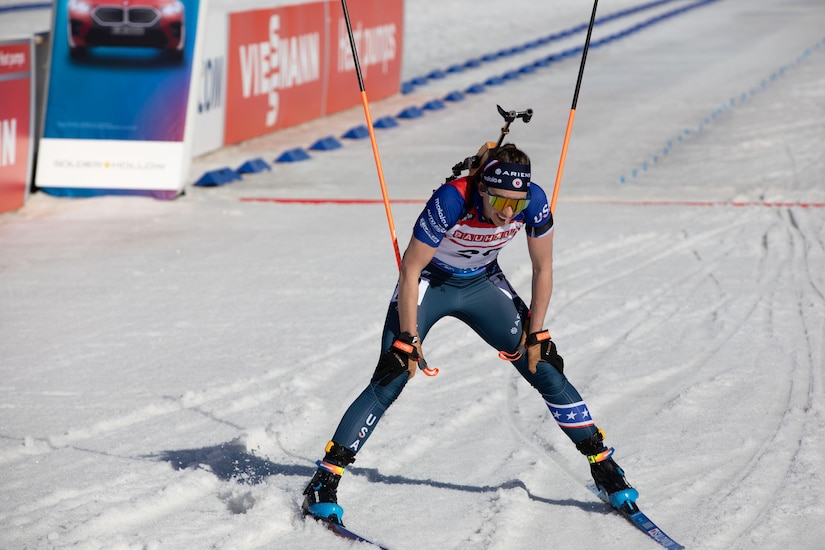
After crossing the finish line, Irwin let out a nervous, excited laugh.
"I had a crazy day," she said.
Still running on adrenaline, Irwin said she didn't sleep for days following the race.
Now at her second Olympic Games at 33, Irwin and her U.S. teammates vie to become the first Americans to medal in the biathlon at the 2026 Milan Cortina Olympics that began yesterday.
"I think we have really, really strong athletes on both the men's and women's side," Irwin said. "And I think I showed at the last Olympics that anything is possible."
Irwin, who ranks 26th in the world and No. 1 in the U.S., has a contingent of friends and family who traveled to northern Italy to support her, after COVID-19 restrictions prevented spectators from attending the Games in 2022.
Irwin notched her second top-10 World Cup finish of the season recently at the Nove Mesto World Cup in Prague. She hit 19 of 20 targets and finished 10th in the 12.5-kilometer mass start race.
"My story is a unique way to show persistence and just believe in yourself," Irwin said. "And really just kind of continuing on, even when you're met with changes."
To prepare for the Olympics, Irwin and the U.S. Biathlon team traveled to what she called an "elevation camp" in northern Italy to grow accustomed to competing at a high altitude. The Antholz-Anterselva Biathlon Arena, one of the highest biathlon competition venues in the world, sits more than 5,200 feet above sea level. The athletes log 12-20 hours of endurance training each week and work on interval sets to maintain peak physical fitness.
Irwin will be joined by Army Spc. Sean Doherty on the U.S. Olympic team, and as she learned in the Army, the United States will compete as a team. Doherty, an eight-time World Championship team member, will be competing in his fourth Olympics having placed seventh in the mixed relay at Beijing and 42nd in the men's individual race.
A Biathlete in the Making
Irwin didn't know it then, but she laid the groundwork for her future athletic career while growing up in the rural Midwest. Unlike many of her teammates, Irwin discovered the sport later in life.
Irwin competed in basketball, track and cross-country in Pulaski, a small Wisconsin town 20 miles west of Green Bay. At age 16, she began Nordic skiing during the Badger State's frigid winters to stay in shape for the track and cross-country seasons.
Irwin attended Michigan Technological University in Michigan's Upper Peninsula. There at the remote rural campus, she competed in cross-country and track. Irwin joined MTU's Nordic ski team, which trains at Mont Ripley, a ski area in the wilderness of Hancock, Michigan. Following graduation in 2016, she fell in love with Nordic skiing.
Irwin moved to Sun Valley, Idaho, in the Pacific Northwest, to pursue a spot on the U.S. Olympic Ski team. There she joined the Sun Valley Ski Education Foundation's Cross Country Gold Team.
Irwin had to humble herself and live within her financial means.
She said she became homeless for a short time, driving her car from house to house sleeping on friends' sofas while working as a dog caretaker. She struggled to earn income while training and remained on her parents' health care plan.
Irwin posted some of the best times in the nation, but she knew she needed to compete at a higher level to make the Winter Olympics.
When it became clear that she would not qualify for the Olympic team following the 2017-2018 World Cup season, she decided to move away from cross-country skiing.
Then, her best friend, Joanne Reid, asked her to give the biathlon a try, inviting Irwin to attend the U.S. biathlete camp in Lake Placid, New York.
The mental shift from racing down a slope to firing at a target became a motivating addiction. She learned the nuances of sight adjustment and trigger pressure.
"When you know you're doing well," Irwin said. "And then you get on the range, and you see all those shots go down; it's the coolest feeling in the world."
Irwin still struggled financially. She could barely afford gas, and fortunately, a friend donated her first rifle.
Irwin signed a contract with the Vermont National Guard Biathlon Program in 2019 and eventually joined WCAP.
"I don't think I would have gotten this far in biathlon without the support of the U.S. Army," Irwin said.
Gradually, she grew faster on the slopes. She started hitting targets more accurately and refined her shooting discipline. At the 2019 Biathlon National Championships, Irwin placed seventh in the sprint, fourth in pursuit and eighth in super sprint. Soon after she began improving on the World Cup circuit, finishing in second in the women's relay at the 2022 World Cup in Antholz, Italy.
After qualifying for the 2022 Olympics, Irwin reached a new pinnacle.
"I was never a state champion in running," Irwin said. "I was never an NCAA champion in Nordic skiing or anything like that. But I just knew that I had more in me and I wanted to keep pushing myself and I wanted to keep seeing how far I could get [in the biathlon]."
Irwin attended basic training at Fort Leonard Wood, Missouri, in 2019, followed by advanced individual training at Fort Jackson, South Carolina, where she studied to become a human resources specialist.
The discipline and learning to work with other soldiers changed Irwin.
"[Basic training] was one of the most mentally difficult things I've ever done," she said. "But ... I learned a lot about resilience and working as a team."
At boot camp, Irwin learned to fire an M16 rifle, a much heavier weapon than the lightweight, .22-caliber long rifle used by biathletes.
Guard, Army Comes to Her Aid
Irwin had repeatedly shielded Reid from the advances of a ski wax technician who abused Reid for years, according to an Associated Press report.
Irwin recalled learning about the Army's Sexual Harassment/Assault Response and Prevention Program, a concentrated effort by the service to eradicate sexually related crimes within its ranks.
Irwin reported her teammate's case to her chain of command at the Vermont National Guard. Her leaders took immediate action, eventually prompting an 18-month investigation by the U.S. Center for SafeSport, which safeguards Olympic athletes from abuse.
"Being able to tell my chain of command in the Vermont National Guard and having such overwhelming ... resources, they really made sure that I was taken care of, and that I was talking to the professionals," Irwin said.
During the PowHERful podcast, Irwin added that she risked her athletic career to bring change to the misogyny and abuse against women within the U.S. Biathlon program.
"We have to start the conversation for the 12-year-old athlete who wants to be in our position," Irwin said. "How do we make it better for them?"
During the investigations, Irwin still stayed on top of her fitness and used biathlon training as therapy. Irwin got lost in her training; running, skiing and shooting harder.
She said she never considered walking away from the sport.
"Continuing to train was therapeutic," she said. "It was my way of continuing to be in control of my life. A lot of that anxiety and stress or whatever is causing that in my life, it melts away."
Irwin said she not only represents the U.S. but also the Army and National Guard in this year's Winter Olympics. WCAP places athletes on active-duty orders during their pursuit of Olympic glory while supporting athletes with health care and training resources.
Irwin works remotely with nutritionists who analyze athletes' bloodwork and provide vitamin supplements. Irwin communicates directly with Army nutritionist Maj. Kelly Kaim through texts and emails.
"It's been a really amazing program to be a part of and the resources," Irwin said. "Everybody within their program has been a really, really huge help in this last push for the 2026 Olympics."
Irwin competed as part the U.S. Biathlon team in the mixed relay 4x6 kilometer event yesterday, finishing 14th.


 Posts
Posts


No comments:
Post a Comment