
The USS Curtis conducts a replenishment with the Japanese JS Hamana and the French frigate FNS Prairial in the Pacific Ocean, Feb. 19, 2021.
The USS Curtis conducts a replenishment with the Japanese JS Hamana and the French frigate FNS Prairial in the Pacific Ocean, Feb. 19, 2021.
March 1, 2021 | , DOD News
Reports of sexual assault by cadets and midshipmen at the three military service academies dropped from 122 in the 2018 school year to 88 in the 2019 school year. But the biggest changes happened in the fourth quarter, defense officials said, and those changes may be due to COVID-19.
The numbers were reported in the just-released Annual Report on Sexual Harassment and Violence at the Military Service Academies for the academic program year 2019 – 2020.

For both the 2018 and 2019 school years, reports of sexual assaults matched up pretty closely for the first three quarters. It wasn't until the fourth quarter where the number of reports for the 2019 school year fell below the numbers reported for the previous year, Nathan W. Galbreath, deputy director of the Department of Defense Sexual Assault Prevention and Response Office, said during a telephone briefing on Thursday.
"You will see that this year's academic program year matches almost, very well, quarter-for-quarter in the number of reports that they received, up until quarter four, when the pandemic response measures hit," he said. "As a result, we saw a decrease in quarter four of the number of sexual assault reports made at the academies, and we do attribute that to the fact that cadets and midshipmen were sent home."
While military service academy students were sent home as part of the COVID-19 pandemic response, Galbreath said, the ability to report sexual assaults and response and support measures remained.
"All sexual assault response coordinators and victim advocates remained available for cadets and midshipmen to make a report throughout the pandemic response," he said. "In addition to that, we saw excellent evidence that all of them went above and beyond in supporting ... the victims that were out there."

Also of note is that the DOD's SAPRO team expected to conduct a prevalence survey this year, which is an anonymous survey meant to ascertain the number of sexual assaults that occur in the group surveyed.
"That measure gives us an idea of the full scope of the problem, whether it's in the active force or at the academies," Galbreath said.
Due to the COVID-19 pandemic, Galbreath said, the survey was not conducted this year. He said the nature of the survey and the accuracy it provides, requires it be done in person, rather than via computer. He also said the DOD SAPRO team expects to attempt to conduct that survey again in April 2022.
Also of note in the most recent report is that while service academy students report confidence in their officer and academy leadership, they don't have the same trust in their student leadership, Galbreath said.

"Overall, our surveys and our focus groups tell us that student culture really impacts the experience of cadets and midshipmen," he said. "What we find is that our feedback and our focus group data says that the cadets and [midshipmen] don't have a lot of confidence in their cadet chain of command to step-up and do the right thing, when placed into positions of learning how to lead."
Galbreath said the DOD SAPRO team asked the service academies to take steps to better prepare those student leaders to intervene and enforce standards of discipline, dignity and respect.
"Sexual assault and sexual harassment are persistent and disruptive problems that have no part in military service," Army Maj. Gen. Clement Coward, the director of DOD's SAPRO, said. "The academies are making progress, but considerable work remains to continue reducing and stopping sexual assault at the academies. We look forward to visiting the academies this summer to review their efforts in depth and align them with the secretary of defense's vision and direction to eliminate the scourge of sexual assault and sexual harassment from our military."

Marines and sailors lift a tactical vehicle from the USNS Pililaau during Hagatna Fury at Naval Base Guam, Feb. 22, 2021. The exercise allows Marines to hone abilities to seize, defend and provide expeditionary sustainment for key maritime terrain.

Navy Petty Officer 2nd Class Lesly Oseguera, left, operates a portable exothermic cutting unit with Petty Officer 1st Class Ian Abbott aboard the aircraft carrier USS Dwight D. Eisenhower in the Atlantic Ocean, Feb. 27, 2021.

Honor Guard members present colors during an award ceremony at Travis Air Force Base, Calif., Feb. 19, 2021.

The Coast Guard cutter Polar Star sits at anchor in Taylor Bay, Alaska, Feb. 10, 2021, as it nears the end of monthslong Arctic deployment.

March 1, 2021
The following individuals have been sworn-in virtually or in-person from Feb. 23, 2021, through today, March 1, 2021.
For the lists of personnel sworn-in previously, please see the releases on Jan. 20, 2021, Feb. 9, 2021, Feb. 16, 2021 and Feb. 22, 2021.
March 1, 2021
The Department of Defense announces a new $125 million package for the Ukraine Security Assistance Initiative that includes training, equipment, and advisory efforts to help Ukraine’s forces preserve the country’s territorial integrity, secure its borders, and improve interoperability with NATO.
This action reaffirms the U.S. commitment to providing defensive lethal weapons to enable Ukraine to more effectively defend itself against Russian aggression.
The USAI package includes two additional armed Mark IV patrol boats to enhance Ukraine’s capacity to patrol and defend its territorial waters. To date, the U.S. has committed a total of eight Mark IV patrol boats. The package also includes capabilities to enhance the lethality, command and control, and situational awareness of Ukraine’s forces through the provision of additional counter-artillery radars and tactical equipment; continued support for a satellite imagery and analysis capability; and equipment to support military medical treatment and combat evacuation procedures.
The remaining $150 million in fiscal year 2021 USAI funds appropriated by Congress will be provided when the Defense Department, in coordination with the Department of State, certifies that Ukraine has made sufficient progress on key defense reforms this year, as required by the National Defense Authorization Act.
The Department encourages Ukraine to continue to enact reforms that strengthen civilian control of the military, promote increased transparency and accountability in defense industry and procurement, and modernize its defense sector in other key areas in line with NATO principles and standards.
The United States has committed more than $2 billion in security assistance to Ukraine since 2014 and remains committed to assisting Ukraine with the implementation of these reforms to advance its Euro-Atlantic aspirations in support of a secure, prosperous, democratic, and free Ukraine.

Secretary of Defense Lloyd J. Austin III speaks with service members aboard the USS Essex, Feb. 25, 2021.
Feb. 26, 2021
Today, the Department of Defense released the stand-down training materials to address extremism as one of the initial steps in support of the memo directing commanding officers and supervisors at all levels to conduct a one-day "stand-down". The training materials provide services and components information on training and facilitated discussions to address the issues of extremist ideology within the ranks.
The training material can be found here.
Feb. 26, 2021 | , DOD News
America's nuclear triad consists of heavy bombers, submarines and intercontinental ballistic missiles capable of delivering nuclear weapons.
The nuclear triad is important because it's there to deter Russia, China and, to some extent, North Korea and Iran from delivering nuclear strikes on the U.S. and its allies, said Air Force Gen. John E. Hyten, vice chairman of the Joint Chiefs of Staff.

He spoke at the virtual Air Force Association's Aerospace Warfare Symposium today, mentioning aspects of the New START treaty with Russia, which places verifiable limits on all Russian-deployed ICBMs. That treaty is in effect until Feb. 4, 2026.
Hyten said he and other Defense Department officials think the New START treaty is a good thing because it limits nuclear weapons and has a process to verify adherence.
However, the New START treaty should be just the beginning of a larger discussion with Russia and China about placing further limits on nuclear weapons proliferation, he said.
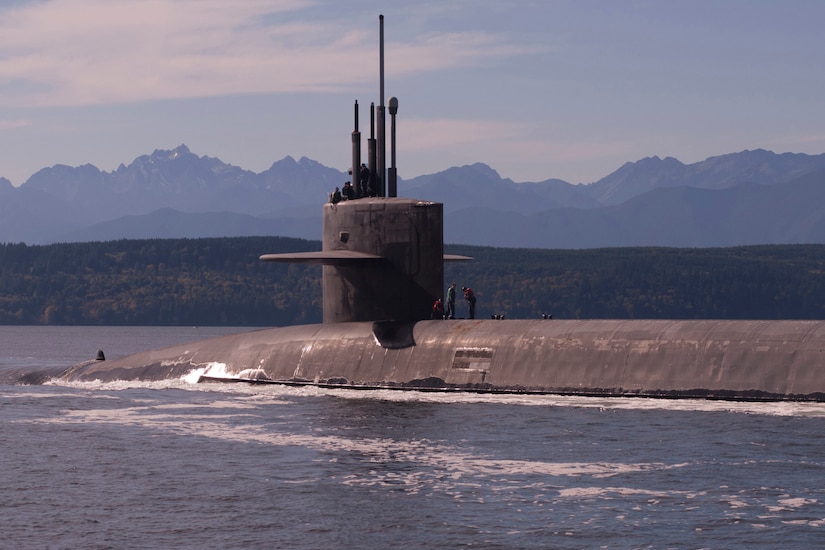
For instance, Russia is building new capabilities — such as nuclear-armed torpedoes, nuclear armed cruise missiles and sea-launched ballistic missiles — that can threaten the U.S. and are not accountable under the treaty.
And, then, there's China, Hyten said. "China is the fastest growing nuclear power in the world. They're building at a percentage level, more new nuclear weapons than anybody on the planet. They're building new platforms. They're building new facilities, new airplanes, new missiles of a variety of types, new hypersonic capabilities, hypersonic capabilities that we have no defenses for, hypersonics that can be nuclear tipped.
"And we have no arms control agreement with China in any way, so we have no insight into their nuclear doctrine," he added. "That is a difficult place to be."

The other problem is that while Russia is finishing its nuclear modernization program and China is in the midst of rapid modernization, the U.S. is just starting its nuclear modernization program, he said.
The U.S. must also have a credible sea-launched cruise missile in order to respond to the Russian capabilities and a low-yield nuclear weapon that can be deployed in small numbers on submarines to deal with the thousands of low-yield nuclear and tactical nuclear weapons Russia is building that aren't accountable with the New START treaty, he said.
"We have to continue to invest in our triad and make sure that we look at all of our adversaries' capabilities because the one thing we don't want is nuclear confrontation and nuclear war on this planet. And the only way to avoid that is to deter our adversaries," he said.
Air Force Gen. Timothy M. Ray, commander of Air Force Global Strike Command, and Air Force Lt. Gen. Thomas Bussiere, deputy commander of U.S. Strategic Command, also spoke at the event.
Feb. 26, 2021
The United States Acting Assistant Secretary of Defense for International Security Affairs, Dr. Mara Karlin, and the Minister of Defence of the Republic of North Macedonia, Radmila Shekerinska, co-signed a Memorandum of Understanding to facilitate defense cooperation today.
The MoU highlights current avenues of bilateral cooperation and signals the intent to build on the strategic relationship by promoting joint training and exercises, enhancing counterterrorism capabilities, increasing professional military education and exchange opportunities, and improving interoperability.
The signing was followed by a phone call where Karlin and Shekerinska discussed the upcoming one-year anniversary of North Macedonia’s accession to NATO and opportunities to further strengthen the partnership.
Feb. 26, 2021 | , DOD News
Each generation has heroes — people who rise above the humdrum and mediocre to inspire those around them and who follow them, to aspire to better themselves and their nations.
Henry O. Flipper — the first African-American graduate of the U.S. Military Academy — was one of the heroes who inspired Secretary of Defense Lloyd J. Austin III, the secretary told students at Defense Department Education Activity high schools at Fort Knox and Fort Campbell, Kentucky.

The first African American leader of the department, who was also a West Point graduate, spoke virtually about his motivations and inspirations for Black History Month.
Flipper was from Austin's hometown of Thomasville, Georgia. He was born enslaved and freed as a result of the Civil War. After his 1877 graduation from West Point, Flipper was commissioned a second lieutenant in the 10th Cavalry Regiment — an all-Black unit in the western U.S. that American Indians called Buffalo Soldiers.
"As a young man growing up in Georgia, I never would have, would have imagined that I'd be walking the halls of the Pentagon, let alone doing that with the president and the vice president of the United States of America," Austin told the students.
"It is my distinct honor to serve as a secretary of defense," he said. "In that capacity, my number one job is to defend our country and secure our nation's interest[s] around the globe. I do this by leading and serving alongside a diverse group of nearly 3 million hard working professionals — soldiers, sailors, airmen, Marines and guardians."

The secretary told the students that DOD is stronger the more diverse it is. He wants DOD to mirror the make-up of the larger American people, which it does with 40 percent of the force representing people of color.
"I think … the military has led the way … in terms of providing opportunity, not only to join, but providing opportunity for promotion," he said. "One of the things that I think we're going to have to work on going forward is making sure that the senior ranks of the military also reflect what the military looks like."
Austin wants senior leadership in the United States military to mirror America's diversity. "That's one of the things I'm going to work on while I'm in this job," he said.
"Black history is American history," Austin said. Heroes of every hue inspire Americans of every hue.
The heroes are willing to step up and make the country better. They are willing to secure the freedoms and rights and privileges for all Americans. "Your generation won't be any different," Austin said.
Feb. 26, 2021
Secretary of Defense Lloyd J. Austin III announced today that the president has made the following nominations:
Rear Adm. (lower half) William E. Chase III has been nominated for appointment to the rank of rear admiral. Chase is currently serving as senior military advisor for cyber policy to the under secretary of defense for policy; and the deputy principal cyber advisor to the secretary of defense, Washington, D.C.
Rear Adm. (lower half) Christopher C. French has been nominated for appointment to the rank of rear admiral. French is currently serving as legal counsel to the chairman of the Joint Chiefs of Staff, Washington, D.C.
Rear Adm. (lower half) William C. Greene has been nominated for appointment to the rank of rear admiral. Greene is currently serving as fleet maintenance officer, U.S. Atlantic Fleet, Norfolk, Virginia.
Rear Adm. (lower half) Joseph D. Noble Jr., has been nominated for appointment to the rank of rear admiral. Noble is currently serving as commander, Naval Supply Systems Command Weapons Systems Support, Philadelphia, Pennsylvania.
Rear Adm. (lower half) John A. Okon has been nominated for appointment to the rank of rear admiral. Okon is currently serving as commander, Naval Meteorology and Oceanography Command, Stennis Space Center, Mississippi.
Rear Adm. (lower half) Scott W. Pappano has been nominated for appointment to the rank of rear admiral. Pappano is currently serving as program executive office, Columbia, Washington, D.C.
Rear Adm. (lower half) Dean A. VanderLey has been nominated for appointment to the rank of rear admiral. VanderLey is currently serving as commander, Naval Facilities Engineering Systems Command Atlantic with additional duties as fleet civil engineer (N01CE), U.S. Atlantic Fleet, Norfolk, Virginia.
Capt. Kristin Acquavella has been nominated for appointment to the rank of rear admiral (lower half). Acquavella is currently serving as director, plans and policies, N415, Office of the Chief of Naval Operations, Washington, D.C.
Capt. Maria L. Aguayo has been nominated for appointment to the rank of rear admiral (lower half). Aguayo is currently serving as chief of staff, Naval Facilities Engineering Systems Command, Washington, D.C.
Capt. Joseph B. Hornbuckle has been nominated for appointment to the rank of rear admiral (lower half). Hornbuckle is currently serving as chief of staff, Naval Air Warfare Center Aircraft Division, Patuxent River, Maryland.
Capt. Ronald J. Piret has been nominated for appointment to the rank of rear admiral (lower half). Piret is currently serving as chief of staff, Naval Meteorology and Oceanography Command, John C. Stennis Space Center, Hancock County, Mississippi.
Capt. Anthony E. Rossi has been nominated for appointment to the rank of rear admiral (lower half). Rossi is currently serving as major program manager, Mission Integration and Special Programs Office, PMA 298, Patuxent River, Maryland.
Capt. Stuart C. Satterwhite has been nominated for appointment to the rank of rear admiral (lower half). Satterwhite is currently serving as deputy director, enterprise support, Office of the Chief of Naval Personnel, Washington, D.C.
Capt. Ralph R. Smith III has been nominated for appointment to the rank of rear admiral (lower half). Smith is currently serving as director, Maritime Operations Center, U.S. Tenth Fleet/U.S. Fleet Cyber Command, Fort Meade, Maryland.

A B-1B Lancer pilot prepares to take off from Dyess Air Force Base, Texas, Feb. 21, 2021. The B-1 is capable of providing vast numbers of precision and non-precision bombs at any moment against any enemy, anywhere in the world.
Feb. 25, 2021
Q: You'd look a lot nicer without a mask.
SECRETARY OF DEFENSE LLOYD J. AUSTIN III: Well, my wife thinks I look better with a mask on. (Laughter.) I'm just kidding.
Hey, it's -- it's been a -- it's been a great day for me today. And I've had an opportunity to go to NORTHCOM and visit with General VanHerck and talked about -- talked to him about what the command is doing in support of FEMA. He was in support of the overall whole-of-government, whole-of-nation effort to -- to get the vaccines out.
And we clearly -- his command has done some impressive things over time in a very short period of time, quite frankly. And what you see here today is evidence of that.
This is -- this looks easy. But when you think about the fact that we have active components troops here, National Guardsmen here, civilian agencies here, local agencies all working together like a well-oiled machine, it's really impressive. And -- and when you -- when you take a look at this, it makes you proud to be in America.
Now, many of these troops that you see here have -- have served in combat zones. They've been out helping people all over the world do things like run their local governments and, you know, towns and villages; administer health care to their citizens; you know, you name it -- provide security.
But you know, I asked a number of our troops today how they feel about being able to come here and help in America, understanding that every shot that they deliver to a person is probably helping to save that person's life eventually. And -- and that's a big deal. That's -- we're in the business of -- of protecting Americans and saving lives. And they feel really good about what they've been doing.
As important, the people that they've been helping feel really good about having them here as well. You know, I talked to some of our local officials and civilian agency heads. And they've told me that, you know, what the military brings to -- to this equation is -- is discipline, organizational skills and effectiveness. And they were impressed by the fact that, every day, our troops take a look at things and endeavor to get better.
You know, good is not good enough. And so they've started in one place and over time -- a very short period of time increased the capacity in ways that we probably couldn't have envisioned a couple of weeks ago. In the walk-up site, I think we're doing some 2,000 shots a day and with a very short wait -- wait time. And here you see the evidence of what organization and teamwork and discipline brings to the equation.
You know, I'm not a very emotional guy, but there are two things I heard here today that almost brought tears to my eyes.
The first thing I heard was from the commander, Lieutenant Colonel Olson, who said, our ability to be here is a bestowal of trust by the American people on us.
You know, that -- that -- that rocked me backwards. Unsolicited, heartfelt -- Olson's been in some tough places and -- and -- and that's a powerful statement.
The other thing I heard that almost brought tears to my eyes was one of our young soldiers here, a young sergeant, is from this neighborhood -- and you've seen him reported on before -- but I didn't realize this and he told me he administered, you know, the vaccine to his mother. That -- that rocked me backwards, as well, and -- and -- almost brought tears to my eyes.
So the ability to do things like that, I think, you know, it really makes a difference and our -- our troops find -- find this to be a very meaningful deployment. And -- and -- it's -- it's a real pleasure to come and -- and -- and see how well this is working but just be -- just -- just as a reminder, you know, we're in support of FEMA, who is in support of the whole of nation effort to get the vaccines out as -- as -- as rapidly as possible and as effectively as possible.
And I think we're learning some lessons, we're sharing those lessons and so I think we're off to a -- a really, really good start. And with that, I'll stop and -- and take a couple questions.
Q: Hi, thank you, Mr. Secretary. You've talked about lessons learned. Can you give us an example of what you think the military has learned at, say, here or these spots that you've talked to people about today, that they can put into motion in other places so it's sort of the new ones?
And you've approved 25 so far, back to these (inaudible). When do you think you will be approving more?
SEC. AUSTIN: We'll improve more when -- as we get requirements, requests from FEMA. You know, again, we're in support of FEMA and -- and -- and until that happens, we'll continue to make sure that we identify the capability and capacity to -- to continue to help.
In terms of the things that we have learned, you know, it's interesting -- our civilian counterparts have -- have -- we've learned a lot from them -- excuse me -- and then we have -- they've learned some things from us, as well, in terms of how to organize, you know, the queues, you know, how to -- how to be more effective in reaching out to people.
I talked to the mayor earlier and he pointed out to me that, you know, with the help of mobile teams, they've been able to reach populations and people that -- that -- you know, that would -- they would not have reached otherwise.
And so one key lesson learned is more mobile teams are -- you know, are good. And so we'll take those lessons back to Jeff Zients, who's running the national effort, who no doubt has already heard this, but he and his team are doing amazing work, great work.
Q: Mr. Secretary, do you think that – how can I put it -- is there a way in those lessons learned to make the civilians learn to react faster, quicker? Has the military taught that lesson to people?
SEC. AUSTIN: Well, you know, I -- I think -- I think we're learning from each other and I think there are -- there are, you know, elements in -- in every community, every state that are really moving at -- at -- at a pretty rapid pace.
Again, what we bring to the -- to the table is organizational skills that -- you know, a little discipline and -- and -- and we -- we have a focus on -- on trying to be better tomorrow than we were today. I mean, that's -- that's in our DNA, that's how we train, that's how we fight, that's how you win -- that's how you win battles, as you well know.
So, you know, I think -- I think there are things that we can continue to export to the civilian community but as important, there are things that we're learning from the civilian community and -- and we'll certainly -- certainly take those lessons to heart.
(CROSSTALK)
Q: ... Mr. Secretary, can I ask -- I'd like to ask you about vaccine hesitancy, particularly in the African American community. You are the highest ranking African American male in the Biden administration. What would you say directly to African Americans who point to things like the Tuskegee syphilis experiments on black men as a reason why they don't want to come here and get a vaccine?
SEC. AUSTIN: Well I think -- I mean, they're -- because of some things that have happened in the history, there's a -- there's a degree of -- of mistrust and I think we have to collectively work hard to -- to dispel rumors and to provide facts to people.
And it's been my experience that when armed with the facts, people will -- will tend to make the right decisions -- and these are individual decisions and we want to make sure that they have the best -- best information available to -- to make those decisions.
At the end of the day, you know, people are going to go home and -- and talk to their -- their families, their physicians, and we want them to do that, but we want them to have the facts. And so in DOD, what we do is -- is we're -- we're trying to make sure that we get as much information out -- factual information out as possible through the chain of command but we also do things like -- like, you know, put as much information as possible on our website, we -- we have commanders that are -- that are making videos, talking -- addressing this issue -- I've made a video myself -- and -- and -- but -- but it's -- it's really important that -- that, you know, people have the facts. And we've found that armed with the facts, they'll make the right decisions typically.
I've taken a vaccine. It is -- it is -- you know, I consider it to be safe. You know, we've not seen very many side effects that are -- that are harmful and -- and so this is the most researched, you know, tested vaccine that we've seen ever probably and it's -- and the efficacy is just incredible.
So my -- my counsel to -- to everyone is, I mean, this saves lives. And it's not just about saving our life, it's about saving our partner's life, our neighbor's life, and in the military, you know, we -- we -- we thrive on teamwork and we have to think about our teammates, as well.
So my getting the vaccine could potentially help save the life of a -- of a teammate.
(CROSS-TALK)
Q: So on that note of you making the push to service members to get vaccinated, the Navy has decided they're going to relax on liberty rules for some sailors on deployment if they've been vaccinated. Is there any guidance you can push to the service secretaries, the service chiefs about looking at their own -- the way that things work for them and coming up with some sort of incentives for soldiers, for airmen to get vaccinated?
SEC. AUSTIN: You know, the -- the greatest incentive to getting vaccinated is that it saves your life and it saves the life of -- of the folks that -- that -- that mean a lot to you and -- and I think that -- that, in and of itself, is -- is very, very important.
And I'd just like to say that -- that I have every confidence in our service secretaries and our service chiefs that they will do the right thing in terms of taking care of their -- their populations and I'm really proud of them and thankful for their focus on what they're doing.
STAFF: Last question to you, Jim.
Q: Mr. Secretary, did the civilian authorities ask you for anything? Did they -- did they say that they would recommend this process in other communities?
SEC. AUSTIN: I -- I -- I -- there's no question -- I -- I didn't ask that specific question but there's no question in my mind that, based upon what I heard in terms of feedback, that they would, and -- and they -- they really liked the approach that -- that we've all taken in terms of, you know, what can we do to get -- to -- to become more efficient, to get better, to get more vaccines in arms. They -- they liked the way that these various communities have come together, and -- and -- and quite frankly, I -- I think this is one of the most amazing things that we've seen lately.
Again, you -- you don't see any competition here. The only competition is, you know, to -- to beat the vaccine, to -- to get as much -- to beat the pandemic, to get as much vaccine out as we can possibly get out, but -- but I think, just based upon what I've heard from them, that, you know, there's no question in my mind that they would recommend a process like this in other places.
STAFF: Thank you all very much, we've got to get going. Appreciate it.
Q: Thank you.


 Posts
All Comments
Posts
All Comments


