The Navy’s Blue Angels fly over Mount Rushmore, S.D., during a Salute to America celebration, July 3, 2020. The Blue Angels, based out of Naval Air Station Pensacola, Fla., were part of the Defense Department’s participation in the event.
The Navy’s Blue Angels fly over Mount Rushmore, S.D., during a Salute to America celebration, July 3, 2020. The Blue Angels, based out of Naval Air Station Pensacola, Fla., were part of the Defense Department’s participation in the event.
"It has been a crazy year, and it's just early July," Air Force Gen. Joseph L. Lengyel said today during a Brookings Institution webcast today titled "The Force America Needs: Lessons of 2020 and the Future of the National Guard."
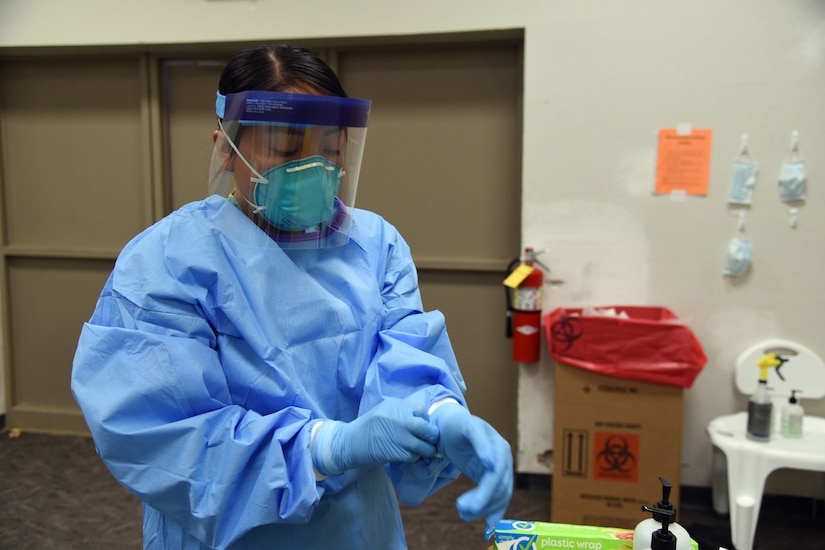
With COVID-19 cases on the rise in some states and no reduction to worldwide operational commitments, Lengyel said, he sees no reduction in operations tempo.
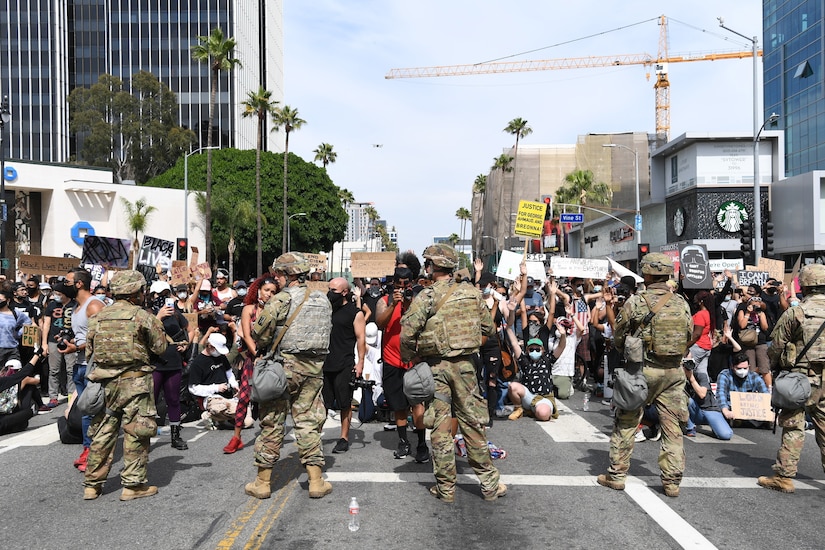
About 45,000 members of the guard have been assisting with COVID-19 mitigation efforts in every state and territory since the pandemic started, the general said. Another 45,000 supported the law enforcement response to civil disturbances in 33 states.
"All across the country, the National Guard was aiding the American people, delivering personal protective equipment, and in some cases, they were manufacturing personal protective equipment, staffing food banks and test centers, protecting peaceful protesters' First Amendment rights, and sharing best practices as we learn how to do some of these things," Lengyel said.
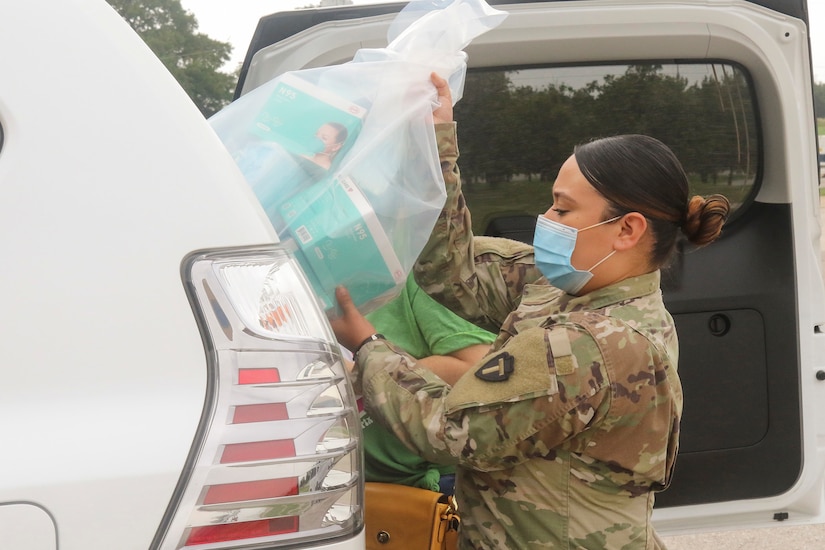
Infantry officers were running food banks and COVID-19 test sites, he noted, adding that the National Guard "can do any task that our nation needs them to do."
While serving Americans on the homefront, none of the National Guard's operational commitments to combatant commanders around the world were reduced, he added.
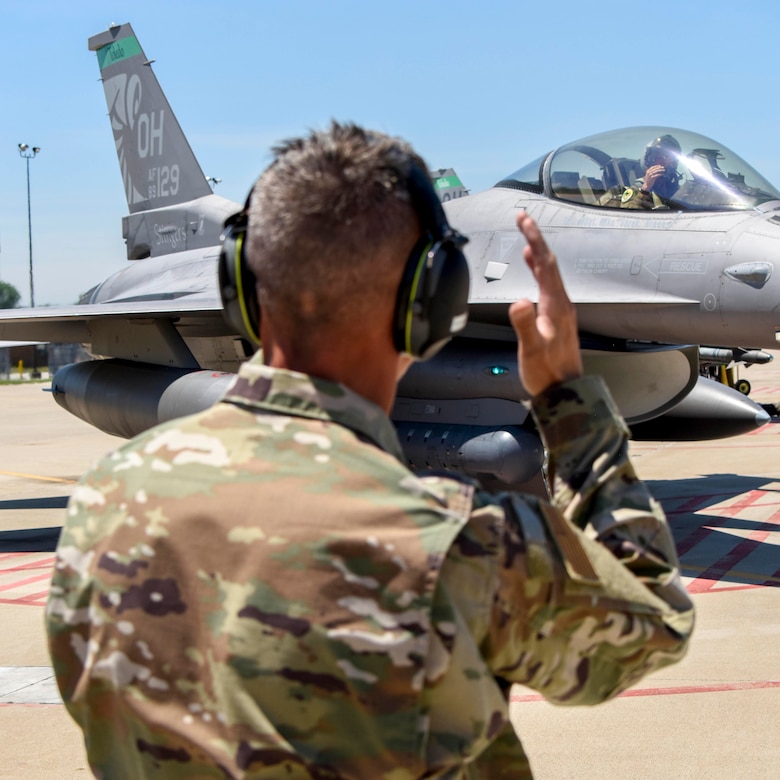
Lengyel said the National Guard has been involved in space operations for at least 25 years and that he hopes it will play a major role in the Space Force, the newest military service.
The National Guard has some unique advantages in the Defense Department, the general said. A big advantage, he pointed out, is that it is less costly to fund the guard compared to the active forces. In time of war or national emergency, the National Guard can be quickly mobilized and used at the federal level or under the direction of the state governors, he added.
Lengyel said that when he joined the Air Force more than four decades ago, the National Guard was used as a strategic reserve. Today, he said, its is an important component of the operational force, trained and equipped with modern weapons and ready to support combatant commanders globally.

Army paratroopers descend after jumping from a C-17 aircraft during training at Andersen Air Force Base, Guam, June 30, 2020, as part of Spartan Flex, an operation to exercise joint capabilities in the Indo-Pacific region.
The Department of Defense is concerned about the People’s Republic of China (PRC) decision to conduct military exercises around the Paracel Islands in the South China Sea on July 1-5.
The designated area where the exercises are due to take place encompass contested waters and territory. Conducting military exercises over disputed territory in the South China Sea is counterproductive to efforts at easing tensions and maintaining stability. The PRC’s actions will further destabilize the situation in the South China Sea. Such exercises also violate PRC commitments under the 2002 Declaration on the Conduct of Parties in the South China Sea to avoid activities that would complicate or escalate disputes and affect peace and stability.
The military exercises are the latest in a long string of PRC actions to assert unlawful maritime claims and disadvantage its Southeast Asian neighbors in the South China Sea. The PRC’s actions stand in contrast to its pledge to not militarize the South China Sea and the United States' vision of a free and open Indo-Pacific region, in which all nations, large and small, are secure in their sovereignty, free from coercion, and able to pursue economic growth consistent with accepted international rules and norms.
The Department of Defense will continue to monitor the situation with the expectation that the PRC will reduce its militarization and coercion of its neighbors in the South China Sea. We urge all parties to exercise restraint and not undertake military activities that might aggravate disputes in the South China Sea.
Secretary of Defense Dr. Mark T. Esper issued the following statement:
"Today, I’m proud to announce the U.S. Senate has officially confirmed General Gustave F. Perna as Chief Operating Officer of Operation Warp Speed (OWS). With experience as Commander of the Army’s Materiel Command (AMC), General Perna is exceptionally well qualified to help lead this historic operation to accelerate the development, manufacturing, and distribution of COVID-19 medical countermeasures. I have every confidence General Perna will carry out the duties of this mission with proficiency and professionalism, and the Department of Defense is committed to ensuring he has the resources, authority, and support he needs throughout this process."
Today, federal authorities filed a criminal complaint against 22-year-old Cecily Aguilar in connection with the disappearance of U.S. Army Specialist Vanessa Guillen, announced U.S. Attorney John F. Bash, U.S. Army Criminal Investigative Command (USACID) Special Agent in Charge Vanessa Neff at Fort Hood, and FBI Special Agent in Charge Christopher Combs, San Antonio Division.
The criminal complaint charges Aguilar with one count of conspiracy to tamper with evidence. According to the complaint, 20-year-old U.S. Army Specialist Aaron Robinson told Aguilar that he killed a female soldier by striking her in the head with a hammer while on Ft. Hood on April 22, 2020. Robinson further admitted to Aguilar that he transferred the woman’s body off of Ft. Hood to a remote site in Bell County. Subsequently, Robinson enlisted the help of Aguilar in disposing of the dead female’s body. The complaint further alleges that at a later time Aguilar recognized the deceased, whom she helped Robinson mutilate and dispose of, as Vanessa Guillen. The remains found in Bell County have yet to be formally identified by authorities.
The complaint further states that earlier this week, Robinson shot and killed himself when confronted by police.
Upon conviction, Aguilar faces up to 20 years in federal prison and a maximum $250,000 fine. She remains in custody at this time awaiting her Initial Appearance in federal court in Waco. The hearing is expected to take place early next week.
Agents and investigators from USACID, FBI, Texas Rangers, Bell County Sheriff’s Office, Killeen Police Department, Belton Police Department, Texas Parks and Wildlife and the U.S. Marshals Service are continuing to investigate this case. Assistant U.S. Attorneys Mark Frazier and Greg Gloff are prosecuting this case on behalf of the government.
A criminal complaint is merely a charge and should not be considered as evidence of guilt. The defendant is presumed innocent until proven guilty in a court of law.
Recently, the department approved award of the Armed Forces Service Medal and Humanitarian Service Medal to recognize service members for their qualifying participation in COVID-19 operations or activities. Both Active and Reserve Component members are eligible for such recognition.
The period of award for both medals is from Jan.31, 2020, to a future “to be determined” termination date. Given the global nature of the COVID-19 pandemic, there is no designated ‘area of eligibility’; rather, award authorities determine eligibility based on the nature of the member’s participation in qualifying DoD COVID-19 operations and activities.
Military Department Secretaries determine eligibility for award to service members in his or her respective Military Department based on DoD award criteria. The Chief of the National Guard Bureau determines eligibility for National Guard members who do not fall under the purview of a Secretary of a Military Department.
Service members are not eligible for both medals based on the same activities, deployment, or period of service. Due to the global nature of the COVID-19 pandemic, as an exception, the Armed Forces Service Medal is authorized for award for 30 consecutive or non-consecutive days of qualifying service.
Additionally, the Armed Forces Service Medal deployment requirement is waived for non-deployed service members, provided the members were re-assigned from their normal duties to primarily perform duties related to DoD COVID-19 operations or activities for 30 consecutive or non-consecutive days.
Due to the health risk posed by COVID-19, award of the Armed Forces Service Medal is authorized for one day of qualifying service if that service resulted in the member contracting the virus. (Note: Similar waivers are not required for the Humanitarian Service Medal because award criteria do not include a deployment requirement or a minimum period of qualifying service for award.)
More details can be found in the related memo here.
Like so many units at Hill Air Force Base, Utah, the 309th Maintenance Support Group has had to adjust its battle rhythm due to COVID-19. The unit is working hard to ensure other teams within the Ogden Air Logistics Complex can continue to support their critical missions while keeping employees safe from the coronavirus.

Gene Kourtei, the deputy group director for the 309th MXSG, said that although it's been a challenge, his team has been successful in elevating and achieving the three priorities of keeping employees safe, continuing to meet mission demands and exceeding customer expectations.
"We've worked really hard, and I'm proud of our entire team," Kourtei said. "We've significantly limited the effects of the pandemic to our most important resource while optimizing how we perform business in a constrained environment. I’d like to think a lot of that is due to the deliberate, quick and proactive methodology."
The approach started with using processes already in place to become the central supplier for the entire complex for necessary items such as masks, hand sanitizer and disinfectants.

"We were able to supply everyone in a quick manner," Kourtei said. "We did a great job of purchasing what we could find as fast as we could and distributed those critical items throughout the complex as rapidly as possible."
The unit's engineering team was tasked with developing a response plan in the event of workplace contamination. The team developed a comprehensive checklist that postured the complex to be ready to respond to a multitude of different scenarios. Kourtei said being prepared and transparent at every level has helped employees feel comfortable and safe.
Perhaps the biggest challenge, he said, was developing a teleworking posture.

"Historically, we have never teleworked," Kourtei said. "Moving from no telework to full telework was a test of the complex's agility. Our ability to pivot to that environment was as good as you could ask for. We have kept and continue to keep our employees safe with robust cleaning plans and protocols. I believe the customers didn’t feel much, if any, impact. Our job moving forward is to maintain it that way."
Kourtei said they are ready and prepared to support the complex for as long as needed. They've worked hard to improve communications and have developed solid processes for keeping employees and their worksite environment COVID-19 free while ensuring warfighter demands continue to be met.
(Kendahl Johnson is assigned to the 75th Air Base Wing.)
The Secretary of Defense and Chairman of the Joint Chiefs of Staff briefed the President yesterday on plans to redeploy 9,500 troops from Germany. The proposal that was approved not only meets the President’s directive, it will also enhance Russian deterrence, strengthen NATO, reassure Allies, improve U.S. strategic flexibility and U.S. European Command’s operational flexibility, and take care of our service members and their families. Pentagon leaders look forward to briefing this plan to the congressional defense committees in the coming weeks, followed by consultations with NATO allies on the way forward. We will be providing timely updates to potentially affected personnel, their families and communities as planning progresses.
Navy Vice Adm. Jon Hill, the agency's director, told the Hypersonic Weapons Systems webinar in London the agency is looking to adapt current technologies against the hypersonic threat while looking toward new capabilities.
"The sad reality is that many of these threats, regardless of how they're launched and what their profiles are, really do look like hypersonic threats," he said.
Ballistic missiles as they approach impact are hypersonic, as are many maneuverable cruise missiles. "So if you're the sailor on the deck of a ship, they all look the same to you," Hill said. "If you're a soldier manning a land-based battery, it's going to be maneuvering and coming in very quickly at hypersonic speeds. If you're one of the airmen that's manning one of the many sensors that are out there, it's going to look fast, and it's going to be moving quickly."

So, the hypersonic threat already exists. The Missile Defense Agency now must adapt as the threat morphs, Hill said. Right now, the hypersonic threat is almost ancillary to the capabilities of ballistic and cruise missiles, he added, but as competitors test and build, that threat will become more sophisticated.
"We're defending the United States, our deployed forces, our allies and friends from missile attacks in all phases of flight," Hill said. It is a simple mission statement, but not so simple to execute.
The key to the program is the sensor array. "We leverage all sensors, and many, many countries are in the business of fusing data so that you have a complete track picture," the admiral said. "We call it from … birth-to-death tracking and that is absolutely required. You don't want to lose track of the threats, particularly if [they are] unpredictable and maneuverable."
The agency will leverage space sensors, which is typically how it sees initial launches. "We will fly through ground-based sensors," he said. "We have ships with the sensing capability deployed globally. Another great way that we partner with our allies that sensor architecture is critically important, particularly as the threats become more and more maneuverable over time."
The existing sensing architecture and battle management system and even existing weapons can counter this very formidable threat, but more needs to be done, he said.
So, the bottom line is that just because a weapon is hypersonic doesn't mean it can't be intercepted. "Like all good engineering organizations, we're going to look for where the vulnerabilities are in a hypersonic flight, whether it's a glide vehicle or cruise missile," Hill said.

The glide phase looks to be the most promising place, because it is earlier in a missile's trajectory, Hill said. "We are now investigating what it would take to move into that first part of the glide phase," he added.
This means evolving the terminal system, "and then looking at how we can change the propulsion as required — change the front end to get to the glider phase," Hill said. "It is a tough regime to operate in. But you have to remember that the hypersonic threat is not invincible — in that phase, it's bleeding off energy, it may be doing a roll, and may be starting its maneuver. But it's a great place to engage."
In addition, the admiral said, the agency is looking to build sensing from space.
This is not the 21st century version of pie-in-the-sky. The Missile Defense Agency is working closely with the services and combatant commands and having discussions with international partners on defending against this threat, Hill said.

Marines complete an open circuit dive during a diver propulsion device certification course at Camp Schwab, Okinawa, Japan, June 23, 2020.

Marines patrol through grassy terrain during platoon attack range training as part of Exercise Fuji Viper at Camp Fuji, Japan, June 23, 2020. Fuji Viper focuses on sustaining individual and small unit proficiency and decision making.

Marines assigned to the Marine Barracks Washington, D.C., conduct a full dress rehearsal in preparation for the upcoming Friday Evening Parade at the Corps' oldest post, June 24, 2020. This year's parades will be different from those of the past. With the COVID-19 concerns, the barracks will conduct smaller ceremonies while adhering to Centers for Disease Control and Prevention and Defense Department guidelines.

Air Force Academy basic cadets undergo restriction-of-movement training in Colorado Springs, Colo., June 29, 2020. The COVID-19 pandemic changed how the more than 1,100 men and women are processed. Medical staff tests each trainee for the coronavirus to ensure the safety and security of the cadets and staff.

Marines participate in a 10-mile retrograde hike during the final exercise of mountain-warfare training at Haltdalen Training Facility in Norway, June 26, 2020.
The diverse and ever-changing backdrop of high plains, river basins, vineyards and vibrant groves in the Yakima Valley of central Washington rivals the setting to John Steinbeck’s novel, ''East of Eden.'' Its beautiful and expansive — yet toilsome — landscapes shape the hopes and burdens of those who live there.
Upon arriving in Pasco, just east of the Yakima Valley region, Army Chaplain (Maj.) Jeffrey Forshee, with the Army National Guard, and Air Force Senior Master Sgt. Robert Boleak of the Air National Guard arrived at one of the 50-plus state food banks supported by Washington National Guardsmen to aid Washingtonians in overcoming food constraints due to the economic fallout triggered by the COVID-19 pandemic. In a place of such abundance, the need for essential sustenance seems to be the greatest.
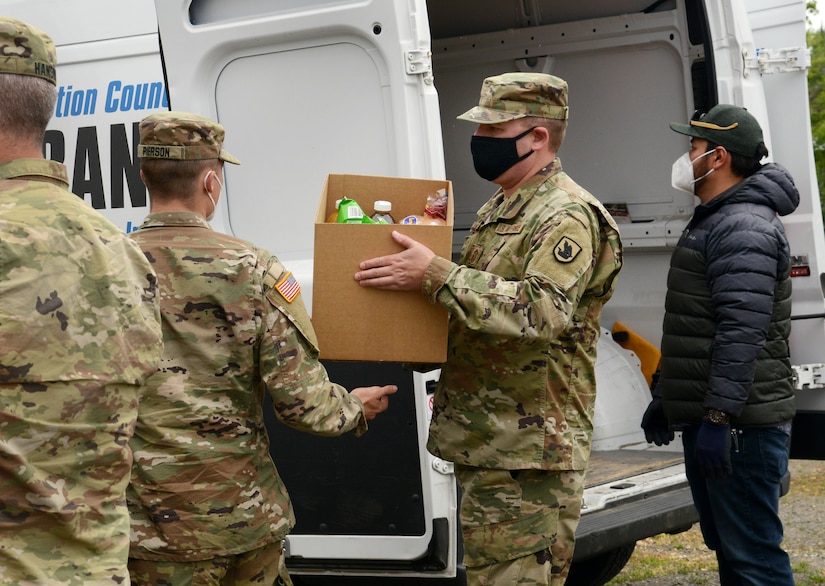
''We've been visiting a lot of these food banks as we connect to our service members and the civilian staff supporting these important missions,'' Forshee said. ''This is an unexpected need during these unprecedented times.''
Forshee and Boleak are part of Joint Task Force Steelhead's staff, leading the religious affairs team, operating both as spiritual leads and the eyes and ears to the members in the field.
''I found that being able to communicate back to the staff at JTF when we've spent time at one of these spots is incredibly valuable,'' Boleak said. ''Oftentimes, information is not being passed down to our soldiers and airmen at some of our sites, which only adds to some of the distress with our [service] members.''
In many ways, the religious affairs team attempts to encounter this new level of anxiety in which basic and previously held assumptions are challenged due to the sudden shift in conditions. The new normal shows that resilience and perseverance have become sacrosanct.
''There are a variety of concerns that our members have that are directly related to the COVID-19 response,'' Forshee said, detailing some of the underlying concerns and questions by service members. ''If leaders are tracking their questions and concerns, if there are too many or too few soldiers on a site, and what are the current guidelines or updates for a safe workplace.''
When the religious affairs team arrives at the locations where guardsmen are working, Boleak quickly jumps in to lend a hand, whether it is unloading a food truck or helping to set up tables at mobile distribution sites. It gives him a chance to make an instant connection and get a sense of the team's morale.
''We get out about three or four times a week,'' he said. ''I see it as a way to build camaraderie and letting them know that we're here to support them and any needs they have, as well as someone who cares about their well-being.''
Forshee perceives the site visits as being more genuine and focused than traditional religious services while meeting the guardsmen's needs in real time.
''Going out to meet soldiers and airmen is much more rewarding because when we arrive we can encounter them in many ways,'' Forshee said. ''It could be a group or just one on one, but often in unscripted moments.''
As soldiers and airmen work the food banks, testing locations and other critical COVID-19 response sites, they are personally interacting with communities experiencing economic distress and escalating fears of the virus. Knowing they are making an immediate impact is not lost on them.

''You see it instantly on some of the faces when we load a box of food and offer encouragement,'' said newly commissioned Army 2nd Lt. Will Stryker, the soon-to-be officer in charge of the Wenatchee mission. ''The first day I worked here in early May, we filled up the parking lot, and then it became twice over that within a few weeks, only to have it continue to grow as more and more people needed assistance.''
While attending Central Washington University, Stryker was activated while still a cadet. Now, since his June 12 commissioning, he's ready to take on the added responsibility for his crew, maintaining the demands and tempo for those in his immediate community.
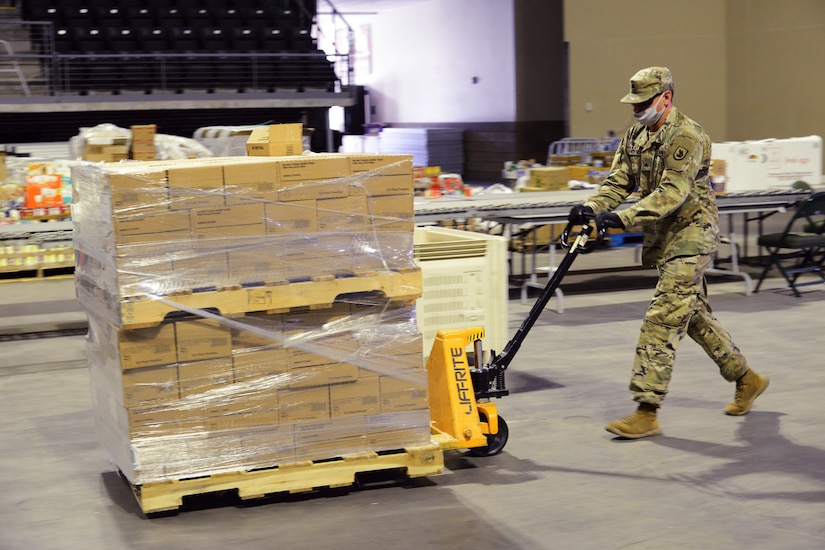
''We've seen that while COVID is continuing along its course, more and more people who have dipped into their reserves are starting to need additional assistance,'' he said, while watching his teammates use forklifts to unload a truckload of potatoes, canned goods and other nonperishable items into the vacant hockey area. ''When I look at these stands and know that they normally would be full of fans cheering on the 'Wenatchee Wild,' it is oddly surprising to be in the center of the floor, and have it be so quiet other than us moving pallets of food in.''
More than 30 soldiers are responsible for this site. Stryker said that he's lucky to have a solid group of noncommissioned officers and a team that is so dedicated to this work.
''There are [military police], truck drivers, cooks, mechanics and infantrymen; it's an awesome crew,'' Stryker said.
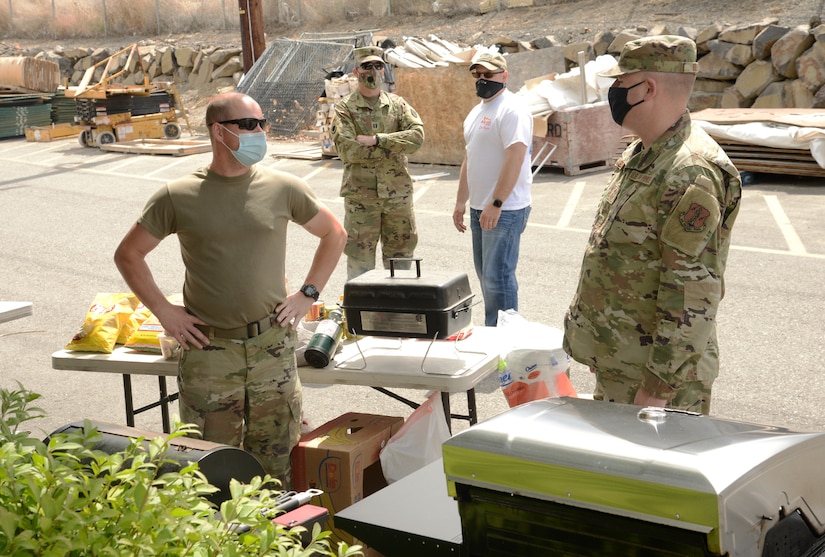
As the food bank needs continue, several sites have added and rotated new members into the ranks. By late May, Army Chaplain (Capt.) Michael Johnson swapped places with Forshee, while embracing the same role of intermingling with troops across the state. After the last truck was unloaded at the arena in Wenatchee, the soldiers took part in a barbecue, allowing Johnson an opportunity to address the team while enjoying the camaraderie.
''I definitely got here on the right day,'' Johnson said. ''As a Baptist pastor, potlucks are a really big thing. If there's food, we will be there,'' he said, while jokingly speaking to everyone enjoying a well-deserved break in their hectic schedule.
''Thank you guys for what you are doing. If there's something that we can do for you or your immediate family members, we want to help,'' he said. ''It can be anything, even as a sounding board — we're there for you. Chaplains and assistants, we're here to serve you, and we're so glad to be part of this generous team.''
Johnson said he sees some of the same concerns in his community church in Yakima when he's not in uniform. Yet from a personal perspective, he noted that his path to becoming a chaplain came from financial uncertainty earlier in life.
''I was married [with] three kids and asked myself, 'What’s going on here?''' Johnson said, explaining how he enlisted in the active duty Army when trying to make a living as a musician.
''The part-time jobs, the gigging musician or being a music teacher, it all wasn't adding up, especially at the end of every month,'' he continued. ''That's when I discovered the Army Band, it was the right fit at the right time, and I went for it.''
After 10 years, he made another leap, leaving his successful music career and the full-time Army life to come back to Washington and follow another new path of ultimately becoming a chaplain.
''My experience in the Army during an uncertain period in life helped me on a personal level, and it provided the means for my family,'' Johnson recalls. ''It's made me realize now that being a chaplain is who I really am, it fits my calling to help soldiers on the religious and spiritual needs: it's the 'whole person approach' to soldier care.''
The demand to support Washington communities as large as Seattle and as small as Touchet seems to be unending, especially in the realm of food sustenance and COVID-19 testing sites across every region of the state. Since March, more than 1,000 Washington National Guardsmen have activated to support the global pandemic response. To date, nearly 28 million pounds of food has been processed, packed and distributed by Evergreen Guardsmen.
''I know for many residents, the ongoing need for these food banks is vital,'' said Claudia Limon, a service coordinator with the Blue Mountain Action Council.
The BMAC is a nonprofit, multipurpose agency, serving residents in Southeastern Washington that helps strengthen self-sufficiency, develop strategies to prevent poverty and leverage community support through volunteerism. They have teamed up with the guardsmen to keep up with the increasing nourishment needs.
A group of a dozen guardsmen have arrived in the town of Touchet, setting up tables and an entry control point as they load car after car with pre-assembled boxes of food.
''We couldn't do this without the help from the National Guard,'' Limon said, directing the long line of cars, amassed along the main roadway leading up to the mobile food bank. ''This has been a terrific partnership, especially with the need being so great.''
As Boleak helps stack boxes from one of the many trucks for this weekly distribution mission, he quietly goes about his routine of jumping in and offering a hand.
''At the end of the day, I think all of us can feel good about lending a hand while doing the people's work,'' he said, ''It all comes down to neighbors helping neighbors.''
(Air Force Master Sgt. John Hughel is assigned to the Washington Air National Guard.)

An Air Force basic cadet gets a haircut while following social distancing precautions at the U.S. Air Force Academy in Colorado Springs, Colo., June 25, 2020, to begin the journey of becoming a commissioned officer.
A lonely sense of isolation is among the many emotions people feel after months of stay-at-home orders and wearing face masks in public.

Danielle Lee Loera, the spouse of a technical sergeant at Travis Air Force Base, California, opened a window to a more hopeful perspective. She designed and produced masks with a clear covering that allows the wearer's mouth to be visible, helping them to communicate not only with words, but with emotions as well.
After seeing a friend's social media post of just such a mask, Loera, who has fashioned more than 900 masks since the COVID-19 pandemic began, said she was inspired to make some with a transparent cover over the mouth.
"I loved the idea of a window mask," she said recently via email. "I was immediately enamored with the idea of being able to see facial expressions, and I recognized, in my own life, just how important a smile is."
Her initial motivation was to make masks that allowed lip reading. The high school she attended was the only one in its district for those who are deaf or partially deaf, and she studied American Sign Language. Helping the hearing impaired is an issue she takes to heart, she said.
"I know that facial expressions and lip reading are as much a part of the language of sign as the hands," she added.

One recipient of Loera's inclusive masks was Tracy O’Banion, a Fairfield, California, resident, who was eager to share how happy she was to receive the masks. The two connected via social media after Loera posted a photo of herself wearing the window mask. Within days, the two connected, and O’Banion had a fresh supply of masks.
O'Banion said the masks are beneficial in communicating with her husband, who retired as a master chief petty officer after 30 years with the Coast Guard. She said the window mask has also helped at health care appointments and in other situations.
"Hearing people are not as affected by wearing a mask in their daily lives as deaf folks are," she said. "Just imagine people talking behind a mask, and [you] not being aware of anything they are saying. The windowed mask lets me lip read and gauge a person's emotions."
"Also, I like to know if people are smiling or not," O'Banion said via text message, adding a smiley emoji.
O'Banion said her masks help her feel more connected to others.

"I'm so grateful Danielle made these," O'Banion said. "It was so thoughtful, and she really understands the isolation deaf folks feel due to so many people wearing masks these days with the [coronavirus]."
Loera said the masks can also benefit more than just the hearing impaired. Although Loera's initial inspiration was lip reading, she has found that the masks serve a plethora of purposes.
"A very good friend of mine has an autistic son, and, like the hard of hearing, he is learning to read facial expressions," she said. "She has ordered masks, not for her son, but for herself and his teachers to aid him on his learning journey."
Loera said the masks are made with cotton fabric with a heavyweight, vinyl material with anti-fogging technology that is free of bisphenol-A, also known as BPA, an industrial chemical used to make hard, clear plastics. Loera's masks also follow guidelines from the Centers for Disease Control and Prevention. She said each mask takes about seven minutes to make.

"My pattern conforms to the face and the nose and has a window," she said. "The vinyl window acts as a filter, and it can go all the way around the ears. The straps are important, not only for comfort, but also because many hard-of-hearing and deaf people have hearing aids and implants already there. I wanted to accommodate hearing aids while also keeping it comfortable for the user."
Loera's husband, John, whom she praised for his support, is a flight engineer with the 9th Air Refueling Squadron at Travis Air Force Base.
"He doesn't know how to sew very well, but he has ironed, cut and pinned more masks than I can count," she said. "He's had my back in this, financially, emotionally and physically — because we both have the same goal: help as many people as we can, because we have the ability and drive to do so."
(Nick DeCicco is assigned to the 60th Air Mobility Wing.)

An honor guard participates in a wreath laying ceremony to pay tribute to those who served in the Korean War at the Korean War Veterans Memorial in Washington, D.C., June 25, 2020.


 Posts
All Comments
Posts
All Comments


