
Army Pfc. Jillian Ross secures decking with an electric drill during training in Kittery, Maine, Aug. 9, 2021.
Providing up-to-date information, news and original content on American Military issues.
Army Pfc. Jillian Ross secures decking with an electric drill during training in Kittery, Maine, Aug. 9, 2021.

Sailors conduct a 21-gun salute during a burial at sea aboard the USS Harry S. Truman in Atlantic Ocean, Aug. 9, 2021.

Air Force firefighters extinguish a car fire during a training exercise at Al Udeid Air Base, Qatar, Aug. 10, 2021.

Navy Chief Petty Officer Shannon Chatterton shows a family the toys and implements used by military working dogs at Naval Submarine Base New London, Conn., Aug. 3, 2021.

Marines participate in an intermediate swim qualification at Marine Corps Base Quantico, Va., Aug. 6, 2021.

A Marine fast-ropes from a helicopter onto the USS America, not shown, in the Solomon Sea, Aug. 6, 2021.

Soldiers assigned to the 3d U.S. Infantry Regiment, known as “The Old Guard,” set off cannons during a performance of the 1812 Overture at the National Museum of the United States Army, Fort Belvoir, Va., Aug. 8, 2021. The concert has taken place annually for more than 40 years.

Marine Corps officer candidates conduct close order drill during Officer Candidates School at Marine Corps Base Quantico, Va., Aug. 5, 2021.

Navy Petty Officer 2nd Class Ricardo Cobian conducts maintenance on an EA-18G Growler in the hangar bay of the aircraft carrier USS Carl Vinson during operations in the Pacific Ocean, Aug. 9, 2021.

An EA-18G Growler flies above the aircraft carrier USS Ronald Reagan during operations in the Arabian Sea, Aug. 9, 2021.

Army Staff Sgt. Kyle Westen conducts maintenance checks on an M1 Abrams in Pabrade, Lithuania, July 26, 2021. Westen is assigned to the 1st Infantry Division, which arrived in Europe to begin a nine-month rotation supporting Operation Atlantic Resolve, which builds readiness, increases interoperability and enhances the bond between ally and partner militaries.

Navy Chief Petty Officer Evan Bruce jumps from a KC-130 aircraft during a maritime insertion course in San Diego, July 29, 2021.

An Air Force F-35A Lightning II, a P-51 Mustang and an A-10 Thunderbolt II fly in formation during the 2021 Thunder Over Michigan Air Show at Selfridge Air National Guard Base, Mich., Aug.7, 2021.

Sailors conduct replenishment aboard the USS America during Talisman Saber in the Coral Sea, July 27, 2021. The exercise is designed to strengthen capabilities to respond to security concerns in the Indo-Pacific region.

Marines and sailors conduct air-cushioned landing craft operations from the USS Kearsarge during Large Scale Exercise in North Carolina, Aug. 3, 2021. The exercise demonstrates the Navy’s ability to employ a lethal force.

A member of team Homestead receives the COVID-19 vaccine at a vaccination event during the August Unit Training Assembly at Homestead Air Reserve Base, Fla., Aug. 7, 2021.

Marine Corps Capt. Andrea Occhipinti inspects laser guided training during Pacific Iron at Andersen Air Force Base, Guam, Aug. 4, 2021. The exercise is designed to project forces into the U.S. Indo-Pacific Command’s area of responsibility.

Army Green Berets parachute onto a drop zone alongside members of the Japan Ground Self-Defense Force during Exercise Forager 21 at Andersen Air Force Base, July 30, 2021. The exercise enhances ability to dynamically employ forces to address the full range of security concerns while supporting regional alliances.
Aug. 12, 2021 | BY David Vergun , DOD News
The U.S. is now navigating through uncharted waters with the possibility of strategic deterrence failing under rapidly growing threats from China and Russia, the commander of U.S. Strategic Command said.

Navy Adm. Charles A. Richard described those threats and provided solutions through integrated deterrence in all domains, both conventional as well as nuclear, across the services and in tandem with allies and partners when he spoke today at the Space & Missile Defense Symposium in Huntsville, Alabama.
"We are witnessing a strategic breakout by China. The explosive growth and modernization of its nuclear and conventional forces can only be what I describe as breathtaking. And frankly, that word breathtaking may not be enough," he said.
China is rapidly improving its strategic nuclear capability and capacity, Richard said. It's growing and enhancing its missile force, including multiple independently targetable reentry vehicles. These include intermediate range ballistic missiles, mobile ICBMs and submarine-launched nuclear ballistic missiles.
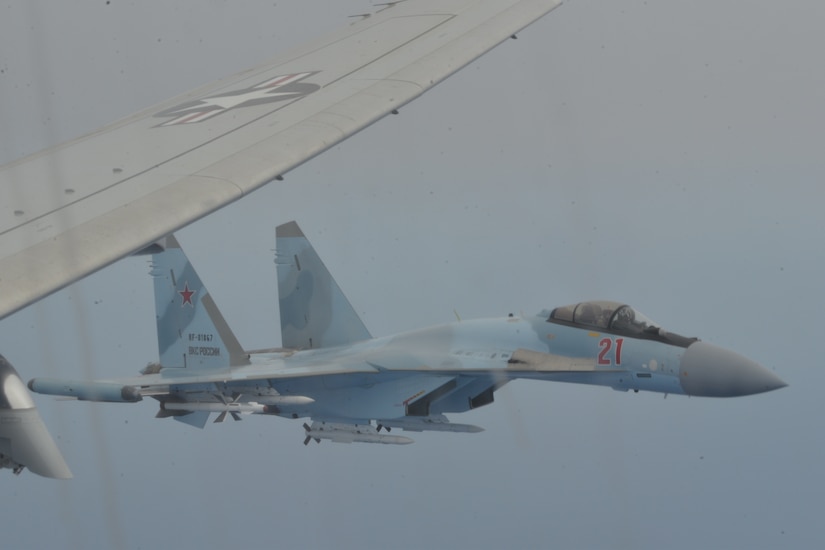
Beijing is also pursuing advanced weapons such as hypersonics, he said.
"Because of these challenges our current terrestrial- and space-based sensor architecture may not be sufficient to detect and track these hypersonic missiles," he said.
In 2019, China tested more ballistic missiles than the rest of the world combined, he noted.
Beijing is also developing a modern nuclear command and control capability and is modernizing its conventional forces to include ships, submarines and aircraft, he added.
"They have the largest Navy in the world and they have the third largest air force in the world," he said.
Russia continues to use a wide range of capabilities that are below the threshold of conflict, such as cyber and state-sponsored coercion of nations, seeking to solidify great power status, Richard said.

Russia is pursuing modernization of its conventional and strategic forces, he said. Nuclear weapons remain a foundational aspect of Russia's strategy and they have recapitalized over 80% of their strategic nuclear forces, including expanded warhead delivery capacity.
Like China, Russia is investing heavily in developing hypersonic weapons and a variety of other missiles, he said.
Nuclear modernization is a Defense Department priority for deterrence, Richard said.
That modernization includes not just the nuclear triad, it also includes investing in a nuclear command and control system that is protected against cyberattacks, he said.
"Every operational plan in the Department of Defense, and every other capability we have, rests on an assumption that strategic deterrence will hold. And if strategic deterrence, and in particular nuclear deterrence, doesn't hold, none of our other plans, and no other capability that we have is going to work as designed," Richard said.

Richard also mentioned bolstering conventional forces, missile defense and standing up the Joint Al-Domain Command and Control system. Developing and fielding hypersonics and high-energy laser weapons are also very important.
To better understand and respond to national security threats, the department needs to harness America's great intellectual community, as it has done before with the RAND Corporation, he said.
The ongoing National Defense Strategy, Nuclear Posture Review and Missile Defense Review, are the ideal means to address the threats, inform decision makers and inform the department's path forward.
Industry as well needs to shore up the nation's defenses by delivering needed technology and systems on time and at reasonable cost, he said.
The importance of allied and partner interoperability and rigorous joint and combined war games and exercises cannot be overstated, Richard said.

Army Maj. Eloisa Cox talks with her daughter, Spc. Ayana Anthony in South Korea, July 30, 2021. Both are assigned to 3rd Armored Brigade Combat Team, 1st Armored Division.


 Posts

