Marines conduct insertion and extraction training off the coast of Okinawa, Japan, March 19, 2021.
Marines conduct insertion and extraction training off the coast of Okinawa, Japan, March 19, 2021.

A pilot flies an Air Force F-16 Fighting Falcon during Red Flag 21-2 at Nellis Air Force Base, Nev., March 17, 2021. Participants work with joint and allied partners in 2.9 million acres of land and airspace to advance interoperability.
March 23, 2021 | , DOD News
Kris Kristofferson is a famous singer-songwriter and actor. He is also an award-winning college athlete, a Rhodes Scholar and an Army veteran.
Although Kristofferson is a singer, he's more famous for the songs he wrote but were covered by others, such as: "Me and Bobby McGee," "For the Good Times," "Sunday Mornin' Comin' Down" and "Help Me Make It Through the Night."

As an actor, he starred in a number of films including: "Alice Doesn't Live Here Anymore," "A Star is Born," "Convoy," "Heaven's Gate," "Stagecoach," "Bring Me the Head of Alfredo Garcia," "Pat Garrett and Billy the Kid" and "Blade."
While he is known for his exploits on stage and the big screen, other parts of his life are less well known.
Before his singing and acting career, Kristofferson was a talented athlete in a number of sports.
In 1958, Kristofferson attended Pomona College in California, where he excelled in rugby, football and track and field. He became so famous that he appeared in Sports Illustrated magazine's "Faces in the Crowd" that year.

Clearly, his grades didn't suffer from time spent on the athletic field; he graduated summa cum laude in literature. He also earned a Rhodes Scholarship to the University of Oxford, England.
At Oxford, he was awarded the Blue for boxing, which honors athletes who are at the top of their game. The Blue, the highest honor granted to individual sportspeople at the University of Oxford, depends on very specific criteria within that sport and is a highly sought-after achievement for Oxford student athletes.
Kristofferson also was on the university's rugby team.
Lars Henry, Kristofferson's father, was an Air Force pilot, who would eventually retire as a major general. Henry urged Kristofferson to enter the military after college, which he did.

After joining the Army, Kristofferson received flight instruction at Fort Rucker, Alabama, and became a helicopter pilot. He also successfully completed one of the military's most physically challenging courses: Ranger School.
In the early 1960s, he was stationed with the 8th Infantry Division in West Germany, where he formed a band.
After serving overseas, Kristofferson was offered an Army job, teaching English literature at the U.S. Military Academy.
However, Kristofferson's interests were in music, and he decided to leave the Army in 1965 to pursue songwriting. It is said that his decision to leave the military was a blow to his family.

To supplement his income, Kristofferson worked as a commercial helicopter pilot in Louisiana, splitting his time between there and Nashville, Tennessee, where he'd pitch country songs that he wrote. During his time ferrying people and supplies to an oil platform in the Gulf of Mexico, Kristofferson wrote two major hits:, "Help Me Make It Through the Night" and "Me and Bobby McGee." Janis Joplin recorded "Me and Bobby McGee" just prior to her death in 1971. It reached the top of the charts, and it is credited as being Kristofferson's breakthrough song.
In 2004, Kristofferson was inducted into the Country Music Hall of Fame.
March 19, 2021
Acting Under Secretary of Defense for Policy Ms. Amanda Dory held a phone call with U.K. Director General, Strategy and International, Mr. Angus Lapsley to reaffirm their commitment to deepening the transatlantic relationship.
The leaders discussed the publication of the U.K.’s Integrated Review of Security, Defense, Development, and Foreign Policy; or Integrated Review. Ms. Dory welcomed its emphasis on the transatlantic alliance and Indo-Pacific region, and noted that its publication follows the U.K.’s recent announcement of its largest increase in defense spending in thirty years.
Ms. Dory congratulated the U.K. on the publication of this sweeping review and looks forward to continuing close collaboration with the U.K. MoD as it begins implementation.
March 22, 2021 |
The theme of this year's International Women's Day, March 8, was "Women in leadership: Achieving an equal future in a COVID-19 world." Throughout the COVID-19 pandemic, women across the world have been leading efforts in patient care and the return to normalcy. Dedicated medical professionals in the District of Columbia National Guard are putting the well-being of others first, in and out of uniform.
Air Force Maj. Telisha Johnson, chief nurse for the 113th Medical Group, D.C. Air National Guard, jumped at the call to coordinate with leadership and local organizations to help mitigate the spread of the virus.

"First, I was deployed to the [D.C.] Department of Health to assist in [the] planning [of] an alternate care site … [and] figuring out the staffing situation [if] there [were] a medical surge amongst the hospitals," Johnson said. "When we got to the alternate care site, I was responsible for not only training personnel that would be coming there from MedStar [Health], but also I was going to be the operations chief for the alternative site."
Being a leader in the medical field means determining where your time is best spent, so when the virus began its surge across the U.S. in March of 2020, Air Force Lt. Col. Karolyn Teufel, a physician with the 113th Wing, D.C. Air National Guard, had to make a tough decision.
"I was being asked to do both missions: patient care and contingency planning and testing sites," Teufel said. "I was torn between contributing to that guard mission but also taking care of COVID-19 patients at [my hospital]. D.C. got overwhelmed with COVID-19 in April of 2020, and I just felt like I couldn't leave my coworkers at the hospital."
Teufel withdrew from the military COVID-19 mission and devoted her time entirely to patient care at her hospital through May before returning to assist the military with testing sites in the summer.

Recently, as the focus has turned more from testing to prevention, Johnson has been overseeing the distribution of COVID-19 vaccinations for military personnel in the D.C. National Guard and members of other states supporting security missions in the district.
Given the unique challenge of COVID-19 — a virus that not only attacks the physical health of millions, but also the emotional and mental health of millions more — women are proving to be particularly well suited to caring for the holistic health and recovery of the world.
"The post-COVID-19 world is a place where women will thrive, because the experience of COVID-19, I think, allowed women to shine and prosper in that they were already natural multi-taskers," Teufel said. "It required people to think outside the box … that's already something women were doing before COVID-19: trying to be creative in balancing careers and families."
Women are standing out in every way during the pandemic, and it's causing others to take notice.
"One of the vaccine developers is a female. She's African American. It is just amazing to see that no matter where you come from, you could be a powerhouse, a force to be reckoned with," Johnson said. "I think seeing that is what is inspiring little girls across the country. [It is] inspiring women like me to keep on reaching."

As the country continues to social distance and vaccinate, women are still balancing their other military roles. Teufel is preparing for a possible deployment as a critical care air transport physician transferring service members who are injured or sick from deployment zones.
Regardless of the roles women have, they are being looked to as leaders in all fields. Whether it's in the military or public sector, more women are being recognized for their technical skills and leadership abilities.
"We've definitely seen more leadership roles earned by [women] than ever before across not only the military but the United States," Johnson said. "We're pushing the boundaries. We're breaking glass ceilings and doing everything we can to make sure that we have equal footing across this country, across the world. I see nothing but greatness in our future."
(Army Staff Sgt. Erica Jaros is assigned to the 715th Public Affairs Detachment.)
March 22, 2021 | , DOD News
On March 16, 1987, President Ronald Reagan signed a proclamation dedicating March as Women's History Month.
"From earliest times, women have helped shape our nation," the proclamation reads.

"Those achievements span the wide range of human endeavor. They have not been attained without the quiet courage and sacrifice of millions of women, some famed, most not," it states.
"Women have fought for moral and social reform and have taken part in and led many great social and political movements of our land. Women have founded many of our philanthropic, cultural, educational and charitable institutions. Women have served our nation with valor and distinction during wartime, nursing the wounded, piloting airplanes, performing vital jobs in defense plants," it continues.
Although women played key support roles in early U.S. warfare — including the Revolutionary War and the Civil War — it wasn't until March 17, 1917, right before the start of World War I, when the first legally enlisted.

On that date, Loretta Perfectus Walsh enlisted in the Navy Reserve. She also holds the distinction of being the first Navy petty officer.
During World War I, about 35,000 women officially served, mostly in the Army, but also in the Navy. About five times that number served in World War II.
President Harry S. Truman signed the Women's Armed Services Integration Act on June 12, 1948. With this act, for the first time, women were recognized as full members of the armed forces. This meant they could finally claim the same benefits as their male counterparts, and it also allowed women to make a career in the Army, Navy, Air Force and Marines.

Since 2018, June 12 has been recognized as Women Veterans Day.
International Women's Day, March 8, was first celebrated in the United States in 1911.
In 1978, the school district of Sonoma, California, participated in Women's History Week, an event designed around the week of March 8.
In February 1980, President Jimmy Carter issued a proclamation declaring the week of March 8 to be National Women's History Week.

The proclamation stated, "From the first settlers who came to our shores, from the first American Indian families who befriended them, men and women have worked together to build this nation. Too often the women were unsung and sometimes their contributions went unnoticed. But the achievements, leadership, courage, strength and love of the women who built America was as vital as that of the men whose names we know so well.
By 1986, a year before Reagan signed his proclamation, 14 states had already declared March as Women's History Month.

Military working dog Jimo sniffs out explosive-making materials in a tree during training at Hill Air Force Base, Utah, March 10, 2021.

A Navy T-45C Goshawk readies to take off from the flight deck of the USS Gerald R. Ford in the Atlantic Ocean, March 15, 2021.

Marines perform defense operations during Castaway 21.1 in Okinawa, Japan, March 18, 2021. Marines train to integrate with the joint force to seize and defend key maritime terrain, provide low-signature sustainment and execute long-range precision fires to support naval operations.

Air Force Tech. Sgt. Skyler Shull rappels down a 90-foot training tower at Eglin Air Force Base, Fla., Feb. 25, 2021.

Navy Petty Officer 3rd Class Soriya Chum signals an operator to lower a pallet aboard the USS Benfold during a replenishment with the USNS Charles Drew in the Philippine Sea, March 19, 2021.
March 22, 2021
The Department of Defense launched a new mobile app designed to help the military community manage stress. The free Chill Drills by Military OneSource mobile app is now available for download on Google Play and Apple’s App Store.
The Chill Drills app includes a collection of mindfulness audio exercises that give service members and military families access to expert stress-relieving techniques, which can help:
“Life in the military comes with many opportunities and also unique challenges, so managing stress is critical,” said Deputy Assistant Secretary of Defense for Military Community and Family Policy Patricia “Patty” Montes Barron. “The Department of Defense is thrilled to deliver one of our most popular and highly-requested web products in the form of a new mobile application, so the military community can regenerate and be well anytime and anywhere.”
To ensure the Chill Drills app continues to meet the needs of the military community, the department will review and evaluate the new app to help inform ongoing updates and enhancements.
Chill Drills is one of two apps recently launched by the department. The My Military OneSource mobile app, launched in 2020, offers a fast, 24/7 gateway to personalized military benefits, access to experts, guides for the military community and much more.
To learn more about the Chill Drills app or to download the app, visit www.MilitaryOneSource.mil/ChillDrills. Users can also stream Chill Drills from the Military OneSource website with an internet connection.
Military Community and Family Policy is directly responsible for establishing and overseeing quality-of-life policies and programs that help our guardians of country, their families and survivors be well and mission-ready. Military OneSource is the gateway to programs and services that support the everyday needs of the 5.2 million service members and immediate family members of the military community. These Department of Defense services can be accessed 24/7/365 around the world.
Military OneSource is a DOD-funded program that is both a call center and a website providing comprehensive information, resources and assistance on every aspect of military life. Service members and the families of active duty, National Guard, and reserve (regardless of activation status), Coast Guard members when activated for the Navy, DOD expeditionary civilians, and survivors are eligible for Military OneSource services, which are available worldwide 24 hours a day, seven days a week, at no cost to the user.
The My Military OneSource app is helping to transform the military community’s access to quality of life programs and services – better connecting people to the resources they need to regenerate, connect, be well, and thrive. DOD designed the app to offer users a more personalized experience with Military OneSource, based on their profile selections, search activity, and the ability to mark favorite content within the app environment. Download the My Military OneSource mobile app for free on Google Play or Apple’s App Store.

A Marine fires an M9 service pistol during a combat marksmanship range in Kuwait, March 17, 2021.

Airmen unload COVID-19 vaccines from a C-130 Hercules at Al Dhafra Air Base, United Arab Emirates, March 15, 2021. Approximately 1,300 vaccines were sent to the base, ready to distribute among service members and Defense Department contractors in the country.

Army Spc. William Towne, a combat medic assigned to Headquarters and Headquarters Company, 4th Battalion, 9th Infantry Regiment, 1st Stryker Brigade Combat Team, 4th Infantry Division, answers questions of a Los Angeleno at the California State University Los Angeles Community Vaccination Center in Los Angeles, March 19, 2021. U.S. Northern Command, through U.S. Army North, remains committed to providing continued, flexible Defense Department support to the Federal Emergency Management Agency as part of the whole-of-government response to COVID-19.

Andrea Hunt, a teacher's aide at the Sullivans Elementary School at Commander, Fleet Activities Yokosuka, receives the COVID-19 vaccine from Navy Seaman Janasia Spotson, assigned to Naval Hospital Yokosuka, during a COVID-19 vaccine distribution at CFAY’s Hawk’s Nest in Yokosuka, Japan, March 19, 2021. Essential front line personnel and service members assigned to CFAY and tenant commands received the one-shot vaccine during the vaccine distribution.
March 21, 2021
Pentagon Press Secretary John Kirby provided the following readout:
Secretary of Defense Lloyd J. Austin III spoke by phone with Pakistan’s top military leader, Chief of Army Staff Gen. Qamar Javed Bajwa, March 21.
Secretary Austin reinforced the United States’ commitment to maintaining a strong bilateral defense relationship with Pakistan and expressed gratitude for Islamabad’s continued support for the Afghan peace process.
Secretary Austin noted that he looks forward to further cooperation between the United States and Pakistan in areas of common interest.
March 20, 2021
STAFF: Good afternoon, ladies and gentlemen. His excellency Lloyd James Austin, Secretary of Defense for the United States of America. His excellency Raksha Mantri Shri Rajnath Singh, Defense Minister of India. Delegation members from both countries. (Inaudible) and the media.
As you are aware, our two delegations have just concluded their talks on defense cooperation. In this regard I would like to invite first his excellency Rajnath Singh to (inaudible)
(UNTRANSLATED)
RAKSHA MANTRI SHRI RAJNATH SINGH, INDIAN DEFENSE MINISTER: Thank you. I would like to read my initial statement in English.
Excellency Secretary Austin, ladies and gentleman, it is great honor and pleasure to receive U.S. Secretary of Defense, Mr. Austin, in his first official visit abroad and to India.
I just spoke with Secretary Austin immediately after he assumed charge. We had an excellent conversation during which I invited him to visit India at his earliest convenience. His visit to India, despite the COVID-19 global pandemic, shows the abiding commitment of the United States to our bilateral relationship.
I am happy to inform that we had a comprehensive and fruitful discussion with Secretary Austin and his delegation. We are keen to work together to realize the full potential of the India-U.S. Comprehensive Global Strategic Partnership.
Our discussions today focused on our wide ranging defense cooperation and expanding military-to-military engagement across services, information sharing, cooperation in emerging sectors of defense, and mutual logistics support.
We reviewed the wide gamut of bilateral and multilateral exercises and agreed to pursue enhanced cooperation with the U.S. Indo-Pacific Command, Central Command and Africa Command. Acknowledging that we have in place the foundational agreements, LEMOA, COMCASA, and BECA, we discussed the steps to be taken to realize their full potential for mutual benefit.
I conveyed my appreciation to Secretary Austin for participation of U.S. in Aero India 2021 along with a business delegation. I invited U.S. industry to take advantage of India's liberalized foreign direct investment policies in the defense sector. We both agreed that there are opportunities for collaboration in defense industry.
The recent Leaders' Summit of India, USA, Japan, and Australia under the Quad framework emphasized our resolve to maintain a free, open, and inclusive Indo-Pacific region. We discussed the need for enhanced capacity building to address some of the non-traditional challenges such as oil spills and environment disasters, drug trafficking, illegal, unreported, and unregulated fishing, et cetera.
India is committed to further consolidate our robust defense partnership with the United States. I look forward to working with you, Excellency, closely to make the India-U.S. relationship one of the defining partnerships of 21st century.
Thank you very much.
STAFF: Thank you, sir. Now I express Secretary Austin to make his statement.
SECRETARY OF DEFENSE LLOYD J. AUSTIN III: Well, unfortunately, I can only provide my comments in English.
(Laughter.)
Well, thanks to everyone for coming. And first and foremost, I'd like to express my deepest condolences for the tragic accident that killed an Indian Air Force pilot earlier this week. Our hearts go out to his family and friends and his death reminds us of a risk that our brave servicemen and women take each of these days to defend our democracies, our people, and our way of life.
Today I want to thank Minister Singh for the warm welcome and the deepest thanks -- my deepest thanks go out to the people of India for their gracious hospitality.
It is indeed a privilege to be here at New Delhi on my first overseas trip as Secretary of Defense. And I'm grateful for the opportunity to meet with my counterpart, despite the challenges from COVID-19.
I'm pleased to report that Minister Singh and I had a very productive discussion, as you've heard, on a number of security interests that are important to our two countries. And at the top of my agenda, I want to convey the Biden-Harris administration's message of our strong commitment to our allies and partners.
India, in particular, is an increasingly important partner among today's rapidly shifting international dynamics. And I reaffirmed our commitment to a comprehensive and forward-looking defense partnership with India as a central pillar of our approach to the region.
As the world faces a global pandemic and growing challenges through an open and stable international system, the U.S. and India relationship is a stronghold of a free and open Indo-Pacific region.
Prime Minister Modi has stated that India stands for freedom of navigation and freedom of overflight, unimpeded, lawful commerce, and inherence to international law.
So this is a resounding affirmation of our shared vision for regional security in the Indo-Pacific. And it's clear that the importance of this partnership and its impact to the international rules-based order will only grow in the years ahead.
Our work today is grounded in our shared values and converging strategic interests. We discussed opportunities to elevate the U.S.-India major defense partnership, which is a priority of the Biden-Harris administration. And we'll do that through regional security cooperation and military-to-military interactions and defense trade.
In addition, we are continuing to advance new areas of collaboration, including information sharing and logistics, and artificial intelligence, and cooperation in new domains such as space and cyber. We also discussed engagement with like-minded partners through multilateral groupings such as the Quad and ASEAN.
And as the Indo-Pacific region faces acute transnational challenges, such as climate changes and challenges to a free and open regional border, cooperation among like-minded countries is imperative to securing our shared vision for the future.
Despite today's challenging security environment, the partnership between the United States and India, the world's two largest democracies, remains resilient and strong. And we will seek every opportunity to build upon this major partnership.
Thanks again to Minister Singh for your warm hospitality and for your strong leadership as we continue to deepen our cooperation and advance our shared interests and values and defend the international rules-based order.
I look forward to working with you in the years ahead and I'm confident that together we can build a partnership that's fit for today's and tomorrow's challenges.
Thank you very much, sir.
STAFF: Thank you very much, sir.
March 20, 2021
STAFF: Good afternoon, everybody. Please make sure you silenced your electronics before we begin. As I had mentioned earlier, the Secretary's got about 20 minutes. There's no opening statement. This is an on the record press opportunity. And I will call on you in turn. So we can get right to the -- right started right at it.
First question, for you, Jim, go ahead. Jim?
Q: Me?
STAFF: Yes.
Q: Not used to that. Mr. Secretary at the -- you mentioned that you had discussions on engagement with -- discussions with Minister Singh on having engagements with like-minded partners in a multilateral group like the Quad or ASEAN. How do you see that materializing? How do you see that operationalizing, if you will?
SECRETARY OF DEFENSE LLOYD J. AUSTIN III: Yes, I, clearly from a defense perspective, we do have a number of things in common, and if you just look at the countries overall, if you look at Australia, India, Japan, us, you know we really are interested in maintaining a free and open Indo-Pacific region. We're interested in being able to navigate the seas and fly the skies and international space and maintain in that degree of flexibility.
Now if you look at the fact that India and us are the largest democracies in the world. There's clearly some shared values there that we’ll continue work together to -- we can build upon that and we are building upon it in an economic interest. So there are a number of things that we can and will work on going forward.
Q: And if I could just ask a follow-up. Does this mean you anticipate having more Indian officers in American headquarters and vice versa? And more exchange in like professional military education, perhaps larger exercises with the countries out here?
SEC. AUSTIN: We'll see what happens. I mean these are all mutual agreements in terms of the directions that we want to take. And clearly in terms of increasing interoperability then more exercises are good. And, so, we'll see. But, again, we can expect that there'll be frequent exchanges and we look forward to the ability to work together to build great capacity, greater capability going forward.
Q: Thank you.
STAFF: (Inaudible)
Q: Hello, Secretary. Welcome to India. Do you share the concerns expressed by the Senate Foreign Relations Committee chief that India was trending away from democracy? And in his letter to you suggested that the crackdown on progressive farmers, intimidating journalists and government critics was problematic? Do you share that concern?
SEC. AUSTIN: You've heard President Biden say that human rights and rule of law is important to the United States of America. We always lead with our values and as a democracy that's pretty important to us. And, again, India is a democratic country and they -- you treasure your values as well. There are a number of things that we can and will work on together.
STAFF: Lara?
Q: Hi Mr. Secretary thanks for doing this. I just wondered if during your discussions with Prime Minister Modi or Minister Singh, during those meetings did you press them not to buy the S-400? And what problems would that propose for the U.S./India relationship?
SEC. AUSTIN: Lara we -- we have countries that we work with from time to time that have Soviet or excuse me Russian equipment that they acquired over the years are we certainly urge all our allies and partners to move away from Soviet or excuse me Russian equipment. In some cases it was Soviet equipment because they bought it so long ago.
But to move away from that and really avoid any kind of acquisitions that would trigger sanctions on our behalf. There has -- there has been no delivery of an S-400 system. And so that conversation -- the issues of sanctions is not one that's been discussed. But we did address with the Minister of Defense the issue of the S-400.
Q: So, if I can just follow-up. You (inaudible) sanctioned Turkey over the purchase of the S-400. So this must be something that is on your mind and their mind. So, is that -- is sanctions on the table?
SEC. AUSTIN: Again they have not -- have not acquired an S-400 system yet. So, there would be no reason for sanctions (inaudible).
Q: So that's the agreement that they have? They (inaudible) delivery but they have an agreement to purchase that system?
SEC. AUSTIN: Yes, we're aware of the fact that they have expressed an interest in acquiring a system. But again that system has not been delivered.
STAFF: Vishnu?
Q: I've asked.
STAFF: I'm sorry. Phillip.
Q: Yes. (Inaudible) with China. In the last one year because of dangers with (inaudible) has U.S. thought at any point that war between India and China was imminent? And also as a follow-on, what do you think how India and U.S. can collaborate to get -- to counter the Chinese aggression, not just in (inaudible) and in borders with India but also in the Asia-Pacific region or Indo-Pacific as you would say.
SEC. AUSTIN: So, let me make sure I have your question straight here. Is the first part of the question whether or not we thought a war between China and India was imminent?
Q: Yes.
SEC. AUSTIN: And the second part was?
Q: The second part was, how do you -- what do you think India and U.S. can do together to counter Chinese aggression? Do you feel that India needs to do more with U.S. in terms of joint patrolling in terms of more collaborative approach in the Indo-Pacific?
SEC. AUSTIN: Well the first part of the question, the answer is, no. To my knowledge we've never considered that India and China were on the threshold of war. The second part of the question in terms of what can be done to check Chinese aggression in the region. I think -- I think that continuing to work with like minded countries as we are working with India, we are working with Australia, Japan and others in the region to ensure that we maintain a freedom of navigation that we do -- we're doing the right things to promote peace and stability in the region and that we really work together to ensure a free and open Indo-Pacific region.
A lot of capability with the -- capabilities with these various countries and again I think working together with like minded countries who have shared interests is the way you check any aggression in any region. And so we'll -- you can look for us to continue to do that in the future.
STAFF: Sylvie.
Q: Thank you. Thank you for doing this Mr. Secretary. Diplomacy and human rights an important part of the Biden/Harris administration. Since you are the first member of the administration to meet with Prime Minister Modi, did you raise the question of violations of the human rights especially against Muslim minorities in (inaudible)?
SEC. AUSTIN: Thanks. And to answer your question about whether or not I engaged the Prime Minister on that specific issue, I did not have an opportunity to talk with him about that. Having said that, I did have a conversation with other members of the Cabinet on this -- on this issue. And I think -- we have to remember that India is our partner and a partner that -- whose partnership we value. And I think partners need to be able to have those kinds of discussions.
And certainly we're -- we feel comfortable in doing that. And you can have those discussions in a very meaningful way and still -- and make progress.
STAFF: (Inaudible)
Q: (Inaudible) the historical Quad being expanded to include countries like South Korea? Is that on the path? And will Australia now become a permanent member of the Malabar exercise?
SEC. AUSTIN: I think your question was is the Quad going to expand to include other countries? Again, I -- from our perspective we're always willing to work with countries who share our values and have like goals and aspirations. And so whether or not those countries will choose to align with the United States and others is up to them.
But, again, we're always willing to work with folks who share our values and share our aspirations.
STAFF: Dan?
Q: Mr. Secretary, thank you. In the last week President Biden has said that he can see U.S. troops staying in Afghanistan beyond May 1st. "NBC News" has reported that discussion focus on November. As we look at this, is that true especially in light of General Miller, General McKenzie and some other senior officers raising concerns that the conditions on the ground simply do not merit it at this time?
SEC. AUSTIN: I'm aware that there is speculation that the president has made a decision on keeping troops there to November -- until November. And I'm a pretty prominent guy in those discussion typically and to my knowledge the President has not made a decision or made any announcements on when he'll decide to remove the troops. So that, as you know, there's a rigorous process that's ongoing as the President really works his way through making that decision.
And no decisions have been made. No decision on length of stay or troop numbers have been made to this point. So, I'll leave it at that.
Q: If I could follow-up? It seems to me and many others that we're running into a physics problem at some point if we're going to adhere to that May 1st deadline. Just in terms of getting things out safely and in some sort of orderly fashion. How are you going to make this happen if it's actually May 1st?
SEC. AUSTIN: Well, we are mindful of the timelines and requirements that the Taliban has kind of laid on the table. I would just tell you that there's probably nobody who understands the physics associated with removing troops and equipment out of a place better than me. And I think that, you know, as we work through this process we'll keep all those things in mind and we'll keep as many options open as we can. And we'll -- whatever the decision the President makes you can trust that it will be fully supported. And the experts like General Miller and General Milley and General McKenzie, once given, you know, the mission to accomplish things one way or the other, they'll get it done and they'll do -- they'll do a great job at getting it done, as well.
We're going to take the last question here John.
STAFF: Jack.
Q: Mr. Secretary, do you see India operationalizing its foreign policy enough to deal with China since it's historically been a non-aligned country and also focused on Pakistan? And then just did your conversations touch at all on arms sales such as the MQ-9 or a base access, since I know that's something the U.S. has been pushing?
SEC. AUSTIN: Well, as you would imagine with two chiefs of defense we covered a wide range of topics that included equipment. It also included information sharing; it included additional opportunities for assisting each other logistically and just a number of things. And those were really, really good conversations.
And quite frankly I leave those conversation very encourage about what's in the realm of possible going forward. We consider India to be a great partner and again I think we have done a number of things to work well together. There's just a lot of opportunity there to strengthen that partnership and to do some things, additional things to make sure that we're promoting peace and stability in the region and providing for a free and open Indo-Pacific region, as well.
Q: Are they at a point where they're prioritizing the China threat over the Pakistan issue as they historically do?
SEC. AUSTIN: I think that's probably better answered by the Indian government in terms of what their priorities are. My concern is that they prioritize their relationship with us and their willingness to work with us at the very top of their list of priorities here. So, again, in my engagements here I walk away very encouraged, not only by the hospitality that we've enjoyed while we've been here, but by the forward thinking and forward leaning that we witnessed with the -- with the Pakistanis.
STAFF: Thanks, everybody.
SEC. AUSTIN: Excuse with the Indians, I'm very, very sorry -- the Indians, sorry.
STAFF: Thanks, everybody.
Q: Thanks for doing this.
March 20, 2021 | , DOD News
Secretary of Defense Lloyd J. Austin III came away from his meetings with Indian officials in New Delhi encouraged by the response from "an increasingly important partner amid today's rapidly shifting international dynamics."
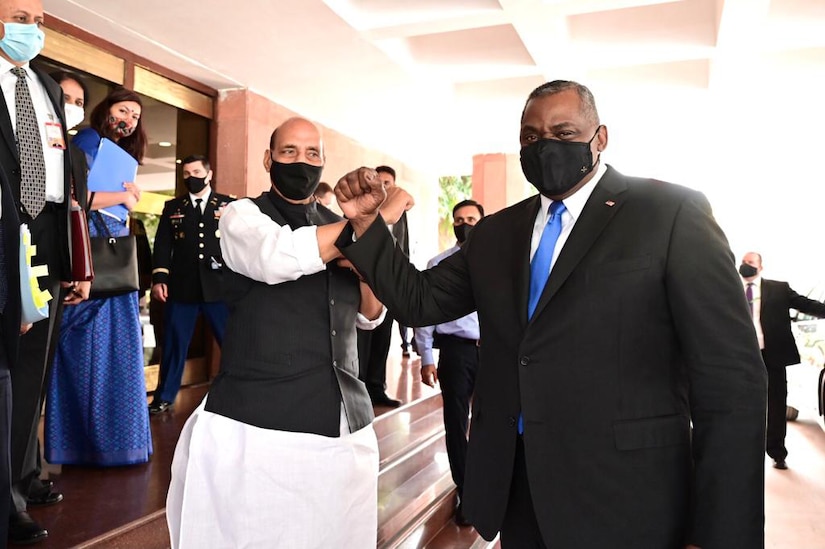
The secretary stressed the U.S. commitment to allies and partners throughout the region. India is a major defense partner to the United States. "I think working together with like-minded countries who have shared interests is the way you check any aggression in any region," the secretary told reporters traveling with him. "And so you can look for us to continue to do that in the future."
India is a key pillar in U.S. strategy in the Indo-Pacific region. Prime Minister Narendra Modi stated that India stands for "freedom of navigation and overflight, unimpeded lawful commerce and adherence to international law."
So does the United States, Austin said. "As the world faces a global pandemic and growing challenges to an open and stable international system, the U.S.-India relationship is a stronghold of a free and open Indo-Pacific region," he said. "And it's clear that the importance of this partnership, and its impact [on] the international rules-based order will only grow in the years ahead."
India – traditionally a non-aligned state – sees converging strategic interests with the United States in this regard. The U.S. and India have begun military exercises together and have worked in some operations together – most notably a counter piracy effort off the coast of East Africa and in the Gulf of Aden.
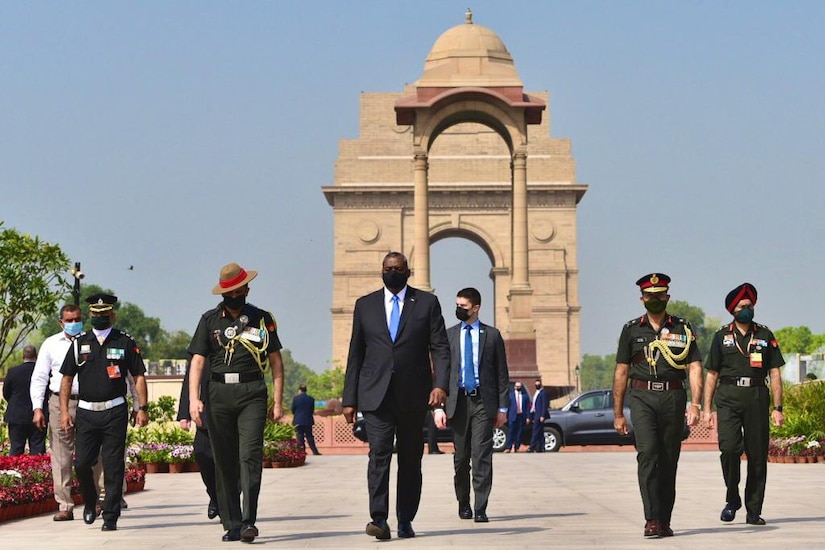
The secretary met with Indian Defense Minister Rajnath Singh earlier in the day and discussed opportunities to elevate the U.S.-India Major Defense Partnership through regional security cooperation, military-to-military interactions and defense trade.
"These are all mutual agreements in terms of the directions that we're wanting to take," Austin said. "And clearly, in terms of increasing interoperability … more exercises are good. And so, we'll see. But again, we can expect that there will be frequent exchanges and we look forward to the ability to work together to build greater capacity and capability going forward."
Some of the areas the leaders agreed to work in include: information-sharing, logistics cooperation, artificial intelligence, and cooperation in new domains such as space and cyber.
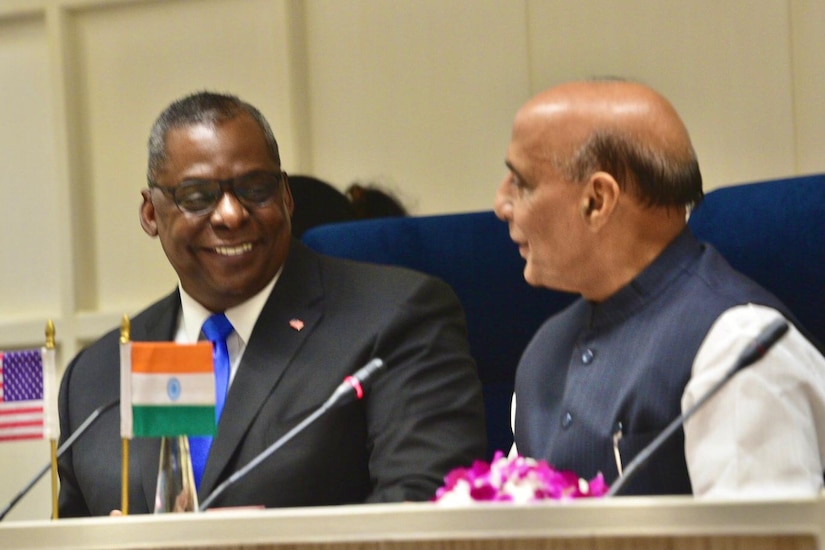
Singh issued a statement after his meeting with Austin that India is "keen to work together to realize the full potential of the India-US comprehensive global strategic partnership."
Singh said the two men "reviewed the wide gamut of bilateral and multilateral exercises and agreed to pursue enhanced cooperation with the U.S. Indo-Pacific Command, Central Command and Africa Command."
Both men stated that the India-U.S. relationship could be one of the defining partnerships of the 21st century.


 Posts
All Comments
Posts
All Comments