Friday, June 11, 2021

Pentagon Press Secretary John F. Kirby Holds a Press Briefing

 June 11, 2021

Pentagon Press Secretary John F. Kirby

PRESS SECRETARY JOHN F. KIRBY: Hey, how you guys doing? Happy Friday. A couple things here at the - at the top. Today the department is announcing a new $150 million package as part of the Ukraine security assistance initiative to help Ukraine's forces preserve their country's territorial integrity and to improve interoperability with NATO.

The package includes capabilities such as two counter-artillery radars, some counter unmanned aerial systems, and secure communications. It will compliment the $125 million package that we announced back in March. This package is made possible after the Department of Defense in coordination with the State Department was able to certify that Ukraine has made sufficient progress on defense reforms this year, as required by the National Defense Authorization Act.

The department continues to encourage Ukraine to enact reforms that are in line with NATO principles and standards to advance its Euro-Atlantic aspirations. Just to remind, the United States has committed more than $2.5 billion in security assistance to Ukraine since 2014 and will continue to strengthen our strategic defense partnership, including through the provision of defensive, lethal assistance. We'll post the full announcement on defense.gov after the briefing.

In accordance with President Biden's January 20th proclamation, the department has developed a plan for redirecting funds and repurposing contracts that are connected with the border barrier construction. We announced, as you know, on April 30th the cancellation of all border barrier construction projects paid for with funds that were originally designed and meant for other missions and functions.

So the Deputy Secretary today has approved a plan to use the $2.2 billion in unobligated military construction funds that were previously made available for border barrier construction to restore funding in this fiscal year for 66 projects in 16 countries, 11 states and three territories.

The decision to restore this funding was based on operational and component priorities. You can see our - her memo on defense.gov now, the - I - it's - it's up on the website, and if you look at the - the attached memo, you'll see the whole list of - of projects that - that'll be restored.

On DEFENDER-Europe 21, it wraps up this weekend. We've been talking about it a lot over the last few weeks. Tomorrow, the U.S. Army's 2nd Cavalry Regiment will begin a four day road march, traveling through Hungary, Slovakia and the Czech Republic as they redeploy to Germany.

Sunday is the final day of DEFENDER-Europe 21, with the completion of the command post exercise, and that will include a distinguished visitor media day hosted by NATO's Multinational Corps Southeast in Bucharest, Romania and will be attended by the Commanding General of U.S. Army Europe and Africa.

Since the first day, DEFENDER-Europe 21 demonstrated our forces' ability to serve as the combined joint forces land component commander and command and control large scale ground combat operations across multiple theaters, in support of NATO and our own National Defense Strategy.

On behalf of everybody here at the department, the Secretary would like to say thank you to all our men and women, allies and partners, who played a critical role in making this year's DEFENDER-Europe 21 such a success.

On other exercises, NORAD exercise Amalgam Dart 21-1 began yesterday and continues through June 18th. Amalgam Dart occurs along North America's northern approaches and will have American, Canadian and allied participants. It will involve a live fly component on the 14th and 15th of June, with U.S. and Canadian fighter and support aircraft.

The Amalgam Dart exercise series is a multi-NORAD region activity to enhance Canadian and American air asset interoperability in the execution of NORAD's aerospace warning and aerospace control missions in the defense of Canada and the United States.

In recent years, NORAD has been developing its Arctic defense capabilities by using training opportunities such as this exercise to improve its capability and capacity, by leveraging Canadian, American, as well as allied assets to defend our northern approaches.

With that, we'll go to questions. I think, Lita, you're first and you're on the phone, right?

Q: Yes, I'm on the phone. John, a couple of quick questions on the border funding. Can you say whether or not the department had to pay any penalties or - to get out of any contracts? Was that still pending, so could this number - this amount increase?

Secondly, is all of this diverted construction money or is the department going to be able to recoup any of the drug fund money that it spent? Thank you.

MR. KIRBY: On the - the first one, I'm not aware of any penalties, Lita, I'll check on that, but I want to stress that the - the $2.2 billion that we've restored of the $3.6, which was the - the previous administration - moved from construction projects, that $2.2 billion was unobligated. So that money is now going to be put forth on 66 projects. There were all - a total of 123 projects that - military construction projects that the - the Trump administration canceled to apply the funds for the - the border wall. So more than 50 of the 123, the - the funds dedicated - were - would have been dedicated to those more than 50 - had been dedicated to - to border wall construction.

I - I'm not even aware, Lita - and again, I'll check on this - that contracts have to be - or are being canceled. We'll check on that. But again, just to stress, the $2.2 billion is unobligated. That had not - not been used at all for any border wall construction. And as you know, we ended that border wall construction back in April.

I'm sorry, what was your second question, Lita?

Q: The - the second was does this preclude any of the drug fund money from also being restored? Is that money all gone or is there a possibility some of that could also be recouped?

MR. KIRBY: You mean counter-narcotics funds? Is that what you're talking about?

Q: Yes.

MR. KIRBY: Let me take that one. I do not have - I don't - I don't know. Our announcement today is really just about these military construction projects, so I don't have a good answer for you on that. I'll take it. Tony?

Q: ... one follow up on the funding issue. Would the $2.2 billion - would that be going strictly to unobligated military construction projects or could it be going to Research & Development and Procurement?

MR. KIRBY: It's - it's meant for these military construction projects. So again, there were 123 total that money was taken away from. More than 50 of that - more - 50 - more than - the money is supporting more than 50 of those projects was used - already obligated and used for the border wall construction that we, again, terminated on April 30th.

There are 66 remaining projects that were not - that - that funds were not obligated for and so that - the - the $2.2 billion, that's going to go - that's going to go to those - to those 66, and they're all listed on our website, you can look at them all. There are some examples that OMB put out in their press release, too - you know, gun range on a base, an elementary school for primary students in Germany. They're all there on that list. That - the - so that money is being put back into those 66.

And we determined what the - what 66 were going to get the $2.2 based on, you know, talking to the services and the military departments, as well as our operational commanders cause sometimes - you know, since the original intent was made for those projects, operational requirements have changed. So we did this all across the department to make sure that we chose those carefully.

Q: And a follow up - yesterday's hearing at the SASC, the issue of the sea-launched - a cruise - nuclear cruise missile came up, very contentious. The Secretary seemed to suggest that the department is - supports that program now, pending a Nuclear Posture Review.

Was I listening to - was I hearing him correctly, that at this point, the department does support that weapon that had been proposed by the Trump ...

MR. KIRBY: I think what the Secretary said was the - the - you know, we - he certainly supports modernizing the triad ...

Q: Right.

MR. KIRBY: And that as part and parcel of that effort, we do have a -- you know, we're going to conduct a nuclear posture review. He's not going to get ahead of that. But that, you know, he wants to make sure that as we think about modernizing triad and as we work through this nuclear posture review that we make sure we have the right mix of proper capabilities to defend the country. That's what he was saying yesterday.

Q: Because he did say -- Senator Fischer asked, do you support the request? And he said, yes, we do, the current budget request.

MR. KIRBY: Of course he supports the president's budget request. Of course he does. That was the whole purpose of the hearing. But he also wanted to make clear that we've got a nuclear posture review we're going to conduct. And he also is in favor of modernizing the triad.

Q: Right. OK. Fair enough.

MR. KIRBY: OK? Let me go here. OK. Thanks. OK, Sylvie, AFP?

Q: Yes, hello. John, do you have a reaction to the decision of the French president to reduce the military deployment in Mali and to end the (inaudible) operation?

MR. KIRBY: Well, obviously that's a decision for the French government to speak to. It's their national decision and we certainly would defer to them on that. What I can tell you is that we're going to continue to assist building partner capacity in Africa, and that would include building partner capacity to conduct counterterrorism operations. And we'll continue to provide a measure of support, the kind of support that we've been providing to the French as they need it in the region.

Q: And so you would -- do you think this -- the fact that they decided to end the operation means that the operation failed?

MR. KIRBY: Sylvie, again, I'd let French government characterize this decision. That's really not for us to speak to. We remain committed, for our part, to counterterrorism operations with partners in Africa. And a big part of that is helping them build their own capacity to conduct those kinds of operations. And that -- that's going to remain a focus. We're still dedicated to that task.

Gordon?

Q: Yes, my understanding was that some of the recommendations from the China task force were classified and some of them were unclassified. I don't know if you've spoken to this since the briefing the other day. But can you share any of the unclassified recommendations or how should we expect those to become known?

MR. KIRBY: Gordon, the directive that the secretary signed after receiving the recommendations of the China task force is a classified directive. So I don't think it's fair to say that at this time some are unclass and some are class. The directive he issued is a classified directive.

What I said the other day, and I'm happy to repeat again today, is that I can characterize some of the initiatives such as the secretary directing himself in this memo to take a personal and an individual effort in leading the development of some of the operational concepts, some of the prototyping, and some of the exercises that the department will probably take a look at going forward.

He also, in this memo, tasked the undersecretary for personnel and readiness to develop some workforce plans to develop better expertise throughout the department on the issue of China and the Indo-Pacific writ large.

And so there is a -- you know, there is a series of things that we can talk about already. What I said, also, the other day is that over time as some of these recommendations get implemented and executed, we'll be able to talk about some of them, and we'll be able to point you back and say, OK, this was an outcome of what we're doing now, whatever that is, is that was an outcome of task force recommendations.

There will be other things that we will implement as a result of the task force recommendations that will remain classified and we won't be able to talk about.

Q: But something post-implementation would become by virtue of they've already been executed...

(CROSSTALK)

MR. KIRBY: Well, for instance, what -- the other thing I said was the task force recommendations will be used to inform not only the upcoming new national defense strategy, but also the global posture review. And again as we develop those products, you'll begin to see how they were informed by the work of the China task force.

Q: The posture review is still expected to land next month?

MR. KIRBY: I'd say late summer/early fall. They are still working at it.

Q: Something that we're going -- is going to be...

(CROSSTALK)

MR. KIRBY: I have no doubt that -- that we'll be able to speak to the global posture review. Of course, we'll also have to keep Congress fully informed as that work concludes. But I do suspect that that will be something we'll be able to talk about, in the aggregate, in the aggregate. OK?

All right. You guys have got to use bold markers on this, I can't read your writing here.

Stephen Losey, Military.com?

Q: Hi, thanks for taking my question. Do you have an update on the number of service members who have developed myocarditis after getting their COVID vaccines?

MR. KIRBY: Don't know if I do. Hang on. OK. I don't know if this is an update or this is what -- what we've said before, but I can tell you that we've identified approximately 30 cases of myocarditis among the more than 3.6 million doses that we have administered. We take each one seriously and we're working closely with the CDC and other federal partners, academic, medical professionals as well to ensure that we evaluate all cases consistently.

We know that medical events developing or worsening around the time of the vaccine does not necessarily mean that the vaccine was involved, but as the CDC has noted, evaluations of this important topic are ongoing and again we support that. We remain extremely confident in the vaccines themselves, and we continue to encourage people to take them.

Q: Do you know in that 30 how recent that 30 number is?

MR. KIRBY: I do not.

Yes, sir.

Q: (inaudible), so Turkey's president, Recep Tayyip Erdogan, will meet with President Joe Biden. Before that meeting they had a phone call with Secretary Austin and Turkish minister -- National Defense Minister Akar. So I would like to ask what they talked about, you know, (inaudible) meeting, not a summit, but had they talked about S-400 and 35, because it is a big issue in Turkey and they are coming here to talk about -- you know, with the president, before President Trump, also the ministers, they are talking. So we'd like to learn the information.

MR. KIRBY: Sure, sure, I appreciate the question. The secretary is very much looking forward to attending the NATO summit with President Biden. He also enjoyed his conversation yesterday with the minister of defense. We issued a readout of that phone call. I'm not going to go beyond that readout. But they talked about a range of regional security issues that are of interest to both Turkey and the United States. OK?

Let's see, Sam LaGrone, USNI.

Q: Hey, John, how you doing? Just wanted to follow-up on some of the testimony yesterday or this week on the Navy part of the budget. So Mr. Stefany, the Acting Acquisition Chief for the Navy indicted that there was going to be yet another force structure assessment for Navy shipping. By my count I think this is the third or forth in as many years.

And OSD has been kind of taking the lead on that. We haven't seen a 30 year ship build in plan, and if there is an announcement in the force structure assessment. Can you give us a sense on who's got the ball in terms of the next ship building plan and where that's going and how that's going to be manifested itself in the next weeks? Thanks.

MR. KIRBY: There is - Sam, there is a 30 year ship building plan coming. I suspect we'll be able to transmit it to Congress in the near future. I don't want to get ahead of the process but we are - we are working with the Navy on that and we do intend to submit one. Again, I won't get ahead of the plan itself but I can - I can tell you that we are in fact moving forward on a 30 year ship building plan.

Q: But in terms of a force structure assessment, that' - I mean that's separate from the 30 year ship building plan. That's a - that's a 45 - how ever many year outlook depending on who's in-charge. Separate from the 30 year ship building plan what's - what are developments in that regard? Thanks.

MR. KIRBY: I can't speak to the force structure assessment you're speaking to that the - that the Navy mentioned. I'd refer you back to the Navy to offer you more details on that. Again, the Secretary's focused very much on a global posture review for the entire department around the world. As I said that work is proceeding, we expect it will complete sometime late summer, early fall. But again I'd refer you back to the Navy on the force structure assessment that they spoke to.

Q: Thanks.

MR. KIRBY: OK. Anybody else here? No. OK, on the phones. Jeff, Task & Purpose.

Q: Thank you. As yesterday's SASC hearing shows the criticism from the right that the military is going woke and going after conservatives continues. And I just wanted to see what do you have to say to those politicians and pundits who continue to argue that the diversity and anti-extremism training over the past several months has actually weakened the military?

MR. KIRBY: Jeff, I think the Secretary handled this very well yesterday in the hearing. And I don't think that I could say anything to improve upon his own words. So I certainly would encourage you to go back and look at the transcript and - regarding the questions he got on this. The only thing that I say, Jeff, is it's not about messaging one side of the aisle or the other.

It's important - the Secretary believes it's important for the American people to know that diversity and equity and inclusion matters to the - to the United States Department of Defense. It matters to the defense of this nation. You can't on one hand say that the job is to defend the nation and develop war fighting capabilities and then not talk about the war fighters and who they are and the skills that they possess and what they represent.

Likewise, as the Secretary said himself it's not just a diverse workforce we want it's a diverse leadership that we want. That it's important for the men and women of the department to reflect the nation that they defend. It's also really important for the leaders of those men and women to reflect that same nation and reflect them. Diversity of experience, background all of that contributes to better decision making. That's not - that's a proven fact - that more diverse organizations decide better, think better and lead better, and that's the - I think the message that we'd want the American people to take away.

Q: You mentioned thirty cases of myocarditis. How recent is that figure?

MR. KIRBY: That was - I got that question already, and I - I don't know. I don't have that, I'll see if we can find out how recent it is. It's 30, I know that that's what we're evaluating. But the timeline of those 30 cases, I just don't have that.

Q: Thank you.

MR. KIRBY: Jeff Seldin, VOA?

Q: Thanks very much for doing this. Questions on Afghanistan - there were some reports earlier that the Taliban were targeting some Afghan interpreters, others who work with U.S. forces in Afghanistan. Has the Pentagon been able to confirm whether or not that is indeed true? And if it's not true, is there any concern that the disinformation could hurt future efforts to work by, with, and through partners in other areas?

MR. KIRBY: From those reports, Jeff, obviously we're focused on connecting a safe and orderly retrograde, that's the mission that we've been given. And we will transition to a new relationship with the Afghan forces, one that helps them defend their country and their citizens but will be done through financial support and some over the horizon logistical support. But I can't confirm those reports.

Q: And just one other question on Afghanistan, if I may? ISIS Khorasan claimed the attack on the HALO Trust headquarters in Afghanistan. Is - are the Taliban doing enough to contain ISIS Khorasan at this point? Any updated assessment of that?

MR. KIRBY: I don't have an assessment on that attack. I certainly can't confirm the details of it. The secretary's been very clear that the violence is still too high in Afghanistan, and we all want to see that violence come down, and we still continue to believe that the best way forward in Afghanistan is a political negotiated end to this war, and an Afghan led process to do that. But again, I can't confirm the operation reporting that you've got there.

Sangmin Lee?

Q: Thank you for taking my question. I have a question about exercise of Red Flag Alaska. Can you tell me why at this time Korea and Japan forces joined? And how many airplane and crew from Korea and Japan joined? And lastly, what specific exercise they are doing at this time?

MR. KIRBY: Red flag is - it's an annual exercise, this is not the first time that we have conducted it with Japan and South Korea, that is not uncommon. Last year the exercise didn't move forward because of COVID. I can tell you that 300 service members, about 300 from Japan and from South Korea are scheduled to participate.

As for - I don't have the number of aircraft, I'd refer you to the Pacific Air Forces Command for that. But these exercises are focused on improving the combat readiness of U.S. and our allied forces providing training for units, preparing for air and space expeditionary force tasking. So it's an air exercise, again, designed to improve our interoperability with each other, and our air combat skills.

OK, last (inaudible) - I think is Laurie.

Q: Hi, John. Thank you very much for taking my question. My question involves a "Washington Post," report that Russia is going to supply Iran with advanced satellites that will give it a much better capability - surveillance capability. How concerned are you about that, particularly with regard to U.S. forces in Iraq and Syria?

MR. KIRBY: I can't confirm those reports. I mean, I'm certainly not going to speak about intelligence matters, and I think it's a great question to be put to leaders in Moscow and Tiran to speak to. What I can say is that we're going to remain focused on the malign activities of Iran in the region, and sometimes beyond the region.

Their increasing ballistic missile capabilities, their support to terrorist organizations, their efforts to impede freedom of navigation in and around the region. All those things are at the forefront of the secretary's mind as we think about our operations in the central command region of responsibility, and our own force posture there. That's going to remain a key focus for the secretary moving forward. Tony?

Q: Thank you very much.

Q: John, there’s reports of an Iranian vessel that is transiting toward Venezuela, any sense, sir - is this considered a threatening move? Or part of his panoply of threats that Iran poses?

MR. KIRBY: We're monitoring this deployment of these two ships, I think, again, I believe questions should be put to leaders in Tiran about what their intent is. So I'm not going to speculate about what they think they're trying to achieve, but we are monitoring it and keeping an eye on it.

Q: Yesterday there was an exchange between Senator Hirono and Secretary Austin about the Pacific Defense Initiative. She gently pointed out that it was loaded with platforms - platform centric. I looked at it, there's like $1 billion of F-35 upgrade money in there that was already - (inaudible) in the Marine Corps, and Air Force, and Navy Air Force budgets.

He said he wanted to work with the staff to clear up perceived misalignments in this Pacific Defense Initiative. Can you address that on what perceived misalignments was he talking about?

MR. KIRBY: I think the secretary was simply making it clear that we're going to continue to work with Congress as we move through, again, the budget process here. But we are committed to the Pacific Deterrence Initiative.

He is very committed to the $5.1 billion in the budget dedicated to that. And I think he also wanted to make the point that the Pacific Deterrence Initiative, important as it is - and legislated as it is, is not the end-all of all our support to the Indo-Pacific region, or towards our efforts to match the pacing challenge that we see coming from the PRC.

So you also see in the budget, investments in hypersonics, 5G technology, micro electronics, we talked about nuclear modernization - you and I. Shipbuilding - additional ships for the Navy. There's a lot that will go into helping us deal with the global pacing challenge of China.

Q: Yes, but the point is it looks like you're padding the Pacific Defense Initiative with things that are already in the budget that could go anywhere. It looks like it was padding, I think that was her point.

(CROSSTALK)

Why would the F-35 ...

MR. KIRBY: The secretary - I would just say that the secretary is very comfortable with the $5.1 billion that's dedicated in the budget to the Pacific Deterrence Initiative and the things therein.

Thanks, everybody. Have a great day.

Official Says Input From Allies on Nuclear Posture Review to Be Important

 June 11, 2021 | BY David Vergun , DOD News

China is rapidly becoming more capable and assertive and concerns regarding its nuclear modernization and expansion are increasing. Russia's comprehensive modernization of its nuclear capabilities, over 80% complete, includes the addition of new dual-capable systems that threaten the United States and its allies and partners, the acting assistant secretary of defense for strategy, plans and capabilities said.

Melissa Dalton spoke yesterday at a House Armed Services Committee's Strategic Forces Subcommittee hearing on "FY22 Budget Request for Nuclear Forces and Atomic Energy Defense Activities." 

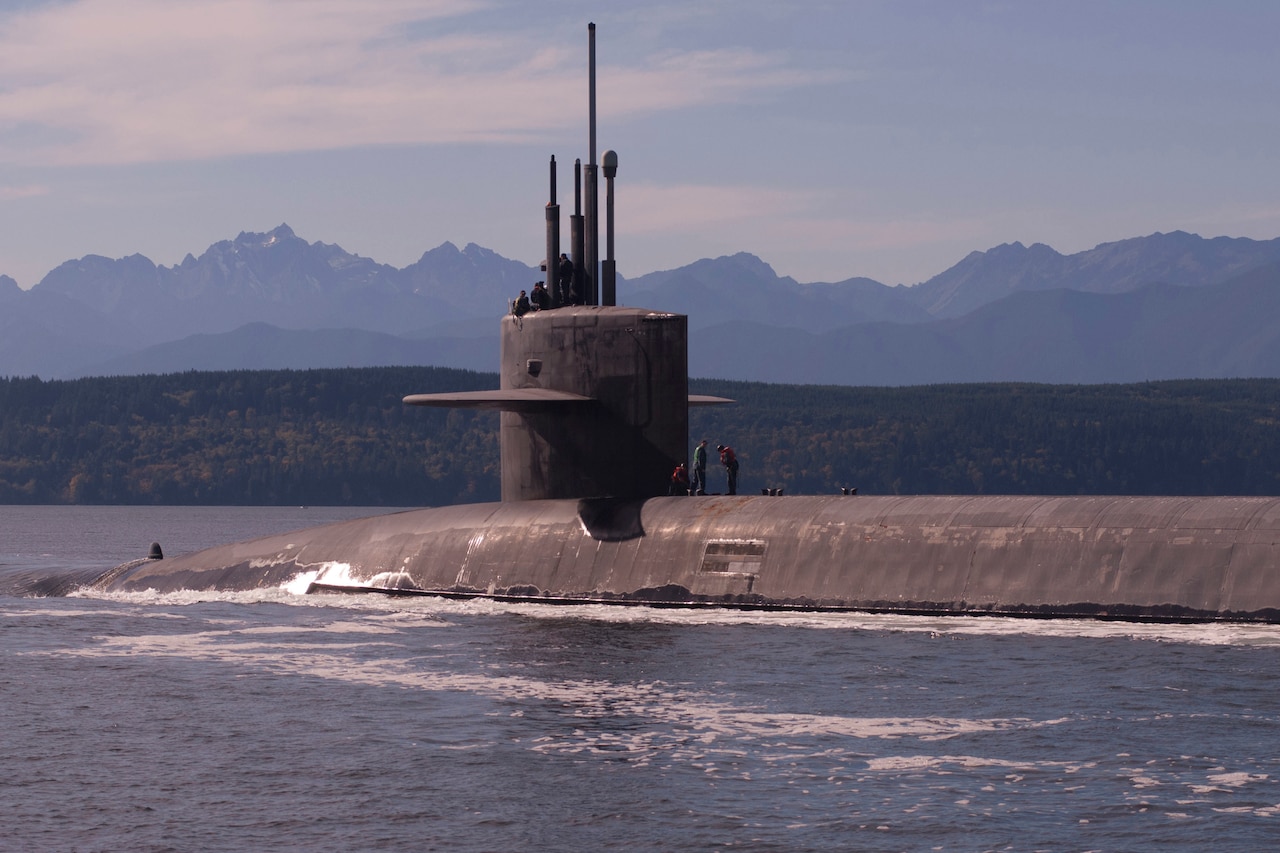
Submarine at sea

"We are confronted with multifaceted deterrence challenges across domains from both competitors, which add increased escalation risks, all making deterrence more challenging. Strategic risks, emanating from both North Korea and Iran, add significant complications to the strategic threat picture," she said.

For these reasons, nuclear deterrence remains the department's highest priority mission, Dalton noted, adding that more is needed to confront these growing, multifaceted threats. 

The National Defense Strategy review will focus on integrated deterrence, she said, meaning an effort to address threats and opportunities across conventional, cyber, space, hybrid, information and nuclear domains, she said. 

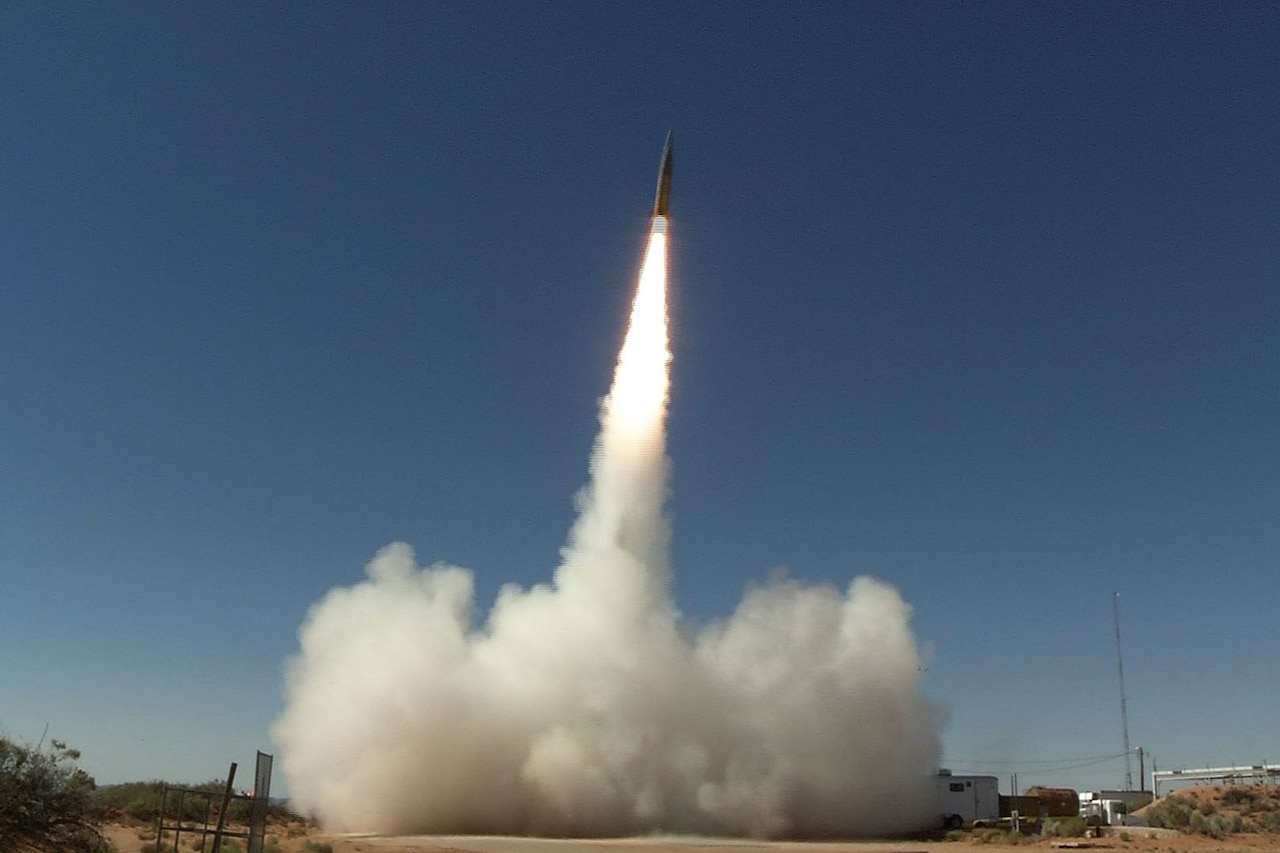
Missile launches into sky

"Nuclear forces remain essential to ensure no adversary believes it can ever employ nuclear weapons, for any reason, under any circumstances, against the United States or our allies and partners, without risking devastating consequences," Dalton said. 

"That is why the nuclear triad remains the bedrock of our strategic deterrence, but we must modernize our aging capabilities to ensure a credible deterrent for the future," Dalton added. 

The fiscal year 2022 Defense Department's budget request for nuclear forces is $27.7 billion. It includes $15.6 billion to sustain and operate current nuclear forces and $12.1 billion for recapitalization programs.

A bomber sits on a runway.

It supports efforts to modernize the nuclear triad and ensures that modern replacements will be available before aging systems reach the end of their extended service lives, she said. 

"This modernization effort is at a critical juncture," Dalton said, adding that "nuclear weapons have been extended far beyond original service lives and the tipping point where we must simultaneously overhaul these forces is now here. Updating and overhauling our nation's nuclear forces is a critical national security priority."

The department will always seek to balance the best capabilities and the most cost-effective solution, as well as to ensure the U.S. has the right capabilities to meet current and future threats, she noted.

People in a tunnel secure a missile.

Dalton mentioned that to ensure that the right balance of capabilities is struck, there is a pending review of nuclear policy and posture, which will be nested within the National Defense Strategy currently in development, under the direction of the Interim National Security Strategic Guidance.  

The review will focus on the vital interests of the United States, along with its allies and partners, and will be informed by the current and projected global security environment, threats posed by potential adversaries and the capabilities of the United States, allies and partners to address those threats, Dalton said.

"Consultation with allies will be a core component of this review, and we have begun engaging with allies to ensure that their views are heard and understood before reaching any conclusions," she said.

DOD Leaders Share Their Intelligence Threat Assessments

June 11, 2021 | BY David Vergun , DOD News

The fiscal year 2022 Defense Department's $715 billion budget request includes $23.3 billion for the military intelligence program and defense intelligence leaders addressed the capabilities and gaps of military intelligence.

Under Secretary of Defense for Intelligence and Security Ronald Moultrie; Army Gen. Paul M. Nakasone, commander, U.S. Cyber Command, director of the National Security Agency, and chief of Central Security Service; and Army Lt. Gen. Scott D. Berrier, director of the Defense Intelligence Agency, provided testimony at a House Armed Services Subcommittee on Intelligence and Special Operations hearing on fiscal year 2022 defense intelligence enterprise posture.

The intelligence professionals at the Defense Department work every day to address the current and future threats facing the United States, said Moultrie.

The department develops its military intelligence program in coordination with the director of national intelligence to align the intelligence capabilities between defense and national priorities, while avoiding unintentional duplication, he said.

The expansion of the competitive space beyond traditional military domains and geographic boundaries increases and complicates demands for defense intelligence, collection, analysis and planning, he said.

Challenges from strategic competitors such as Russia and China, rogue states such as Iran and North Korean, and violent extremists require that the defense intelligence enterprise invest in the ability to seamlessly share and fuse information, synchronize capabilities and expand partnerships with other government agencies, the private sector, academia and partner nations, he said.

The department is taking a whole-of-government approach, which includes reviewing classification processes, pursuing wider dissemination of classified information through alliances and partnerships, and the thoughtful release to the public of certain unclassified information to support U.S. interests, Moultrie said.

The department is focused on countering insider threats through better vetting procedures and protecting its vital supply chain, he said.

"Most important to our continued intelligence advantage will be building and retaining a diverse workforce capable of meeting the new challenges of the 21st century. It must have digital literacy and advanced skills to harness emerging technologies and adapt to ever changing threat environments. It must be a workforce that is free of sexual harassment and intolerant of violent extremism, at any level, and it must also be equitable, inclusive and one [that] reflects the nation it serves," he said.

Moultrie also mentioned that the department will work closely with allies and partners in sharing intelligence.

Nakasone said the NSA's focus is on two missions: signals intelligence and cybersecurity. The signals intelligence mission achieves access to adversaries' network and data, which provides the nation with an information advantage in competition crisis or conflict.

The cybersecurity mission prevents cyber threats to U.S. national security systems and critical infrastructure, with a special emphasis on the defense industrial base, and weapons security, he said.

The NSA's military intelligence program provides resources for vital cryptologic capabilities to increase the ability of the defense intelligence enterprise to deliver accurate and timely intelligence to combatant commanders and deployed forces, he said.

Berrier said today's threat environment reflects rapid, significant technological change in adversarial challenges in every operating domain. 

"I am committed to ensuring DIA is positioned to meet these challenges by modernizing key capabilities across the top secret IT network, our foundational military intelligence mission and our ballistic missile technical collection architecture," he said.

Missile Defense Review Will Address Growing Threats From Iran, North Korea, Others

 June 11, 2021 | BY DoD News

With nations such as North Korea, Iran, Russia and China all maturing their missile technology, the Defense Department plans to launch a review of its own missile defense policies, strategies and capabilities over the next few months, said the deputy assistant secretary of defense for nuclear and missile defense policy.

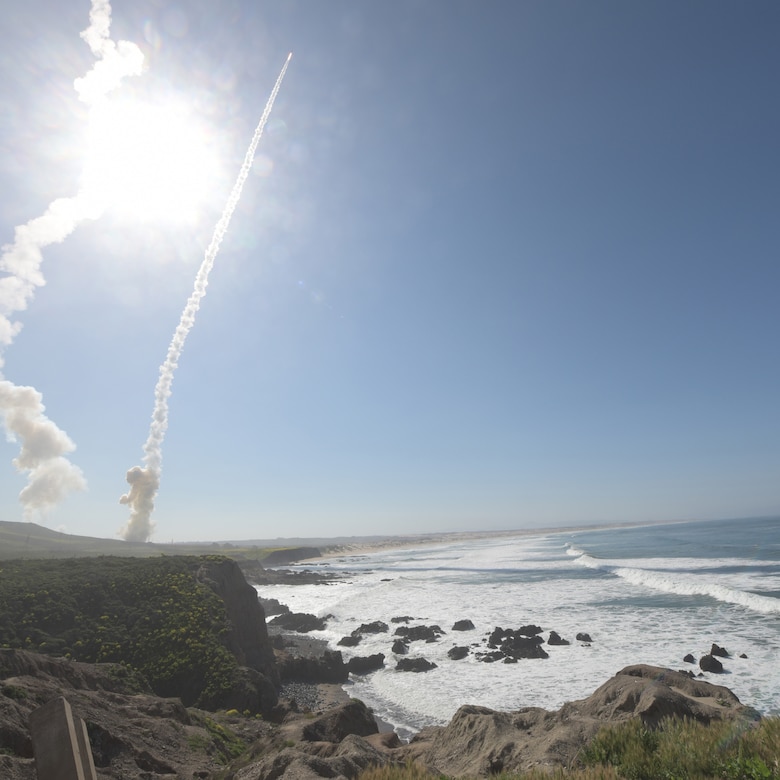
A missile launches skyward during a daytime test, leaving a trail of smoke and fire.

"The review will align with the National Defense Strategy and contribute to the department's approach to integrated deterrence," Leonor Tomero said during a Wednesday hearing before the Senate Armed Services Committee.

The review will be coordinated across the department, including such entities as the Missile Defense Agency, U.S. Northern Command, NORAD and the acquisition community, Tomero said.

"We'll look at the threat in the changing security environment ... how do we improve and have effective and affordable missile defense for both the homeland and regional defense," she said.

That review will be a part of the National Defense Strategy, which Tomero said should be completed by January 2022.

According to testimony filed by Tomero with the committee, the review will be guided by a handful of principles from defense against rogue states' intercontinental ballistic missiles to assure allies the U.S. continues to be committed to security partnerships.

With ICBMs, Tomero said, the missile defense review will focus on ensuring the U.S. has an affordable defense against rogue state ICBMs. There, missile defense must protect against limited attacks by those ICBMs, she said, and also limit their use as a threat.

A long-exposure photograph shows the nighttime launch of a missile, which leaves a trail of light.

"This protection will also contribute to diminishing the coercive potential of these states who may seek to constrain the ability of the United States to provide credible security assurances to our allies and partners during a crisis or conflict," she said.

The missile defense review will also evaluate the ability of U.S. missile defense capabilities so that the U.S. can operate with allies and partners on exercises and regional defense.

"Our regional missile defenses will continue to contribute to the United States' ability to operate throughout the world," she said. "They will enable regional and transregional military operations and exercises, providing force protection in contested environments."

Finally, the review will evaluate the continued ability of the U.S. missile defense capability to assure allies of the United States' commitment to security partnerships.

"Not only will missile defense partnerships reinforce the indivisibility of U.S. and allied joint security interests, these relationships will also provide opportunities for allied and partner cooperation, co-development, and burden sharing," she said.

Threat Reaction


Marine Corps Staff Sgt. Nelson Aviles participates in ground threat reaction drills at Mount Bundy Training Area, Northern Territory, Australia, May 28, 2021.

DOD Announces Plan to Restore $2.2 Billion in Funding Previously Used for Border Barrier Construction

 June 11, 2021


In accordance with President Biden’s direction in Presidential Proclamation 10142 issued on January 20, 2021, the Department of Defense has developed a plan for redirecting funds and repurposing contracts as appropriate and consistent with applicable law.

The Department’s plan, implemented in part as it was developed, consists of two parts – cancellation of projects and redirection of funds.

As announced on April 30, 2021, the Department of Defense has cancelled all border barrier construction projects paid for with funds originally appropriated for other military missions and functions.

With respect to the redirection of funds, Deputy Secretary of Defense Kathleen Hicks has approved a plan to use the $2.2 billion of unobligated military construction funds previously made available for border barrier construction to restore funding in FY 2021 for 66 projects in 11 States, 3 territories, and 16 countries.

The decision to restore funding for well-designed and executable projects was based on operational and component priorities.

View the DOD plan here. 

COVID-19 Vaccine


Air Force Senior Airman Anabell Salcedo administers a COVID-19 vaccine to a man at a community vaccination center in St. Paul, Minn., June 7, 2021. Salcedo is assigned to the 628th Healthcare Operations Squadron at Joint Base Charleston, S.C.

Hornet Inspection


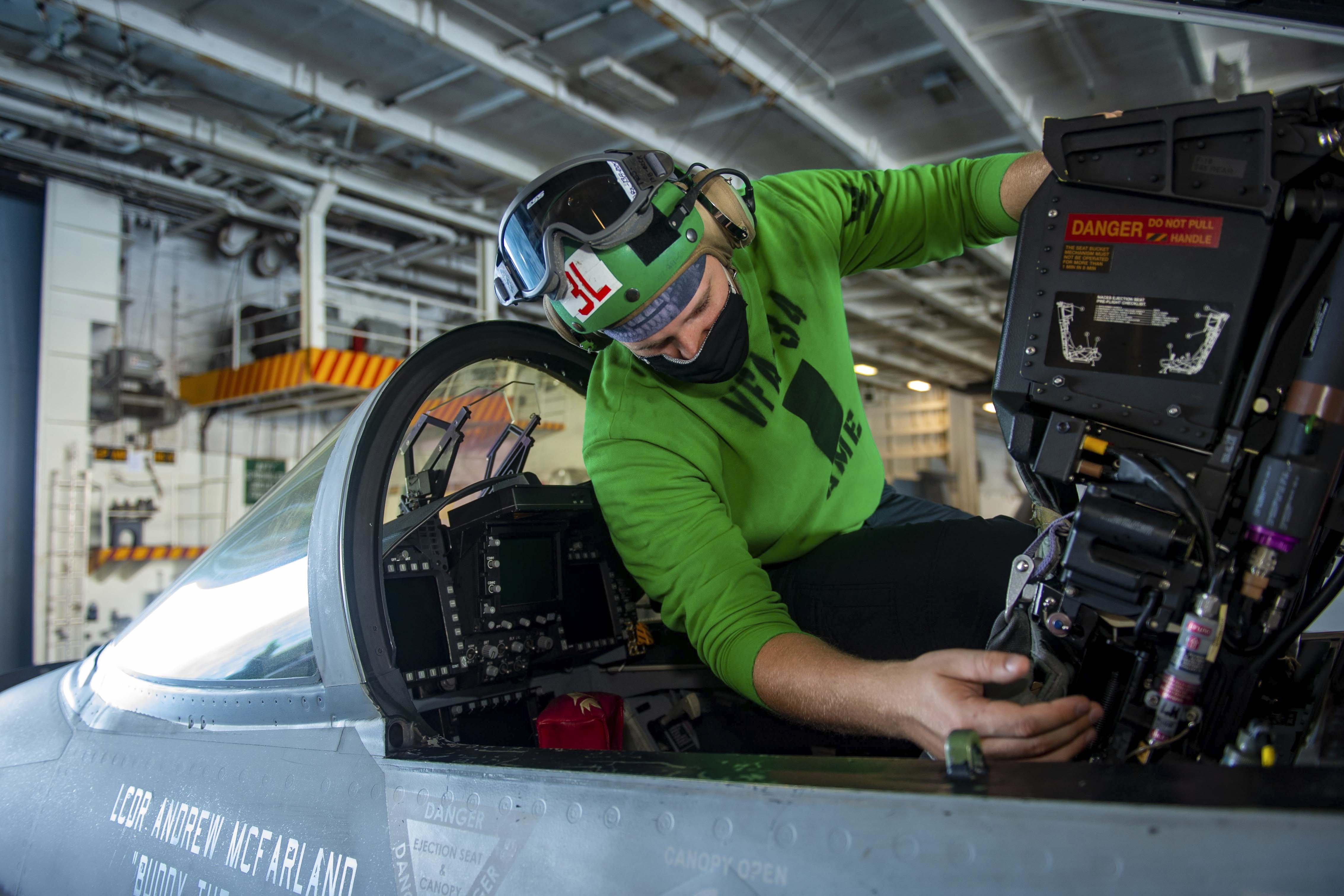
Navy Petty Officer 3rd Class Drew Werosta inspects the cockpit of an F/A-18F Super Hornet in the hangar bay of the USS Harry S. Truman in the Atlantic Ocean, June 9, 2021.


Cool Camel


Army Maj. Steven Kornegay pets a camel after his promotion ceremony in Djibouti, June 9, 2021. Kornegay had a ceremony in traditional dress with Djiboutian soldiers.

Ceremony Salute


Marines participate in a pass and review during a change of command ceremony at Marine Corps Air Station Futenma, Okinawa, Japan, June 11, 2021.

Defense Department Announces $150 Million in Assistance for Ukraine

 June 11, 2021


The Department of Defense announces a new $150 million package for the Ukraine Security Assistance Initiative (USAI) that includes training, equipment, and advisory efforts to help Ukraine’s forces preserve the country’s territorial integrity, secure its borders, and improve interoperability with NATO.  

This $150 million package represents the remaining funds appropriated by Congress for USAI in Fiscal Year 2021 and is made possible by the Defense Department, in coordination with the Department of State, certifying that Ukraine has made sufficient progress on defense reforms this year, as required by the National Defense Authorization Act.

The USAI package includes capabilities to enhance the lethality, command and control, and situational awareness of Ukraine’s forces through the provision of counter-artillery radars, counter-unmanned aerial systems, secure communications gear, electronic warfare and military medical evacuation equipment, and training and equipment to improve the operational safety and capacity of Ukrainian Air Force bases.

These capabilities complement the $125 million USAI package announced on March 1, 2021 that included armed Mark VI patrol boats, counter-artillery radars, tactical equipment, support for a satellite imagery and analysis capability, and equipment to support military medical treatment and combat evacuation procedures.

The Department encourages Ukraine to continue to enact reforms to: better align Ukraine’s defense enterprise with the core NATO principle of democratic civilian control of the military; adopt a defense industry strategy that better supports the needs of the Ukrainian Armed Forces, bolsters Ukraine’s economic competitiveness, and improves corporate governance; adopt foreign direct investment controls based on national security interests; increase efficiency and transparency in the defense procurement cycle; and advance human resources management reforms to align the Ukrainian Armed Forces with a Western-style career management system.

The United States has committed more than $2.5 billion in security assistance to Ukraine since 2014 and will continue to strengthen our strategic defense partnership, including through the provision of defensive lethal assistance. The United States will also continue to assist Ukraine with the implementation of these reforms to advance its Euro-Atlantic aspirations in support of a secure, prosperous, democratic, and free Ukraine.

Summer Shield


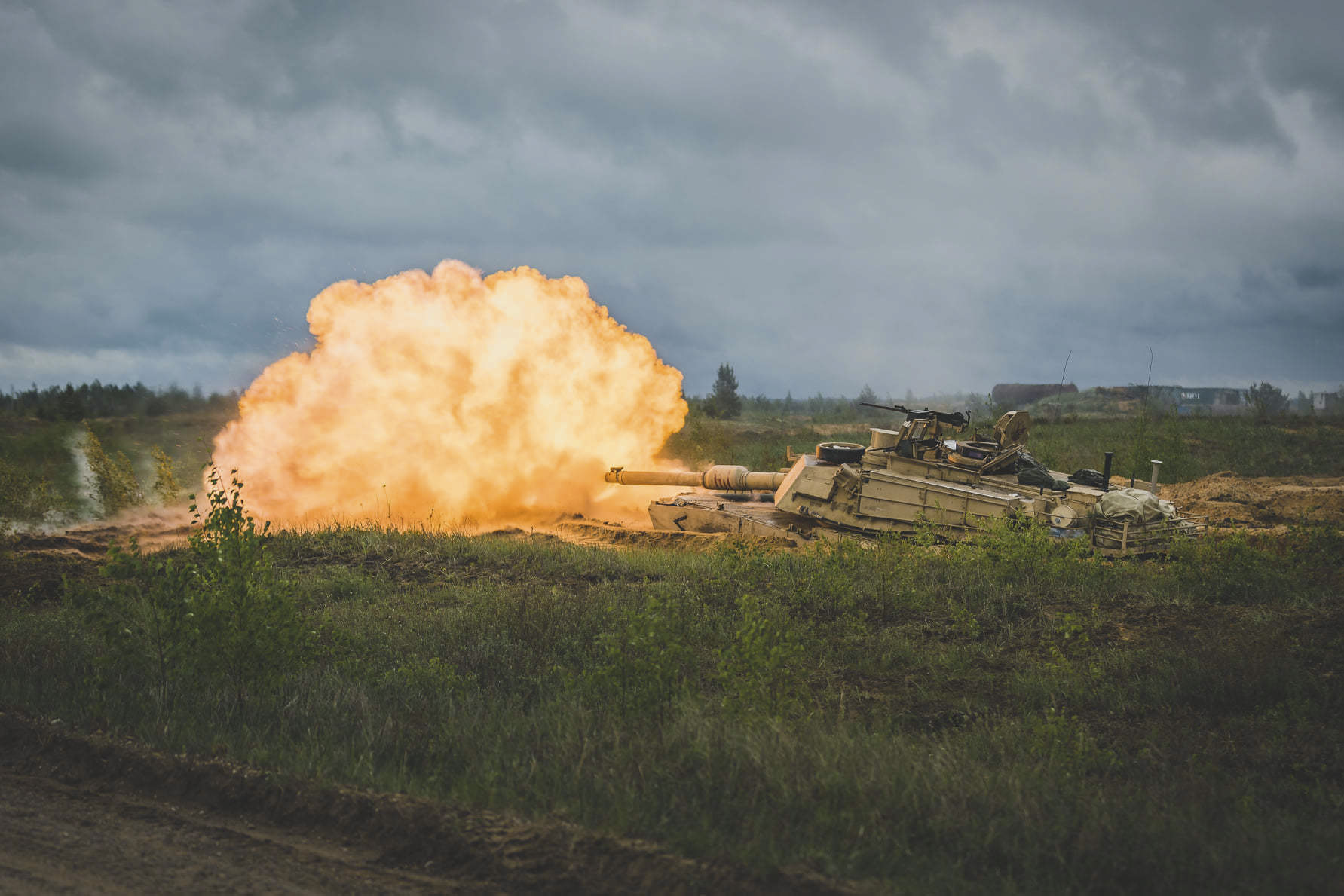
An Army Abrams tank fires in Adazi, Latvia, May 28, 2021, during Summer Shield, an annual exercise.

Medevac Training


Soldiers conduct medevac hoist training with an HH-60 Black Hawk at Fort Carson, Colo., June 2, 2021.

Tire Team


Army Spc. Tyre Moody, left, and Sgt. Cruz Gonzalez replace a rear tire on a Black Hawk helicopter at Camp Buehring, Kuwait, June 6, 2021, while supporting Operation Inherent Resolve and Operation Spartan Shield.

Merced Man Charged with Drug Trafficking Offense

 FRESNO, Calif. — A federal grand jury returned a one-count indictment Thursday against Richard Charles Thomas Jr., 38, of Merced, charging him with possession with intent to distribute methamphetamine, Acting U.S. Attorney Phillip A. Talbert announced.

According to court documents, on Aug. 25, 2020, Thomas led law enforcement officers on a highspeed chase through the city of Merced. While fleeing police, Thomas threw a black bag from the vehicle. Officers recovered the bag, which contained approximately 839 grams of methamphetamine, $3,162 in cash, and personal effects belonging to Thomas.

This case is the product of an investigation by the Drug Enforcement Administration and the Merced Police Department. Assistant U.S. Attorney Jessica A. Massey is prosecuting the case.

If convicted, Thomas faces a mandatory minimum statutory penalty of 10 years in prison and a $10 million fine. Any sentence, however, would be determined at the discretion of the court after consideration of any applicable statutory factors and the Federal Sentencing Guidelines, which take into account a number of variables. The charges are only allegations; the defendant is presumed innocent until and unless proven guilty beyond a reasonable doubt.

This case is being prosecuted as part of the joint federal, state, and local Project Safe Neighborhoods (PSN) Program, the centerpiece of the Department of Justice’s violent crime reduction efforts. PSN is an evidence-based program proven to be effective at reducing violent crime. Through PSN, a broad spectrum of stakeholders work together to identify the most pressing violent crime problems in the community and develop comprehensive solutions to address them. As part of this strategy, PSN focuses enforcement efforts on the most violent offenders and partners with locally based prevention and reentry programs for lasting reductions in crime.

Hawaii Howitzer


Soldiers conduct M119 Howitzer night live-fire training at Schofield Barracks, Hawaii, May 19, 2021.

Eye Exam

Air Force Capt. Joshua Goetz uses a slit lamp to examine a Moroccan patient's eye at a military surgical field hospital in Tafraoute, Morocco, June 7, 2021. The medical treatment was part of Exercise African Lion, U.S. Africa Command's largest joint annual exercise hosted by Morocco, Tunisia, and Senegal.


Big Dig


Navy Petty Officer 2nd Class Jordan Conelly operates a backhoe during construction of a cement bunker as part of joint exercise Poseidon’s Watchtower at the Joint Okinawa Training Range Complex in Japan, June 4, 2021.


Hanging Around


Soldiers demonstrate their insertion and extraction capabilities during a study course at Schofield Barracks, Hawaii, May 27, 2021. Throughout the course, students were taught how to rig, inspect and deploy via a UH-60 helicopter.

Thursday, June 10, 2021

Readout of Secretary of Defense Lloyd J. Austin III's Phone Call With Turkish Minister of National Defense Hulusi Akar

 June 10, 2021


Pentagon Press Secretary John F. Kirby provided the following readout:

Secretary of Defense Lloyd J. Austin III spoke by phone today with Turkish Minister of National Defense Hulusi Akar to discuss bilateral cooperation and regional issues. The Secretary reaffirmed the longstanding U.S.-Turkey defense relationship and said he looked forward to seeing the Minister at the June 14 NATO Summit in Brussels.

Coast Guard to rename personnel housing facility after NYPD/USCG Reserve 9/11 hero Vincent G. Danz with 20-year remembrance

 Who: Capt. Zeita Merchant, Commander, Coast Guard Sector New York, and New York City Police Department Commissioner Dermot Shea.

What: The Coast Guard is scheduled to hold a ceremony, in conjunction with NYPD, to announce the dedication of the Coast Guard Sector New York’s unaccompanied personnel housing facility in honor of Petty Officer 2nd Class Vincent G. Danz, a Coast Guard Reservist, and NYPD police officer, who died while responding to 9/11. 

When: Wednesday, June 9, 2021, at 10 a.m.

Where: USCG Sector New York, Fort Wadsworth, Staten Island, New York City.

NEW YORK — Coast Guard Sector New York will hold a dedication ceremony honoring Danz, and dedicating the housing facility, Vincent G. Danz Hall, as part of the 20th year remembrance of the events on 9/11.  

Danz served as a Coast Guard Reservist at Coast Guard Activities New York, as well as an NYPD officer at the Emergency Services Unit in the Bronx. He responded on 9/11 to aid victims and lost his life when the World Trade Center collapsed.

The unaccompanied personnel housing building was originally built in 1986 by the Navy to support Naval Station New York. The Coast Guard then gained ownership of the property when it moved to Fort Wadsworth from Governor’s Island in 1997.   

Media interested in attending are asked to RSVP to Coast Guard Public Affairs at (718) 354-2359

Geospatial Survey



Air Force Airman 1st Class Elizabeth Rodriguez levels a geospatial surveying instrument at Kadena Air Base, Japan, June 9, 2021. The instrument calculates relative distance, direction and elevation — calculations that are then uploaded to update geographical information.

African Lion


Utah Army National Guardsmen lift some cargo in Tan Tan, Morocco, June 8, 2021, during African Lion, U.S. Africa Command's largest joint, annual exercise.

Demolition Range


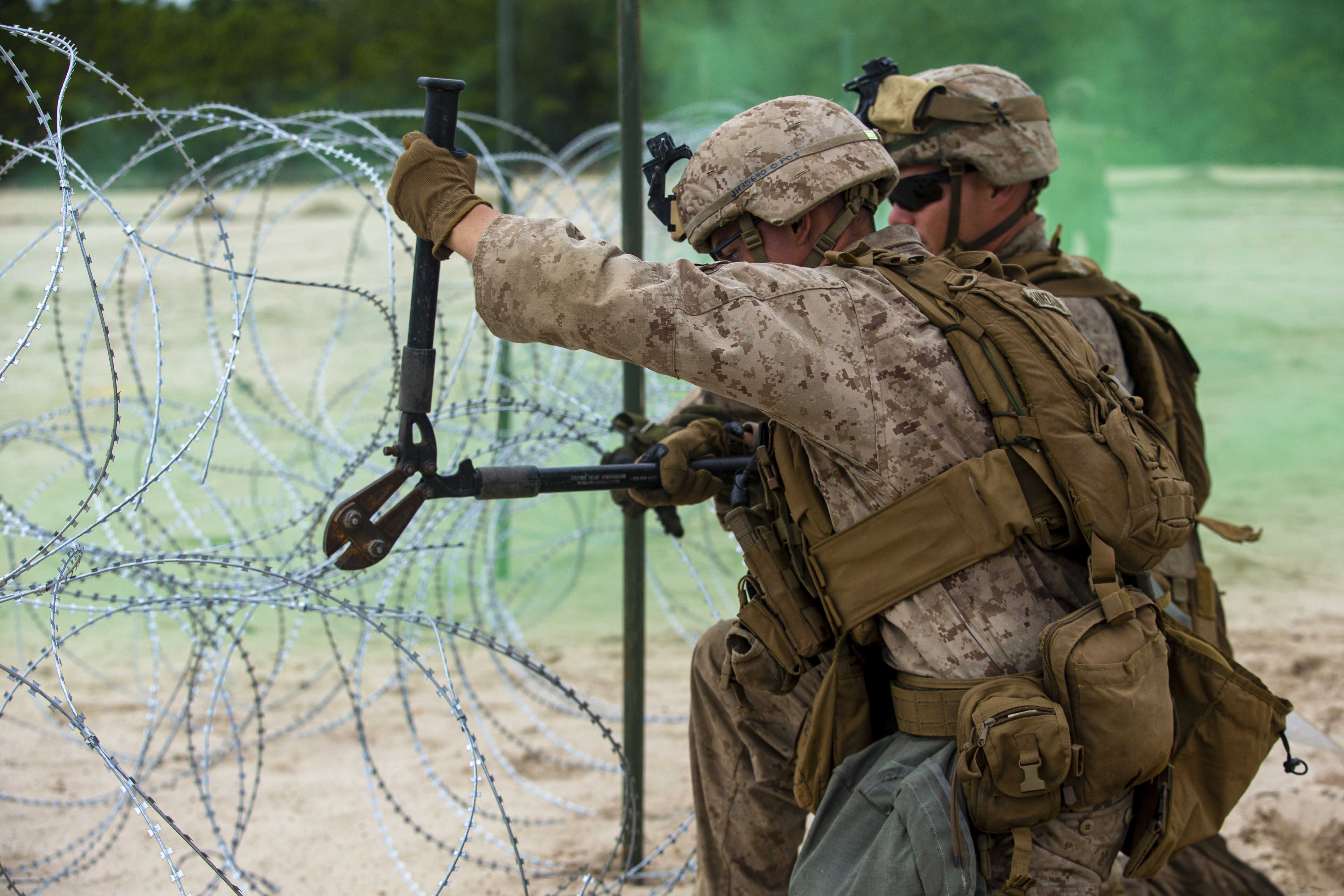
Marine Corps Lance Cpl. Jack Hinebaugh participates in a demolition range event during a combat readiness evaluation at Camp Lejeune, N.C., June 7, 2021.

General Officer Announcements

 June 10, 2021


Secretary of Defense Lloyd J. Austin III announced today that the president has made the following nominations:

Marine Corps Maj. Gen. David J. Furness for appointment to the rank of lieutenant general, and assignment as deputy commandant for plans, policies, and operations, Headquarters, U.S. Marine Corps, Washington, D.C.  Furness is currently serving as assistant deputy commandant for plans, policies, and operations, Headquarters, U.S. Marine Corps, Washington, D.C.

Marine Corps Maj. Gen. Matthew G. Glavy for appointment to the rank of lieutenant general, and assignment as deputy commandant for information, Headquarters, U.S. Marine Corps, Washington, D.C.  Glavy is currently serving as commander, Marine Corps Forces Cyberspace Command, Fort George G. Meade, Maryland.

Home Builders


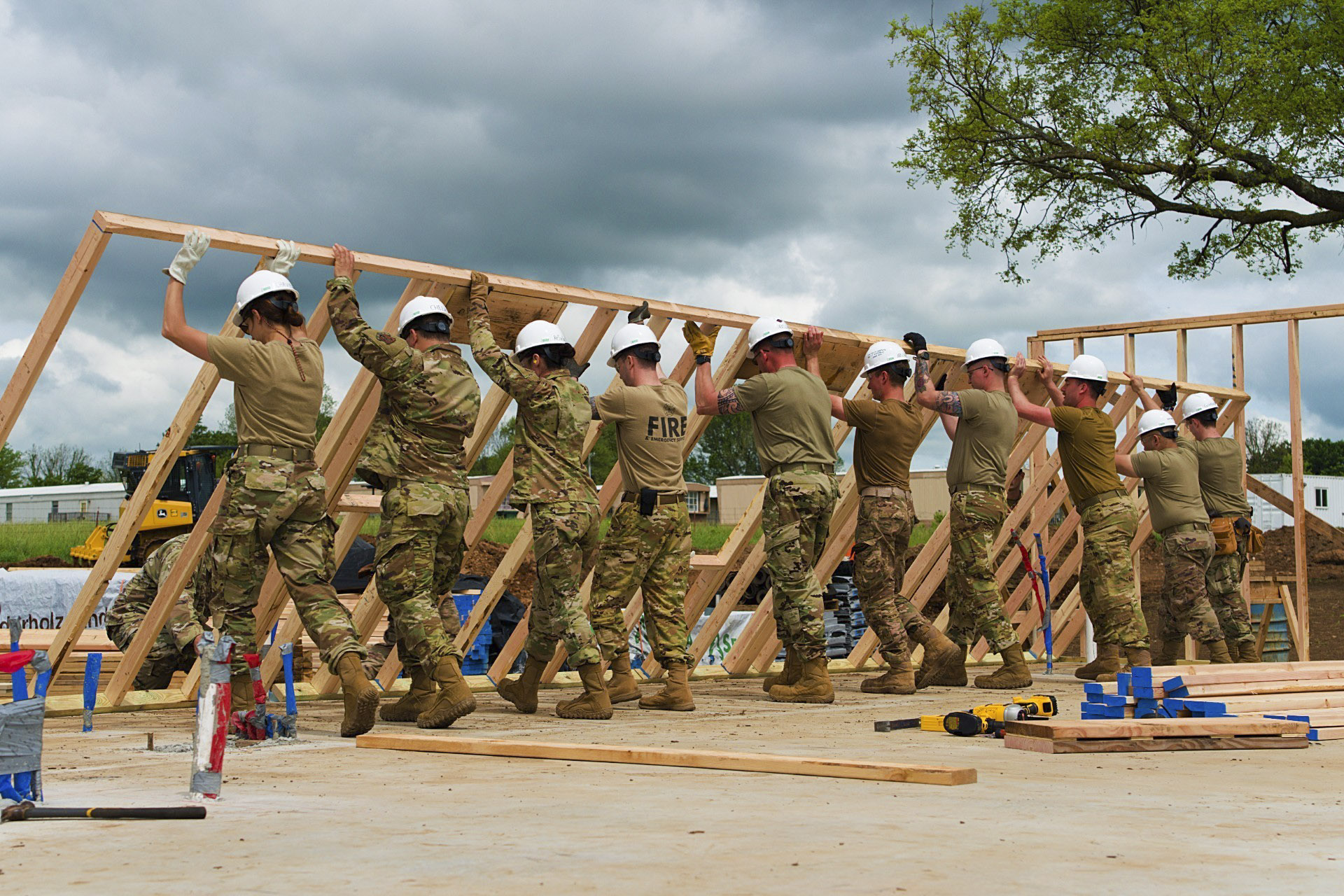
Airmen construct the first home in the Cherokee Veterans Housing Initiative in Tahlequah, Okla., May 18, 2021. The initiative is a collaboration between the Defense Department's Innovative Readiness Training program and the Cherokee Nation that constructs new single-family homes and supporting infrastructure for eligible Cherokee Nation veterans and their families.

Shot Scores


Sailors score targets during a qualifying gun shoot aboard the USS New Orleans in the East China Sea, May 30, 2021.

Sierra Fire


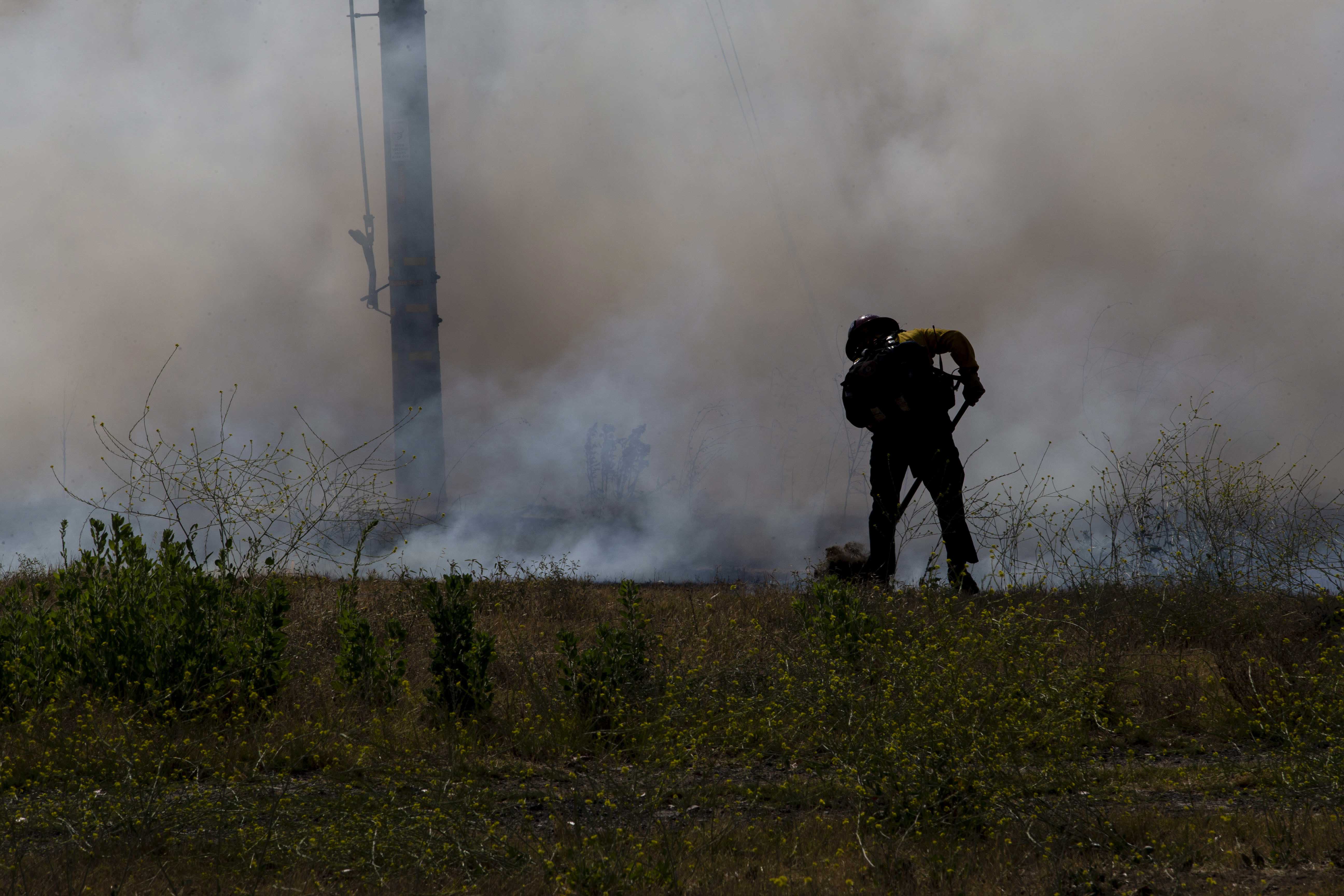
A Marine Corps Base Camp Pendleton firefighter responds to the Sierra Fire at the base in California, June 9, 2021.

Flying Partners



Army AH-64 Apaches fly in formation with Hungarian Mi-24 Hinds during Saber Guardian in Varpalota, Hungary, June 9, 2021. The multinational exercise aims to increase participating nations' capacity to conduct full spectrum military operations.

Vaccination Time


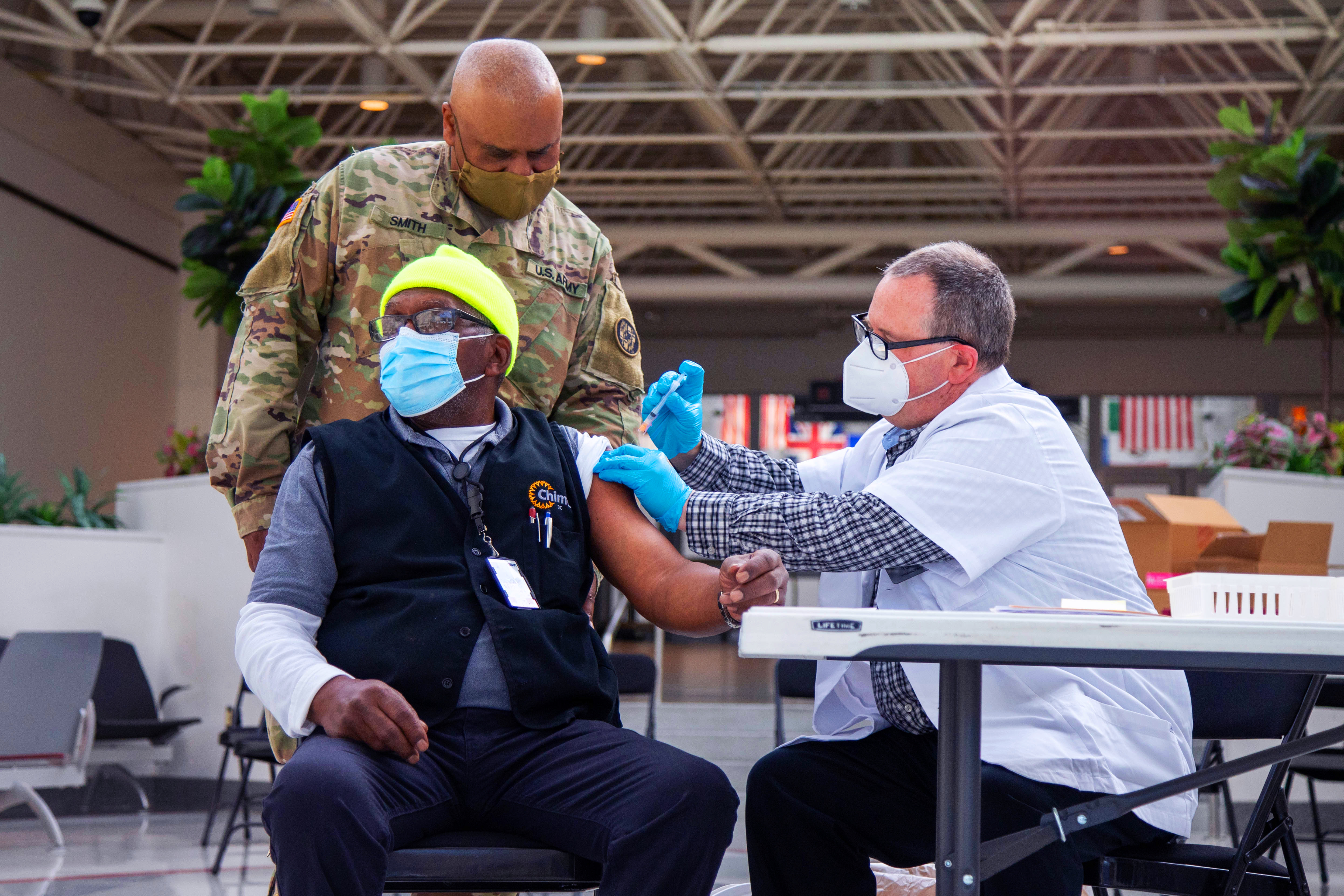
Army Staff Sgt. Ralphael Smith, a member of the Maryland State Medical Detachment, holds up the sleeve of CHIMES employee Robert Johnson, while Dr. Tony Gearhart, a Safeway pharmacist, administers a COVID-19 vaccine during the CHIMES vaccination event in Baltimore, May 17, 2021. Safeway, a supermarket company, and Maryland’s Vaccine Equity Task Force partnered together to vaccinate members of CHIMES, a not-for-profit organization that assists people with intellectual and behavioral challenges.

Slovakia Assistance


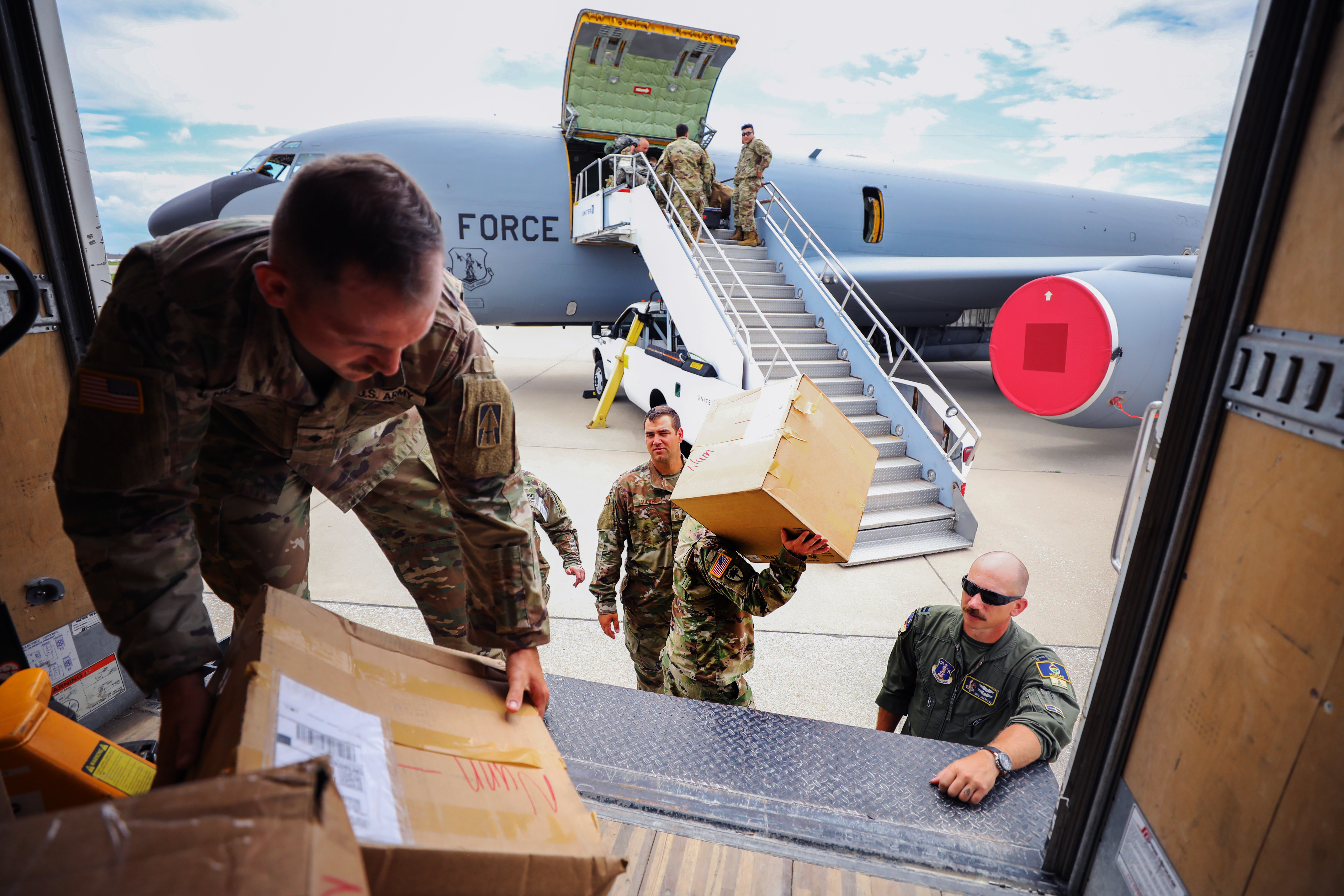
Soldiers assigned to the Indiana National Guard transport donated medical supplies to assist the country of Slovakia in its ongoing fight against COVID-19 at the Indiana National Guard Headquarters in Indianapolis, June 6, 2021.

Pohakuloa Firepower


Soldiers participate in a fire support coordination exercise at Pohakuloa Training Area, Hawaii, June 7, 2021.

Knight's Landing


Army Sgt. 1st Class Roman Grijalva of the Golden Knights, the Army's parachute team, makes a demonstration landing at Fort Bragg, N.C., May 28, 2021.


Pentagon Press Secretary John F. Kirby Holds a Press Briefing

 June 9, 2021

Pentagon Press Secretary John F. Kirby

PRESS SECRETARY JOHN F. KIRBY: Hey guys. Sorry I'm late. I've been saying that more and more these days, I don't know. Megan you want to remind me of that, don't you? Keep me credible, accountable, also humble.

OK, some things at the top here. I think you may have seen on Friday, the Navy's M225 stingray unmanned, there's a picture of it there, unmanned aerial vehicle, successfully completed the first ever aerial refueling between an unmanned tanker and an aircraft. The stingray took off and then transferred several hundred pounds of fuel to a super hornet.

This historic flight demonstrates the stingray -- that the stingray can fulfill its primary tanker mission and free strike fighters up for more of the duty of -- from the duty of transferring fuels, sorry. And this also extends the range capability of the carrier airwing and the carrier strike group and it's a great step forward toward manned/unmanned teaming concepts, pretty dramatic image there. Monday, military Sealift command fleet replenishment oiler USNS Patuxent, assigned to the U.S. fifth fleet provided emergency assistance to the general cargo vessel Falcon Line that was in distress in the Gulf of Aden.

You can see an image there of some of the crew being rescued. Upon notification of the situation the Patuxent proceeded at maximum speed to rescue the crew of Falcon Life before the ship completely sank, it sank due to engine trouble after taking on water. Patuxent safely recovered the 15 crew members and provided food, water and medical screening. The fifth fleet is coordinating with the owner of the ship and other authorities to determine the most appropriate locations to debark the crew members.

Over to Europe now, another update on Defender Europe. Today, wrapped up three days of air and missile defense live fire events in Romania as part of exercise Saber Guardian, you see an image there from the exercise. Tomorrow the U.S. Army's 41st Field Artillery Brigade will move to Norway to conduct a live fire exercise as part of Norwegian National exercise Thunderbolt. This will mark the end of the fires shock series of events and will feature multiple launch rocket systems, high mobility, artillery, rocket systems and high altitude balloon operations. And will include U.S. Army and Norwegian Army interoperability exercises.

OK, on to other news, the Secretary is proud to announce today the establishment of a sixth Defense Department Regional Center. This will be the Ted Stevens Center for Arctic Security Studies. The Ted Stevens Center will provide a new venue to collaborate across the U.S. government and with our allies and partners to advance shared interests for a peaceful and prosperous Arctic.

The Defense Department Regional Centers are international academic venues for bilateral and multilateral research, communication and training with the goal of building strong sustainable international networks of security leaders.

And I think you also saw today the Secretary issued a directive to the force that initiates several major department wide efforts to better address the security challenges posed by China as the United States number pacing challenge. These initiatives, some of which will remain classified, are designed to focus departmental processes and procedures and better help department leaders contribute to whole of government efforts to address the challenge of China.

Having completed its work now the China task force will stand down and the Secretary was very grateful in thanking them for their hard work and their efforts to again better align the department to deal with this particular challenge.

OK, with that we'll take questions. Sylvie, are you here? Nope, OK. Jen? -- is she on the phone?

Q: Yes, yes.

MR. KIRBY: Sorry, she is. Sylvie, go ahead.

Q: Hello, hello. I am - can you confirm that the administration is trying to close the Guantanamo Detention Center?

MR. KIRBY: The - the President has been clear, Sylvie, that we are conducting a thorough and deliberate review that's focused on closing the facility. The President was very clear before taking office that this was a goal he wanted to achieve. To that end the National Security Council continues to work closely the Departments of Defense, State and Justice as well as other departments and agencies. And those discussions are ongoing.

Jen?

Q: John, can you explain a little more about the directive and what the Defense Secretary said to the force in light of the task force on China? What was his conclusion? What was the point of his directive? Just if you could explain a little more?

MR. KIRBY: The directive's classified so there's not going to be a lot that I can get into in terms of the specifics. But it - in the directive to the force he basically is telling the department what the recommendations of the task force were and endorsing those recommendations. The best way I can describe it and I kind of touched at this in the opening is that - is that the task force's work was sort of a down and in look at the way the department is organized, the way it's structured and the way we think about the broader issues of China from a security perspective.

It wasn't mean to be an up and out look, so it's not a strategy that is produced here. Really it's an assessment of how the department's doing with respect to truly treating China as the number one pacing challenge.

And the task force found some gaps and seams, some things that we can be doing better. And back to your question, the directive issue by the secretary lays out some initiatives and efforts that were recommended by the task force that he wants the department to adopt so that we can improve the way we think, the way we plan, the way we structure and organize ourselves to truly deal with China as the number one pacing challenge.

I think what the secretary's concern was that he didn't want to just say this. He wanted to make sure that we were actually acting on it, this idea of the pacing challenge.

Q: Is it accurate? It's been characterized that his message was that while we've been hearing about the China threat for several administrations, that there was more talk about focusing on the China threat and fewer actions. Is that a correct characteristic?

MR. KIRBY: I think that's a little unfair, Jen. The task force as they worked over the last four months found that there was a lot of goodness in terms of dealing with the challenges posed by China, done by the Obama administration as well as the Trump administration.

They found things that were worth pursuing and continuing. It was really a look at how we're doing right now and that there are ways we can improve. And as we said all along, this institution is all about self improvement.

And so, it's not at all an indictment. Quite the contrary, of anybody in the past, I mean, because there were some - there was some good work done. It's really about stitching it together and making sure that when we say we considered China the number one pacing challenge that we here and in the department, you know, can put resources and structure behind that and make it so.

I would also add just one other point, and that's we very much see the work of the task force and the work that will go forward as part and parcel of a much larger whole of government approach to a bilateral relationship with China.

Again, this was really an inward look at the department. It wasn't an outward look. It wasn't designed to develop a new policy or a new strategy specifically.

Q: Anything concrete that you can point to that was recommended?

MR. KIRBY: There were a couple of things that we can talk to. I mean, one was a tasking to the personnel and readiness department here to come up with recommendations and plans to better include China as a focus area inside the workforce and particularly in the world of training and education and how much are we really looking at making sure we have a workforce or a part of the workforce that can help us better focus on China?

So again, I guess the training and education and proficiency and understanding that nation and that part of the world.

A lot of the work of the task force, while I can't get into the details of it, will help inform both the global posture review, which is ongoing and will be completed later this summer as well as the initial work we're doing to start to build out a new national defense strategy.

So they will help - their work will help inform those two additional bodies of work. And then the other thing was in this directive the secretary tasked himself. He tasked himself in this directive to personally take the lead in being more involved in the development of operational concepts and prototypes, in training and exercises that he will - that, you know, he will share and that he will be personally leading and personally involved in that to a degree that we haven't seen before.

So in addition to tasking the department he tasked himself in this. Did that help? Let's go back to the phones. Tara?

Q: Hello. I'm right on time with the mute button. I have a couple of follow ups, too. Can you tell us what makes this task force finding different than the work that has proceeded it? And then secondly on a different topic, Air Force Acting Secretary, John Roth, yesterday told Congress that for now the over-the-horizon capability to support Afghanistan will be basically from the existing footprint that the Air Force has in the region, and I'm just wondering if that means there haven't been any inroads made with potentially new locations for a - to move U.S. forces to provide that over-the-horizon capability? Thanks.

MR. KIRBY: Let me start with the second one first. As we've said for quite some time we already have an over-the-horizon capability - counterterrorism capability there and other parts of the worlds, and we are already using that over-the-horizon capability in Afghanistan.

You all reported on the presence of an aircraft carrier. Well the aircraft from those carrier air wings have been conducting missions from the sea and into Afghanistan, and as well we have existing regional bases and facilities to assist us in that - in that kind of effort, and I think that's what the acting secretary was speaking to, that we are already using fixed-wing assets from inside the region and out of Afghanistan to enact this kind of capability.

It doesn't mean that that's the end all be all, and it doesn't mean that that's where we're - that we aren't going to try to explore other options, and we are. And the department is actively supporting diplomatic efforts to discuss potential options in other places in that part of the world.

I don't have any specific announcements to make or agreements to announce today, but I mean, we are actively pursuing additional options, but again I want to come back to the main point which is that we already know how to do over-the-horizon, and we already are doing over-the-horizon kind of - enacting over-the-horizon kind of capabilities in Afghanistan.

And then your first question, Tara, was on what's new about the task force as opposed to previous efforts. I'm not aware of previous efforts similar to what we established here with the China Task Force, so I can't speak to what previous administrations might have done that are similar to what Secretary Austin put in place.

This was, as we announced when we -- four months ago was going to be a sprint. It was a sprint. It was designed not to develop a new policy or a new strategy but really to take a look at how we're doing inside the department at really making true our concerns about the pacing challenge that China poses.

And so, in that regard it is quite unique the work that they produced and the recommendations that they made, and again I've already talked to some of them. These are - these are new approaches that we're going to pursue, and there'll be other new approaches that will come out of the work that they've done, some of which we'll be able to talk about and some of which we won't.

Pierre?

Q: I believe you mentioned that you are seeking more access to -- and we -- should we understand that we are looking at more deployment and more access to GCC countries around these areas?

MR. KIRBY: I'm not going to get into specific discussions of who our diplomats are talking to and what that might look like. We already have, as you well know, a robust footprint in the Middle East that we can rely upon and draw upon. In fact, we are relying upon and are drawing upon to help us with this retrograde.

So there are capabilities already existing in the region that are quite -- quite agile, quite nimble, quite effective. But in terms of what it's going to look like going forward, again, I'm not going to get ahead of a diplomatic process.

Q: (INAUDIBLE) does this go hand-in-hand with the content of the readout of the secretary call -- conference with Mohammed bin Salman last week in Saudi Arabia. When you said in your readout that we are going to help Saudi Arabia defend itself, I mean, are we into like...

MR. KIRBY: I would not draw the line between that conversation and that readout and what -- your first question about, you know, sort of basing and over-the-horizon capabilities. That the readout we offered after that call was accurate for the purpose of that call. I wouldn't -- I wouldn't read more into it than that.

Let's see, Tony from Bloomberg.

Q: Hi, John. I have a couple of quick questions on the China follow-up. Is there -- what systems can you point to in the FY22 budget request that help further the secretary's directive? Two, are there areas in the task force that stressed areas where we could cooperate with China and possibly reduce tensions rather than this continual push that they are the pacing threat?

MR. KIRBY: Tony, the -- again, I think it's important to remember what the task force was designed to do. It was to assess how we're doing in the department in terms of our main obligation, and you've heard the secretary talk about this, our number one job is to defend the nation. And you want to make sure that -- that we can do that in all respects. And that we -- you know, we still consider China to be the number one pacing challenge of the department.

And, you know, he wanted to see -- have the task force take a look at structures, organizations, processes, concepts, to make sure that we are aligned to that -- to that purpose. It's not -- nobody's seeking conflict here. It's really about alignment and getting a sense -- a better sense of the gaps and seams and what we can be doing better here to have the appropriate focus on China.

And, Tony, the work of the task force was not meant to and did not have a budgetary component here. It wasn't about shaping or recommending systems or programs to be put into the FY22 budget. So I don't -- I want -- it's important for me to divorce you from that idea that the task force was sort of informing the budget in any specific way.

Separate and distinct from that, that said, and putting the task force aside for a moment, I mean, I think, Tony, if you look at the at the budget writ large you'll see not only $5.1 billion for the Pacific Deterrence Initiative, but you will see hypersonics funding in there. You'll see funding for microelectronics and 5G technology and missile defense and nuclear modernization.

I mean, there are a host of capabilities and systems that are represented in the budget that do support our desire to make sure that we're ready for the continual challenges that -- that the countries like China pose, not just in the Indo-Pacific region but around the world.

Q: OK. Fair enough. Thanks.

MR. KIRBY: Sure.

Q: Thank you, John. So I have a follow-up on Guantanamo and a separate question. On Guantanamo is there a timeline or a date that the administration would like to basically close the Guantanamo facility. I mean are you looking at a certain date or aspirational even, and can you do that without cooperation from the Congress?

MR. KIRBY: I'm not aware that there's a target date out there at all, Fadi. There's -- as I said, an ongoing interagency process right now and -- and that work continues and when they're -- when that's over and we can be -- we can read that out, I'm sure -- I'm sure they'll do that but I'm not aware of any particular date.

And as for Congress, I mean of course there will need to be close coordination and consultation with members of Congress as we continue to move forward. What's important here is that the president was serious when he said he wanted to close the facility. The Department of Defense supports that goal.

We are part in parcel of this interagency process and we're going to continue to work at that.

Q: And on Saudi Arabia, the official Saudi news agency reported yesterday that a joint military exercise started between Saudi forces and American forces in the northwestern part of Saudi Arabia and they published photos supposedly showing American troops being deployed. What can you tell us about that military exercise?

MR. KIRBY: I'll have to take your question. I don't have information on that particular exercise.

Q: Because I asked earlier and --

MR. KIRBY: You asked me earlier?

Q: No, no; someone at the DOD official.

MR. KIRBY: OK.

Q: -- and they denied knowing of any such training. And this is creating some kind of confusion because it's out there with photos.

MR. KIRBY: I'll do what I can to clear up the confusion. Let me just take the question rather than try to spit ball here. That usually gets me in trouble.

Ms. (Zheera?).

Q: Thank you.

MR. KIRBY: You're welcome.

Q: I asked, John, about Afghanistan; unfortunately Taliban increased their attack on everyday Afghan people, dying in Afghanistan. And NATO director, general director, was here. Did you discuss anything about Afghanistan?

MR. KIRBY: We certainly did. Secretary General Stoltenberg was here. We issued a read out of it and in that read out talked about the fact that Afghanistan was absolutely on the agenda when they met. Secretary Austin and the Secretary General, and the Secretary reaffirmed our commitment to doing what we can to help our resolute -- resolute support partners as they retrograde themselves out of Afghanistan.

And so to the degree we can be supportive and helpful in that the, secretary made sure that the secretary general knew that. There was also a reaffirmation by both leaders that as the secretary general very eloquently put it. We went in together, we changed our operations together throughout the last 20 years, we adjusted together and we're going to go out together.

And that still remains the fact, yes. Mike, did you have your hand up?

Q: No.

MR. KIRBY: OK.

Q: Thank you. Two questions. First, I want to (inaudible) about the China task force. Based on the recommendation, is there anything that the United States expects the allies in the region to do more in order to maintain peace and -- peace and stability in the region?

MR. KIRBY: The task force was designed to help us and look at ways we can better leverage alliances and partnerships and -- and better contribute. To be better contributors, too, on alliances and partnerships. It wasn't about tasking them to do anything different. That -- that wasn't the purpose.

Q: Separate question, the secretary's trip to Singapore was cancelled due to the COVID-19 unfortunately. The secretary --

MR. KIRBY: The entire conference was cancelled.

Q: Yes. And the secretary lost the opportunity to demonstrate the U.S. commitment to the Southeast Asia. So how will the secretary make up for it? Is the secretary planning alternative opportunities to engage with partners in the region?

MR. KIRBY: I mean the secretary was disappointed, I think, clearly that we couldn't make the trip to Shangri-La work but we understand, certainly respect the decision by authorities to cancel it, given concerns over COVID, perfectly valid reason to do so. So we're disappointed but we will continue to look for other ways to engage our allies and partners in the region.

And I think you'll see that, I don't have anything specific to announce today but you'll see it over time and I have no doubt that the secretary will be willing and able to travel back to the region just as soon as practical. But I just don't have anything specific to speak to.

Q: OK.

MR. KIRBY: OK. Tom Squiteri?

Q: Hi, John, thanks. My question was about the Arctic Center, you answered that in your opening remarks. Thank you.

MR. KIRBY: All right. Thank you. Paul Shinkman, U.S. News?

Q: John, do you have anything -- I have two questions. First on Afghanistan, do you have anything on the deadly shooting yesterday of the 10 mine clearing workers in Baghlan Province, specifically that the perpetrators belong to ISIS and that the Taliban helped the aid workers in the aftermath of the attack?

MR. KIRBY: Paul, I don't have anything on that. If you'll allow me to, I will take the question and we'll get you a response back.

Q: Thank you. And then separately on vaccines. Is -- does the military now or is it planning to have any role in President Biden's plan to purchase and distribute internationally the 500 million Pfizer vaccines?

MR. KIRBY: I don't have any specific plans to speak to today, Paul, but as you've seen, we have contributed to U.S. government efforts to -- to transport vaccines as well as personnel protective equipment to nations in the past; India, Bangladesh we just talked about yesterday.

And should there be additional tasking of the Defense Department to assist in these efforts to help citizens around the world, the secretary has made it very clear to Department leaders that he wants us to be able, willing -- able and willing to lead in in that regard. But I just don't have anything specific to -- to speak to today.

Q: Thanks, John.

MR. KIRBY: Yes, I think it was yesterday, right, when I talked about Bangladesh. So I mean we are actively participating in those efforts. OK. This means I got something wrong right. No, actually it doesn't mean I got something wrong. OK. We'll go to Mallory.

Q: Thanks, John. My questions on the china task force. The Chinese have been quite open about their strategic priorities in the Western Pacific and the commandant of the U.S. Marine Corps has of course released a very detailed and publically available strategy about how he sees the potential competition with China.

What -- what can you say about the naval component of the China task force's recommendations and how these direct -- how these directives could triple down to the services and naval strategy?

MR. KIRBY: Well, Mallory, without getting into specific detail beyond what we've already done today, as I've said the -- the work of the task force will inform both global posture review as well as the new national defense strategy.

And on the former, I mean, that global posture review is really all about, as the secretary says all the time, matching resources to strategy and strategy to policy.

And what he is expecting out of the global posture review is a sense of, you know, the footprint, among many other things, but the footprint. You know, how many resources do we have, how many ships do we have, how many people do we have in any one part of the world and is that right, is it the right number and are they in the right places to do what we need them to do?

And so, backing that all up, the China Task Force, their work will help inform that process. Again, without getting into specific -- I couldn't give you a specific, you know, number today but, clearly, their work will help inform that.

Q: We're still tracking that for later this year? The posture review?

MR. KIRBY: The global posture review is in progress and we expect it to be complete somewhere around late summer, maybe early fall.

Q: Thank you.

MR. KIRBY: Yes. Jared, you had a question?

Q: Hi, John, thanks. Just a quick one on Turkey then a brief follow-up if possible. Turkey's defense minister said Monday that they would take over security at Kabul Airport if conditions were met and that they were awaiting a response from their allies on this. Has DOD communicated with the Turkish Defense Ministry on this since Monday? And is DOD prepared to fulfill those requirements?

MR. KIRBY: Not familiar -- I'm not familiar with those comments by Turkey and I don't have the latest lay down in terms of where the discussions are with the -- the Turks. Let me take the question and we'll see if we can get you something more detailed.

I would just say broadly we, obviously, have had ongoing discussions with Turkish leaders about their plans for security at the airport. Obviously, this is a -- a national decision that -- that President Erdogan has to make and we respect that.

But we have had some preliminary discussions, obviously, and then just more broadly as we've said before, I mean, security at the airport in whatever form or fashion it takes is going to be important for not only the United States but for other nations to be able to maintain a diplomatic presence there in Kabul.

But you asked a very specific question for which I did have a specific answer. I'll do the best I can, I can't promise you a whole lot of detail right now because I'm just not familiar with the -- with those comments by the Turks. But I'll -- I'll take a look at it.

Q: I appreciate it. And if I could just follow-up real quick.

MR. KIRBY: I think I got a couple more here. Jeff Schogal?.

Q: Thank you very much.

Defense Secretary Austin recently demoted an Army two-star general to second lieutenant after this former general officer pleaded guilty in federal court to sexual assault. I wanted to see, does the Defense Department have any avenues to also take away all of his retirement benefits because at the moment he is receiving retirement benefits commensurate with his lower rank.

MR. KIRBY: Jeff, that was a decision made by the Department of the Army and I'd refer you to the Department of the Army for -- for your question. I'm not in a position to answer that. It wouldn't be appropriate coming from us.

Q: Thank you. What I was told was this a Secretary Austin decision?

MR. KIRBY: I -- I'm going to refer to you to the Department of the Army. OK, Kris Anderson? OK, I thought she was there. Couldn't get her. OK, thanks, everybody.

Q: Do you have anything on the active shooter situation in Joint Base San Antonio?

MR. KIRBY: Well, I've seen press reports today just before walking out here, Fadi. I'd refer you to the Air Force on that. I, I mean, I've -- I've seen their statements that they had an active shooter situation. As I understand it there are no reported injuries. But as I walked out here the base was still on lockdown and I think really much better for you to go to the Air Force on this as a developing situation. They'll have more information, and I'm sure they'll be transparent as things unfold and they're able to say more they will. OK. Thanks, everybody.