A Navy air-cushioned landing craft approaches the well deck of the amphibious assault ship USS Essex in the Pacific Ocean, May 19, 2021.
A Navy air-cushioned landing craft approaches the well deck of the amphibious assault ship USS Essex in the Pacific Ocean, May 19, 2021.
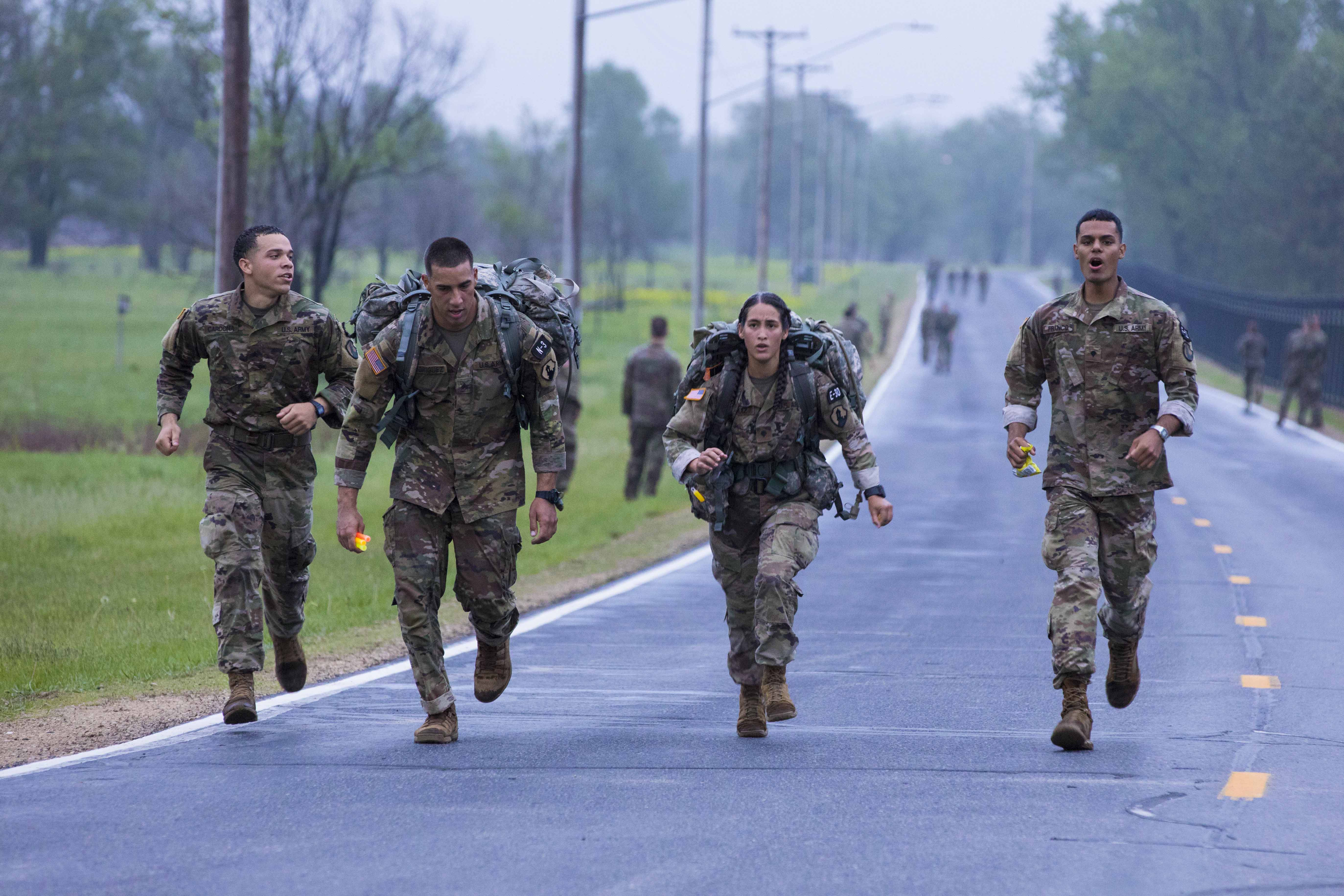
Soldiers complete a 12-mile ruck march during the 2021 U.S. Army Reserve Best Warrior/Best Squad Competition at Fort McCoy, Wis., May 24, 2021.

A staff member hangs U.S. flags in the Memorial Amphitheater at Arlington National Cemetery, Arlington, Virginia, May 25, 2021.

Soldiers assigned to the Arizona National Guard load boxes with fresh produce at a local food bank in Phoenix, Ariz., May 21, 2021. The AZNG continues to support food banks and vaccination sites across the state during this COVID-19 emergency response.
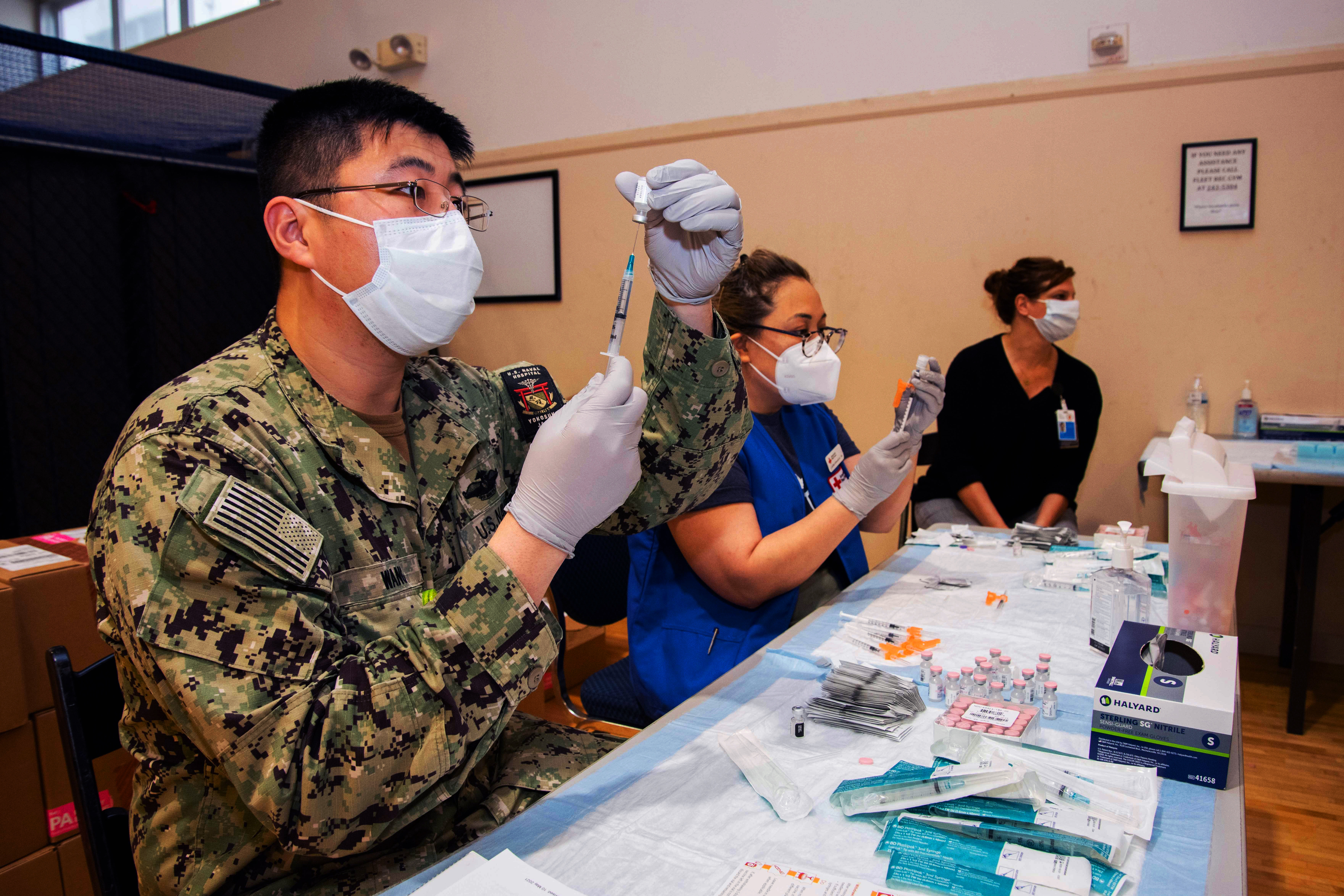
Navy Petty Officer 2nd Class Yan Wang, with the Naval Hospital Yokosuka, and Laurei Fernandes, an American Red Cross volunteer and registered nurse, prepare syringes with doses of the Pfizer COVID-19 vaccine during a vaccine distribution event at Commander, Fleet Activities Yokosuka’s Hawk’s Nest in Yokosuka, Japan, May 20, 2021. For more than 75 years, CFAY has provided, maintained and operated base facilities and services in support of the U.S. 7th Fleet’s forward-deployed naval forces, tenant commands and thousands of military and civilian personnel and their families.

Air Force Airman 1st Class Payton Innis checks an engine on a B-52H in Europe, May 24, 2021.

The Coast Guard cutters Maui and Robert Goldman travel in the Persian Gulf, May 24, 2021.

Marine Corps Cpl. Alicia Lucio, right, Cpl. Tim Roberts, center and Cpl. Peter Chang prepare a weather balloon for flight during a training event at Kadena Air Base, Okinawa, Japan, May 25, 2021.

Marine Corps Lance Cpl. Damian Lance stores food during an event at the Northern Territory Foodbank in Darwin, Australia, May 20, 2021. Marines and sailors volunteered to help sort food and set up a barbeque to support the celebration of Australia’s National Volunteer Week.

A sailor guides an air-cushioned landing craft into the well deck of amphibious assault ship USS Essex during operations off the coast of southern California, May 18, 2021.

A Navy air-cushioned landing craft departs from Marine Corps Base Camp Pendleton, Calif., May 19, 2021.

A Marine Corps military working dog and handler take a break during narcotics and explosives detection training at Camp Foster, Okinawa, Japan, April 27, 2021.

Air Force Tech. Sgt. Jacob Kuhn, assigned to the 9th Airlift Squadron, waves his unit’s flag from the top of a C-5M Super Galaxy before a mission at Eglin Air Force Base, Fla., May 13, 2021.
May 24, 2021 | , DOD News
Kathleen H. Hicks provided keynote remarks at the ARPA-E Energy Innovation Summit, an annual conference and technology showcase of the Department of Energy's Advanced Research Projects Agency-Energy today.
Climate change has exacerbated natural disasters such as hurricanes, drought and flooding both at home and abroad, she said.
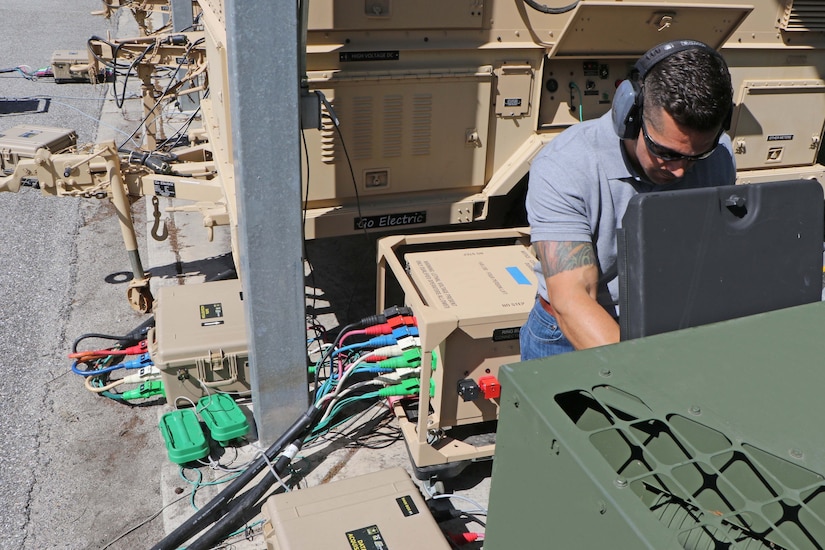
Overseas, the U.S. military has taken an increasing number of humanitarian assistance mission, she said, adding that climate change will result in an increase in civil wars and terrorism.
At home, hurricanes have devastated installations in the Southeast and out west, service members have been called to assist with wildfire suppression efforts, she said.
"Climate change is also driving new areas of geopolitical competition, such as in the Arctic. We are being asked to meet this expanded mission set even while climate change impedes our training and readiness. Climate-induced extreme weather is already a major drain on our budget. Every dollar that we spend addressing the effects of climate change is a dollar that we are not putting toward other priorities, like meeting the challenge posed by China and modernizing our forces," Hicks said.
To ensure that the department remains in a position to defend the nation and combat the effects of climate change, DOD is undertaking a number of actions, she said.
For example, the department is fostering a culture of climate-informed decision making, she said. This means that climate considerations must become an integral element in resource allocation and operational decision making processes.
The department will need to incorporate climate change into threat assessments and update modeling and simulations to reflect climate change, she said. Also, warfighting concepts, regional and country engagement plans and logistics planning also need to be updated.
"We will continue to train, test and equip a climate-ready force. This will mean ensuring that our forces are prepared to operate in extreme and often variable climate environments. We must ensure that our service members have the ability to train safely in extreme conditions. Additionally, we have to make sure our weapons systems and other equipment can operate in extreme conditions," Hicks said.
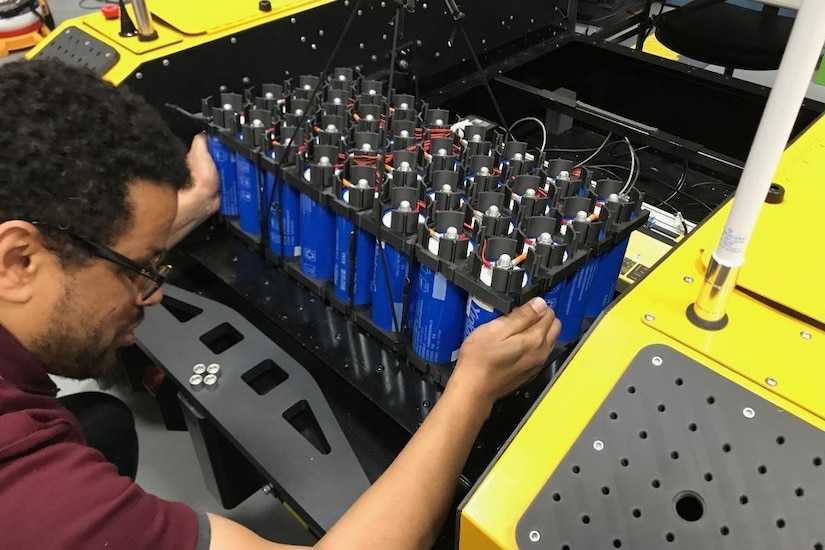
The department is also looking for ways to reduce the energy needed to complete the missions overseas, she said.
"Doing that will require some hard thinking about what the future force should look like. We are preparing for autonomy, hybridization and electrification and new materials to improve efficiencies and enhanced capability," she said.
Defending the nation also means having a supply chain that can support military requirements, she said. For example, the U.S. is lagging competitors, including Beijing, in attracting investment in technologies such as lithium ion batteries.
A top DOD priority is taking care of its people, Hicks said. That means building infrastructure such as buildings people work and live in on installations that are constructed to be resilient to severe weather.
It also means energy resiliency that is less reliant on the commercial grid, she said, noting that micro-grids can power installations with energy storage and distributed generation with non-fossil fuel systems like solar.
Aside from the U.S. Postal Service, DOD has the largest vehicle fleet in the federal government, with 170,000 non-tactical vehicles.
"As global transportation continues to electrify, the department must meet the moment or risk being left with an expensive and inefficient fleet. Therefore, DOD must begin investing in both electric vehicles and smart charging infrastructure to support the fleet," she said.
Another priority is working with interagency organizations like the Department of Energy, as allies and partners for such things as energy technology development, she said.
May 24, 2021
PRESS SECRETARY JOHN F. KIRBY: OK, a few things to get through here at the top, so bear with me.
I think you saw just a little bit ago, the secretary released a short statement thanking National Guardsmen and women for their service at the Capitol complex over the last five months; truly extraordinary work, oftentimes in pretty extreme and nasty weather, but they chipped in and performed an invaluable service, and it was important for the secretary to -- to say thank you to them as they now begin to transition out of the area. Their mission is over. There's still about a thousand or so that are still in the Capitol area, but they're -- they're in the process -- their -- their whole effort now is just in the process of -- of -- of moving on back -- back home.
MR. KIRBY: As you likely saw on the news over the weekend, the United Kingdom's Carrier Strike Group 21, or CSG 21, got underway from Portsmouth. CSG 21 is a large-scale, multinational deployment designed to demonstrate expeditionary capabilities, operational readiness, and interoperability between the United States, the U.K., and other allies and partners that will highlight global reach and enhances the deterrence and defense capabilities of the NATO alliance.
In total, the strike group will include nine ships and approximately 3,700 personnel. Though it's a British-led, our Navy will be participating with the deployment of the Destroyer USS The Sullivans and a Marine Corps F-35B squadron that will be attached to the aircraft carrier HMS Queen Elizabeth.
In addition to the press coverage coming out of the U.K., our combatant commands and services will also be highlighting DoD's participation at various stages throughout this deployment. We're delighted to be under way and to be a part of it.
Speaking about being under way and a part of international efforts, Defender 21, the exercise in Europe, continues as scheduled. Over the weekend, the United States Army 2nd Cavalry Regiment Road March began. During the four-day march the unit will travel through Germany, Czech Republic, Hungary, and Slovakia, and integrate -- exercise immediate response later this week.
Also of note, Exercise Saber Guardian kicked off today, more than 13,000 service members from 19 nations will conduct live fire and air and missile defense operations in several countries, and will conduct a large-scale medical evacuation exercise in Germany.
On a separate topic, I think you saw that the earlier today the secretary spoke with his -- with Pakistan's chief of army staff, General Bajwa, to discuss shared regional interests and objectives. During the call, the secretary reiterated his appreciation for Pakistan's support for the Afghanistan peace negotiations and expressed his desire to continue to build on the United States-Pakistan bilateral relationship.
On to COVID, as part of the national response to COVID-19, the Department of Defense in coordination with the Department of Health and Human Services signed a Defense Production Act Title III agreement with Retractable Technologies, Incorporated, to expand the production of safety syringes and needles. The amount of the agreement was $27.3 million and this investment will enable Retractable Technologies to install two additional automated assembly lines at the manufacturing facility in Little Elm, Texas. The full release on this agreement can be found on our web site Defense.gov.
And lastly, I think you probably saw, but for your planning purposes, as the White House announced today, the president will lay a wreath at the Tomb of the Unknown Soldiers a week from now in honor of Memorial Day. Immediately following that wreath-laying, the president will give a Memorial Day address in the amphitheater. Secretary Austin and Chairman Milley will also be in attendance and will provide remarks. The first lady, the vice president, the second gentleman, and Deputy Secretary Hicks will also all be in attendance. Due to COVID, this will be a closed event and not open to the public.
And with that, I will take questions. Bob?
Q: Another question for you connected to the disclosure last week that the Justice Department during the Trump administration had obtained phone and email records of Barbara Starr of CNN. And I realize that this was before Secretary Austin took office, of course. My question is, would -- what is Secretary Austen's view on the appropriateness of this sort of activity? Would the Pentagon under Austin cooperate with any Justice Department effort to obtain communications records of reporters who cover the Pentagon?
MR. KIRBY: Well, I certainly can't speak to this case in particular, and I would refer to the Justice Department to speak to that. And I don't think it would be wise for me to get into a hypothetical -- you know hypothetical cases going forward.
Now let me just say, Bob, the Secretary has enormous respect and admiration for what members of the media do and the contributions you make to informing and educating not just the American people but republics around the world, and he believes in fostering a healthy relationship with the media, particularly the media that cover this building, and -- and that includes, you know, enabling a -- a measure of trust and confidence in the kinds of communications that those relationships will foster.
Q: So he doesn't have a specific view on whether the Department should or could cooperate on -- on ...
MR. KIRBY: I think he would -- you know, the -- it would be -- it -- it -- you know, look, he is -- he -- he understands that you have a -- an important job to do and that you also have a duty, an obligation to protect the sources of information that -- that you need to do your job. He understands that. But I -- I don't think it's helpful for me to hypothesize or speculate with any great detail about -- about cases that haven't even happened, things that haven't happened or haven't been a concern.
Clearly, we have good interagency relationships here in town, and that includes with -- with the Justice Department, but I just don't know that it would be helpful to speculate about something that hasn't happened yet. He -- he does understand the importance of your work and the -- the way in which you need to go about that work.
Q: All right, thanks.
MR. KIRBY: Yep. Hey, can we go -- yeah, Abraham?
Q: Thanks. John, could you elaborate a little bit more on the -- on the Guard drawdown? Are they going to leave a residual force? Are they going to leave a QRF? Any capabilities, equipment, that type of thing? Are they going to get reimbursed for it? And then I have a second quick question.
MR. KIRBY: There's no reimbursal (sic) plan, Abraham, there's no plans for a Quick Reaction Force to be left behind. As I said, the 1,000 or so that are still in the Capitol region are preparing for departure. I don't have any additional requests or desires to talk to today by the Capitol Police for any residual capabilities. If that changes, we'll certainly let you know.
Q: OK, so nothing left behind? No equipment, no ...
MR. KIRBY: Not that I'm aware of. I would point you to the National Guard to -- for more specifics but I'm not aware of any residual equipment that's going to be left behind. Remember, most of these soldiers were essentially acting as physical and barrier sentries.
Q: Sure. And quickly, on Secretary Austin's call with his counterpart in Pakistan, did he discuss a possible basing agreement?
MR. KIRBY: I think I'll just leave it to the readout and the -- and the degree of specificity in -- in the readout.
Q: Very good.
MR. KIRBY: Yeah. Tara?
Q: Thank you. Just to follow up on the question -- kind of (inaudible) was a recommendation from General Honore's review. Are there plans in place to set up a long term QRF for the Capitol? And then I have another question.
MR. KIRBY: I think we're still taking in some of the recommendations by General Honore and his team. No decisions have been made about any of the specifics with respect to those recommendations, and again, if that changes, we'll let you know.
As of right now, there's no -- there's no intention to have a Quick Reaction Force as a result of these Guardsmen and women leaving.
Q: It's maybe too in the weeds but is that something that we would see reflected in the upcoming budget request, whether or not a QRF was being funded for the Capitol, and would it come out of DOD or would it be part of a U.S. Capitol, like, legislative budget?
MR. KIRBY: I -- I don't have any details on that, Tara. I mean, I -- I -- you know, if it was to be -- if it was something we were going to pursue and we're going to pursue it out of our executable funds, clearly that would be something we'd have to budget to, but I don't want to get ahead of the budget, which obviously we haven't released yet. So I think -- I -- I think I would just stay tuned on that.
But again, no -- I know of no specific plans are -- that are in place right now to act on the recommendations. We're still going through that and -- in -- in concert with the interagency to see what capabilities might be best going forward, but I -- I wouldn't want to speculate right now.
Let me go to the phones. I haven't done that yet. Jeff from VoA?
Q: John, thanks very much for doing this. Two questions. First question, there were reports last week about the death of Boko Haram leader Abubakar Shekau possibly after being captured by Islamic State in West Africa.
Does the -- the Pentagon have any assessment of those reports, and -- and based on -- on them -- those reports, any concern about the growing strength of ISIS West Africa? And then I have another question.
MR. KIRBY: I don't have anything specific to say with respect to that report. Obviously, we're well aware of the threat that Al-Shabaab continues to pose and we're certainly well aware of -- of the desire by ISIS to expand their footprint in places like Africa, but I don't have anything more specific than that.
Q: OK. And -- and second question, getting back to -- to Pakistan, its Foreign Ministry put out a statement today ruling out the possibility of any U.S. military bases for the post-withdrawal from Afghanistan counter-terrorism effort.
What -- is there anything that the U.S. is looking for right now from Pakistan in terms of what happens after the withdrawal is complete and is there any update on other possible basing agreements in the region for doing counter-terrorism operations, once the Afghan withdrawal is done?
MR. KIRBY: I don't have any specific updates in terms of the potential for overseas basing -- the -- there, after our withdrawal. These are obviously diplomatic discussions that are ongoing and are clearly not complete. We're -- we're exploring a range of options and opportunities to -- to be able to provide a credible and viable over-the-horizon counter-terrorism capability, and there's lots of ways you can do that. Overseas basing is just one of them. So nothing to report on that front.
And I certainly wouldn't speak to -- to, in any greater detail, with respect to any one country. Again, the -- the Secretary's discussion this morning was -- was -- was very useful and -- and -- and dealt with, as I said, a range of bilateral opportunities that our two countries have going forward. Lalit?
Q: A follow up question on Pakistan. It's -- the previous administration had to stop all financial aid to Pakistan because the previous administration believed they were not cooperating in the fight against terrorism. Is this new administration reviewing that policy or has it -- where -- where do you stand on that?
MR. KIRBY: At this time, U.S. security assistance to Pakistan is still suspended, and I won't get into speculating one way or another about if or whether that will change going forward.
Q: And according to India, the COVID assistance to India, do you have an update on that? Where do you stand on it?
MR. KIRBY: No, I don't have any up -- updates from -- from what we talked about last week.
Q: And finally, India's External Affairs Minister S. Jaishankar is in town later this week. Does the Secretary have any plans to meet him?
MR. KIRBY: I don't have anything on the Secretary's schedule to speak to with respect to that right now. If that changes, though, I'll let you know.
Q: Thank you.
MR. KIRBY: Yep. Lara Seligman, Politico?
Q: Hey, John, thanks for doing this. I wanted to ask you actually about the budget this week. Secretary Austin and General Milley are testifying on the Hill on Thursday about the budget, before the budget rollout, so what -- can you explain what the logic in this was? Will they be -- have anything to talk about?
MR. KIRBY: Well, I think there's plenty to talk about, Lara. Yeah, I mean, it was just a -- a scheduling -- it just, the -- the -- the way the sort of schedule played out both with the -- the subcommittee and with OMB. So you're right. The testimony will be on Thursday, the budget rolls out on Friday. So while they won't be able to get into too many specifics with respect to actual line items, there's certainly enough of a -- a broad take on budgetary requirements and the budgetary direction that they'll be able to address just in terms of the sorts of capabilities and operational concepts that we're going to be pursuing.
Q: And will there need to be a follow-up hearing that will actually dive into the details? Because a hearing before the budget details come out really doesn't get into any of the specific -- specifics that lawmakers need.
MR. KIRBY: Well, that's right. They won't be able to get into many of the specifics. As for whether there'll be a need for a -- a remedial session, that's really a question better put to -- to Chair McCollum and the ranking member, Ranking Member Calvert of the subcommittee.
OK, Pierre?
Q: Thank you. General McKenzie is in the area making some statements and talked also to the press. Reporting a piece from our colleagues from the A.P. leaves us under the impression that a vacuum is coming. Is the United States committed to the security and to help allies and partners in the area?
MR. KIRBY: Of course we are. Of -- of course we are, and we've said this time and time again, Pierre. Just because we are removing our troops and our -- and ending our military mission in Afghanistan doesn't mean that we're walking away from the region. Nothing could be further from the truth. There's still going to be a robust United States presence in the Middle East, in the Central Com -- Central Command area of responsibility. I think what General McKenzie was referring to was just that we need to be, you know, aware of the potential for other nation-states, with our absence from Afghanistan, you know, what -- what kind of actions they might take. But there's absolutely going to be no diminution of our commitment to our allies and partners in the region, none whatsoever.
Let's see, Jeff, Task & Purpose?
Q: Thank you. How many U.S. troops are in Afghanistan right now?
MR. KIRBY: Jeff, I think you know, we're -- we're not giving out exact numbers of our -- our troops there as we -- as we continue this withdrawal.
Q: Well, can we ballpark it? Can we say, you know, half have left, anything like that?
MR. KIRBY: No, Jeff, I'm -- I'm really not able to do that. We're going to confine our assessments to the assessments that you see every Tuesday coming out of Central Command. And I recognize that -- that you would like more data. I -- I do, and frankly, so does General McKenzie and his staff. But I -- I hope you also recognize our need to be somewhat circumspect in terms of the amount of information that we give out, particularly on a weekly basis so as not to violate operational security, so as not to -- to provide information that could actually put our people in harm's way. I know you share our desire to not -- to make sure that that -- that that doesn't happen.
And as I told you last week, and I'll reiterate it again that as the retrograde, the withdrawal continues and we -- and the capabilities in Afghanistan get progressively smaller, I -- I would expect, and you should expect that the -- the way we package the information and how much we give is also going to change, too, again, to make sure that we're not putting anybody in more harm's way than they already are.
Yes, ma'am?
Q: Any details or update on today's rocket attack on al-Asad in Iraq? Also, any update on the decision about the troops level there? Is there any change?
MR. KIRBY: About American troops in Iraq, no, there's been no change to their presence there or their purpose there, quite frankly.
I -- you may already have all this. This is what I have. If you already have it, I apologize, but at about 1:30 local time there the al-Asad airbase did experience one rocket round that landed on base. Initial reports are that there are no injuries, but the damage is still being assessed. As you know, sometimes initial reports change. That's what we have right now. The attack's under investigation by the Iraqi Ministry of Defense, and I'd point you to them for any additional information. That's probably what you already had, but that -- that's what I've got for you.
Matt from ABC?
Q: Hi, John, thank you. On COVID, now that the CDC is looking into myocarditis, the heart-swelling issue and checking and seeing if they might be associated with vaccines, I know it was reported a few weeks ago that the DOD is maybe looking at some cases within its ranks. Is there any update on that? Is there any cause for concern at this point?
MR. KIRBY: Well, we're always monitoring the health and well-being of our people. I'm not, you know, Matt, I'm not going to speculate, so I'm going to take your question, because that is one that I want to make sure I'm crystal-clear and precise on. So rather than wing it here, let me take that question for you, if that's OK.
Q: Thank you.
MR. KIRBY: Yeah, you bet.
Ellen from Synopsis.
OK, go to you, Barb.
Q: I want to follow up on something discussed earlier. Last week, President Biden publicly said that seizing reporters' phone records was wrong, and it would not happen under his administration. He said that on camera. So not hypothetical, I didn't see you endorse that. Maybe it just didn't cross your mind at that very moment. The president says that he -- in his administration, reporter phone records will not be seized. Is that a policy now that Secretary Austin and this department, including the uniformed military, will abide by and agree with?
MR. KIRBY: Well, we absolutely agree with the president that -- that that's not appropriate behavior. I just didn't want to speculate about cases that haven't happened yet, and -- and you know, what results they might have for national security. That didn't seem like a wise thing for me to do. But of course, we agree with the president.
Yeah, Janne?
Q: Thanks, John. I ask about the lift of missile guidelines and the vaccine, provide the vaccine to South Korea. And last Friday, you had seen with South Korea summit. President Biden, President Moon has agreed to lift missile guideline to South Korea and provide vaccines to, I think, 500 -- 550,000 of South Koreans. So there's -- how do you, I mean, how is DOD’s assessments on this?
MR. KIRBY: What's our assessment of it?
Q: Yes.
MR. KIRBY: Well, obviously we support the president's direction here to provide vaccines to our ROK allies. I -- I think we're still working through the details of how that's going to occur. It'll come out of U.S. stock piles but the (inaudible) of it, the details on when, where how it get distributed, I think we're still working our way through that right now.
Q: Do you think the listing of the missile guidelines will help to defend enough against the threats from North Korea and China?
MR. KIRBY: Yes, I'm not sure what you mean, the listing of missile guidelines. I'm not sure I understand ...
Q: There's like long-range missiles or mid-range missiles, whatever South Korea want. Is there any limits with that missile development?
MR. KIRBY: Well, I'm not going to get into specific capabilities here from the podium. But I'll tell you what, why don't -- why don't we follow-up after so I can get a better sense of what you're referring to. I'm just not aware of limitations on missile guidelines and where you're coming from on that. Some why don't we follow-up afterward and I'll see if can get you a better answer.
Q: OK.
MR. KIRBY: Does that make sense.
Q: Thank you.
MR. KIRBY: OK. OK. Lee Sangmin?
Q: OK. I have a question about possibility that you guys considering redemption of larger scale field of basis, (inaudible) exercise.
MR. KIRBY: If I understood your question correctly, you're asking if we're considering the resumption of large scale exercises with South Korea?
Q: Correct.
MR. KIRBY: I won't talk to specific plans going forward. I mean obviously we've talked about this before but training with our ROK allies is a significant component of our ability to meet our treaty commitments to South Korea and we constantly assess and review what training events might be best and execute it in the -- in the -- in the most effective manner and we're going to continue that going forward.
But I don't have anything specific to read out with respect to a change in this or that exercise. Yes, go ahead.
Q: Yes, just a follow-up question. Thank you (inaudible) and what she said about missile is RMG, revised missile guidelines. And then the South Korea has had limitations when they develop missiles, it is 800 kilometers.
And last Friday, two leaders like terminated, all the limits about the missile, which was really important to Korea because it has implications that -- that we could now have a missile to attack China and Russia. So it has a -- I think that it has a large implications in Indo-Pacific strategy. So it was a little surprising to me that the DOD doesn't have a ...
MR. KIRBY: Yes, I understand. I -- thank you for the context. We'll -- we'll see if we can take the question and get you a good answer.
Q: I have a question about the Taiwan Strait. The two leaders as we saw that they agreed the importance of the peace and security of the Taiwan Strait and then they point it in a joint statement.
So that was another big headline for our Korean media because we had a lot of harsh responses from China. So can you explain a little bit more what implications it has in terms of military aspect defense? So what do you expect from South Korea when there is any kind of armed conflict in Taiwan Strait or things like that?
MR. KIRBY: That's for the South Korean to speak to. Not for us. Our approach hasn't changed. We obviously don't want to see any unilateral change to the status quo. We -- we will continue to assist Taiwan in its self defense as we have in accordance with the Taiwan Relation Act. The three communiques, six assurances. Nothing's changed with our policy with respect to Taiwan and I'd leave it to South Korea to speak to it from their perspective. Yes, sir?
Q: Thank you. There are reports that China has rejected the secretary's request to engage with the vice chair of their -- China's (inaudible) commission several times. Did the secretary make such request?
MR. KIRBY: All I can tell you is the secretary has not spoken to leaders in the people's republic of China. We look forward to being able to having a dialogue with them but I have nothing to speak to of this time of it.
Q: OK. Does the secretary think it is necessary to meet Chinese counterpart or speak directly to them in order to avoid their potential miscalculations?
MR. KIRBY: As I said, we look forward to having a dialogue with -- with them but I have nothing to announce or talk to at this time. (Inaudible). Yes?
Q: On Pakistan you said that the security assistance to Pakistan still remains suspended. We have seen the Secretary Austin and also sort of Ambassador Sutherland spoke to his counterparts in Pakistan. At least can you say that there is a discussion about the security assistance to Pakistan to be resumed or is it -- is it on the table or?
MR. KIRBY: I won't go beyond what I said in the question previous. Let's see, Laurie.
Q: Thank you very much, John, for doing this. I'll -- following up a little bit on a previous question to talk about the fight against ISIS and Iraq and Syria. General McKenzie was just there. Could you tell us both in Bagdad and North East Syria, could you tell us what he discussed and what the results were of those discussions?
MR. KIRBY: Actually, no, I can't, Laurie. I mean I'd refer to you General McKenzie's staff. These are recent discussions. I don't have a read out of how those discussions went. I think the best place to refer you to is Central Command.
Q: I'll do that. But -- but you did reaffirm your -- the U.S. commitment to fighting ISIS in those places?
MR. KIRBY: I -- I can tell you without speaking to General McKenzie's conversation specifically; we remain committed to coalition efforts against ISIS and Iraq and Syria. We still have troops in both places that are dedicated to that mission. We still have partners in the coalition that are dedicated to that mission and nothing's changed about it as of today.
But as to the specifics of General McKenzie's conversations, I think his staff is better positioned to give you that than I am.
Q: Thank you very much.
MR. KIRBY: You're welcome. OK. Thanks everybody.
May 25, 2021 | , DOD News
Marion Anthony Trabert, better known as Tony Trabert, was one of the biggest tennis stars in the 1950s.

Trabert's tennis career was interrupted during the Korean War, from
1950-1953, when he enlisted in the Navy and served aboard the aircraft
carrier USS Coral Sea, which was part of the U.S. 6th Fleet in the
Mediterranean Sea.

After retiring from tennis in 1963, Trabert had a career as a TV tennis and golf analyst until 2004.

In 1970, Trabert was inducted into the International Tennis Hall of Fame. He was enshrined into the Cincinnati Tennis Hall of Fame in 2002. In 2014, Trabert was inducted into the United States Tennis Association's Court of Champions.
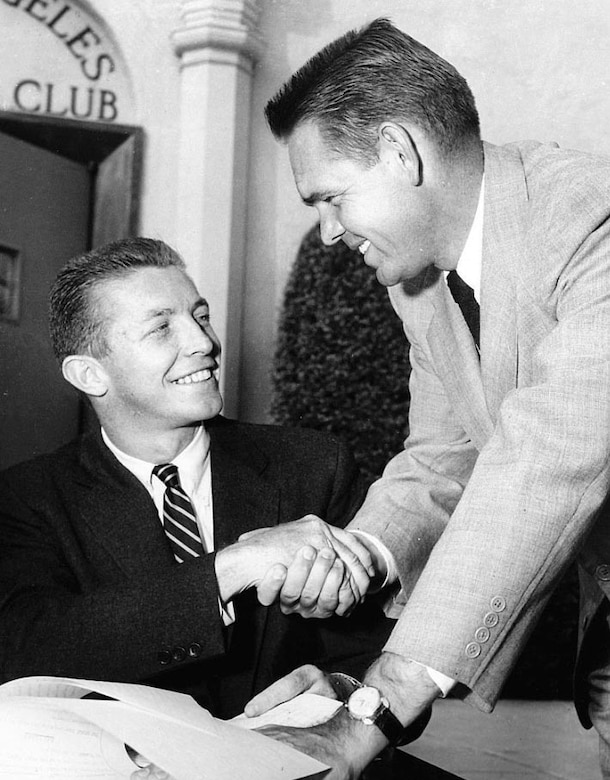
Trabert died at the age of 90 at his home in Ponte Vedra Beach, Florida, on Feb. 3.
Although the USS Coral Sea was built toward the end of World War II, the ship wasn't launched until April 2, 1946, thereby missing the war. The ship was named for a large World War II naval battle in the Coral Sea.

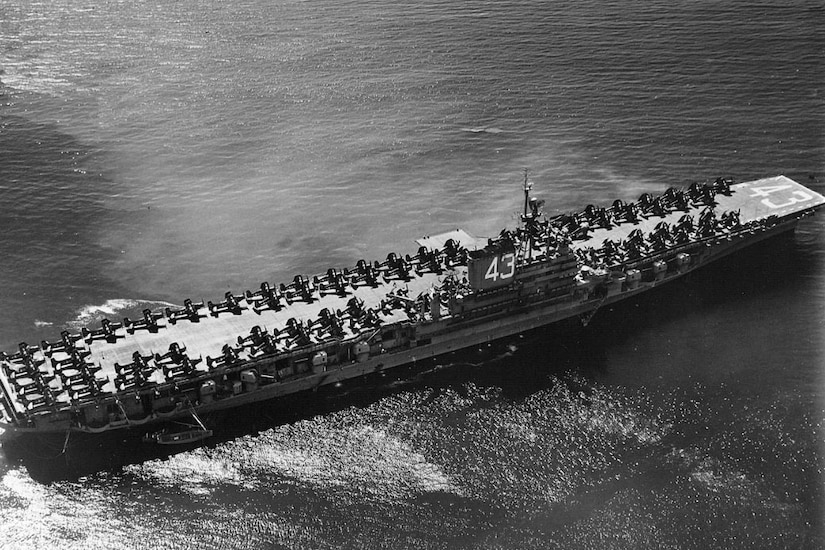
During the Korean War, the ship still featured the traditional straight flight deck that all carriers had during World War II. In 1957, long after Trabert's time on the Coral Sea, the ship was rebuilt with an angled flight deck that all aircraft carriers have today. The vessel was scrapped in 2000.

A Marine prepares to embrace his son during a homecoming event at Marine Corps Base Camp Pendleton, Calif., May 20, 2021.
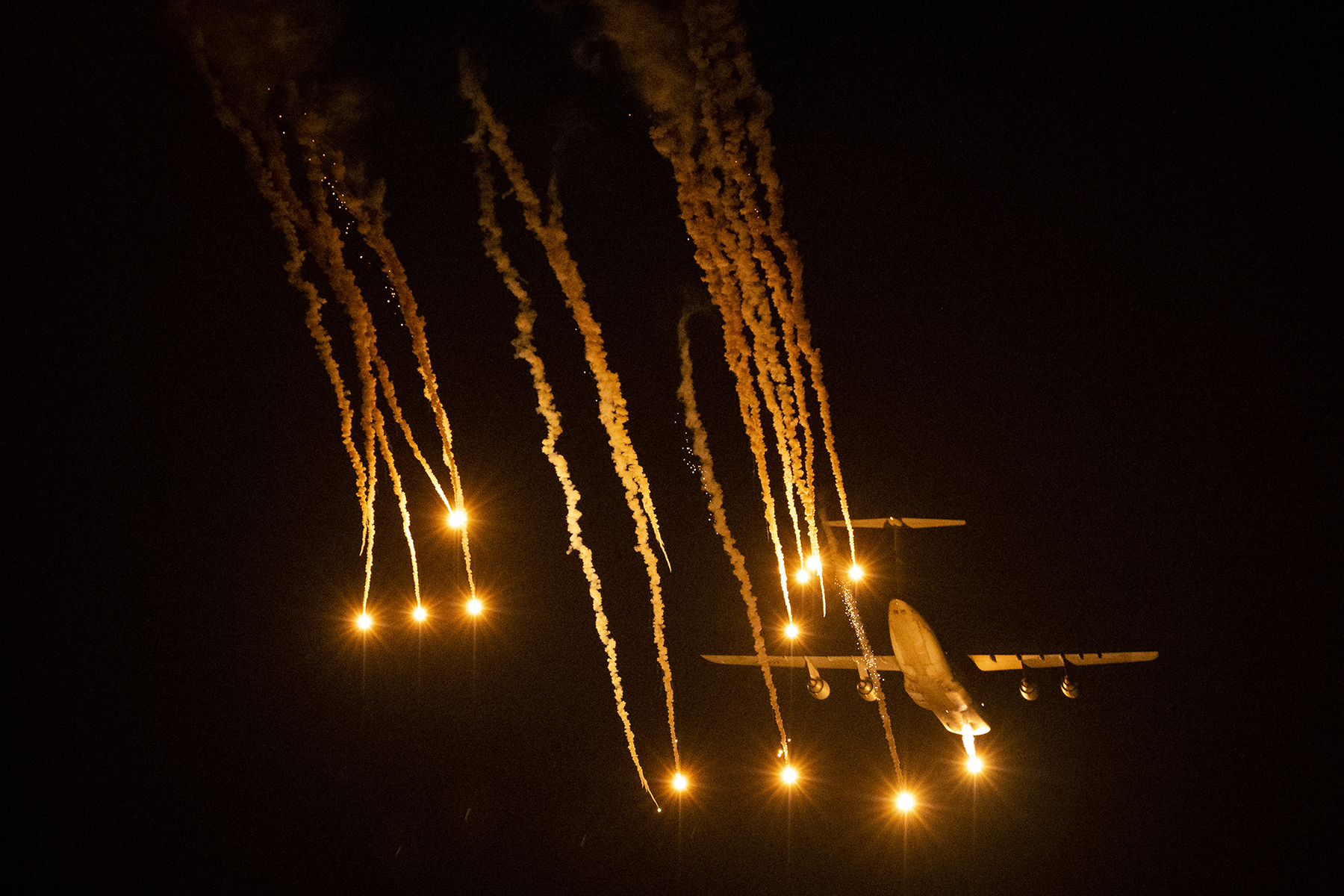
An Air Force C-5M Super Galaxy releases flares during a test at Eglin Air Force Base, Fla., May 12, 2021. The aircrew released the flares as part of a two-week defensive countermeasures test program with the 46th Test Squadron.
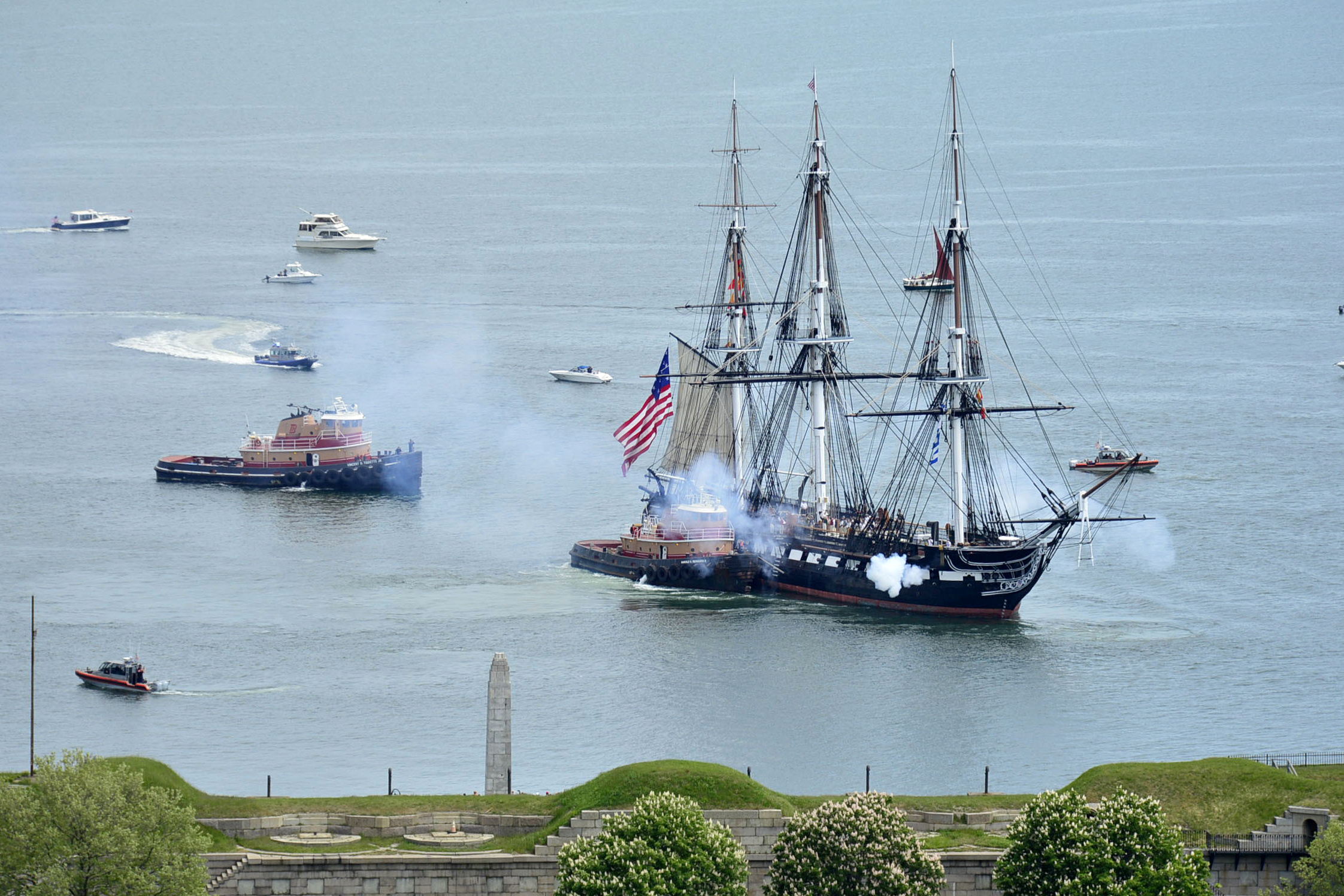
USS Constitution fires its cannons as it's tugged through Boston Harbor, May 21, 2021. Sailors stationed aboard the Constitution provide free tours to more than 600,000 people a year as they support the ship’s mission of promoting Navy history. USS Constitution is the world’s oldest commissioned warship still afloat.
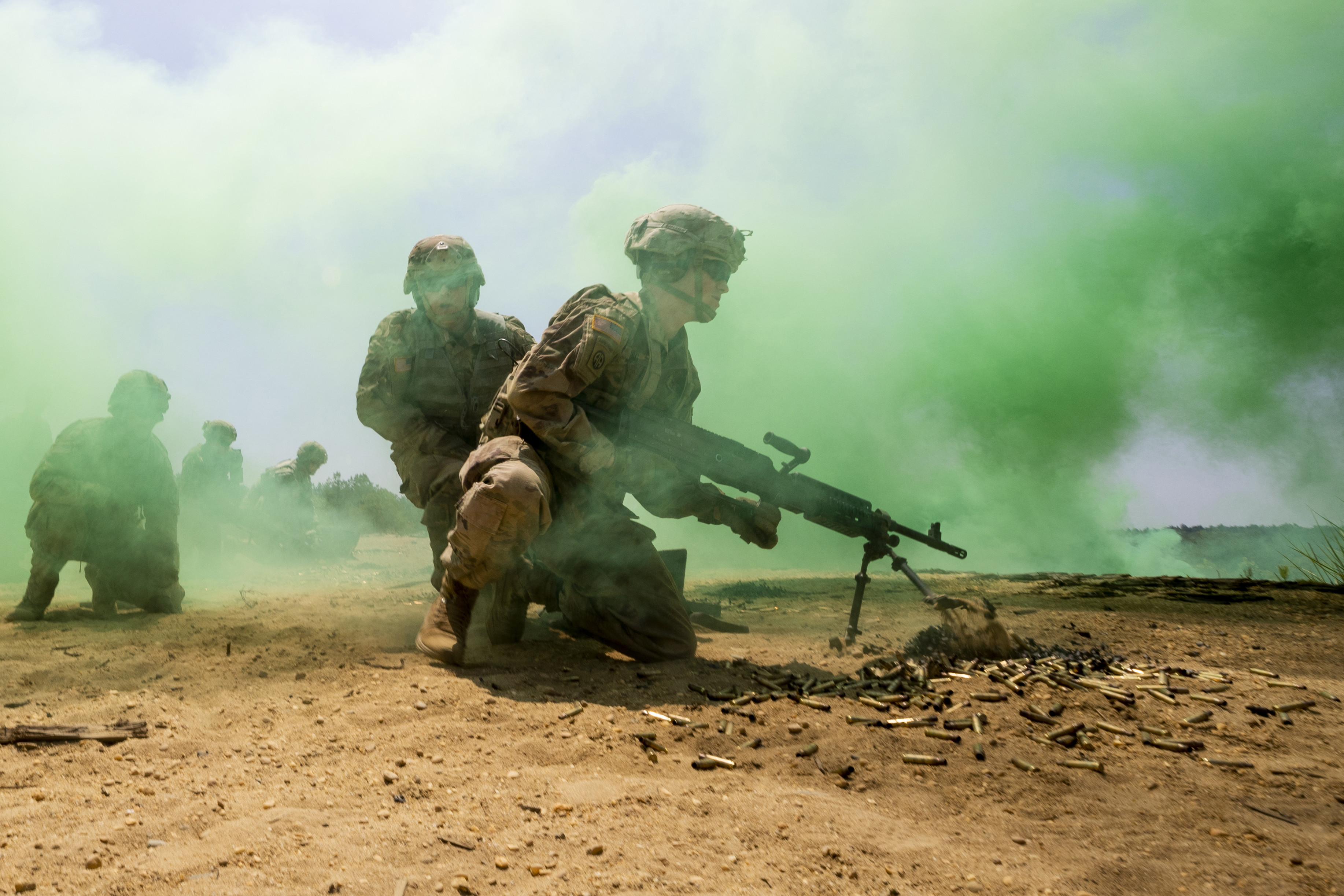
Soldiers take part in live-fire training during an infantry advanced leaders course hosted by the New Jersey National Guard at Joint Base McGuire-Dix-Lakehurst, N.J., May 21, 2021.

A CV-22 Osprey lands on the flight deck of the amphibious assault ship USS America during operations in the Pacific Ocean, May 20, 2021.

Navy Petty Officer 3rd Class Jessica Quinn marks a bingo card during downtime aboard the guided missile destroyer USS Roosevelt in the Atlantic Ocean, May 23, 2021.
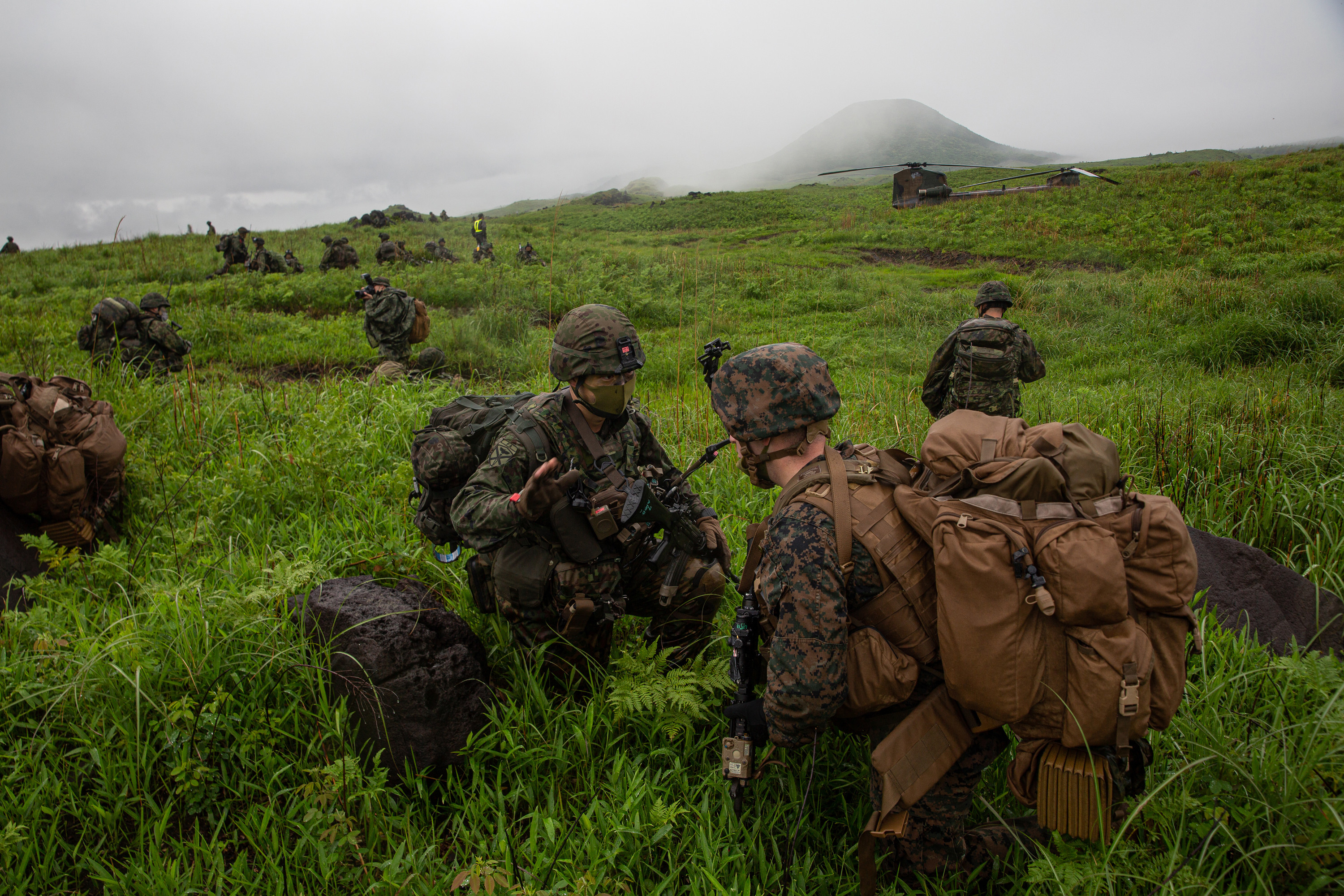
Marines and Japanese soldiers post security while conducting a multilateral assault during Exercise Jeanne D’ Arc at Kirishima Maneuver Area, Japan, May 15, 2021.

Army Sgt. 1st Class Brian Bowling, a critical care flight paramedic with the 129th Aviation Regiment, prepares COVID-19 vaccination syringes for distribution at a medical center in Kingman, Ariz., May 12, 2021. More than 850 Arizona National Guardsmen continue to assist at vaccination sites and food banks throughout Arizona.

Army Pvt. Antonio Ocampo, a wheeled vehicle mechanic with the 1348th Maintenance Company, Arizona Army National Guard, prepares boxes of groceries to be delivered to area residents at a food bank in Phoenix, Ariz., May 21, 2021. The Arizona National Guard is continuing to support food banks as well as COVID-19 vaccination sites statewide.
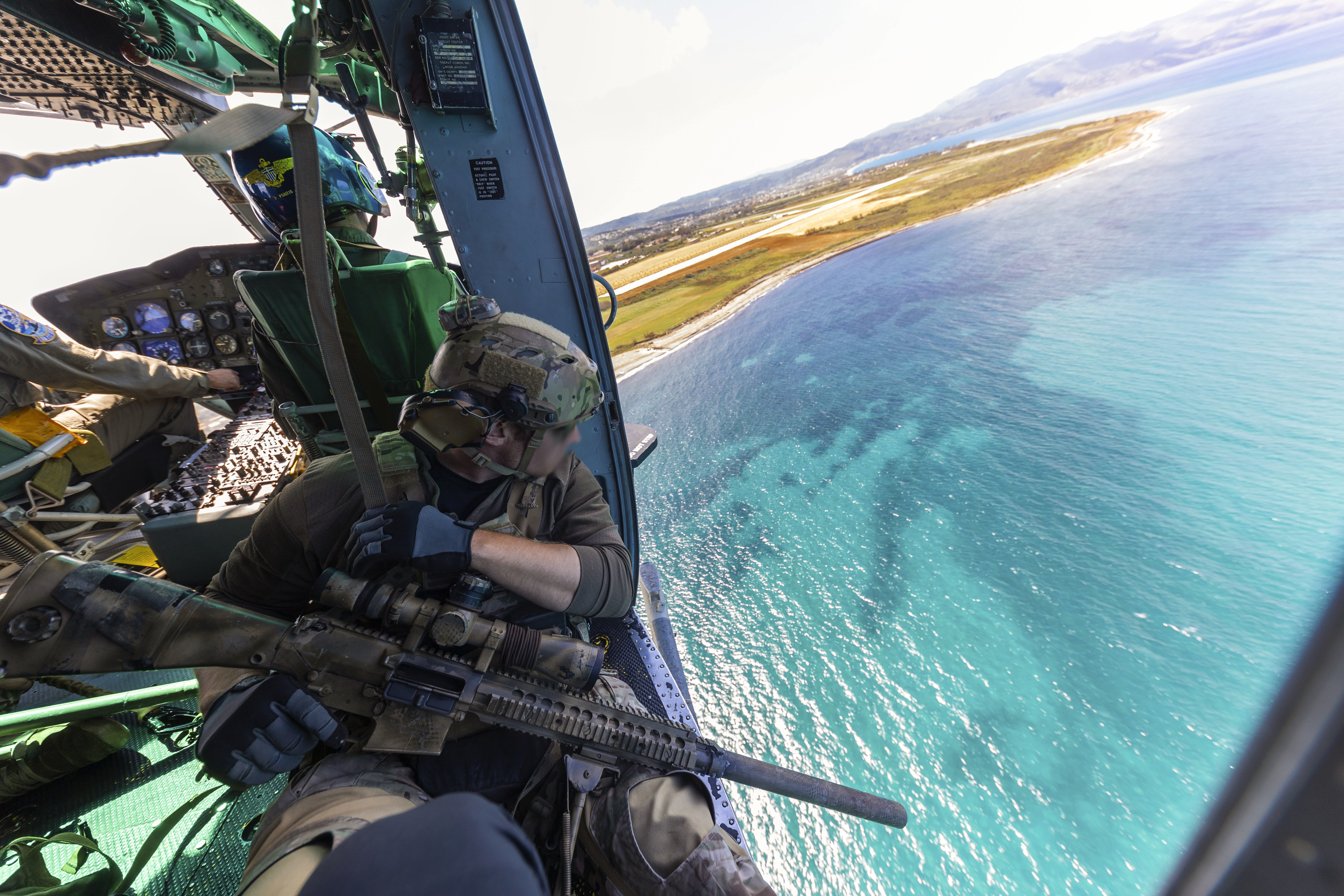
An Army Special Forces solider rides in a Greek helicopter during the NATO Maritime Interdiction Operational Training Centre Sniper Course in Souda Bay Greece, April 21, 2021. The course was designed to improve the accuracy of snipers from land, air and naval vessels.
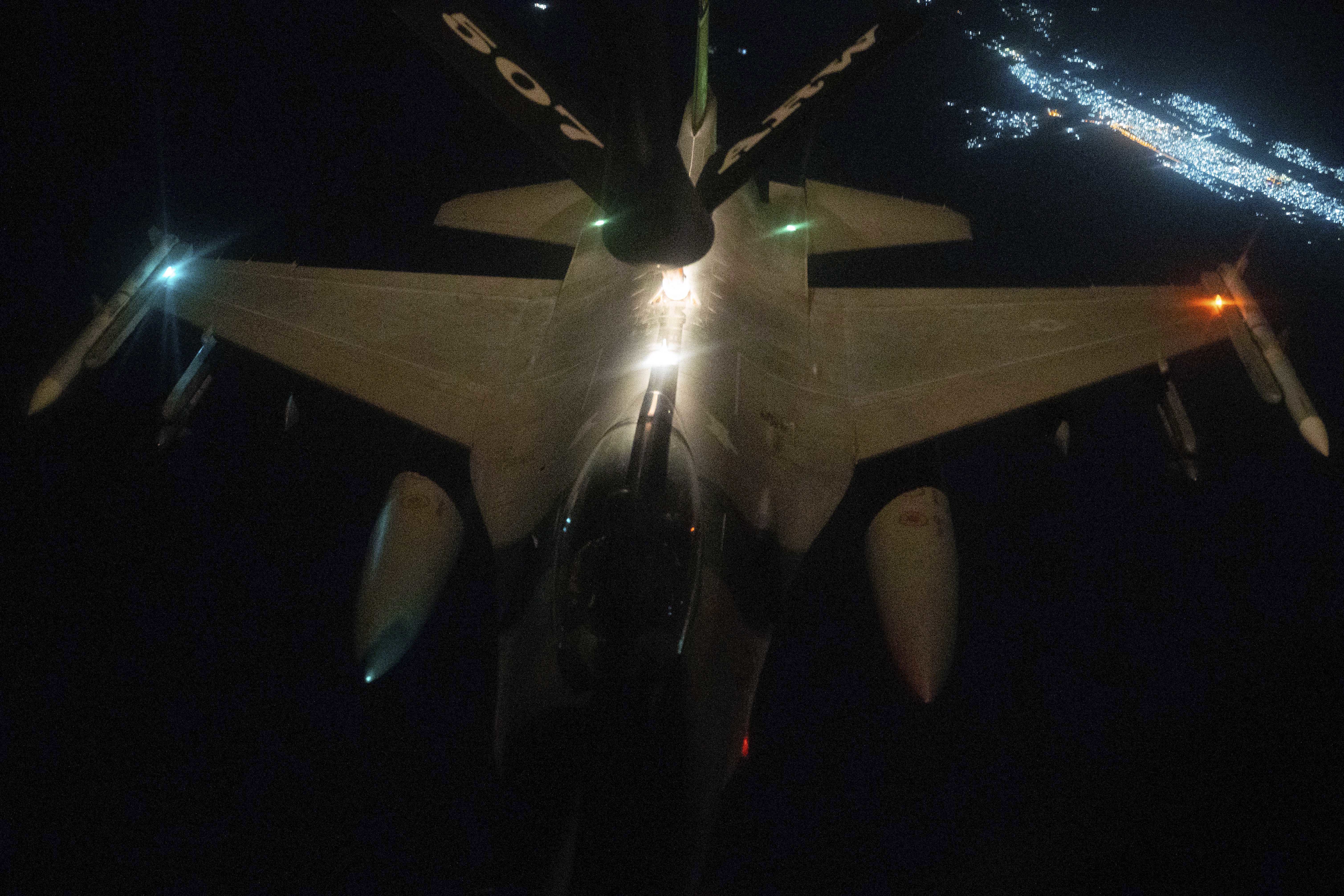
An Air Force Fighting Falcon receives fuel from a KC-135 Stratotanker over the U.S. Central Command area of responsibility May 9, 2021.

The USNS Big Horn, left, conducts a replenishment with the French navy FS Tonnerre while the FS Surcouf follows in the Philippine Sea, May 19, 2021.
May 24, 2021
I want to take this opportunity to thank the Soldiers and Airmen of the National Guard who for the last five months have been standing watch over the Capitol grounds in Washington, D.C.
They came here from all 54 states and territories, leaving behind jobs, homes and families, to bolster security at the Capitol in the wake of the dramatic events on January 6th. Many of them volunteered for this duty, and most of them did so on little notice. In good weather and bad -- sometimes cold and wet and tired -- they provided critical capability to the Capitol Police and local authorities.
These airmen and soldiers protected not only the grounds, but the lawmakers working on those grounds, ensuring the people’s business could continue unabated. They lived out in very tangible ways the oath they took to support and defend the Constitution.
It’s been a trying but telling year for the National Guard. Between natural disasters, civil unrest and an ongoing pandemic, our Guardsmen and women have been tested time and time again. And each time, they have performed magnificently. So magnificently, in fact, that it would be all too easy to take their service -- and that of their incredible families -- for granted. We won’t do that, of course, because we know we will continue to call on them in times of need.
As these troops depart for home and a much-deserved reunion with loved ones, I hope they do so knowing how much the nation appreciates their service and sacrifice -- and that of their families and employers. I hope they know how very proud we are of them.
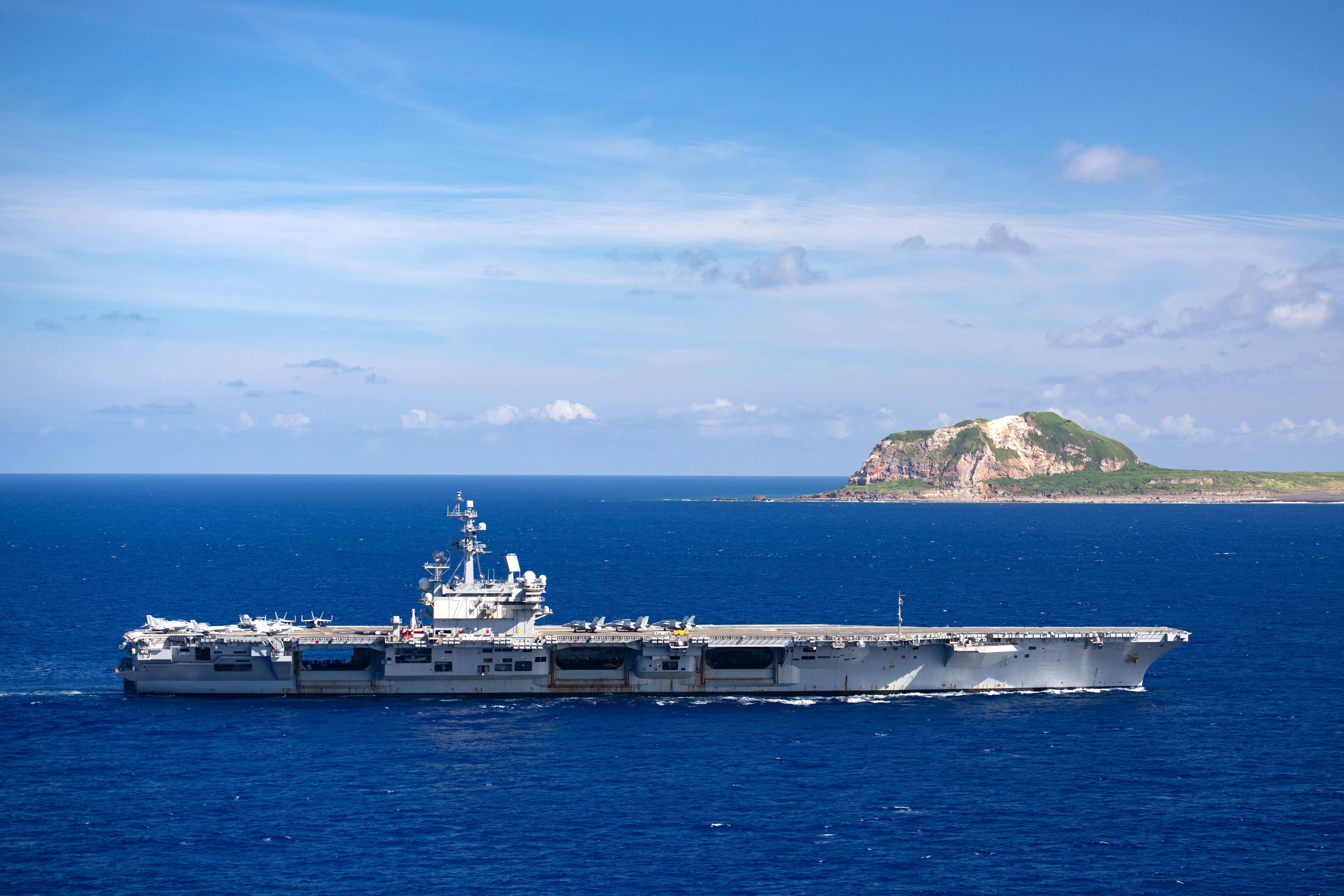
The aircraft carrier USS Ronald Reagan steams off the coast of Iwo To, formerly referred to as Iwo Jima, in the Pacific Ocean, May 22, 2021.
May 24, 2021 | , DOD News
Asian Americans and Pacific Islanders have shaped the history of the United States and have had their lives dramatically influenced by moments in its history. Every May the Defense Department joins the rest of the nation in celebrating Asian American Pacific Islander Heritage Month.
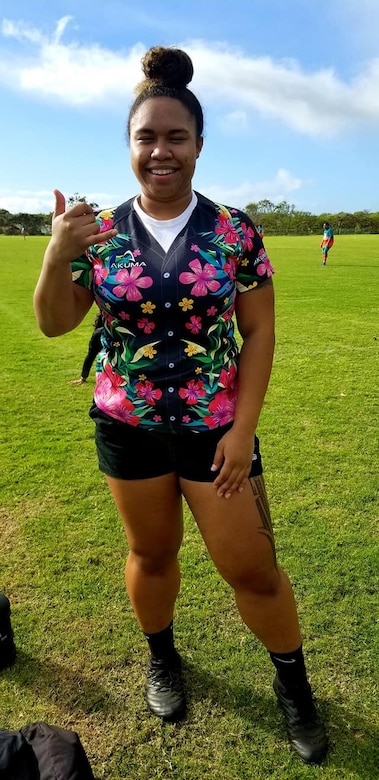
Navy Petty Officer 2nd Class Fa'atuatua Pinkston was born in San Jose, California, and grew up in St. Louis. Her mother was born in Apia, American Samoa.
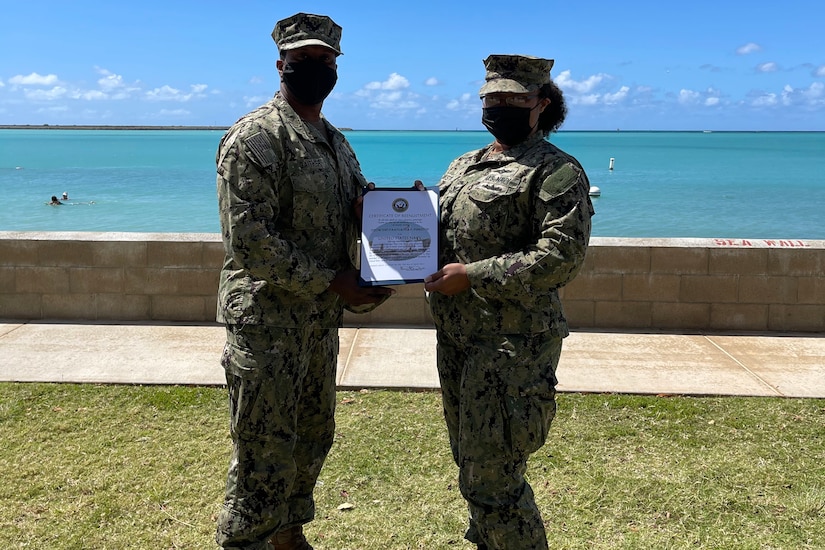
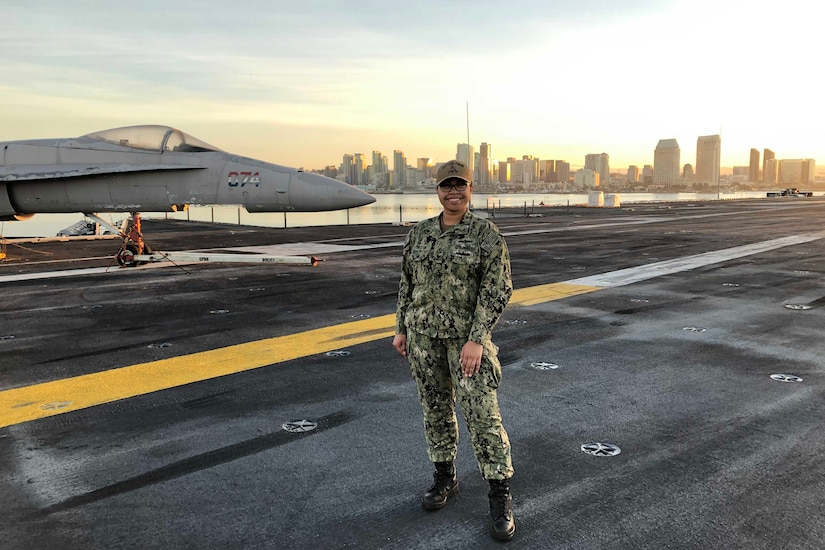
Pinkston said she's doubly proud of her heritage: Pacific Islander, from her mother's side, and African American from her father's side.
"To be an American in the armed forces and being able to express my heritage and culture is very honorable for me," she said. "It is very hard to find others of Samoan heritage but when we do find them, the pride is strong!"
Pinkston said she studied the island culture, which included tribal tattoos and native dances, with special historical meaning associated with those rituals. "A lot of people are excited to hear our interesting stories about those things."
Pinkston said she joined the Navy because she loves the ocean and was fascinated with the structure of the naval vessels. "Something about warships really pulled my interest."
As an information systems technician, she said she manages everything from communications systems to computer networks.
After boot camp in Naval Station Great Lakes, Illinois, she served aboard the USS Carl Vinson aircraft carrier from 2016 to 2019, homeported in San Diego.
She's already been on two deployments in the Pacific and participated in the allied, fleet-wide Rim of the Pacific, or RIMPAC, Exercise.
RIMPAC, is the world's largest international maritime warfare exercise. It's held biennially during June and July of even-numbered years in Honolulu. The only exception was 2020 when it was held in August.
After her time aboard the carrier, Pinkston was stationed at the Defense Intelligence Agency in Pearl Harbor, Hawaii. A few weeks ago, she detached from that command and soon will be assigned to the Explosive Ordnance Disposal Group in Virginia Beach, Virginia.
Pinkston is also a gifted rugby player, on the Navy Women's Rugby team.
Growing up, Pinkston said she always knew that rugby was her sport of passion but there were no nearby teams in her St. Louis neighborhood.
It wasn't until she was stationed in San Diego that she was able to start playing rugby after learning the basics.
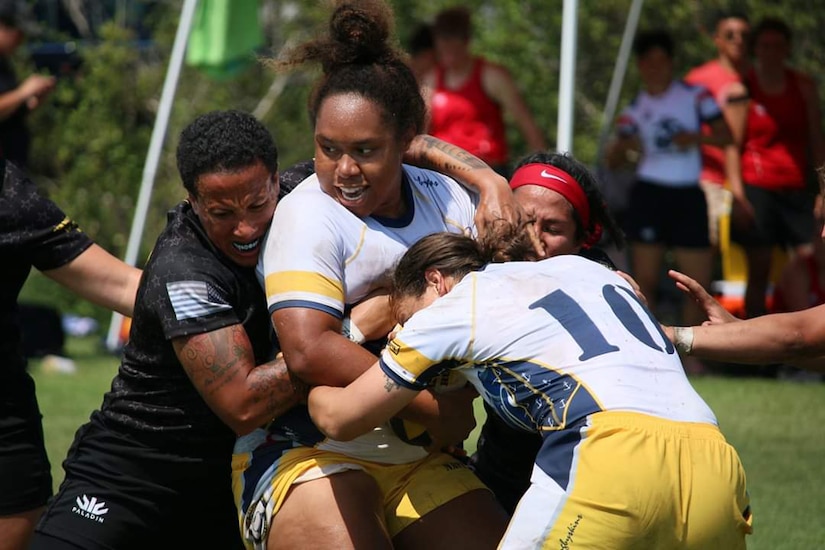
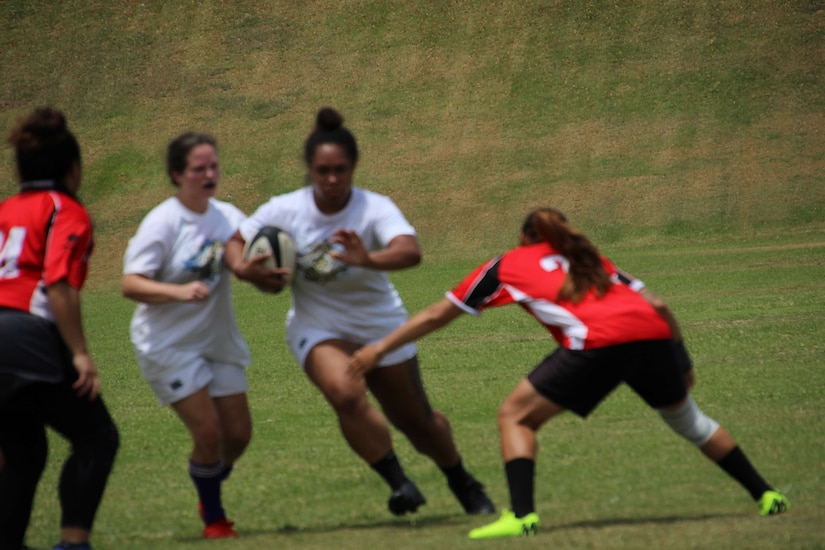
"Rugby has definitely made me a better sailor and person overall," she said.
Rugby is a physical as well as a mental sport. It helps build teamwork and leadership, both important traits to have in the Navy, she said.
"Rugby made me realize my true physical strength, power and potential. I am a beast! I am unstoppable! I am what I envisioned myself to be and rugby helped bring it out. It also helped me dig deeper into my roots as I can compete against women bigger than me and still hold my ground or push further! It has made me powerful and unlocked that skill! Rugby has made [me] confident in every obstacle I take on! If I can take on rugby, I can take on anything!" she said.
Pinkston's future plans are to continue excelling in her Navy career and taking advantage of college courses and certifications and other resources that are offered. She added that as she grows as a leader, she'd like to mentor younger shipmates.May 22, 2021
SECRETARY OF DEFENSE LLOYD J. AUSTIN III: Thank you so much General Williams and thank you for that warm introduction. You know, it's always tough to spend behind General Williams. He's such a -- such a great speaker. Every time I come back here it feels like I'm coming home. By the way General, what do you call this group of fine men and women that I see assemble on the field in front of us?
GENERAL ANTHONY WILLIAMS, SUPERINTENDENT OF WEST POINT: (inaudible) Warriors Mr. Secretary.
SEC. AUSTIN: OK. “Soup” says he calls you warriors. I'm going to call you Lieutenants. Is that OK with you?
(Laughter.)
(APPLAUSE)
This is a big deal guys. I want your Secretary of Defense to be the first to call you Lieutenant. So – Hooah.
(APPLAUSE)
It is great to see Senator Reid and his classmates from the class of 1971. Congressman Womack, Acting Secretary Whitley, General McConville and so many others of the supporters of this -- this exceptional academy. And let me again thank General Williams and Sergeant Major Coffey and all the faculty and staff here at West Point for all that you do and all that you have done to uphold the traditions of this extraordinary place and for all that you have done for the newest officers in our United States Army, and that brings me to the Class of 2021. You know, the next time that I see your Commander-in-Chief and I see him often. I will report to him some very good news and that good news is that reinforcements are on their way.
(APPLAUSE)
Let me give a shout -- a quick shout out to your First Captain, Lieutenant Reilly McGinnis.
(APPLAUSE)
I am particularly proud that this year senior cadets from West Point, the Air Force Academy and the Naval Academy are all women.
(APPLAUSE)
Lieutenants, I hope that you're feeling proud of yourself because we are certainly proud of you. Your graduating under exceptionally tough circumstances but you fought through from R-day to today and you fought through to take your place in the "Long Gray Line" so congratulations.
(APPLAUSE)
You know this isn't just your day. It also belongs to the families and loved ones who have done so much to get you here. Amid the pandemic when so many families have suffered aching losses, it's particularly powerful to have all of you here with us today. Your families have worried and sacrificed and told you to call your mother. They're not going to stop worrying about you now but they're also not going to stop being proud of you. They've given their love and been your biggest cheerleader so let's take a second to turn that around. Everyone, let's give it up for your families.
(APPLAUSE)
See some proud families up there waving and you should be waving. You've done well. Lieutenants it doesn't seem like that long ago that I was sitting where you're sitting. So I'm congratulating you not just as the Secretary of Defense but also as a member of the Class of 1975. You know, I think it's finally safe to -- to admit that for much of high school I never really considered West Point, and still my family has a strong tradition of military service. My father served proudly in World War II as a truck drive in the Army Air Corps, and I can still remember seeing pictures of him in his uniform as a young Corporal. And one of my uncles was the first African-American Green Beret that I ever saw, you know, he came home wearing that green beret.
(APPLAUSE)
Yes, he came home wearing that green beret and those jump boots and I said, you know, I -- I got to do that. I got have some of that. So -- so I grew up wanting to serve at some point. But I also grew up being Catholic and fascinated with the idea of going to Notre Dame and joining the Fighting Irish. And I wound up getting into Notre Dame on a scholarship as well as being offered a place at West Point. So my father called me in one day and he said, let's talk our way through this. This is a pretty important decision. He said listen, if you go to Notre Dame, even with that scholarship, it's still going to cost me some money.
(Laughter.)
But if you go to West Point, it would be quite an honor.
(Laughter.)
And not only will it not cost me money, but they'll also pay you every month.
(Laughter.)
And you'll get an opportunity to do something that very few people in life get to do. You know, you can always go to graduate school at Notre Dame but you only get one chance to go to West Point.
(APPLAUSE)
So we talked some more and then my dad asked me, he said, OK, so son? What do you want to do? I said that's easy dad. I want to go to Notre Dame.
(Laughter.)
And he said, OK son, let's try this conversation again tomorrow.
(Laughter.)
And I guess you can tell how that played out. You know, dad's looking pretty smart about right now. I'd never set foot on West Point when I started out here. I'd never been to the state of New York. In fact, the furthest that I'd ever been, north I had ever been was north Georgia. I paid for my own flight to get here from Georgia and -- and it was the first airplane that I ever flew on. I landed in New York City in 1971 and let me tell you, it wasn't just different from my hometowns in Georgia and Alabama. It was another planet. And so the next day I got on a bus and I headed up here and this academy on the Hudson looked like my second new planet in two days.
It was unlike any place that I've ever seen in my life. The grounds were perfectly groomed and they seemed to be filled with perfect people. You know, I still remember the rising seniors who gave us our first instructions. They were athletic and brilliant. They spoke flawlessly with no pauses or stumbles. I don't think they ever even blinked. So they made quite a first impression on us, and I found myself thinking, there is no way that I can ever be that good. And like many of you, my goal was just to make it through the first day and then to the next day and the next week and the next month. I sometimes wondered what good could possibly come out of all of this intensity, and I remembered being given just a few minutes to read the newspaper in the morning and then being prepared to discuss the items in the newspaper with the upperclassmen.
And I thought, how does that matter? How can that possibly make me a better officer? And now, as Secretary of Defense, I find myself with a stack of intelligence assessments and -- and international news clippings that I race through every morning and as I do I think of West Point and I chuckle. That's just one of the skills that I learned here and it turned out, by the way, that the upperclassmen who gave us such a fine impression on that first day had actually been rehearsing for weeks. And that taught me a lifelong lessons in the importance of serious preparation. I learned the -- I learned that focus and discipline are really important. I learned the importance of mastering your trade, and above all I learned the importance of being -- of becoming a team member.
Lieutenants, on challenging -- challenging deployments, you will have to work together with your teams to survive and succeed, and this institution excels at instilling exactly that spirit. You've learned how to follow with loyalty. You've learned how to lead with honor. You've learned how to question with rigor. You know, looking out at all of you I see the vanguard of a generation. I see patriotic, committed young people coming of age at a hinge in history, who grew up never knowing anything other than a nation at war. And so now, you're about to graduate into a changing country and a changing world where many of the old ways of doing business don't hold up anymore. You're seeing raw divisions at home and the painful aftermath of the pandemic.
You may also have heard some of America's competitors claim that the future belongs to a model that promises wealth as it stamps out freedom. You're watching as America's longest war winds down, and you're seeing technology change the character of war itself. And even as big and rising powers jostle and compete, you're seeing new threats from pandemics to terrorism, to cyber weapons, and you're seeing those threats race across borders like a gale. You know, I might -- I just might have a bit of insight into what you're facing. A democracy under strain, economic fall out, painful issues of racism and discrimination, social tensions and the end of a long and controversial war. Well, that all sounds pretty familiar to those of us from the Class of 1975.
So let me assure you of something, and this is from very personal experience. No matter how strong the headwinds, West Point will keep you on course. It worked for my class and it will work for yours. Some things change, but the skill set taught here is made to last because it teaches you to adapt. It teaches you to stick with it as your class model says until the battle is won. Lieutenants you --
(APPLAUSE)
Lieutenants, you are ready. In this young century, adaptation is the name of the game. Leadership is the name of the game, and West Point has given you what you need to tackle any whether channel -- challenge to embrace any honorable mission. So yes, you are graduating in extraordinary circumstances but let's be clear, extraordinary circumstances are what the United States Army does.
(APPLAUSE)
On the face of it, there may -- may -- may seem not to be much in common between the forces that George Washington led along the Hudson and between the units that I've led in the Middle East. But when we are at our best, we are true to our founding values and we don't fight for a tribe or for a political leader or for conquest or for plunder. No, when we're at our best, we fight to defend our republic. We fight to defend our democratic ideals.
(APPLAUSE)
We fight to defend human rights, human dignity, human liberty.
(APPLAUSE)
Take it from someone who spent 41 years in an Army uniform. I've seen the problems but just like the nation it defends, the United States military strives to be a more perfect version of itself. And I will take that over our competitors any day.
(APPLAUSE)
You know, you serve a country that sees the use of force as a last resort. You serve a country that loves liberty. You serve a country that rejects bullying and aggression and that seeks a world rooted in rules that favor the advance of freedom. That stands for democracy and decency at home or abroad. You serve a country that works hand and hand with our old allies and new partners. That cherishes the rich tapestry of the backgrounds of its citizens. That strives to grow and to man and to reach the better angels of our nature. You serve a country that knows, as our president has said, that we are strongest when the power of our example matters more than the example of our power.
(APPLAUSE)
So since becoming Secretary of Defense, I've worked hard with my team to put those principles into place. We're working urgently to help bring this global pandemic -- help bring this global pandemic to an end. We've focused on the security challenges presented by China. We're working hand and hand with our allies and partners to strengthen a rules based international order that advances a cause of human freedom. And we are driving hard to ensure that we have the right capabilities and the right operational concepts and weaving them together in new and network ways to produce a truly integrated 21st century vision of deterrence. And we're doing all of this while making sure that we take care of all of our people, to grow and to develop the talent that we need for the -- for the future and to ensure that everyone who serves can do so in an environment that's free of hate and harassment and discrimination.
(APPLAUSE)
And that ladies and gentlemen is not just a matter of national principle, it is a matter of national security. And I --
(APPLAUSE)
You know I learned all of this at this great institution. This great engine of leadership and I kept learning from West Point long after I graduated. I lived through a lot between my last day here and my first day as a general officer but there wasn't a day when I didn't draw on my years here at West Point. And you're time here will serve you incredibly well over the decades to come as well. You know, most of all, I still -- I still depend on the values that I learned at West Point. I still believe that leadership demands character. I still believe in telling the truth. I still believe in treating people with dignity and respect. I still believe in serving your country and I still believe in the tenets of our democracy and the words of our Constitution.
(APPLAUSE)
Those -- those values are the lasting -- lasting legacy of West Point. They are the guideposts that will steer you right when you face the hardest decisions of your lives and some of you 2nd Lieutenants will have to -- will have to make life and death calls. Those values will see you through. Those values will guide you home. And you know what? You're prepared to make those decisions. You may not know it yet, but you are ready to be leaders. The values that we uphold are the values that will hold us up, and the Department of Defense is committed to doing everything in its power to support you when you serve and when you deploy and when you come back. And we're also to help your families on the home front because we know that when a soldier deploys their loved ones are on the front lines too.
Now, one word of advice. Hold on to your academy friends. They're a huge part of what you'll carry forward. My West Point buddies and I still remember going into New -- into New York City on the very few weekends that we could get off post. Back in those disco days of 1975, we were surrounded by bell bottoms and big hair and wide collars. And I can tell you up front, just for the record, that I never wore any of those.
(Laughter.)
Obviously, just kidding. We still laugh about those times but there was plenty that we didn't laugh about. We didn't laugh about the struggles of getting through ranger school or airborne school or the strains on the home front of a life of serving your country.
But through it all, we always knew that the friends that we made here were the kinds of people that you'd want to be in a fox hole with, and I can promise you that we're going to need your courage and your commitment in the future. You know when I graduated, Vietnam ended and my classmates and I went for a long time, which -- in which many of us weren't involved in any kind of a major conflict. But after September 2001, this country found itself in a continuous fight for almost 20 years and I wound up commanding troops in combat at the one star, two star, three star and four star levels. Now, America's goal is to always lead with diplomacy and to deter conflict whenever we can, but if we are forced to defend ourselves, we will win and we will win decisively.
(APPLAUSE)
Lieutenants, our job is to fight and win our nation's wars and that means that nothing that you have learned here is solely academic. Because I can pretty much guarantee you that something that we're not anticipating is going to happen -- happen on your watch because we live in an imperfect world. One in which patriotic young men and women still learn the ways of war and volunteer proudly to keep their fellow citizens safe, and we're grateful to all of you for standing up and standing tall. Now we don't get to choose our times but we do get to shape our times. And in our democracy, that isn't just a job for those at the top, it is the responsibility for every citizen and it is a mission for every soldier in the United States Army.
Lieutenants, your hour will come and when it does the eyes of the nation will turn again to the men and women of West Point and our entire military. In the course of the republic and the depth of our security will be shaped again by you and by your teammates in the other services until the battle is won.
(APPLAUSE)
Yes. Those who came before you are so proud to see you sitting here today and we believe in you, in each and every one of you. And we know that you will prevail and we know that you will make us proud for democracy, for liberty, for the Constitution and for duty, for honor, for country. Thank you and congratulations again Class of 2021.
(APPLAUSE)


 Posts
All Comments
Posts
All Comments