Tuesday, April 14, 2020

Military Doctors, Nurse Discuss COVID-19 Crisis in New York


April 14, 2020 | BY Terri Moon Cronk , DOD News

Military doctors and nurses are fanning out across New York hospitals to offer relief to their overworked civilian counterparts as the COVID-19 pandemic hits the city hard.

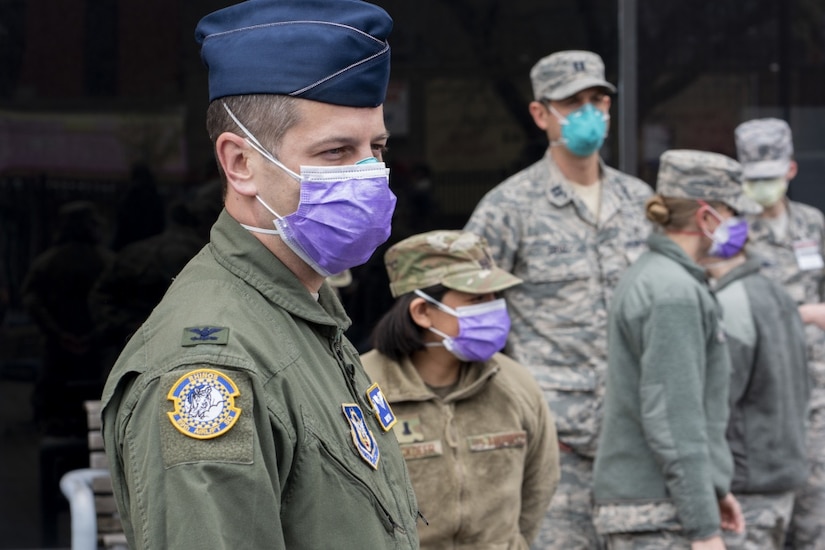
Three members of Joint Task Force New York-New Jersey — Air Force Col. (Dr.) Jennifer R. Ratcliff, commander of the 927th Aerospace Medical Squadron at MacDill Air Force Base, Florida; Army Lt. Col Leslie Curtis, chief nurse officer for the 9th Field Hospital, Fort Hood, Texas; and Navy Capt. (Dr.) Joseph J. Kochan, executive officer for Operational Health Support Unit in Portsmouth, Virginia — briefed the news media on their COVID-19 efforts via telephone today.

"We really are here to support the citizens of the state of New York and support [the Federal Emergency Management Agency system], as long as we're needed," Kochan said.

"The benefit of the military is we are scalable. We have different teams out in [New York City] and in different environments, such as in the [Jacob K. Javits Convention Center]. We can be utilized in whatever ways the city, state or this region requires," Ratcliff said.

We've got the energy and the enthusiasm to really help the people that are tired and have been working very, very long days and weeks."

Military doctors and nurses are working 12 hours or more a day in a world that runs 24/7, officials said.

"We've been bringing in 20 to 30 nurses a day, onboarding them to the agencies," Curtis noted. "Then they 'shadow' for a day or two and are then put on a schedule."

"Combining the staffs of military and civilian doctors and nurses during a pandemic has never been done before," Curtis said. "This is an extraordinary time in history where we've come together in all the services, providing [care] in a tough situation that requires us to really take heed of the environment."

Military medical professionals who integrated into civilian hospitals went out to the hospitals and asked what their needs were, Kochan said. "What we're doing is whatever the hospital needs. We're filling that need as best we can," he added.

"What I find interesting is that once we were credentialed within these hospitals, how quickly we've been able to actually integrate and how welcoming the city has been," Ratcliff told reporters. "We're fresh faces. We've got the energy and the enthusiasm to really help the people that are tired and have been working very, very long days and weeks."

The Navy sent about 200 doctors and nurses to New York City, Kochan said, adding that they have various skill sets, specialties and backgrounds from all over the country. "We push them out into teams based on what the hospitals have asked for to fill in the critical needs they have," he said.

Esper, NATO Defense Ministers to Discuss Global Effort to Defeat COVID-19


April 14, 2020 | BY Jim Garamone , DOD News

The coronavirus sets its own timetable and does not respect international boundaries,  and it will take an international effort to defeat the pandemic, NATO Secretary General Jens Stoltenberg said.

The NATO leader will host a virtual meeting of the alliance's defense ministers tomorrow. Defense Secretary Dr. Mark T. Esper will join the meeting from his Pentagon office.

The only item on the agenda is the alliance's efforts against COVID-19, Stoltenberg said today in a virtual news conference from Brussels.

"The COVID-19 pandemic continues to affect us all," he said. "Even though we have seen that the rate of increase is slowing down in some countries, the illness continues to take a terrible toll."

The secretary general expressed his condolences to those who have lost family and friends and praised health workers who are on the front lines of the fight against the pandemic.

The ministers will review the actions NATO allies are taking to combat the spread of the virus and decide on the next steps. "We will also address how to maintain NATO's deterrence and defense and sustain our missions and operations throughout the pandemic," the secretary general said.

The alliance responded quickly to the pandemic by implementing preventive measures, assuring the continuation of operations and assisting allies in combating the virus, he said.

Air Force Gen. Tod D. Wolters, NATO's supreme allied commander for Europe and commander of U.S. European Command, has set up a task force to share resources and speed up military support to allies in response to the pandemic.

"NATO allies are cooperating to airlift critical supplies from across the globe," the secretary general said. "Hundreds of tons of medical equipment have been donated and delivered. Allies are sharing medical expertise and spare hospital capacity."

The support that the Czech Republic, Hungary, the Netherlands, Norway, Slovenia, Turkey and the United States have provided to the alliance's newest member: North Macedonia, is evidence that the alliance is more than a singularly focused military entity, Stoltenberg said.

The NATO disaster response center has facilitated Denmark's delivery of ventilators and a field hospital to Italy and Germany's delivery of ventilators to Spain, he said, adding that Turkey has delivered medical supplies to allies and partners across the Balkans and to hard-hit Italy and Spain.

"Allied armed forces are also providing essential support to civilian responses in our nations, including with logistics and planning, field hospitals and hospital ships, transport for patients, repatriation of citizens abroad, and the disinfection of public areas and at border crossings," Stoltenberg said.

The coronavirus crisis has far-reaching consequences for how the nations of the alliance and NATO as an entity think about security and national resilience, he said.

"We have seen state and nonstate actors try to take advantage of the pandemic to spread false and harmful narratives and to try to divide us," the secretary general said. "So allies need to work closely together to identify, monitor and expose these efforts. An open and transparent press is the best bulwark against disinformation and propaganda."

All this builds on NATO's core task of preserving security to almost 1 billion citizens in the North Atlantic region, he said. "We must continue to work hard to ensure that this health crisis does not become a security crisis and that we are better prepared when the next crisis comes," he added.

Africom's Partnership Endures During COVID-19 Pandemic


April 14, 2020 | BY Army Staff Sgt. Flor Gonzalez , DOD News

As the world fights to contain the COVID-19 pandemic, the United States, through U.S. Africa Command, is doing its part to help African partner nations combat this new enemy.

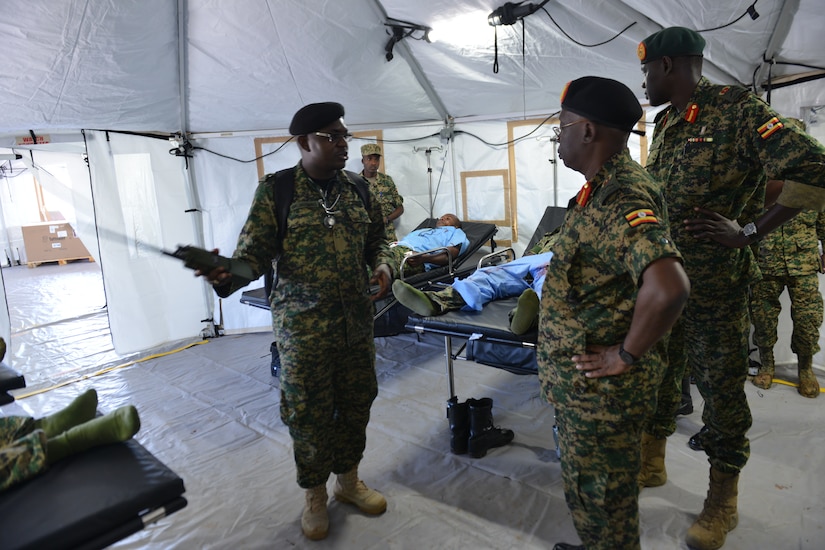
In 2019, four African partner nations — Ghana, Senegal, Uganda and Rwanda — were provided with the training and equipment to efficiently and effectively set up, take down and operate a United Nations-standard level 2 hospital through the African Peacekeeping Rapid Response Partnership program.

The program, funded by the State Department, helps African nations enhance peacekeeping and security capabilities. Of these four partner nations, three are now deploying their level 2 hospitals as part of their response to the COVID-19 pandemic.

"We are proud to stand by our partners as we battle this deadly virus in Africa and around the globe," Air Force Lt. Gen. James Vechery, Africom's deputy commander, said. "As we work shoulder to shoulder, it is exciting to see our African partners putting the capabilities we've developed over the past few years to such great use during this global pandemic."

It is our hope that the support we provide to our partners enables them to lessen human suffering and strengthen their nations, their people and the global community."

The hospitals are one example of Africom efforts to assist African partners to enhance their medical capabilities and pandemic response. Programs such as tactical combat casualty care training, medical readiness exercises and conferences focused on pandemic response efforts all demonstrate the long-term investment by the command.

Ghana, Senegal and Uganda independently decided to deploy their hospitals in support of their national response, said Air Force Maj. Mohamed Diallo, Africom international health specialist. Senegal and Uganda are using the hospitals as overflow facilities for existing hospitals. "We are going to start treating people," Lt. Col. Henry Obbo, Uganda Land Forces spokesman, said. "It's just put here... in case the means of health might require additional facilities."

Ghana, which has nearly 300 confirmed cases of COVID-19, is using the facility to treat those affected by the virus.

"Now more than ever, the United States is pleased to work together with the government, armed forces and people of Ghana," U.S. Ambassador to Ghana Stephanie Sullivan said. "This mobile hospital will directly serve those most in need. Together, we will emerge from this stronger and more united."

Sullivan echoed Ghanaian President Akufo Addo's call for all Ghanaians and residents of Ghana to stay home as much as possible, as it's one of the most effective ways to combat the pandemic and "flatten the curve."

Each hospital package includes 14 shelters with a total of 7,427 square feet of shelter space, consisting of an intensive care unit, a radiology unit and 20 beds.

"While these hospitals were originally designed to support Senegalese soldiers on the battlefield, the Senegalese military has now deployed one of these hospitals and personnel to the city of Touba to assist in the emergency response to the COVID-19 outbreak," said U.S. Ambassador to Senegal Tulinabo S. Mushingi.

Combined with the support from other U.S. agencies such as the Centers for Disease Control and Prevention and the U.S. Agency for International Development, known as USAID, these contributions have greatly strengthened Senegal's ability to respond to the COVID-19 threat and demonstrate the strength of the strong 60-year U.S.-Senegalese partnership, the ambassador added.

The effort highlights a whole-of-government approach aimed at ensuring African partners are educated, resourced and supported to contain the spread of the virus, Africom officials said.

"This program, and the medical capabilities it brings to the COVID-19 fight on the African continent, is a prime example of the unique, continuing commitment that U.S. Africa Command pledges to our Africa partners throughout Africa," Air Force Col. Krystal Murphy, Africom's deputy command surgeon, said. "It is our hope that the support we provide to our partners enables them to lessen human suffering and strengthen their nations, their people and the global community."

(Army Staff Sgt. Flor Gonzalez is assigned to U.S. Africa Command.)