Tuesday, April 14, 2020

Defense Production Act Contract to Provide 39 Million Masks


April 14, 2020 | BY C. Todd Lopez , DOD News

A Defense Department contract under the Defense Production Act will provide more than 39 million N95 respirator masks over the next 90 days to help in the fight against the coronavirus, Defense Secretary Dr. Mark T. Esper said.

"This will help ensure our government has the industrial capacity to meet the nation's needs," Esper said during a Pentagon news conference today.

Also, he said, a $415 million contract awarded by the Defense Logistics Agency is providing 60 systems that can decontaminate as many as 80,000 N95 respirator masks each day, allowing those masks to be reused.

"This will allow medical professionals to reuse masks up to 20 times and will reduce the nation's need for new inventory," Esper said. Six decontamination units have already been delivered to cities including New York; Columbus, Ohio; Boston; Chicago; and Tacoma, Washington, and the rest should be available by early May, he added.

Combined, the 60 systems will allow for the decontamination of some 4.8 million masks each day once they're all in place. Distribution of those systems will be handled by the Federal Emergency Management Agency and the Department of Health and Human Services, Esper said.

DOD has delivered 10 million of the new N95 masks to FEMA and HHS already, the secretary said, and is prepared to provide 10 million more.

The Defense Department has more than 50,000 service members from all services deployed in support of the fight against the coronavirus, Esper told reporters, with more than 4,000 of those being military doctors, nurses and medical professionals. Around 2,100 of those are now in New York City, including 300 who are in civilian hospitals to relieve civilian medical professionals.

Experience has shown that local hospitals in cities such as New York do, in fact, have the number of beds needed to treat patients, but that medical professionals in those facilities have been overtaxed, Esper said, so that is where the U.S. military is focusing its assistance now.

"What's obviously become strained, stressed, are these hard-working nurses and doctors and respiratory therapists and everybody who's been at this now for weeks," he said. "They're getting burned out and worn down." They're also falling victim to the coronavirus themselves, he added.

"So that's where we've now pivoted in the last week or so — to move our doctors — and we're doing that now," Esper said. DOD is moving some doctors off the Navy hospital ship USNS Comfort, which is docked in New York, and putting them into the New York City hospitals to provide relief, he said.

Meanwhile, Esper said, the department is deploying 14 Army urban augmentation medical task forces to priority regions. Six of those task forces are in New York, three are in New Jersey, two are in Massachusetts, and Connecticut, Michigan and Pennsylvania have one each.

The Navy, he said, now has fully established expeditionary medic medical facilities in New Orleans and Dallas, while the Army Corps of Engineers is constructing 25 alternate care facilities around the nation that are expected to make available an additional 15,500 beds in cities such as New York, Detroit and Chicago. Construction of a 450-bed medical facility in Miami also is being discussed, Esper said.

Chaplains Get Creative to Keep Spiritual Community Afloat


April 14, 2020

We're living in strange times. For many, daily life has been upended by the COVID-19 pandemic. Sometimes, we need a little faith to get us through, and that's what Defense Department chaplains are working to bolster during this disruption.

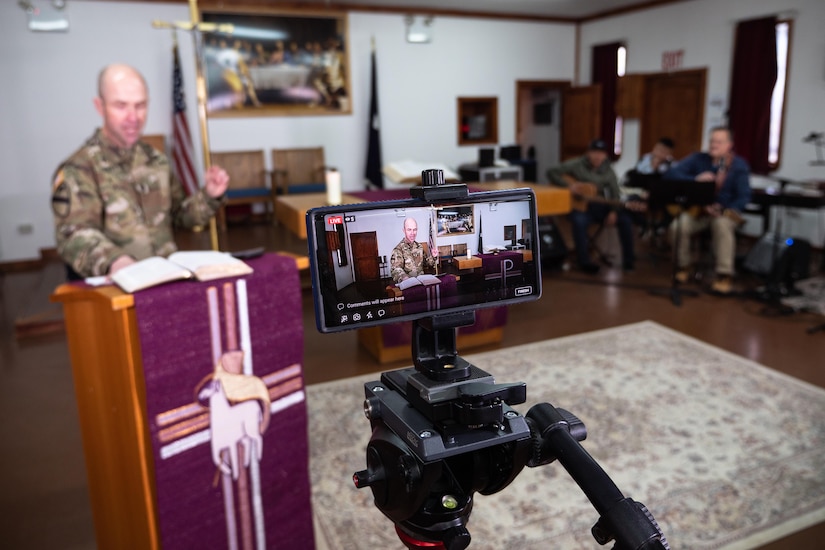
A smartphone in a tripod records a chaplain at a podium as a band sits in the background. A large cross is behind the chaplain.

Since people can't congregate as they normally do, chaplains from all faiths are reaching out virtually to their communities. They're holding online services and using the web, phone calls and other practices to counsel members looking for guidance.

"Chaplains and religious program specialists at all levels must find creative ways to minimize risk while continuing to serve," Chaplain (Rear Adm.) Brent W. Scott, the Navy's chief of chaplains, said. "It is during times like these that the mission of the Chaplain Corps is most vital."

"Chaplains have great resources, and they are here to care for your soul whether you're a person of faith or not," Chaplain (Maj. Gen.) Thomas L. Solhjem, the Army's chief of chaplains, said.

Mental health among service members is a big concern. Religious leaders know that social distancing can be hard, especially for those who live and work alone. That's why their message of "more social distancing, less disconnection" is crucial for service members who must continue their missions.

"Chaplains are using creative ways to push encouraging and supportive words," Chaplain (Lt. Col.) James Foster, the chaplain for the Army's 10th Mountain Division at Fort Drum, New York, said. "There are numerous daily and weekly messages published on brigade and battalion Facebook pages, and some chaplains have even established their own YouTube or unit-specific religious support social media pages."

Chaplains said virtual turnout for religious services has increased since the pandemic began. While streaming religious services normally get only a few hundred views at best, they said their audiences have grown into the thousands.

There are still some physical ways chaplains are able to serve, too — while maintaining social distancing and using personal protective equipment, of course. Over Easter weekend, Fort Knox, Kentucky, held a drive-in, nondenominational service filled with messages, prayers, readings and live music. At Camp Zama, Japan, drive-up communion is being made available weekly outside the chapel for Catholics after Mass is livestreamed, and Protestants can receive communion inside the chapel for one hour on Thursdays.

Chaplains have also been helping to deliver care packages to those in quarantine. It's something they're encouraging others to do, too — safely, of course.

"Think of others at this difficult time," Army Chaplain (Capt.) Moshe Lans, Fort Drum's rabbi, said. "If capable, consider sending something to quarantined people. Food, flowers, cards, notes, gift cards, calling them on the telephone are all ways to let the quarantined person in your life know that you are together despite being physically separate."

Many in the military faith-based community are grateful for their faith leaders' willingness to adapt.

"It is most important during these times of hardship and uncertainty because it is now, more than ever, that we need to keep our faith and still keep our religious routine," Army Sgt. 1st Class Cruzy Cruz, a Catholic who attended Camp Zama's drive-in communion on Palm Sunday, said.

Some chaplains are reminding the faithful that, while this isn't an easy time, it's a good time to recharge their batteries.

"For many of us, this is a much-needed chance to slow down, to read, to grow in our faith and to count our blessings," Chaplain (Maj. Gen.) Steven A. Schaick, the Air Force's chief of chaplains, said in a video message. "Let me be clear, though — this is hard, and this is very real."

Fort Hood Soldiers Certify COVID-19 Response Teams


April 14, 2020 | BY Army Capt. Scott Kuhn

Soldiers are used to functioning as small teams, so the role of a squad leader is integral to a unit's success. In the fight against COVID-19, small-team leaders are finding themselves faced with a new mission.


The soldiers of 3rd Armored Brigade Combat Team ''Greywolf,'' 1st Cavalry Division, at Fort Hood, Texas, have been building and certifying teams responsible for reacting to a positive test for COVID-19 among their ranks. Members of the ''transportation'' and ''clean'' teams for C Company, 3rd Battalion, 8th Cavalry Regiment recently conducted a battle drill to certify their teams.


''We need to certify our young leaders on their responsibilities,'' said Army Capt. Sean Leary, commander of C Company. ''We have assigned responsibility for Team Transport and Team Clean, and this is our opportunity to certify those young leaders and their ability to accomplish their task.''

The effort comprises four teams:


  • Team Trace is made up leaders within the company and battalion, and is responsible for tracing the movements of the infected soldier to identify where hot-spot cleaning needs to occur and soldiers and civilians may need to be tested due to contact with that area or particular soldier.
  • Team Transport is responsible for transporting a positive-test soldier to the isolation barracks if the soldier is in another location, such as a barracks room or at the hospital.
  • Team Clean is responsible for cleaning every identified hot zone where the infected Soldier had been.
  • Team Comply ensures not only that the teams are certified and conducting their tasks to standard, but also ensures that the unit is practicing proper preventive measures to protect the force.

''My job's important, because I don’t want to get another soldier infected, just as I wouldn't want one of my loved ones to get infected,'' said Army Sgt. Heidi Kiracofe, a squad leader with C Company and team leader for Team Clean. ''If we do our job right the first time, the risk to our formation is lower. Ultimately, whether I know someone or not, we all wear the same uniform, and protecting my brothers and sisters from this enemy is important.''


The certification begins with the unit being notified that a soldier at the hospital has tested positive for COVID-19 and needs to be transported to the isolation barracks. The transportation team receives a briefing from the operations sergeant major, who also inspects the team to make sure they are in the proper protective gear, which includes outer garments such as wet-weather gear, gloves, eye protection and a mask.

The transportation team travels to the hospital and, through mobile communications, instructs the soldier to load into the back of the Humvee, being sure to avoid contact with the team. During this time, the unit is lining up a room for the soldier at the isolation barracks and takes the infected soldier there.

Meanwhile, Team Trace begins to identify everywhere the soldier has recently been, cleaning hot spots, if necessary. In this scenario, Team Clean cleans the infected soldier's barracks room. Kiracofe said the standard is a minimum contact time of 10 minutes of the proper cleaning solution applied to all areas, including those small enough that a child could fit a pinky finger.

''The purpose of this certification and making sure they get it right is to protect our soldiers and protect the force and ensuring they can then become trainers themselves and train other NCOs of soldiers who join the team,'' Leary said. ''We never know who will be impacted.''

Each company in the battalion has two transportation teams with two soldiers per team and two clean teams with 10 soldiers on each team. Once certified, they are then able to train additional soldiers so that teams can switch out personnel as necessary.

(Army Capt. Scott Kuhn is assigned to the 3rd Armored Brigade Combat Team, 1st Cavalry Division.)