Friday, January 05, 2018

Face of Defense: Reservist’s Military, Civilian Job Responsibilities Match


By Air Force Senior Airman Tara Abrahams, 940th Air Refueling Wing

BEALE AIR FORCE BASE, Calif., Jan. 5, 2018 — For many reservists, work life does not end when they take off the uniform. Air Force Maj. Francis J. Tobias is one of these airmen. Aside from a change of setting and suit and tie, his profession remains the same.

“I do the exact same job; I just change clothes,” he said.

In uniform, Tobias serves as the director of equal opportunity for the 940th Air Refueling Wing here. In his civilian position, he is the vice president of human resources for the California Dental Association.

This wasn’t always the case though. It took years of patience before Tobias was able to put his two careers together.

It started when he joined ROTC as a freshman with an undeclared major. Shortly into his first year, his detachment commander told him he needed to pick a major to stay in the program.

Tobias was handed a list of majors and began reading through it. It was full of technical studies and a few foreign languages, but none of them was sparking his interest. He continued reading until he reached the last subject on the page: personnel.

“What's personnel?” he asked.

Human Resources

The commander told him it was the study of human resources management. Tobias thought it may be interesting, but in the end, he said, he chose it because it had the least amount of units needed to graduate. But after his first course, he knew he made the right decision.

“I took HR 101 and fell in love with it,” he said.

His passion for helping people fit perfectly with the supportive nature of the career field. “Whatever I do is to help someone else, and that’s what I love about it,” he explained.

When it came time to commission, the demand for personnel officers had decreased. Tobias followed the needs of the Air Force to a logistics position.

On the civilian side, he continued with what he studied, holding various human resources jobs and growing into more advanced positions. Now that he’s the California Dental Association’s vice president of human resources, he and his team provide services to 28,000 dentists across the state.

Human resources services, like equal opportunity in the military, help to develop leadership skills and keep the work environment running efficiently. Both provide training, raise awareness and remove any and all unprofessional, discriminatory and harassing behavior. HR also offers assistance with hiring, recruiting, reviews and benefits.

Civilian, Military Careers Align

About 10 years after entering the human resources career field, Tobias was presented a chance to become an Air Force Reserve personnel officer. He was thrilled.

“The opportunity to connect both my civilian and military careers in this way was both a blessing and a privilege,” the major said. “I felt doing the same job would allow me to grow, both personally and professionally, and this growth would allow for me to be a better support for all those I would help.”

Helping is what equal opportunity focuses on. Tobias and his team strive to enhance mission readiness and ensure all Beale reservists have positive work environments. Airmen are encouraged to reach out to his office and speak up about any difficulties they may be facing.

“We welcome all problems,” he said. “We want [airmen] to feel if they have an issue, they have somewhere to go.”

In addition to mediating problems, equal opportunity also gives briefings during wing commander's calls and organizes activities to foster healthy workplace communications.

“Without positive human relations, it is very detrimental and makes the mission difficult to complete,” Tobias said. “If a member is facing discriminatory behavior, there's no way we can expect that airman to do their job, much less even want to be in the Air Force... If that [behavior] persists, the mission stops.”
Workplace problems can arise in any environment and are often stressful, but rest assured there is always someone to lean on. In or out of uniform, Tobias and his passion for supporting others will help keep the mission running smoothly.

Thursday, January 04, 2018

Mattis Discusses U.S.-South Korean Exercises, Iran Protests


By Jim Garamone DoD News, Defense Media Activity

WASHINGTON, Jan. 4, 2018 — Joint South Korean-U.S. military exercises have been “deconflicted” with the Winter Olympics, Defense Secretary James N. Mattis said here today.

The secretary also discussed the demonstrations in Iran during an impromptu news conference with Pentagon reporters.

The military exercises in South Korea are needed to ensure U.S. and South Korean troops can work together in the event North Korea comes across the 39th parallel again. Still, the Olympics in Pyeongchang are the biggest event that South Korea will host this year. The games are Feb. 9-25, and are followed by the Paralympic Games, March 8-18.

“Exercises are not just done on military bases in defense of [South Korea],” Mattis told reporters. “So we worked with [the South Koreans] on it and [the exercises] will start sometime … after the Paralympics.”

Mattis said the proposed talks between North and South Korea, “are clearly the result of the amount of international pressure, and they are a way for North Korea to start talking while keeping it contained to a benign issue.”

Sanctions Working

The three unanimous U.N. Security Council votes that imposed sanctions on North Korea are having an effect, the secretary said. South Korea impounded two ships that were attempting to trade with North Korea, and North Korean leader Kim Jong Un is increasingly isolated. The secretary said he does not know if Kim’s offer to speak with South Korean leaders is a sincere olive branch or just a dodge.

“It shows the democracies and the nations that are trying to stop this from going to war, and stopping the provocations of nuclear weapons development and ballistic missile launches are united in trying to find a diplomatic solution,” Mattis said.

All of the cautions, all of the attempts at logic with the regime, all of the efforts to halt the regime from its dangerous course did not work until the Security Council imposed its sanctions, Mattis said. North Korea’s longtime allies -- China and Russia -- voted for the resolutions, which sends its own message.

Iran Protests

The secretary also addressed the demonstrations and unrest in Iran. Tens of thousands of Iranians have taken to the streets across the country protesting policies that led to a stagnating economy and price rises. These demonstrations morphed into anti-government protests in some areas, according to news reports.

The demonstrations are the largest public protests since the Green Movement arose out of the disputed 2009 presidential election. Those protests were crushed when the government deployed the Iranian Revolutionary Guard.

“We all remember what happened to the Greens when they came out and the merciless way they were treated by the regime there,” the secretary said. “We -- the American people -- do not have an issue with the Iranian people. We’ve got a big issue with the Iranian authoritarian regime and it appears there are an awful lot of Iranian people who have an issue with it as well. Because even after squashing the Green Revolution years ago, they obviously didn’t remove the irritants and dissatisfaction.”

‘First Navy Jack’ Flies in Hawaii to Honor 17 Sailors Lost in Collisions


By Navy Petty Officer 1st Class Corwin Colbert, Navy Region Hawaii

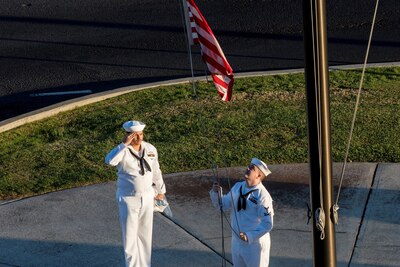
JOINT BASE PEARL HARBOR-HICKAM, Hawaii, Jan. 3, 2018 — As sailors hoisted the colors here Jan. 1 to start out the new year, the “First Navy Jack” rose under Old Glory, as it will throughout 2018 in honor of the 17 sailors lost when the guided missile destroyers USS Fitzgerald and USS John S. McCain collided with merchant ships in separate incidents last year.

The First Navy Jack is a flag consisting of a rattlesnake superimposed across 13 horizontal alternating red and white stripes with the motto, “Don't Tread On Me.” Commodore Esek Hopkins first employed it in 1775 as he readied the Continental Navy in the Delaware River during the Revolutionary War.

In recent years, the Navy has used the flag during difficult times to signify resolve.

Navy Rear Adm. Brian P. Fort, commander of Navy Region Hawaii and Naval Surface Group Middle Pacific, said the First Navy Jack is a reminder that the Navy’s warfighting edge not only is back, but also is renewed and forged with purpose.

“Here in Pearl Harbor, we rose to the challenge 76 years ago, as ‘Remember Pearl Harbor’ sharpened our warfighting culture,” he said. “In the wake of 9/11, when our culture was tested, we rose to the challenge once more. At the direction of the Secretary of the Navy Gordon England, we returned to our First Navy Jack, ‘Don’t Tread on Me,’ on the jack staffs of all Navy warships as a historic reminder of the nation’s and Navy’s origins and our will to persevere and triumph.”

Symbol of Resolve

Navy Command Master Chief Petty Officer Allen Keller, the base’s command master chief, said flying of the First Navy Jack is a symbol of resolve. He challenged the joint base family, service members and civilians alike, to move forward and build on the history and legacy of the country and the Navy.

“2017 was a challenging year for the Navy,” Keller said. “We as an installation will fly the Navy First Jack as a reminder to every airman, sailor, civilian and family member to get back to basics, honor our country and remember our history.”