Showing posts with label hanscom air force base. Show all posts

Tuesday, October 20, 2015

C-130 crash victims remembered by colleagues, leaders


By Mark Wyatt, 66th Air Base Group Public Affairs / Published October 19, 2015

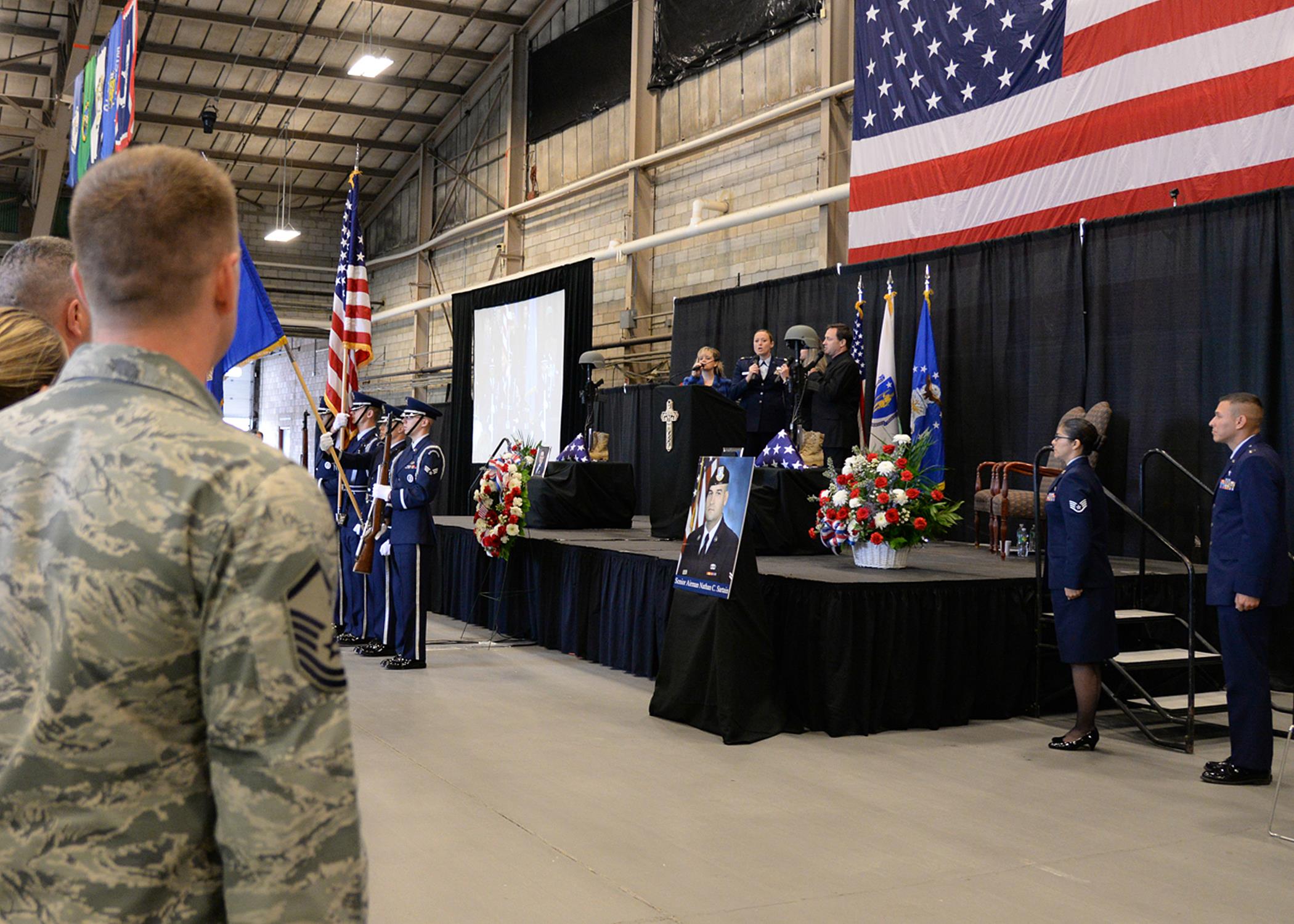
HANSCOM AIR FORCE BASE, Mass. (AFNS) -- More than 1,000 people attended a memorial service here Oct. 16 to honor two Hanscom Airmen killed earlier this month when the C-130J Super Hercules aircraft they were on crashed shortly after takeoff from Jalalabad, Afghanistan.

Senior Airman Kcey E. Ruiz, 21, of McDonough, Georgia, and Senior Airman Nathan C. Sartain, 29, of Pensacola, Florida, were members of the 66th Security Forces Squadron.

During the service, colleagues took time to remember them personally.

"If you were blessed to be his friend, then you had an incredible person in your life, one who leaves us with a legacy we will never forget," said Staff Sgt. Lee Shortell during his remarks on Sartain.

Shortell, who was Sartain's supervisor, added that there were very few people he knew "whose focus on the mission and pride in their work came anywhere close to Sartain's."

Staff Sgt. Derek Smiling, who spoke about Ruiz on behalf of Tech. Sgt. Matthew Marquart, said she was an "amazing troop."

"Kcey Ruiz, you were not only my troop, my sister-in-arms, but you were my friend and you are my hero," Smiling read. "I can proudly say, ‘Kcey, you changed me.’ She made me a better person, changed the way that I am as an NCO, as a supervisor, and as a human being."

Also recalling the two Airmen was the base commander.

"These two defenders embodied the character, honor, dedication and sacrifice of true heroes," said Col. Michael A. Vogel, installation commander. "I could not be more proud and humbled to stand here today as Nate's and Kcey's base commander."

Ruiz and Sartain were deployed with the 455th Air Expeditionary Wing in Afghanistan as Fly Away Security Team members as part of Operation Freedom's Sentinel.

At their home station here, both were installation entry controllers and also armorers.

"On behalf of all the men and women of the 66th Security Forces Squadron, I can tell you how proud we all are of Kcey and Nathan's exemplary service, friendship and defender kinship," said Maj. Joseph Bincarousky, the 66th SFS commander, to the families of the fallen Airmen. "They will always be a part of this family, and your families will always have a place in our hearts."

Both Airmen were posthumously awarded the Air Force Commendation Medal by their unit commander.

Vogel vowed to continue to honor the Airmen's memory by completing the mission.

"We will not falter; we will succeed," he said. "And we will always remember our two fallen heroes and those who loved them."

Friday, August 07, 2015

Air Force moves to replace AWACS radio system

by Justin Oakes
66th Air Base Group Public Affairs


8/4/2015 - HANSCOM AIR FORCE BASE, Massachusetts -- The AWACS Communication and Network Upgrade program office here is conducting market research in an effort to replace the existing tactical radio system on E-3 Sentry Airborne Warning and Control System aircraft.

Recently, the Hanscom-based team issued a request for information to assess potential commercial sources able to produce, install and modify components that will be compatible with the new multifunctional information distribution system/joint tactical radio system, known as MIDS/JTRS.

The current legacy tactical radio system on Block 40/45 AWACS will be replaced by the MIDS/JTRS to support Link 16 enhancements -- some of which have been mandated by the Federal Aviation Administration by 2020.

The Link 16 Network is used by several Armed Services, and facilitates communication between other aircraft and ground forces. Beyond radio command and control communication, Link 16 allows for images and real-time video to pass among users.

In addition to federal regulations, diminishing manufacturing sources also drives the Air Force's decision to update the AWACS communication system.

"The current radio is 20-30 years old, and finding replacement parts becomes increasingly more difficult as time goes on," said Steven Clark, CNU program manager. "We have to replace the existing radio box, but we'll also be modernizing the terminal and adding new capabilities."

Some of the increased capabilities of the new unit include crypto modernization; frequency remapping; Concurrent Multi-Netting 4, or CMN4; concurrent contention reception; enhanced throughput and dynamic network management.

With CMN-4, for example, on-board battle managers will be able to monitor and receive messages on four different channels while transmitting through one dedicated line.

"The more information feeding into our intelligence, surveillance and reconnaissance aircraft simultaneously, the better," Clark said. "Battle managers will have better situational awareness and access to a larger pool of information."

As far as the installation itself, "it's not as simple as removing one radio and replacing it with another," Clark said. "Factors such as size, weight, power, connectivity and available products all have to be taken into consideration."

While the CNU program is still in its infancy, it is gaining momentum quickly.

Program officials anticipate a request for proposal sometime during the second quarter of fiscal 2016, with a contract award goal in early fiscal 2017.

"We're moving forward and taking the necessary steps to ensure a successful and expedited modernization to the AWACS radio system," Clark said.

Wednesday, July 29, 2015

New interrogation system installed on AWACS, more in pipeline

by Justin Oakes
66th Air Base Group Public Affairs


7/28/2015 - HANSCOM AIR FORCE BASE, Mass. -- Out with the old, in with the new -- at least that's the case for the existing interrogation system found on E-3 Sentry Airborne Warning and Control System aircraft.

The AWACS Next Generation Identification Friend or Foe program office here recently completed the first installation of the new AN/UPX-40 system, which also brings new enhancements, onto an operational AWACS at Tinker AFB, Oklahoma.

"This operational installation marks a huge milestone for the AWACS program," said Nick Grudziecki, NGIFF deputy program manager. "And it's only the first of many."

The Air Force has a fleet of 31 E-3 AWACS aircraft, all of which are slated to receive the upgrade.

The radar and computer subsystems on AWACS can gather and present real-time, detailed battlefield information. The radar, when coupled with an identification friend or foe interrogation system, can detect, identify and track enemy and allied low-flying aircraft by eliminating ground clutter signals that confuse other radars. That information can then be used to direct fighter-interceptors toward enemy targets.

The AN/UPX-40 system is replacing the AN/APX-103C model and is unique to AWACS; the new IFF system retains legacy capabilities, but also includes new Mode 5 Interrogation enhancements.

"The UPX-40 dramatically improves the detection of weak signals or maneuvering targets at maximum range and improves detection of targets at all ranges," Grudziecki said. "The new interrogation capabilities also provide faster detection of friendly targets."

The NGIFF development program began in 2008 after the National Security Agency mandated a Mode 5 upgrade to ensure access to airspace and reliable combat identification. After successfully reaching a Milestone C decision in 2012, a production contract was awarded to Telephonics Corp., resulting in the first delivery in fiscal 2015.

According to Grudziecki, eight more installations are planned by year's end, moving closer to the Air Force's goal of 31.

However, the $60 million IFF upgrade is part of a much larger AWACS modernization effort known as Block 40/45.

Block 40/45 represents a revolutionary change for AWACS and worldwide joint command and control, battle management and wide-area surveillance, according to the Air Force's AWACS factsheet. It is the most significant counter-air battle management improvement in the Combat Air Force's tactical C2 history. The modernization will replace current 1970s vintage mission computing and displays with an open system and up-to-date commercial-off-the-shelf hardware and software.

"The role of the E-3 is to carry out airborne surveillance and command, control and communication functions for both tactical and air defense forces," said Lt. Col. Chris Williams, E-3 Netcentric Capabilities Branch materiel leader. "The interrogator is a vital piece of equipment required for AWACS to meet mission needs. With the successful installation of the first UPX-40 system, we are one step closer to equipping the fleet."

Friday, July 17, 2015

First installation complete on third largest AFWET upgrade

by Justin Oakes
66th Air Base Group Public Affairs


7/15/2015 - HANSCOM AIR FORCE BASE, Mass. -- A key system that helps ensure the global free flow of information throughout all military branches and other government agencies is undergoing a major overhaul.

Led by a team at Hanscom Air Force Base, the AFWET system is receiving its third largest upgrade to date, known as the Modernization of Enterprise Terminals, or MET, for short.

Using a variety of satellites to transfer both classified and unclassified data, these terminals provide the backbone for the Global Information Grid and keep Airmen connected across the globe. Structurally, AFWET are heavy- or medium-fixed Wideband Global SATCOM, or Defense Satellite Communication System, terminals comprised of a radome, electronics and a 38- to 60-foot dish antenna.

Recently, the program team completed the first successful MET kit installation for the AFWET system located at Ramstein Air Base, Germany, signifying the modernization effort is well on its way.

"AFWET is a system of systems, and the MET upgrade modernizes approximately 60 percent of the terminals," said Shawn Patterson, AFWET program manager, who has spent more than a decade working on the program. "We are steadily ramping up and expect to have another three installations completed shortly."

The Ramstein terminal is the first of 32 systems the Air Force is responsible for updating. However, MET is a Department of Defense initiative, which will impact an estimated 90 fielded joint terminals altogether.

Since the AFWET program team performs implementation and integration organically -- meaning without the use of prime contractors -- it takes advantage of partnering with other services to reduce cost.

For example, the Air Force was able to benefit from research and development performed by other military branches. In addition, the Hanscom program team utilizes a government-off-the-shelf approach, which helps maintain a joint standard, promotes a standardized software baseline and results in lower prices on joint terminal purchases with the Army.

"Savings have been quite substantial -- in the millions of dollars," Patterson said. "Since this is an enterprise system, and not specifically for Airmen only, capability as well as cost falls to all of the services."

The AFWET program team's primary focus is the MET modernization; however, it is also responsible for the overall life cycle of the terminals, which includes modernizing and sustaining the remaining 40 percent of the terminals.

"We are the product support integrator," Patterson said. "Addressing other sustainment issues outside the MET modernization is all part of keeping the system alive."

There are 25 targeted sustainment actions currently underway with an additional 15 to 25 slated for next fiscal year, according to the AFWET program manager.

Some of the sustainment actions include reliability and software modifications, technical refreshes on alarm systems, modem upgrades and updating fiber communications, terrestrial equipment and routers.

With each completed MET and sustainment effort, the life span of the AFWET system is extended.

"The successful installation of the first MET upgrade marks an important milestone in the progress of the AFWET program," said Col. Todd Krueger, Space, Aerial and Nuclear Networks Division senior materiel leader. "Mr. Patterson and his team have done an outstanding job of preparing for worldwide installation and support while focusing on affordability. They are delivering critical global connectivity for the joint warfighter."