Showing posts with label Middle East security. Show all posts

Friday, August 21, 2026

Readout of the 16th U.S.-Kuwait Joint Military Commission

From August 19-20, Deputy Assistant Secretary of War (DASW) for Near East and Central Asia Michael P. DiMino IV and Kuwait's Chief of the General Staff Lieutenant General Khaled al-Shriaan co-chaired the 16th U.S.-Kuwait Joint Military Commission (JMC) at the Pentagon alongside representatives from U.S. Central Command, the Joint Staff, the Maryland National Guard, and the State Department.  Exemplified by recent operations and decades of cooperation, the delegations emphasized their commitment to a strong, reciprocal, and enduring defense partnership and formalized operational roadmaps that will further advance our mutual defense interests.

During the dialogue, the delegations exchanged assessments of regional security challenges and discussed opportunities for Kuwait to continue bolstering its defense capabilities against shared threats. They discussed mitigating such threats through greater interoperability, expanding cooperation on maritime security, and enhancing regional integrated air and missile defense architectures. Both leaders highlighted how the proliferation of unmanned aircraft systems (UAS) has transformed warfare, underscoring the critical importance of deeper integration.  Kuwait is committed to deepening its investment in its own defense and in the U.S. Defense Industrial Base, highlighted by a pending $1.98 billion acquisition of Anduril counter-small UAS (C-sUAS) systems as part of a broader Kuwaiti plan to expand foreign military sales (FMS).  Additionally, the delegations discussed the America First Arms Transfer Strategy and related efforts to streamline FMS processes and accelerate the modernization of Kuwait's armed forces.

Additionally, DASW DiMino formally announced Kuwait's acceptance into the State Partnership Program and its pairing with the Maryland National Guard (MDNG), represented at the JMC by Adjutant General Major General Janeen Birckhead.

Tuesday, May 19, 2026

National Defense Strategy Prioritizes America First, Leader Says

 May 19, 2026 | By David Vergun, Pentagon News

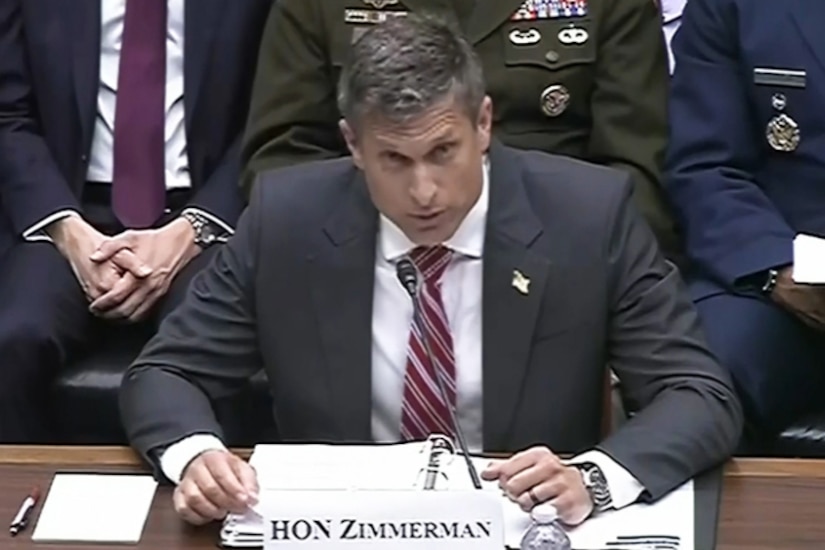
The U.S. will prioritize theaters with the greatest consequence for American interests and where only American power can play a decisive role, said Daniel Zimmerman, assistant secretary of war for international security affairs, who spoke today during a hearing in Washington before the House Armed Services Committee regarding the military's policies, programs and activities in the Middle East and Africa.

A man in business attire sits at a desk and speaks into a microphone. In front of him is a place card that reads, "HON Zimmerman," and behind him are seated people in similar attire.

In the Middle East, allies and partners must take the lead in responsibility for their own security, Zimmerman said.

In Africa, the U.S. is transitioning from an aid-focused relationship to a trade- and investment-focused one, favoring partnerships with capable, reliable states intent on achieving common interests, he said.

The War Department will prioritize taking direct action against Islamic terrorists in Africa who are both capable of and intent on striking the U.S. homeland, while empowering African partners to destroy terrorist organizations throughout the continent, he said.

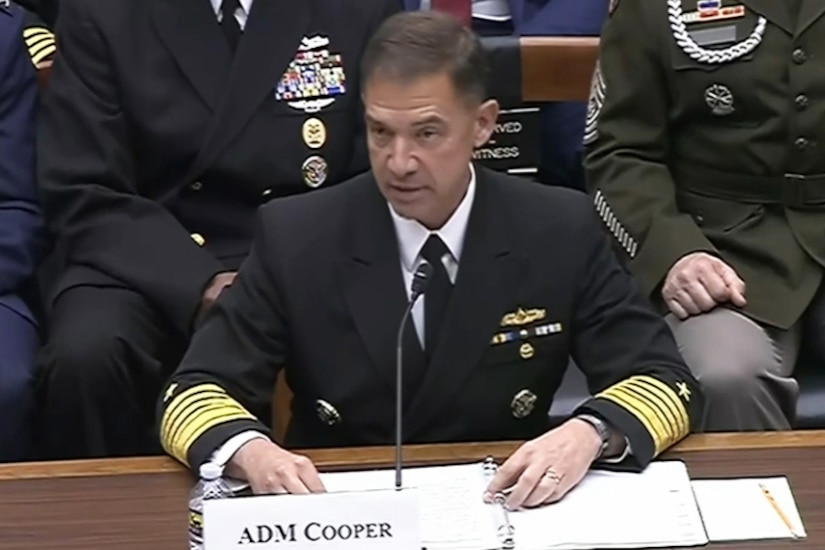
Navy Adm. Brad Cooper, commander of U.S. Central Command, said his command was created in direct response to the threats posed by Iran.

Since 1979, the Iranian regime has terrorized the region and made hostility to the United States a core tenet of its rule. The regime is an even more deadly threat to its own people, killing tens of thousands of innocent Iranians during protests, he said.

"Iran has long had three pillars of intimidation and coercion: their nuclear program, their ballistic missiles and drones, and their proxies — especially Hezbollah, Hamas and the Houthis," Cooper said.

All signs pointed to Iran's intent to create a nuclear weapon and then to protect their nuclear program with ballistic missiles and drones, the admiral said.

"They did it for two reasons: to create a shield to make their nuclear site untouchable and to create an offensive capability so large that regional partners couldn't possibly defend against it," he said.

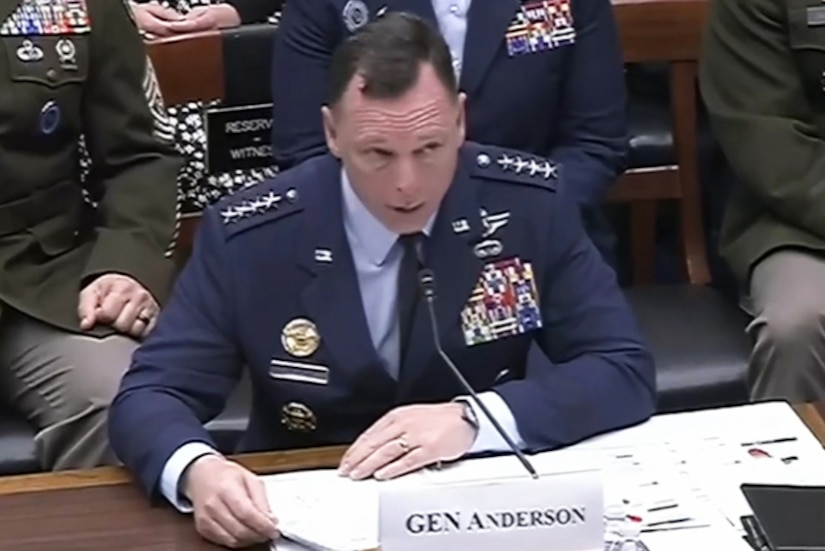
Air Force Gen. Dagvin R.M. Anderson, commander of U.S. Africa Command, said his command is prioritizing willing and capable partners.

The department supports partners with unique capabilities that only the U.S. can provide, he said, such as intelligence, surveillance and reconnaissance targeting and precision strikes.

In Africa, China is working to control critical minerals and infrastructure, and Russia is exploiting instability to extract resources to fuel its war machine, Anderson said.

To contend with these threats, Africom continues to pursue low-cost, high-yield activities to amplify the department's impact on the continent, he said.

Wednesday, January 14, 2026

U.S., Regional Partners Establish New Air Defense Operations Cell in Qatar

U.S. Central Command and regional partners opened a new coordination cell at Al Udeid Air Base in Qatar this week to enhance integrated air and missile defense.

A large military bomber aircraft flies information with two military fighter jets flying on each side of it.

The new Middle Eastern Air Defense — Combined Defense Operations Cell is located in the Combined Air Operations Center on base and comprised of personnel from the U.S. and regional partners. 

The Qatar-based operations center, established more than 20 years ago, currently includes representatives from 17 nations who coordinate the employment of military air assets across the Middle East. The new operations cell is designed to enhance coordination and integration for air and missile defense efforts among regional partners.

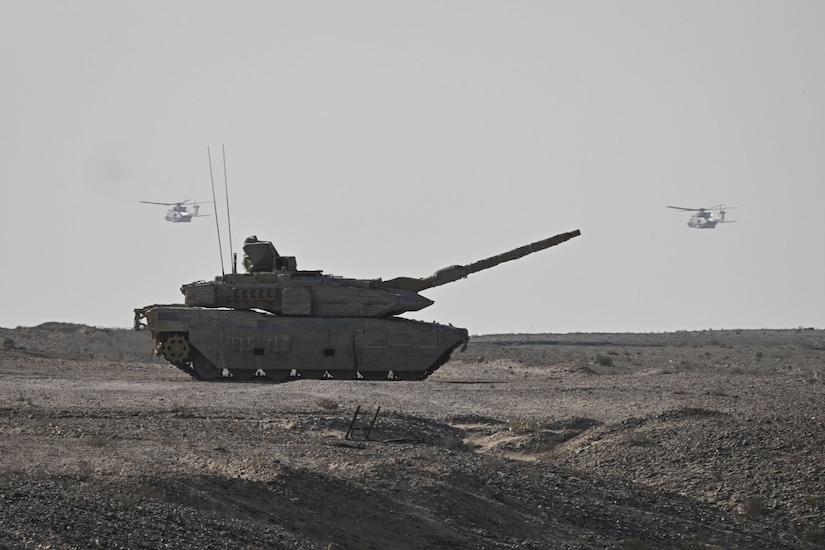
A large military tank points its cannon in the air while sitting in the desert. Two military helicopters are flying in the background.
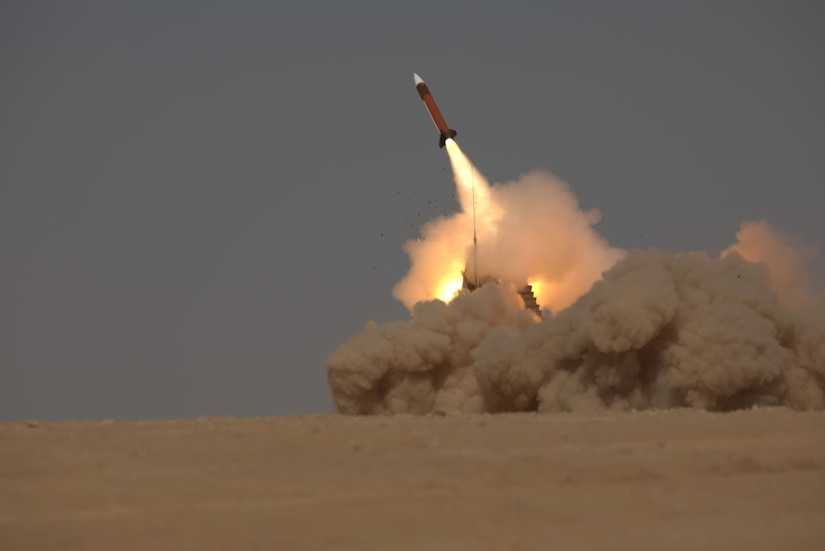
A rocket takes off from a stand with flames shooting out the back and a cloud of dust coming off the ground.
"This is a significant step forward in strengthening regional defense cooperation," said Navy Adm. Brad Cooper, Centcom commander. "This cell will improve how regional forces coordinate and share air and missile defense responsibilities across the Middle East." 

U.S. Air Force Central service members will work alongside regional counterparts at the operations cell in planning multinational exercises, conducting drills and responding to contingencies. The cell will also be responsible for sharing information and threat warnings.

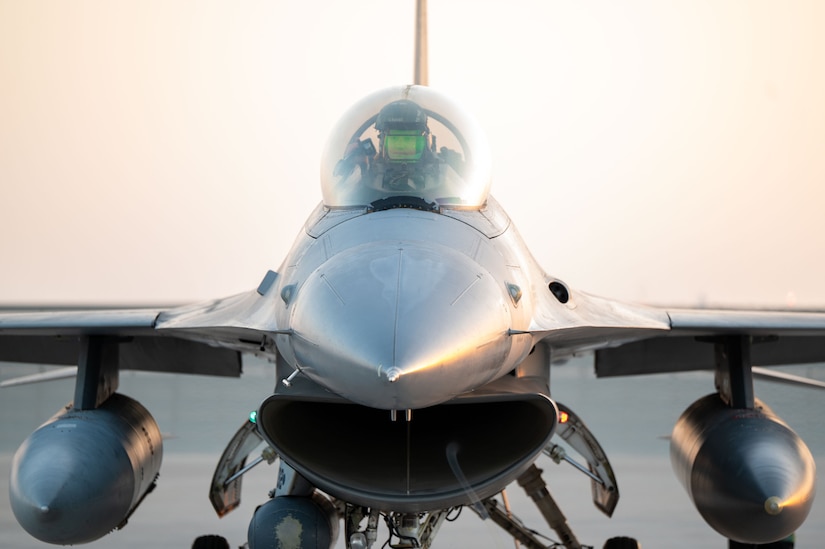
A close-up view of a service member in a flight suit and helmet sitting in the cockpit of a military fighter jet on a tarmac.
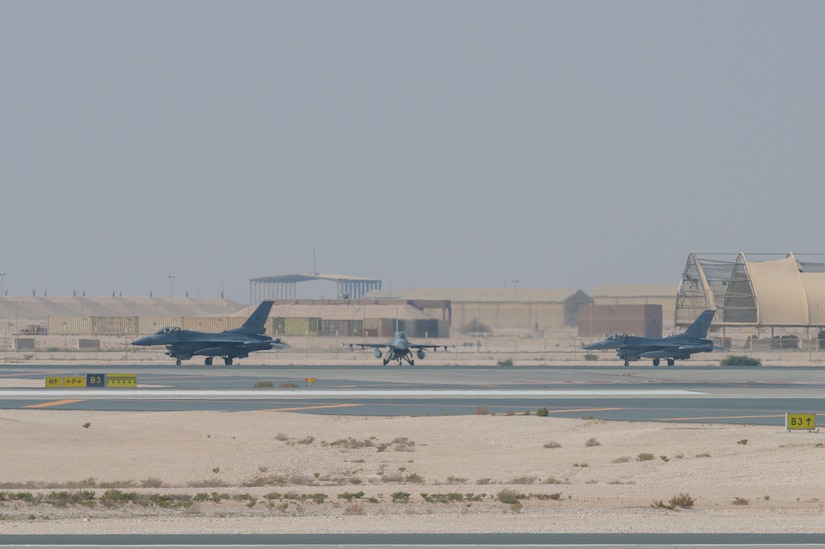
Three military fighter jets taxi on a tarmac in the desert. There are aircraft facilities and shipping containers in the background.
"The [cell] creates a consistent venue to share expertise and collectively create new solutions together with our regional partners," said Air Force Lt. Gen Derek France, U.S. Air Force Central commander. "This strengthens our integrated air and missile defense throughout the region." 

The formation of the cell follows the opening of two bilateral combined command posts last year for air and missile defense. The new facilities, opened by U.S Army Central in partnership with Qatar and Bahrain, will serve as hubs for integrated air defense planning, coordination and operations.