Showing posts with label F-35 Lightning. Show all posts

Thursday, September 24, 2026

Last Warthog Clears Nellis Air Force Base Runway

A man signals with his hand as he sits in the cockpit of an aircraft wearing a flight suit and helmet with face mask.

The last A-10 Thunderbolt II aircraft assigned to Nellis Air Force Base, Nevada, made its final departure yesterday. 

Nearly 70 airmen assigned to Nellis Air Force Base lined up on the flight line to give the A-10, affectionately nicknamed the "Warthog," one final salute as it took off. 

Although the departure signifies the conclusion of nearly 50 years of elite tactical training, operational testing and maintenance sustainability at the installation, the A-10's impact will not soon be forgotten. 

The first attack jet arrived at the base in 1977. Over the past five decades, the installation served as the primary proving ground for the Warthog's tactical employment. Nellis-based units refined the aircraft's software, avionics and precision weapons, while the U.S. Air Force Weapons School's 66th Weapons Squadron trained more than 300 A-10 weapons officers across 100 classes. 

"We are maintaining the culture of the A-10 by involving as many other fighter communities involved in the close air support mission," said Air Force Lt. Col. Ridge Flick, 66th Weapons Squadron commander. "We are also training F-15 Eagle, F-35 Lightning II and F-16 Fighting Falcon pilots to take on some roles we have had in combat search and rescue." 

As the aircraft departs, Flick emphasized that the squadron's mission to forge elite tactical leaders remains unchanged. The unit will continue training the next generation of ground-based specialists, including combat rescue officers, pararescue, special tactics officers and combat controllers. 

A fighter jet takes off from a desert environment.
People standing in a straight line on a tarmac salute as a fighter jet departs.
As the Air Force retires the A-10 fleet, the military's close air support capability is not declining. Instead, foundational tactical expertise, operational roles and personnel are transitioning to multirole and advanced fighter platforms across the service. 

Airmen assigned to the 757th Aircraft Maintenance Squadron's Thunder Aircraft Maintenance Unit are being reassigned to other squadrons and airframes, such as the F-35 and the F-16. The discipline that A-10 maintainers developed over 50 years of managing airframe fatigue, wing replacements and depot-level overhauls is being integrated into those newer flight line programs. 

At the same time, fifth-generation platforms like the F-35 are absorbing new close air support and combat search-and-rescue command roles into their operational profiles. The platform combines stealth features, advanced sensor suites and secure data-sharing networks to conduct precision ground-support missions in contested environments. For maintainers making the shift, the transition carries both operational and personal significance. 

"Working on the A-10 is meaningful to me because that is something that I share with my grandfather," said Air Force Staff Sgt. Eva Kehn, a weapons load crew chief assigned to the 757th Aircraft Maintenance Squadron. "I'm very excited to have that new chapter and bond over that again with my grandfather." 

With her reassignment to an F-35 unit at Nellis, that unique family connection will continue. Her grandfather now serves as a civilian F-35 instructor, meaning their shared professional bond will transition to a new airframe. 

"It's a bittersweet moment," said Air Force Master Sgt. Aaron Edmonds, an aircraft section chief assigned to the 757th Aircraft Maintenance Squadron. "I enjoyed my time with the A-10, but I'm excited because this departure marks the closing of one chapter and the start of another."

Thursday, July 30, 2026

U.S., U.K. Air Forces Conduct Fighter Weapons Certification During Exercise Combat Archer

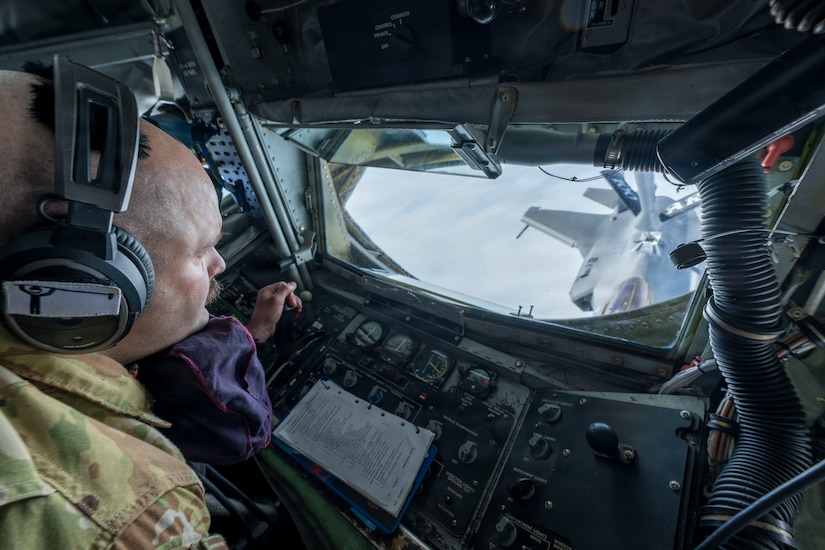
A man wearing a camouflage military uniform and headphones sits in the cockpit of a tanker aircraft.
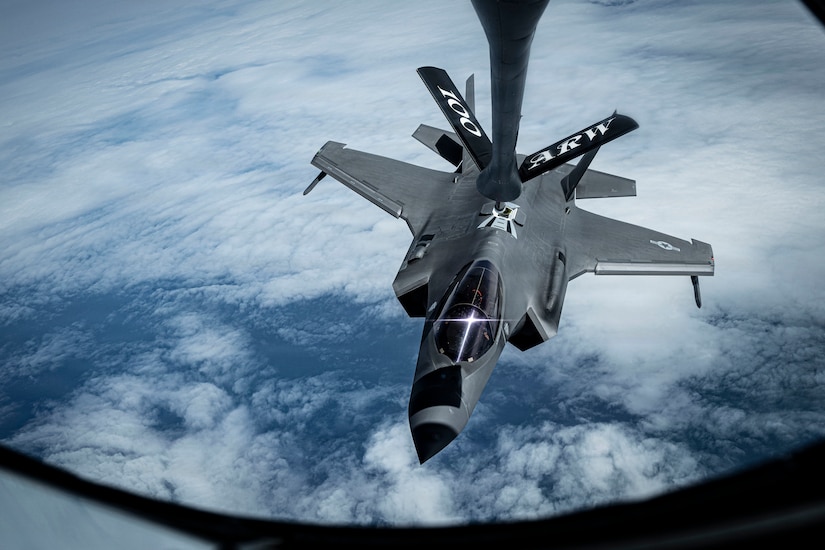
A fighter jet is connected to the boom of a tanker aircraft while refueling in flight.
After two weeks of high-end, tactical air and missile training, Exercise Combat Archer U.K. 26 concluded July 24, with the combat certification of the U.S. Air Force's 492nd and 493rd Fighter Squadrons stationed at Royal Air Force Lakenheath, England.

Led by U.S. Air Forces in Europe and Air Forces Africa, alongside Royal Air Force F-35B Lightning fighter jets, the exercise paired an evaluation unit with active U.S. fighter squadrons to certify pilots and ground crews for combat operations.

The squadrons were supported by the 351st Aerial Refueling Squadron from Royal Air Force Mildenhall, England, and the 83rd Fighter Weapons Squadron from Tyndall Air Force Base, Florida, which conducted the evaluation.

Exercise Combat Archer U.K. focused on air-to-air, weapons system evaluation training scenarios, ensuring high-end combat readiness for global operations. 

In accordance with chief of staff of the Air Force directives, operational units are required to certify in all aspects of air-to-air weapons system employment before executing real-world taskings. Exercises like Combat Archer further confirm Air Force units are postured and ready as a credible force to assure, deter and defend in an increasingly complex security environment.

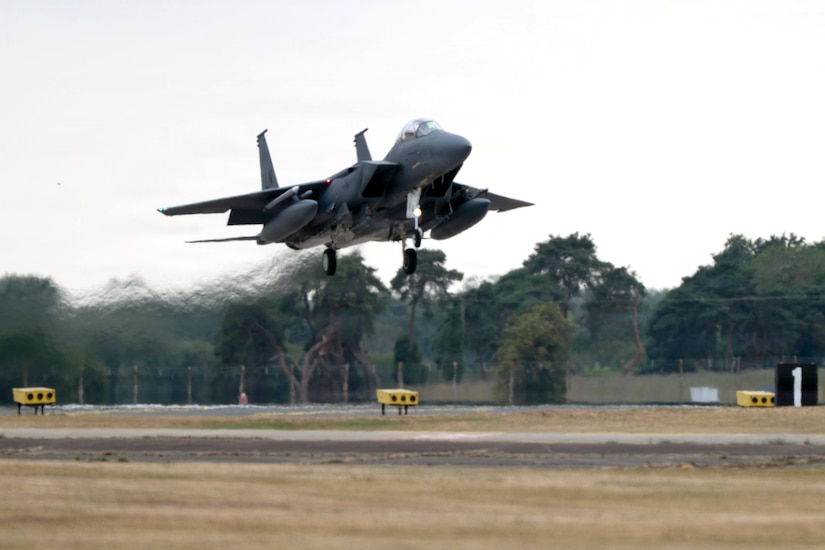
A fighter jet lands on an airstrip; there is a tree line in the background.

"Across the command we know we have pockets of lessons learned and exercising them together in a challenging environment, before the time of need, gives us a strategic advantage," said Air Force Lt. Gen. Jason Hinds, U.S. Air Forces in Europe and Air Forces Africa commander. "Exercises like Combat Archer U.K. 26 ensure tactical proficiency, readiness of our maintainers and operators and confidence in the weapon system."

During the exercise, ground crews and pilots gained valuable experience employing air-to-air missiles and aerial gun weapons. While maintenance personnel focused on building, loading and arming munitions onto aircraft, aircrew ground training focused on determining appropriate payloads for their assigned realistic combat scenarios. All training culminated in live fires where pilots executed weapons employment on airborne targets.

"It's a chance, in a controlled environment, for pilots to actually experience what live weapons employment looks like," said Air Force Capt. Thomas Holmes, 48th Fighter Wing project officer and 493rd Fighter Squadron pilot. "Exercises like Combat Archer U.K. really hone those air-to-air skills. There is no substitute for that kind of training."

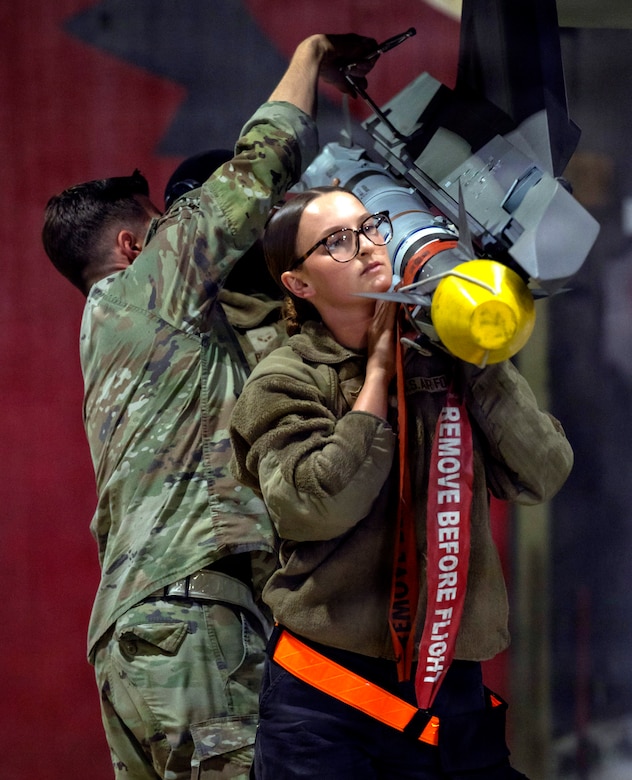
A woman wearing a military camouflage uniform lifts a missile on her shoulder as two men wearing similar attire connect it to a fighter jet.

The Royal Air Force F-35 fighter jets executed critical beyond-visual-range weapons scenarios, directly synchronizing allied tactics, techniques and procedures to forge deeper trust and operational confidence.

Specialized certification training like this ensures forces are ready, lethal and postured to safeguard against any threat to U.S. interests in Europe and around the globe. The exercise provided crucial data to system engineers, enabling them to improve aircraft and munition guidance systems for the Air Force.

The 83rd Fighter Weapons Squadron evaluated both the ground and air components of weapons employment while simultaneously using traceable air-to-air missiles, enabling for detailed real-time telemetry data analysis. The integration of U.S. 4th- and 5th-generation fighter jets alongside Royal Air Force aircraft allowed forces to test their ability to provide and sustain combat operations in a realistic training environment alongside allies and partners.