Showing posts with label northern command. Show all posts

Thursday, August 06, 2026

Northcom Prepares Deployment to Support Wildfire Suppression

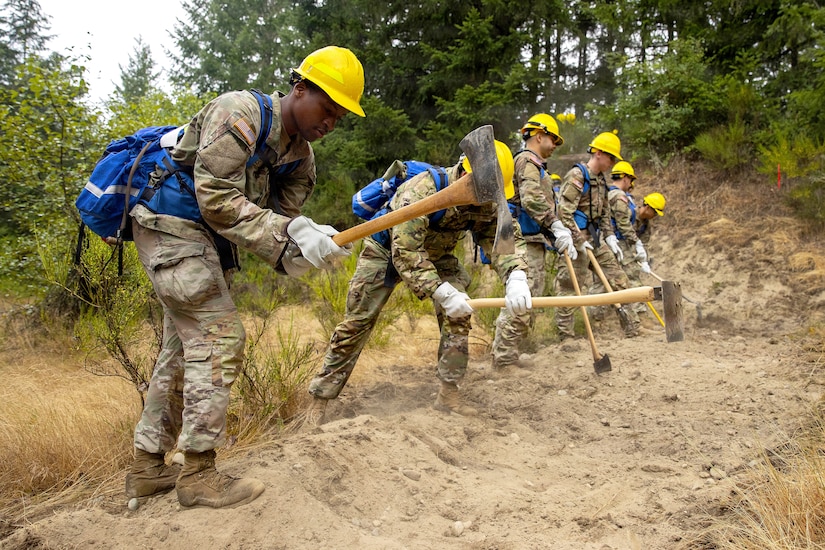
Six people in camouflage military uniforms and hard hats use tools to dig a clearing in the ground.

At the request of the National Interagency Fire Center, U.S. Northern Command is preparing to deploy approximately 200 soldiers to support a wildland fire ground response operation in the Pacific Northwest.

U.S. Army Western Hemisphere Command, Northcom's joint force land component, will oversee the military ground operation in support of federal and state efforts.

The 1st Battalion, 23rd Infantry Regiment, based at Joint Base Lewis-McChord, Washington, has been notified of the upcoming mission. The soldiers, who completed initial wildland firefighter training with the U.S. Forest Service in July, will undergo additional specialized training at JBLM prior to deploying.

"Our soldiers are well-trained and ready to respond quickly and effectively to assist in protecting people, property and public lands," said Army Brig. Gen. Jerry E. Baird Jr., U.S. Army Western Hemisphere Command deputy commanding general. "This mission underscores our unwavering dedication to the defense support of civil authorities mission."

The additional training will be conducted by a highly experienced cadre and will cover firefighter safety, fire suppression methods and the proper use of personal protective equipment. Once fully prepared and deployed, the soldiers will serve as hand crews, constructing fire lines and conducting line-holding actions under the direct guidance of experienced civilian wildland fire crew bosses.

The War Department has been a key wildland firefighting partner for decades, providing unique capabilities and resources to the national response effort.

Friday, July 06, 2012

DOD C-130 Crews Continue Western Wildfire Fight


From a U.S. Northern Command News Release

WASHINGTON, July 6, 2012 – In 140 airdrop missions since they were called into action to battle fires in the Rocky Mountain region and other western locales, Defense Department C-130s equipped with the U.S. Forest Service’s Modular Airborne Fire Fighting System have discharged more than 332,400 gallons of retardant as of early today, U.S. Northern Command officials reported.

Six Department of Defense C-130 aircraft under the command and control of U.S. Northern Command now are assisting in the firefighting effort at the request of the National Interagency Fire Center in Boise, Idaho, officials said.

C-130 efforts yesterday centered on the Squirrel Creek Fire, located about three miles west of Woods Landing, Wyo., officials said, discharging about 8,500 gallons of retardant.

Thursday, July 05, 2012

Military C-130 Crews Continue Firefighting Efforts


Compiled from U.S. Northern Command News Releases

WASHINGTON, July 5, 2012 – In 123 airdrop missions since they were called into action to battle fires in the Rocky Mountain region and other western locales, Defense Department C-130s equipped with the U.S. Forest Service’s Modular Airborne Fire Fighting System had discharged more than 320,000 gallons of retardant as of early today, U.S. Northern Command officials reported.

The aircraft are under Northcom’s command and control and are participating in the firefighting effort at the request of the National Interagency Fire Center in Boise, Idaho.

C-130 efforts yesterday centered on the Squirrel Creek Fire, three miles west of Woods Landing, Wyo., officials said, discharging about 50,600 gallons of retardant during 18 missions flown in a 15-hour span.

On July 3, crews flew 16 airdrop missions over 22 hours, discharging about 41,250 gallons of retardant.

Monday, July 02, 2012

Firefighting C-130s Placed on Operational Hold After Crash


Compiled from U.S. Northern Command and 153rd Air Expeditionary Group News Releases

PETERSON AIR FORCE BASE, Colo., July 2, 2012 – In what officials describe as “a prudent measure,” all military C-130 aircraft equipped with the Modular Airborne Fire Fighting System have been placed on operational hold after one of the aircraft crashed yesterday.

A MAFFS-equipped C-130 from the North Carolina Air National Guard’s 145th Airlift Wing crashed while battling a fire in southwestern South Dakota at about 6:30 p.m. Mountain time yesterday, officials said.

“There were casualties, and our thoughts and prayers go out to those who were injured and those who lost their lives,” U.S. Northern Command officials said in a written statement today. “The family members of these airmen are especially on our minds. We will provide further details on the status of the casualties soon.”

The cause of the crash has not been determined, and the incident is under investigation, officials said. At the time of the crash, the crew was fighting the White Draw Fire near Edgemont, S.D.

Yesterday’s crash was the first in the 40-year history of the MAFFS program, a joint Defense Department and U.S. Forest Service program that provides additional aerial firefighting resources when commercial and private air tankers are no longer able to meet the Forest Service’s needs. MAFFS is a self-contained aerial firefighting system owned by the Forest Service that can discharge 3,000 gallons of water or fire retardant in less than five seconds, covering an area a quarter of a mile long by 100 feet wide.

The MAFFS-equipped fleet is spending today getting the crews together to “reflect, reset and review,” said Air Force Col. Jerry Champlin, 153rd Air Expeditionary Group commander. "We all need to make sure our crews and planes will be ready to re-engage in the mission safely."

U.S. Forest Service Chief Tom Tidwell said the agency is deeply saddened by this tragic incident. "The agency fully supports the decision by the military to stand down its MAFFS operation to address the needs of personnel and families and ensure the safety of the mission when it resumes,” he said. “The agency will continue to allocate available firefighting assets according to the prioritization of incidents."

It is not known when the MAFFS aircraft will resume operations, officials said.

More Aircraft Arrive to Combat Western Wildfires


American Forces Press Service

WASHINGTON – Eight Department of Defense C-130 aircraft equipped with U.S. Forest Service Modular Airborne Fire Fighting Systems now are assisting in multi-agency efforts to control wildfires in Colorado and other western states, according to a U.S. Northern Command news release update issued today.

Four of these MAFFS-equipped aircraft arrived yesterday at Peterson Air Force Base, Colo., joining four other aircraft there that have been flying wildfire suppression missions in the Rocky Mountain region, the Northcom release said.

The National Interagency Fire Center based in Boise, Idaho, requested the aircraft support from the Defense Department, according to the release.

The eight aircraft are under Northcom command and control and all, at present, are being based at Peterson, which is in Colorado Springs, according to the release.

Northcom, based at Peterson, partners with other agencies to conduct homeland defense, civil support and security cooperation to defend and secure the United States and its interests.

Military units now supporting C-130 aircraft wildfire suppression missions flown from Peterson are: the Air Force Reserve’s 302nd Airlift Wing, based at Peterson; the Wyoming Air National Guard’s 153rd Airlift Wing, from Cheyenne; the North Carolina Air National Guard’s 145th Airlift Wing, from Charlotte; and the California Air National Guard’s 146th Airlift Wing, from Channel Islands.

As of early today, DOD aircraft have conducted 73 air drops and discharged more than 190,000 gallons of flame retardant during wildfire suppression missions in Colorado, Wyoming, Montana, and South Dakota, the Northcom release said.

Obama: Employ All Resources to Fight Colorado Wildfires


American Forces Press Service

WASHINGTON – As President Barack Obama thanked firefighters and volunteers, and met with impacted families in wildfire-devastated areas in and around Colorado Springs, Colo., yesterday, he also vowed to marshal all federal resources -- including military -- to combat the fires.

“We're going to continue to make sure that the Federal Emergency Management Agency, the Forest Service, our military and National Guard and all the resources that we have available at the federal level are brought to bear in fighting this fire,” Obama said today in his weekly video address to the nation. He recorded this week’s address during his Colorado visit.

The federal government has marshaled thousands of firefighters, hundreds of fire engines, and more than 100 aircraft, including 19 air tankers, to support firefighting efforts in a number of Western states including Colorado, White House officials noted.

Meanwhile, four Department of Defense C-130 aircraft equipped with U.S. Forest Service Modular Airborne Fire Fighting Systems and under the command and control of U.S. Northern Command are assisting in the efforts to control fires in the Rocky Mountain region at the request of the National Interagency Fire Center in Boise, Idaho, according to a Northcom news release issued today.

Northcom, based at Peterson Air Force Base, Colo., partners with other agencies to conduct homeland defense, civil support and security cooperation to defend and secure the United States and its interests.

Four additional MAFFS-equipped aircraft will be arriving later today to assist with firefighting efforts within the Rocky Mountain region, the Northcom release said.

As of early today, DOD aircraft have flown the following wildfire fighting missions in Colorado:

-- Waldo Canyon Fire, near Colorado Springs, : Fifty air drops, employing approximately 133,500 gallons of flame retardant;

-- Flagstaff Fire, near Boulder, : Five air drops, employing about 13,200 gallons of flame retardant; and

-- Arapahoe National Forest Fire, : Six air drops, employing approximately 13,250 gallons of flame retardant.

Military units that conducted those missions are the 302nd Airlift Wing, Air Force Reserve, Peterson Air Force Base, Colo., and the Wyoming Air National Guard’s 153rd Airlift Wing based in Cheyenne. Both units are currently flying missions out of Peterson Air Force Base, Colo.

The California Air National Guard’s 146th Airlift Wing, from Channel Islands, and the North Carolina Air National Guard’s 145th Airlift Wing, from Charlotte, will soon join the 153rd and the 302nd, military officials said.

This is the first time since 2008 that all eight military aircraft have been activated at one time, said Air Force Col. Jerry Champlin, 153rd Air Expeditionary Group commander. In that year, the aircraft were stationed at McClellan Airpark in Sacramento, Calif., to fight fires in that state.

Champlin, a member of the Wyoming Air National Guard, has tactical control over the MAFFS aircraft.

Although all eight C-130s will operate from Peterson Air Force Base for now, where they will drop fire retardant depends on the daily situation in the region, officials said. The Forest Service also may choose to base one or more aircraft in other operating areas.