Showing posts with label force protection. Show all posts

Saturday, October 17, 2026

Army Task Force Partners With Acquisition Directorate to Accelerate Counter-Drone Tech in Africa

U.S. Army Southern European Task Force, Africa announced a partnership with the Army's Global Tactical Edge Acquisition Directorate to test emerging drone systems in Africa and deliver them to soldiers within 180 days. 

The command's first accelerated capability event is scheduled for spring 2027 in Tan-Tan, Morocco. It will focus on counter-unmanned aircraft systems and force protection, targeting capability gaps in protecting early-entry command posts and operating locations against small UAS. 

An unmanned aerial system flies in the air on a cloudy day.

Africa offers an open spectrum, uncongested airspace and diverse terrain that training ranges in the United States and Europe cannot easily match. These conditions allow soldiers to validate solutions in theater and scale them across the service. 

Operating under the Army Pathway for Innovation and Technology Office, the acquisition directorate embeds personnel within Army service component commands. These teams translate urgent commander priorities into executable requirements, giving field commanders access to acquisition authorities at the tactical edge. The teams already operate within U.S. Army Europe and Africa, U.S. Army Pacific and U.S. Army Central. 

Army Col. Christopher Hill, director of the Global Tactical Edge Acquisition Directorate, described the organization as the Army's answer for putting innovative solutions in the hands of the warfighter.

"[Army service component commands have] always had priorities, they've always had capability gaps, but the two things they've never had is acquisition authority and research, development, test and evaluation dollars," he said. 

Because the directorate maintains visibility across multiple commands, Hill said its personnel can align modernization efforts, maximize funding and transition proven theater solutions Army wide. 

The unit assigned a team to U.S. Army Southern European Task Force, Africa this summer to link immediate operational needs with rapid acquisition resources. Together, the commands will use the accelerated capability event framework as a fast-track pathway to identify, evaluate and deliver field-ready technology. 

Through a three-phase model, submission and preparation, soldier-led demonstrations and follow-on operational evaluation, capability events deliver rapid solutions within an accelerated acquisition timeline.

Friday, September 04, 2026

Exercise Urgent Response Tests Marine Corps Installation Partnerships

Simulated gunfire interrupted the workday inside an occupied office building yesterday as service members, civilian employees and contractors at Marine Corps Support Facility Blount Island, Florida, faced a split-second decision: run, hide or fight.

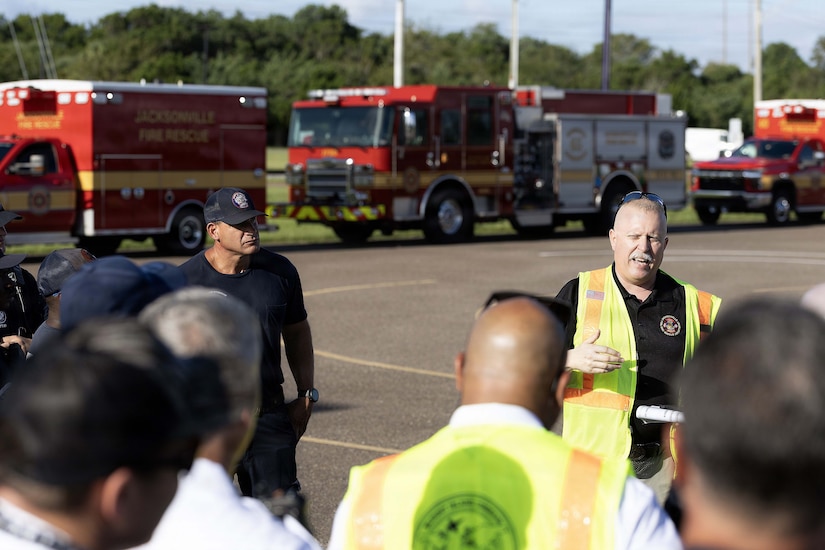
A man in business casual attire and a reflective vest talks to a dozen people in similar attire standing in a parking lot outside; there are three emergency vehicles parked in the background.

The attack was part of Exercise Urgent Response, a four-hour, full-scale force protection exercise that brought the Marine Corps facility together with Jacksonville fire and law enforcement agencies, state emergency managers and federal investigators. 
 
Participants tested how they share information, treat simulated mass casualties, respond to explosive hazards and preserve the military installation's mission during a complex emergency. 
 
The facility provides infrastructure, maritime access and workforce support for Blount Island Command. The tenant command, under Marine Corps Logistics Command, generates and distributes ready-for-issue equipment and supplies across the global positioning network. 
 
A high-decibel blast simulated gunfire as exercise role players portraying active assailants moved through stairwells, hallways, offices and cubicles.

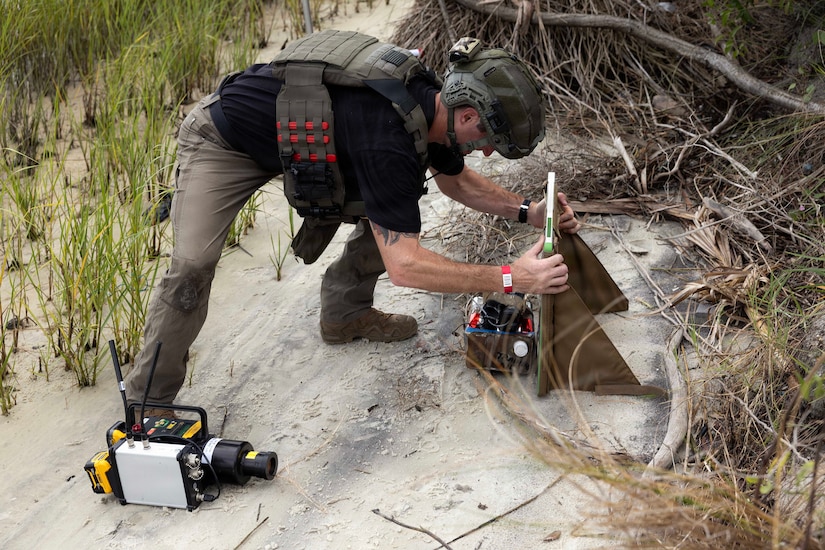
A man in emergency response gear puts an X-ray machine next to a simulated explosive sitting in the sand.

As occupants evacuated, sheltered in place or prepared to defend themselves, Marine Corps police department officers coordinated their response with the Jacksonville Sheriff's Office. The scenario tested individual preparedness, requiring those inside to recognize the threat, identify primary and alternate exits, report concerning activity and respond appropriately when law enforcement entered the building. 
 
Jacksonville Fire and Rescue Department crews entered once law enforcement secured access, triaging and treating simulated casualties before transport. 
 
"It was a lot of great communication on all sides," said Jacksonville Fire and Rescue Department Capt. Shawn Hall. "By the time we arrived, the Marine Corps police department was already in place, already taking lifesaving steps and giving trauma care, so we could get in with medical treatment and transport." 
 
The exercise also reinforced the Marine Corps' 2026 National Preparedness Month theme, "Prepare Today. Protect Tomorrow." The annual September observance encourages individuals and communities to plan ahead and strengthen their readiness for emergencies. 
 
The scenario later expanded to include a simulated explosive threat near the shoreline. The Jacksonville Sheriff's Office hazardous devices unit assessed and rendered the device safe.

Inside the installation's emergency operations center, participants tracked the evolving scenario, shared information and maintained a common operating picture for decision-makers and responders. Florida Division of Emergency Management representatives supported state-level situational awareness and resource coordination from the center. 
 
Naval Criminal Investigative Service personnel supported intelligence sharing and exercise control. 
 
Together, participants tested incident command, interoperable communications, threat and triage information sharing, resource coordination and emergency medical response while maintaining connectivity with the emergency operations center as multiple situations unfolded. 
 
The exercise expanded on a January operational planning effort that brought the installation, Blount Island Command and local, state and federal partners together to examine how they would protect the Marine Corps facility and sustain operations during a complex incident. 
 
"The exercise successfully validated installation defense plans, mutual aid agreements and real-world interoperability with local, state and federal partners," said Marine Corps Lt. Col. Beau Pillot, Blount Island Command operations director. "Exercise Urgent Response bridged the gap between deliberate planning and real-world execution." 
 
Evaluators from participating organizations observed performance against established objectives throughout the exercise. Their findings will inform a formal review and help refine response plans and future training events.