Showing posts with label Pacific region. Show all posts

Wednesday, October 14, 2026

Lightning Academy Bolsters Army Fast Rope Training

A person in a camouflage military uniform slides down a rope hanging from a hovering military helicopter; three other people in similar attire are operating the aircraft.

Air sweeps across the Schofield Barracks training area in Hawaii from a UH-60 Black Hawk helicopter hovering in place, from which Army Capt. Liam Davenport leverages the past three days of progressive training, sending soldiers down two fast ropes to the ground during the culminating event of the Fast Rope Insertion/Extraction System Master Course.

The course, conducted Oct. 5-7, supports the 25th Infantry Division's dedicated effort to increase the number of qualified system masters throughout the formation. Expanding their expertise provides units with personnel capable of safely controlling fast-rope operations, giving commanders another option to rapidly insert and maneuver soldiers and equipment across restrictive terrain in the Pacific region.

Dense jungles, water obstacles and limited helicopter landing zones can restrict how forces move.

"In the Pacific, getting to the objective can be as challenging as the mission itself," said Army Staff Sgt. Eljay Basug, a course senior instructor assigned to Lightning Academy, 25th Infantry Division.

The fast-rope system provides an alternative when those conditions prevent an aircraft from landing, allowing units to rapidly insert personnel closer to an objective and lower equipment into otherwise difficult-to-access areas.

The three-day course develops that expertise through progressive instruction. Students begin with classroom training covering their duties and responsibilities, operational procedures, equipment and knots before conducting introductory descents from a low platform. 

The course advances to a 40-foot tower, conducting day and night training iterations, mass exits and descents with equipment before transitioning to live aircraft operations. The progression allows students to build confidence and demonstrate the fundamentals at increasing heights before applying them from an aircraft.

"With [fast rope insertion/extraction], it allows units to bypass those obstacles and insert closer to the objective," Basug said. "It gives unit commanders a greater reach, greater flexibility [and] greater speed to accomplish the mission."

Expanding that capability requires more than increasing the number of soldiers who can descend a fast rope. While a basic roper has the individual skills to descend, a master provides the expertise needed to enable the operation. These masters inspect personnel and equipment, enforce safety standards and control the insertion.

Davenport, the air assault, rappel master and fast rope insertion/extraction system officer in charge assigned to Lightning Academy, 25th Infantry Division, said those responsibilities distinguish a master from a basic roper.

"The FRIES master is the one in the aircraft," he said. "He's on the comms with the pilot in command and the crew chiefs, verifying that they're over the target grid, verifying the calls [and] making sure that the ropers are good to go."

Unlike rappelling, which is taught during air assault training, fast ropers are not physically attached to the rope during their descent. Once on the ground, they can quickly clear the insertion point and transition to their follow-on mission.

A person in a camouflage military uniform slides down a rope hanging from a hovering military helicopter.

"With fast roping specifically, it's getting in and out of objectives," Davenport said. "Whether that be a target building, open field, or even a ship."

Bolstering qualified FRIES masters across the division aims to push that expertise closer to the formations that may need it. Davenport said a future goal is for organizations throughout the 25th Infantry Division to have qualified masters capable of supporting fast rope training within their own formations.

Developing that expertise at the unit level increases the division's capacity to maintain and employ the capability beyond the schoolhouse, giving commanders additional options for moving forces based on the mission and terrain.

For the 25th Infantry Division, increasing the number of masters builds the personnel and expertise required to employ fast-rope operations across the formation. Distributing that expertise gives commanders greater flexibility to maneuver soldiers and equipment, overcome restrictive terrain and reach objectives throughout the Pacific.

Friday, September 26, 2025

Maritime Medical Response: 129th Rescue Wing Stabilizes Mariner 700 Nautical Miles Offshore

Sept. 25, 2025 | By Air Force Master Sgt. Joseph Prouse, 129th Rescue Wing

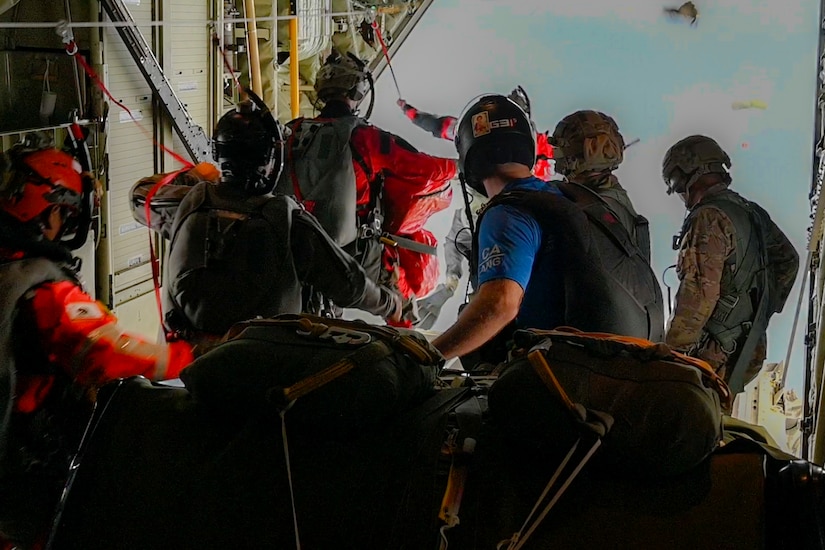
A Guardian Angel pararescue team assigned to the 129th Rescue Wing, California Air National Guard, stabilized a Filipino mariner aboard the Panamanian-flagged cargo ship Grand Vega after reports of stroke-like symptoms during a two-day search and rescue operation approximately 700 nautical miles off the California coast. 

Four people stand at the door of an open aircraft and prepare to jump.

U.S. Coast Guard District 11 relayed the alert in coordination with the Air Force Rescue Coordination Center. The Grand Vega was crewed primarily by Filipino mariners. 

The wing launched an HC-130J Combat King II on Sept. 18, carrying five Guardian Angel team members — pararescuemen and a combat rescue officer — to plan for various sea state contingencies and ensure the team could access the ship upon arrival. Pre-mission planning emphasized multiple insertion options for varying sea states to ensure patient care would not be delayed by conditions. 

Four pararescuemen conducted a maritime parachute insertion with a boat package, accessed the vessel, and moved below deck to assess and stabilize the patient for transfer. A follow-on recovery package launched from Moffett Air National Guard Base the next morning. The package included one HH-60G Pave Hawk and one HH-60W Jolly Green II, while an additional HC-130J provided command-and-control and air-to-air refueling support. 

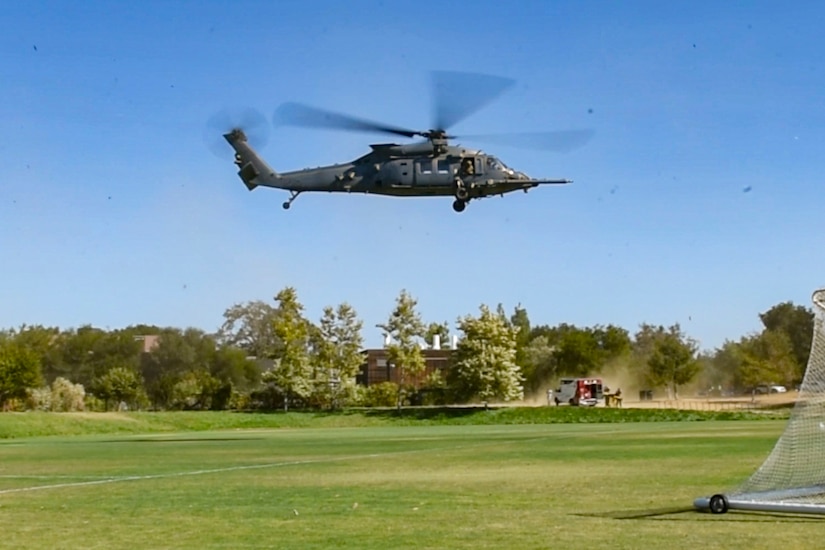
A helicopter hovers in a blue sky over a grassy field with trees in the background and a soccer goal in the foreground.

"This mission demonstrates disciplined planning, swift insertion and expert patient care at an extreme distance," said Air Force Maj. Coda Brown, 129th Operations Group. "Our Guardian Angel teams, rotary-wing crews and HC-130J aircrews integrate seamlessly with the U.S. Coast Guard to save lives when both minutes and miles matter."  

Brown noted that interagency cooperation is critical to maritime safety and security in the Pacific region. 

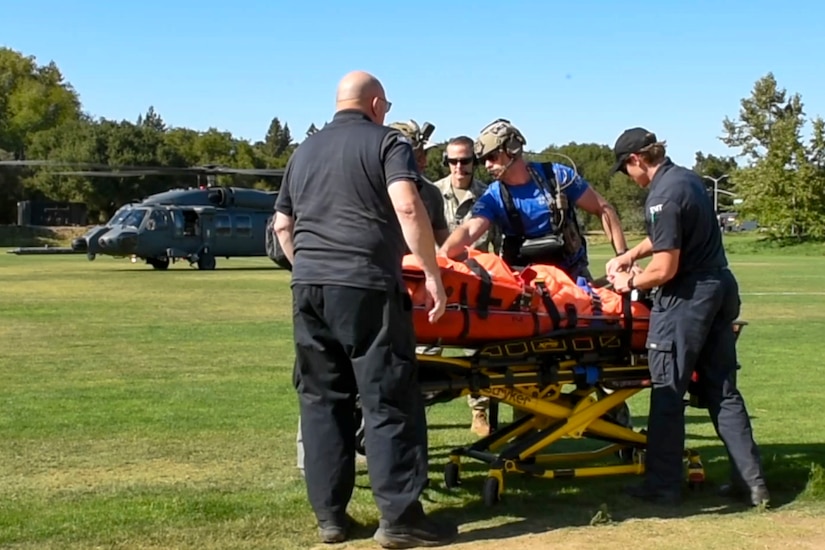
The patient was hoisted to a helicopter and transported to Stanford Hospital, where local paramedics were staged at the landing zone to complete the handoff for a higher level of care. Officials said the rapid transfer is expected to improve the patient's outcome. 

"I am incredibly grateful to be part of this mission, but most importantly, I am happy the patient received the care he needed, and all members returned home safely," said a pararescueman with the 131st Rescue Squadron. 

Unit officials said the operation is recorded as the wing's first life saved with the HH-60W and possibly the final life saved with the HH-60G, marking a conversion milestone for the 129th Rescue Wing. Unit leaders said this achievement underscores the wing's ongoing commitment to modernizing its fleet and maintaining high operational readiness, adding that the response reinforces the 129th Rescue Wing's enduring ties with key partner nations and allies, including the Philippines, and demonstrates the unit's commitment to saving lives. The mission's strategic effects build Pacific proficiency and validate the wing's vital role in the region. 

Five people secure a person to a medical transport stretcher in a grassy field with a helicopter behind them.

Behind the scenes, maintainers, weather and intelligence professionals, aircrew flight equipment specialists, logistics personnel, communications experts, command post staff and medical specialists enabled the response. 

The 129th Rescue Wing provides worldwide combat search and rescue, as well as civil search and rescue capabilities. The wing operates HH-60G/HH-60W helicopters, HC-130J aircraft and Guardian Angel teams in support of joint and interagency partners, including the Coast Guard. 

The mission marks the wing's 1,169th life saved.