Showing posts with label 25th infantry division. Show all posts

Friday, February 06, 2026

Army Marksmanship Instructors Increase Lethality During M7 Training

Soldiers assigned to the 25th Infantry Division trained at the Schofield Barracks, Hawaii, in January on the Army's newest service rifle, the M7, with instructors from the U.S. Army Marksmanship Unit providing hands-on support focused on marksmanship fundamentals.
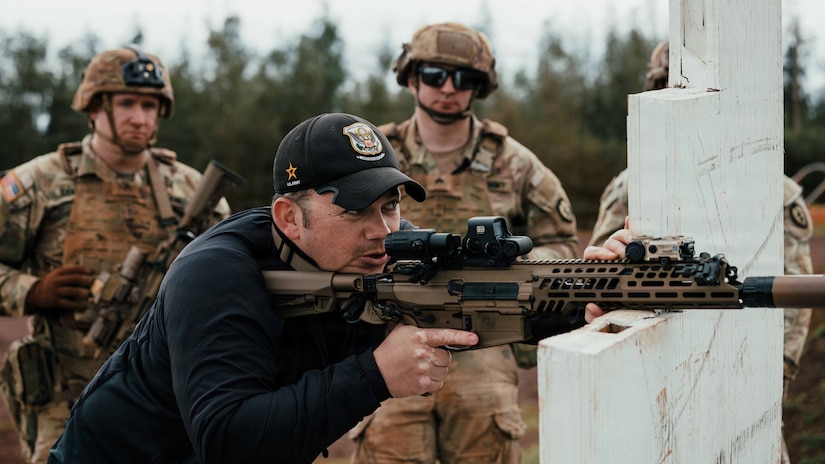
Three people in camouflage military uniforms and helmets stand and observe a man wearing casual attire and a baseball cap as he stands and aims a military rifle out of frame; the rifle is balanced on a white support structure, and trees are in the background.

The instructors worked alongside soldiers to reinforce proven shooting techniques that apply across weapon systems and assisted with ongoing M7 fielding efforts alongside program partners.

"We are working with instructors from [the program executive office] and [the U.S. Army Tank-automotive and Armaments Command] to assist in the net fielding efforts and provide marksmanship instruction and guidance to both the students and instructors as they field the next generation squad weapon," said Army Sgt. 1st Class Alexander Deal, team chief for the U.S. Army Marksmanship Unit Service Rifle Team, adding fundamentals remain critical when soldiers transition to a new platform.
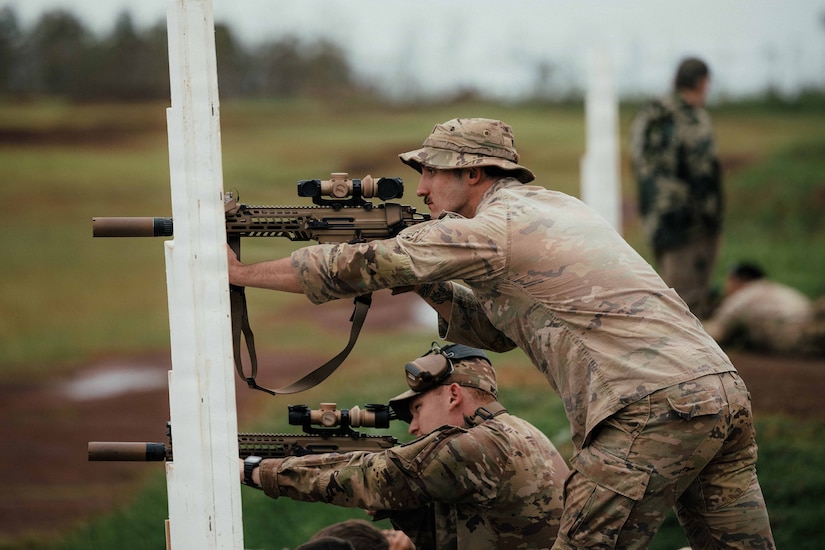
Two men in camouflage military uniforms, one standing and one kneeling in a grassy terrain, aim military rifles out of frame; the rifles are balanced on white support structures. Three other people in similar attire are doing the same in the background.

"It's hard to say what fundamentals matter the most. They're all equally important, but establishing a consistent and stable position, consistent head placement, proper sight alignment, and trigger control are going to make shooting a new weapon system a lot easier," Deal said.

According to Deal, competition-style training exposes shooters to stressful and unfamiliar scenarios that highlight their strengths and weaknesses.

"[It] can help soldiers' combat effectiveness by putting them into new scenarios they may not have been in before and putting them under the stress of time, speed or accuracy to assess their level of training and where there may be room for improvement," he said.

Deal emphasized that consistency must come before speed, especially for developing shooters.
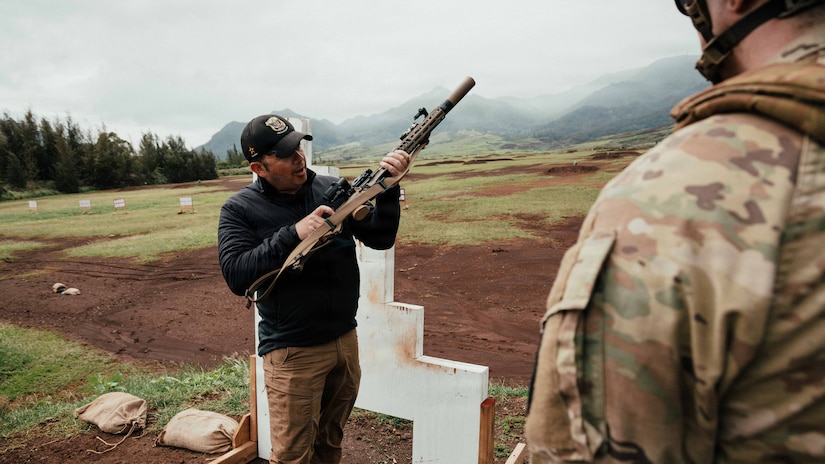
A man in casual attire and a baseball cap holds a military rifle outside in grassy terrain on a cloudy day with trees in the background, as a person in a camouflage military uniform stands partially out of frame and observes.

"It's hard to start fast and figure out what you're doing wrong versus slowing things down, assessing fundamentals and building up speed and distance [over time]," he said.

The training course is focused on noncommissioned officers returning to their units.

"The NCOs are getting familiarized with the weapon systems and optics so they can go back and train other NCOs, officers and their soldiers, and begin proper marksmanship training," Deal said, adding that the long-term goal is to sustain improvement across Army units.
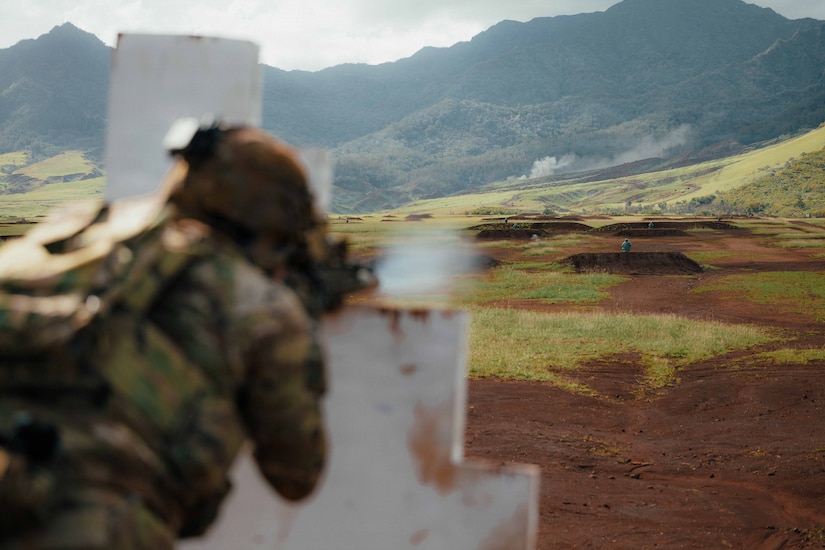
Two men in camouflage military uniforms, one standing and one kneeling in a grassy terrain, aim military rifles out of frame; the rifles are balanced on white support structures. Three other people in similar attire are doing the same in the background.

"They're going to transfer that knowledge to their soldiers and peers and hopefully make improvements to their marksmanship programs that carry over into better practices and increased lethality," he said.

Friday, July 10, 2015

1/40th CAV redeploys with fanfare

by Staff Sgt. William Banton
Joint Base Elmendorf-Richardson Public Affairs


7/10/2015 - JOINT BASE ELMENDORF-RICHARDSON, Alaska -- Approximately 350 Soldiers from the 4th Infantry Brigade Combat Team (Airborne), 25th Infantry Division were honored in a redeployment ceremony at Buckner Physical Fitness Center July 10, 2015.

Several hundred paratroopers assigned to the 1st Squadron (Airborne), 40th Cavalry Regiment, along with a small contingent of paratroopers assigned to the brigade's Headquarters and Headquarters Company, returned home from a 10-month rotation in support of peacekeeping operations in Kosovo.

"This team ensured a continuous safe and secure environment for the freedom of the people of Kosovo," said Maj. Gen. Bryan Owens, U.S. Army Alaska commanding general, at the redeployment ceremony. "These Arctic Warriors served daily alongside our North Atlantic Treaty Organization allies supporting nations including Hungary, Armenia, Germany, Poland and Turkey."

As part of the NATO-led Kosovo Force, Multinational Battle Group-East, the 1-40th CAV supported Kosovo police, alongside a multinational force which included Soldiers from Romania, Armenia, Moldova and Kazakhstan. This support included conducting steady-state operations involving more than 1,000 presence patrols, 180 unexploded ordnance disposals, 139 synchronized patrols and 18 reconnaissance operations.

"I think the behavior and the conduct of the Soldiers was extremely professional," said. Col. Clint Baker, MNBG-E commander. "We had a flawless record of mission success. All in all, I think the Soldiers did it as about as good as anyone could do it. I'm really proud of them."

Owens echoed the same sentiment in his remarks.

"They epitomize what the chief of staff of the Army refers to as globally deployed, regionally engaged forces," Owens said. "Today it is an absolute pleasure to welcome home this team and say job well done."

KFOR entered Kosovo in June 1999 in support of U.N. Security Council Resolution 1244, tasked with maintaining a safe and secure environment and freedom of movement for all Kosovo's citizens. At that time, the Balkans were in turmoil, facing the biggest military and humanitarian crisis since World War II.

A mounting conflict between the Serb-dominated military of the Federal Yugoslav Republic and the ethnic Albanian Kosovo Liberation Army demanding independence from Belgrade had claimed some 10,000 lives and sparked the exodus of almost 1 million Albanian refugees.

According to the U.S. Department of State, the U.S. forces played a key role in KFOR operations to end the war and established diplomatic relations with Kosovo, following its declaration of independence in 2008.

Additional reporting by Donna Miles, American Forces Press Service, and Army Sergeant Brian Ragin, 4-25 Public Affairs.

Thursday, March 29, 2012

Iraq, Afghanistan Vets Find Healing in Helping Wounded Warriors


By Donna Miles
American Forces Press Service

SNOWMASS VILLAGE, Colo., March 29, 2012 – Five years after suffering a traumatic brain injury in combat, Chris Carver is among a growing legion of veterans from operations in Iraq and Afghanistan who have discovered the healing power of helping other wounded warriors on their road to recovery.

Shortly after deploying to Iraq for the second time with the 25th Infantry Division, Carver’s patrol was hit by an improvised explosive device. He spent two months in a coma, and still experiences short-term memory loss that requires him to use a handheld electronic device to keep his daily schedule on track.

But Carver isn’t one to dwell on the negatives. “I’ve made a lot of progress,” he said. And he has found a new life’s calling in the process.

Carver called the adaptive sports he’s been introduced to through the Veterans Affairs Department one of the biggest factors in his recovery. “I’ve had all kinds of therapies,” he said. “But sports have been the most worthwhile. Activities give you something to look forward to and make you want to advance.”

Now medically retired, Carver has committed himself to helping other disabled veterans experience that same healing power. He’s studying at Eastern Washington University to become a social worker and dreams of helping veterans transition to civilian life and realize their potential.

In addition, he’s a team leader for Team River Runner, a national organization that introduces wounded veterans to adaptive kayaking.

As one of 400 participants this week here at the National Disabled Veterans Winter Sports Clinic, Carver said he’s already learned new techniques here that will make him a better instructor when he returns home to Spokane, Wash. “That’s one of my main focuses,” he said. “I want to be able to take something back to the community.”

Carver said he’s discovered through his work with wounded warriors and disabled veterans that “helping others is also about helping you.”

“Just knowing that you made a difference in someone else’s life is making a difference in yours,” he said.

Marine Corps Lance Cpl. Anthony Yanez is among the more recently wounded combat veterans who said he plans to take the lessons he’s learning about the healing benefits of recreational therapy to pass on to other veterans.

Yanez’s life changed forever on July 21, 2010, when an IED attack in Afghanistan’s Helmand province rendered him a quadriplegic. The blast occurred exactly two years after Yanez entered boot camp at Parris Island, S.C., and four months after he and his wife, Katreece, celebrated their son’s birth.

But at 22, now medically retired from the Marine Corps, he refuses to let his disability get him down, or keep him down. He’s making plans to attend college beginning this fall to study nutrition and fitness and has started taking part in various VA-sponsored sporting events for disabled veterans.

“It’s an adrenaline rush,” he said after skiing down Snowmass Mountain in an adaptive bucket ski and snowmobiling at the T Lazy 7 Ranch in nearby Aspen Highlands. “It motivates me and lets me keep on moving and doing.”

Yanez said he’s anxious to share his experiences with other disabled veterans after he returns home. “When I tell them what I’ve been able to see and experience, I can pass on to them: ‘Don’t just sit there. Get out and be as active as you can be.’”

Tuesday, November 08, 2011

Graffiti of War Exhibit Debuts Veterans Day

By Army Pvt. Andrew Slovensky
362nd Mobile Public Affairs Detachment

WASHINGTON, Nov. 8, 2011 – Overseas-deployed service members’ artwork will be highlighted during a national exhibition tour that kicks off on Veterans Day in Pottsville, Pa.

The “Graffiti of War” project represents an anthology of more than 400 pieces of art left by deployed service members in Iraq, Kuwait and Afghanistan. The collection includes images of graffiti murals painted on the tall concrete barriers at many operating bases in Iraq now being turned over to Iraqi security forces.

Deployed service members have often designed murals on walls around U.S. bases in Iraq. The paintings illustrated unit affiliations, military vehicles and equipment, mythological and historic figures, ranks, names, and anything else that flowed from the creative minds of the artists.

However, those murals are disappearing quickly, being covered over with fresh coats of white paint in preparation for the departure of U.S. troops.

“Painting over the murals is part of giving the installation back to Iraq,”said Army Sgt. Maj. Charles Rosado, 25th Infantry Division tactical command post noncommissioned officer-in-charge on Contingency Operation Base Adder.

But first, the Graffiti of War effort is working to document those murals and artistic efforts so they’re not lost in time.

“The project came to life as an idea within my platoon,” said Jaeson Parsons, an original collaborator and director of operations for Graffiti of War. Parsons, who deployed to Iraq as a combat medic in early 2006, said he and his fellow soldiers were discussing the graffiti they saw during a long mission in Al-Taqaddum Airbase, Iraq.

“Many of these murals are historical markers, a sort of ‘who's who’ of units and divisions that were deployed in this war,” he said.

Parsons made a return trip to Iraq this summer to document many of the murals and expressions.

By displaying them for the American public to see in the Graffiti of War traveling exhibit, he said he hopes to help them better understand the struggles and accomplishments of service members deployed to combat zones.

Parsons, who said he suffered his own battle with post-traumatic stress disorder, wants to raise awareness for PTSD and other “invisible wounds” that service members suffer in combat that are not always evident.

“These murals and artistic creations represent a glimpse of a moment in time when this unit was there, an unconventional record of the decade of war our nation and her warfighters struggled through,” Parsons said.

The Graffiti of War exhibit will debut Nov. 11 to 20 as part of Pottsville’s Block of Art event. Additional venues are being arranged, including a February showing at Wolf Gang Gallery in Montgomery, N.Y.

Sunday, April 11, 2010

Vietnam, No Regrets

On April 22, 2010, Conversations with American Heroes at the Watering Hole will feature with J. Richard Watkins, Vietnam Veteran and author of Vietnam, No Regrets.

Program Date: April 22, 2010
Program Time: 1700 hours Pacific
Topic: Vietnam, No Regrets
Listen Live:
http://www.blogtalkradio.com/lawenforcement/2010/04/23/vietnam-no-regrets

About the Guest
J. Richard Watkins, USA, was a member of the “1/27th Wolfhounds, 25th Infantry Division.” He was in Vietnam from “late 1969 through 1970.” J. Richard Watkins is the author of Vietnam No Regrets.

Kendra Carroll of Apex Reviews said of Vietnam No Regrets, “In the 30+ years since its conclusion, countless volumes have been crafted regarding the Vietnam War - not to mention movies, television specials, and documentaries. Most of the written and visual media have done a commendable job of exploring the logistical blunders and other revealing aspects of the war itself; however, very few of them have given Vietnam the same empathic human touch as "Saving Private Ryan" so famously did for World War II.

Throughout the pages of Vietnam No Regrets, author and Vietnam veteran J. Richard Watkins steps directly in the gap and fills that void in standout fashion. A heart-wrenching memoir recounted in an unfiltered, no-holds-barred manner, Vietnam No Regrets takes the reader straight into the heart of one of the most controversial extended episodes in our nation's history, painting the gruesome conflict in a graphic, vivid light - undeniably real and raw.”

About the Watering Hole
The Watering Hole is Police slang for a location cops go off-duty to blow off steam and talk about work and life. American Heroes Radio brings you to the watering hole, where it is Sometimes funny; sometimes serious; but, always interesting.

About the Host
Lieutenant Raymond E. Foster was a sworn member of the Los Angeles Police Department for 24 years. He retired in 2003 at the rank of Lieutenant. He holds a bachelor’s from the Union Institute and University in Criminal Justice Management and a Master’s Degree in Public Financial Management from California State University, Fullerton; and, has completed his doctoral course work. Raymond E. Foster has been a part-time lecturer at California State University, Fullerton and Fresno; and is currently a Criminal Justice Department chair, faculty advisor and lecturer with the Union Institute and University. He has experience teaching upper division courses in Law Enforcement, public policy, Public Safety Technology and leadership. Raymond is an experienced author who has published numerous articles in a wide range of venues including magazines such as Government Technology, Mobile Government, Airborne Law Enforcement Magazine, and Police One. He has appeared on the History Channel and radio programs in the United States and Europe as subject matter expert in technological applications in Law Enforcement.

Listen, call, join us at the Watering Hole:
http://www.blogtalkradio.com/lawenforcement/2010/04/23/vietnam-no-regrets

Archive Link:
http://www.americanheroesradio.com/vietnam_no_regrets.html

Program Contact Information
Lieutenant Raymond E. Foster, LAPD (ret.), MPA
editor@police-writers.com
909.599.7530